wayground logo

Free Printable Worksheets

Font size

S
M
L
XL
Worksheets

College Bio Final

Total questions: 114

Worksheet time: 2hrs 5mins

Name
Class
Date
1.
Which is the correct order?
a)
C,D, B, A, F, E
b)
D,A,F,C,E,B
c)
B,E,C,F,A,D
d)
C,B,D,A E,F
2.
The uncontrolled division of cells...
a)
meiosis
b)
cancer
c)
nondisjunction
d)
crossing over
3.
What phase of mitosis is pictured?
a)
Prophase
b)
metaphase
c)
anaphase
d)
telephase
4.
The chromosomes line up across the middle of the cell
a)
Anaphase
b)
Interphase
c)
Prophase
d)
Metaphase
5.
Which of the following is NOT an example of mitosis?
a)
Growth
b)
Repai of damaged cells
c)
Replacement of dead cells
d)
Reproducing
6.
How many daughter cells are produced in mitosis?
a)
4 new cells
b)
2 new cells
c)
One new cell
d)
none of these
7.
How many times does the cell divide in meiosis?
a)
twice (PMAT)
b)
none of these
c)
3 times
d)
once
8.
How many daughter cells are produced in meiosis?
a)
4 daughter cells
b)
none of these
c)
3
d)
1
9.
The cells produced via meiosis are called:
a)
gametes
b)
somatic cells
c)
body cells
d)
skin cells
10.
Which phase comes NEXT?
a)
prophase
b)
metaphase
c)
anaphase
d)
telophase
11.
the phase of mitosis in which the sister chromatids separate (pull apart) from each other
a)
prophase
b)
metaphase
c)
anaphase
d)
telophase
12.
The point on the chromosome where the two chromatids are held together is the
a)
centromere
b)
centriole
c)
chromosome
d)
chromatid
13.
The structure of coiled DNA and proteins that forms in the cells nucleus prior to mitosis is 
a)
centromere
b)
centriole
c)
chromosome
d)
chromatid
14.
The first stage of the cell cycle during which the cell matures and prepares to divide and copies its DNA; The stage the cell stays in the most
a)
interphase
b)
prophase
c)
metaphase
d)
anaphase
15.
During which stage of the cell cycle does the cell spend a majority of its time?
a)
Prophase
b)
Interphase
c)
Metaphase
d)
Cytokinesis
16.
Chromosomes are made up of two identical sister _____________.
a)
chloroplasts
b)
nuclei
c)
chromatids 
d)
gens
17.
Which of the following describes the purpose of the mitosis cell cycle?
a)
To make more of the same cells.
b)
For growth and repair.
c)
To prevent the cell from becoming too large.
d)
All of the above.
18.
How does cytokinesis differ in plant and animal cells?
a)
Cytokinesis only takes place in animal cells.
b)
Cytokinesis only takes place in plant cells.
c)
Plant cells form a cell plate, animal cells form a cleavage furrow.
d)
Animal cells form a cell plate, plant cells form a cleavage furrow.
19.
Which cell structure produces the spindle fibers?
a)
Centromeres
b)
Centrioles
c)
Chromatids
d)
Ribosomes
20.

At a point in the cell cycle, chromosomes have aligned near the middle of a cell. Which sequence of events will the cell need to complete to produce two identical daughter cells?

a)

ANAPHASE, TELOPHASE, CYTOKINESIS

b)

ANAOHASE 2, TELOPHASE2, CYTOKINESIS

c)

TELOPHASE, CYTOKINESIS, INTERPHASE

d)

PROPHASE, ANAPHASE, TELOPHASE

21.

Which effect is most likely caused by nondisjunction during meiosis?

a)

A. an increase in nuclei

b)

B. an extra chromosome

c)

C. only two types of nitrogenous bases

d)

D. increased survival benefits from traits

22.

Which of the following best describe the term “crossing over”?

a)

a. separation of two sister chromatids

b)

b. A molecular interaction between two sister chromatids

c)

c. An exchange of information between two homologous chromosomes

d)

d. A molecular interaction between two non-sister chromatids

23.

During the ___ phase, DNA is replicated.

a)

S

b)

G1

c)

G2

d)

M

24.

The chromosomes that pair up during meiosis, are called __________ chromosomes.

a)

homozygous

b)

asexual

c)

homologous

d)

heterozygous

25.

What is one of the advantages, of reproducing sexually versus asexually?

a)

survival of the fittest

b)

overproduction

c)

genetic variation

d)

cloning

26.
Any substance that is known to cause cancer is called a
a)
carcinogen
b)
nicolyte
c)
pathogen
d)
retrovirus
27.

Which of the following is a difference between sexual and asexual reproduction?

a)

regeneration is exclusive to sexual reproduction

b)

asexual reproduction occurs only in haploid organisms

c)

sexual reproduction includes the development of unfertilized eggs

d)

sexual reproduction is more likely to increase the chance of genetic variation than is asexual reproduction

28.

Most prokaryotic organisms reproduce mainly by the process of

a)

regeneration

b)

binary fission

c)

budding

d)

production of spores

29.

Sister chromatids are

a)

found only when a cell is not actively dividing

b)

tightly linked together at the centromere

c)

formed when chromatids separated during cell division

d)

made only of DNA

30.

When a eukaryotic cell is not dividing, its genetic material can be found in the form of very long thin fibers called

a)

chromatin

b)

chromosomes

c)

the nucleolus

d)

RNA

31.

The diploid chromosome compliment of human somatic cell consists of how many chromosomes?

a)

14

b)

23

c)

46

d)

58

32.

The process by which the cytoplasm of a eukaryotic cell divides to produce two cells is called

a)

mitosis

b)

cytokinesis

c)

binary fission

d)

telophase

33.

If the S-phase was eliminated from the cell cycle, the daughter cell would

a)

have half the genetic material found in the parental cell

b)

be genetically identical

c)

be genetically identical to the parent cell

d)

synthesize the missing genetic material on their own

34.

The phase of mitosis during which the nuclear envelope fragments and the nucleoli disappear is called

a)

interphase

b)

prophase

c)

metaphase

d)

telophase

35.

The cell cycle control system

a)

receives messages from the outside of the cell that influence cell division

b)

triggers and controls major events in the cell cycle

c)

is influenced by growth factors that bind to cell receptors

d)

all of the above

36.

A benign tumor differs from a malignant tumor in that a benign tumor

a)

is cancerous

b)

spreads from the original site

c)

does not metastisize

d)

never causes health problems

37.
How many alleles (letters) do each person carry for a trait?
a)
1
b)
2
c)
3
d)
4
38.
T - tall and t = short
In the punnett square below, what belongs in the missing square
a)
tt
b)
Tt
c)
Bb
d)
TT
39.
Females-XX; MalesXY.  A couple has 4 girls.  What is the chance the next child will be a boy?
a)
75%
b)
100%
c)
25%
d)
50%
40.
A homozygous dominant dog with brown fur is crossed with a heterozygous dog with brown fur. What are the percentages of the possible genotypes?
a)
100% BB
b)
75% BB and 25%Bb
c)
50 % BB and 50% Bb
d)
50% Bb and 50% bb
41.
What law states that in Tt the person will only show the dominant allele
a)
law of segregation
b)
law of independent assortment
c)
law of dominance
d)
law of punnett squares
42.
An offspring will receive how many alleles from each parent to determine a specific trait?
a)
one
b)
two
c)
three
d)
five
43.
Two brown eyed parents (Bb) have a baby. What is the chance the baby is blue eyed?
a)
0 %
b)
25%
c)
50%
d)
75%
44.
Two heterozygous (Tt) tall pea plants are crossed. Which describes their offspring?
a)
50% tall and 50% short
b)
75%tall and 25% short
c)
100%short
45.
W=white hair
w= non-white hair
If you cross a horse with WW and a horse with ww what fraction of the offspring would be expected to have white hair?
a)
none
b)
3/4
c)
1/2
d)
all
46.
How are Incomplete Dominance and Co Dominance different than a normal Mendelian cross?
a)
There is no difference
b)
The heterozygous genotype has a unique phenotype
c)
There is no heterozygous genotype
d)
There is only one phenotype regardless of genotype.
47.
If you cross a black chicken with a white chicken, only checkered chickens would be produced.  What kind of inheritance pattern does this follow?
a)
incomplete Dominance
b)
Co-Dominance
48.
Which type of inheritance causes both traits to be expressed equally in the heterozygote?
a)
Complete Dominance
b)
Incomplete Dominance
c)
Co-Dominance
d)
Sex-linked
49.

A calico cat shows both the traits for orange fur and black fur. What kind of allele expression is this?

a)

Incomplete dominance

b)

Codominance

50.

What type of inheritance pattern is shown here?

a)

Codominance

b)

Incomplete dominance

51.

Snap dragon color is a incomplete dominant trait. A red flower (RR) is crossed with white flower (WW)? What color are flowers that are RW?

a)

Red and white

b)

Red

c)

Pink

52.

A red flowered plant (RR) is crossed with a white flowered plant (WW). The gene for petal color in these plants expresses incomplete dominance. What percentage of the offspring will have pink (RW) flowers?

a)

0%

b)

25%

c)

50%

d)

100%

53.
Choose the nucleotide sequence of the RNA strand that would be complementary to the following strand: 
GTAGTCA
a)
UATUAGA
b)
ACGACTG
c)
CAUCAGU
d)
CATCAGT
54.
The main function of tRNA is to...
a)
carry a message that, when translated, forms proteins
b)
form a portion of ribosomes
c)
string together complementary RNA and DNA strands
d)
bring amino acids from the cytoplasm to the ribosomes
55.
What is the term for a three-nucleotide sequence that codes for an amino acid?
a)
base
b)
codon
c)
amine
d)
serine
56.
Which phrase best describes translation?
a)
converts mRNA into a polypeptide
b)
catalyzes bonds between amino acids
c)
produces RNA from DNA molecules
d)
recycles tRNA molecules for reuse
57.
Which of the following is the site of transcription?
a)
vacuole
b)
lysosome
c)
nucleus
d)
ribosome
58.
Which of the following is created in the nucleus and carries the genetic code to the cytoplasm?
a)
DNA
b)
tRNA
c)
mRNA
d)
rRNA
59.
A tRNA that carries the amino acid methionine pairs with which type of codon?
a)
serine codon
b)
tRNA codon
c)
start codon
d)
anticodon
60.
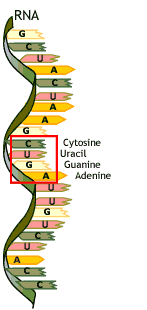
In RNA, Uracil pairs with ______. 
a)
cytosine
b)
adenine
c)
guanine
d)
thymine
61.
Choose the nucleotide sequence of the RNA strand that would be complementary to the following strand: 
GTAGTCA
a)
UATUAGA
b)
ACGACTG
c)
CAUCAGU
d)
CATCAGT
62.
What process is going on in this photo? 
a)
Transcription 
b)
Translation 
c)
Replication 
d)
All the above 
63.
Which component of DNA determines the traits of an organism? 
a)
Nitrogen Bases
b)
Sugar-Phosphate Backbone
c)
Hydrogen bonds
64.

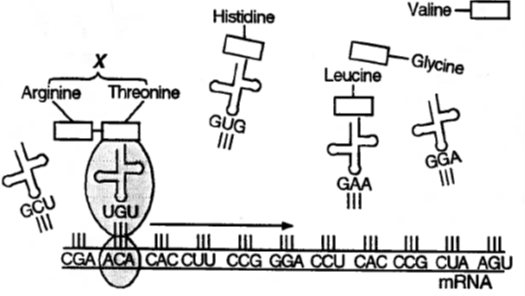
What process is happening in the diagram?

a)

transcription

b)

translation

c)

dna replication

d)

mitosis

65.

The signal that marks the end of a gene and causes transcription to stop is

a)

polymerase

b)

ligase

c)

a terminator

d)

methionine

66.

Which of the following enzymes catalyzes the linkage together of RNA nucleotides to form RNA?

a)

polymerase

b)

ligase

c)

ribozyme

d)

reverse transcriptase

67.

The RNA codon AUG means

a)

add amino acid methionine

b)

start the protein here

c)

add the amino acid tyrosine

d)

end the polypeptide chain here

68.

Which of the following occurs when RNA polymerase attaches a promoter DNA?

a)

elongation of mRNA

b)

termination of mRNA

c)

initiation of a protein

d)

initiation of mRNA

69.

A gene is

a)

the same as a chromosome

b)

the info for making a polypeptide

c)

made of RNA

d)

made of protein

70.

A mutagen is

a)

a gene that has an altered mutation

b)

something that causes a mutation

c)

any change in a nucleotide sequence of DNA

d)

the portion of the chromosome altered by the mutation

71.

tRNA plays a role in which of the following ?

a)

picking up the amino acid specified by the anticodon

b)

recognizing the appropriate codons in mRNA

c)

translating codons into amino acids

d)

all of these are correct

72.
The enzyme that produces RNA in Transcription is called
a)
RNA Polymerase
b)
DNA Polymerase
c)
Transcriptase
d)
RNA Intrase
73.

An organism that is ____________________ has best genes from same or very similar organism.

a)

Cloned

b)

Selectively bred

c)

transgenic

d)

transformed

74.

An organism that is ____________________ has genes from other organisms that are not closely related.

a)

Cloned

b)

Selectively bred

c)

transgenic

d)

transformed

75.

The E.coli with the pGlo plasmid inserted into its chromosome would be a ____________________ organism.

a)

Transgenic

b)

Inbred

c)

Cloned

d)

Hybrid

76.

Where does the GFP protein come from?

a)

E. coli bacteria

b)

seaweed

c)

jellyfish

d)

algae

77.
A ____________ is required to transfer genes from one organism to another.
a)
vector
b)
reverse transcriptase
c)
transport molecule
d)
genetic probe
78.
Which of the following is a circular DNA from bacteria that can hold a foreign gene?
a)
plasmid
b)
restriction enzyme
c)
ligase
d)
protein expression
79.
Which of the following is a protein that acts as DNA scissors?
a)
plasmid
b)
restriction enzyme
c)
ligase
d)
protein expression
80.
Which of the following is an enzymatic protein that acts as DNA glue?
a)
plasmid
b)
restriction enzyme
c)
ligase
d)
protein expression
81.
Which of the following model organisms is often used in rDNA technology to make insulin?
a)
small squid
b)
mouse
c)
fruit fly
d)
E. coli
82.
What is the purpose of PCR?
a)
To produce millions of copies of DNA.
b)
To produce millions of copies of a specific region of DNA
c)
To add nucleotides to a DNA sequence
d)
To watch polymerase work.
83.
What does PCR stand for?
a)
Polymerase Chronic Reagent
b)
Principle Chorionic Reliability
c)
Polymerase Chain Reaction
d)
Probably Cannot React
84.
What is the function of a primer?
a)
To identify the particular region of DNA to be copied by PCR.
b)
To copy DNA.
c)
To create DNA nucleotides.
d)
To maintain the temperature of the PCR reaction.
85.
How many cycles of PCR does it take to produce a double-stranded DNA fragment of the desired length?
a)
1
b)
2
c)
3
d)
4
86.

The term that describes a picture of homologous pairs of human chromosomes is:

a)

karyotype.

b)

genetics.

c)

archetype.

d)

a and b only.

87.

If guanine makes up 19% of the nucleotides in a sample of DNA from an organism, then cytosine would make up _____ percent of the bases.

a)

19%

b)

62%

c)

31%

88.
Based on these results whose blood was found in the blood stain at the crime scene?
a)
Bob
b)
Sue
c)
John
d)
Lisa
89.

Amplifying trace samples of DNA is called

a)

introns

b)

restriction enzymes

c)

STR

d)

PCR

90.
Which two bear species are most closely related?
a)
Bear 1 and Bear 2
b)
Bear 1 and Bear 3
c)
Bear 2 and Bear 3
d)
There’s no way to tell
91.
Why do the fragments of DNA in gel electrophoresis travel away from the negative electrode?
a)
DNA is negatively charged so attracted to the positive end of the unit
b)
DNA is positively charged to attracted to the negative end of the unit
c)
the agarose gel in negatively charged
d)
the agarose gel is positively charged
92.
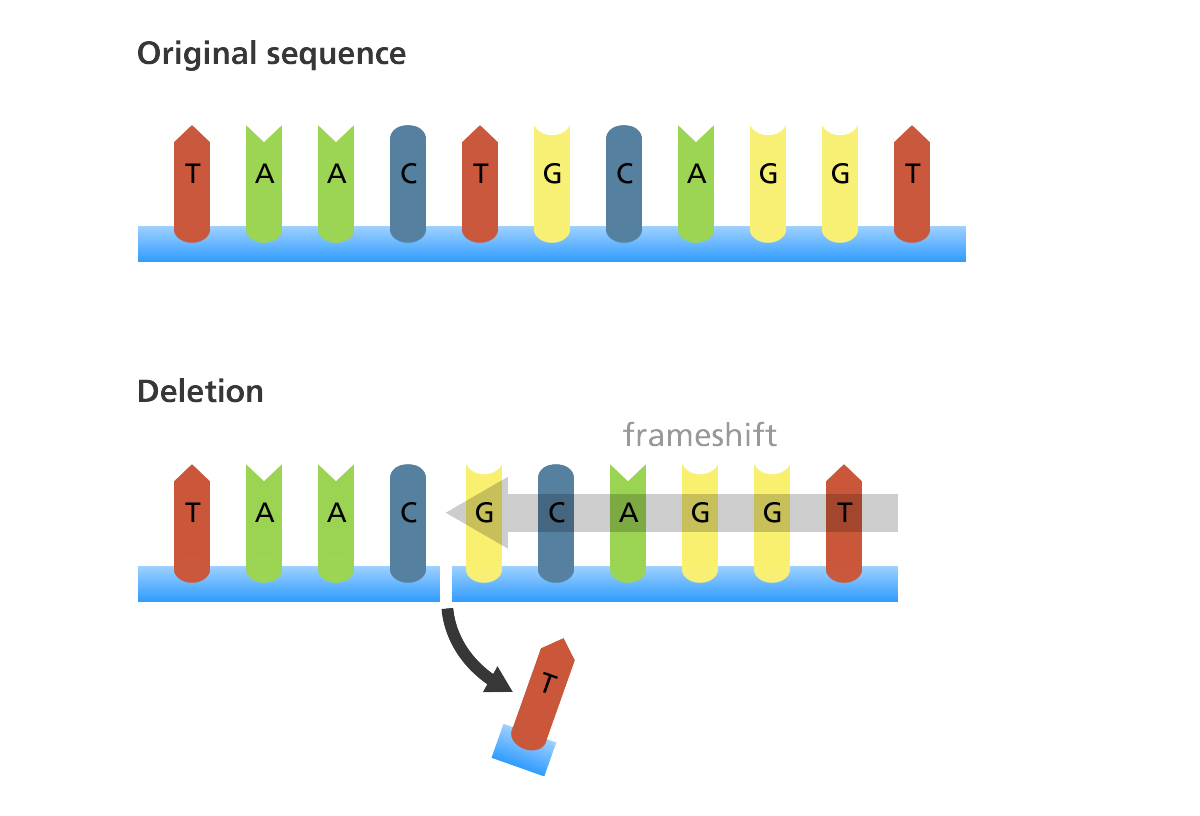
What type of gene mutation has occurred here? 
T-G-A-C-C-A
T-G-A-C-C-A-A
a)
Base Substitution
b)
Base Deletion
c)
Base Insertion
d)
Frameshift 
93.
What type of gene mutation has occurred here? Normal-
AGA-TTC-ATA-GCG
Mutant-
AGA-TTC-AAT-AGC-G
a)
deletion frameshift
b)
insertion frameshift
c)
substitution
d)
nonsense
94.
What type of gene mutation has occurred here? Normal-
AGA-TTC-ATA-GCG
Mutant-
AGA-TTC-AAT-AGC-G
a)
deletion frameshift
b)
insertion frameshift
c)
substitution
d)
nonsense
95.
DNA molecule segment is : TTACGCAAG
The mutated DNA segment is TTACGCAAC. This is an example of ___ mutation.
a)
Base Substitution
b)
Base Insertion
c)
Base Inversion
d)
Translocation
96.
A mutation that does NOT show up through protein function is called
a)
deletion mutation
b)
inversion mutation
c)
silent mutation
d)
transverse mutation
97.
Why are insertion and deletion mutations so harmful?
a)
They change all of the codons from the mutation on down the line, which changes the amino acid sequence
b)
They insert things that an organism doesn't need.
c)
They often delete things that organisms need.
d)
Insertion and deletions are not any more harmful than substitution mutations.
98.

The environment around Manchester, England, changed during the Industrial Revolution. How did this change affect peppered moths living in the area?

a)

Natural selection favored moths with dark wings because predators could not see them on the soot-colored trees.

b)

Natural selection favored moths with white wings that were easy for predators to see.

c)

Natural selection favored moths with white wings because predators could not see them on the soot-colored trees.

d)

Natural selection caused moths with white wings to become extinct.

99.

What is a change in an organism that allows for it to survive in its environment?

a)

homologous

b)

vestigial

c)

variation

d)

adaptation

100.

When individuals choose traits possessed by the opposite sex it is called…

a)

Mutation

b)

Gene Flow

c)

Genetic Drift

d)

Sexual Selection

101.

Genetic drift is more likely to happen in...

a)

aquatic populations

b)

small populations

c)

terrestrial populations

d)

older populations

102.

What is this an example of?

a)

diversity of species

b)

variation

c)

vestigial structures

d)

DNA studies

103.

Which of the following is an example of the bottleneck effect?

a)

Cheetah populations reach their lowest levels with reduced diversity and as they rebound are so genetically similar they appear to be inbred.

b)

Affected individuals with blue skin can trace their ancestry back to one of the first settlers in the region.

c)

The environment of a fox population changes and over time foxes who are white survive and pass on their genes to their offspring.

d)

Humans choose two dogs they like the characteristics of and breed them together.

104.

Which of the following is an example of the founder effect?

a)

Humans choose two dogs they like the characteristics of and breed them together.

b)

Affected individuals with blue skin can trace their ancestry back to one of the first settlers in the region.

c)

The environment of a fox population changes and over time foxes who are white survive and pass on their genes to their offspring.

d)

Cheetah populations reach their lowest levels with reduced diversity and as they rebound are so genetically similar they appear to be inbred.

105.

Genetic drift is more likely to happen in...

a)

aquatic populations

b)

small populations

c)

terrestrial populations

d)

older populations

106.

Genetic drift is change in the allele frequency of a population due to...

a)

random chance

b)

natural selection

c)

non-random mating (sexual selection)

d)

artificial selection

107.

This mechanism of evolution occurs when populations migrate.

a)

Extinction

b)

Gene flow

c)

Genetic drift

d)

Natural Selection

108.
Which Hardy-Weinberg equation represents the genotype frequencies in a population?
a)
p + q = 1
b)
p2 + 2pq + q2 = 1
c)
p2 + pq2 + q2 = 1
d)
p + 2pq + q3 = 1
109.
What do you call all of the genes in a population?
a)
Gene pool
b)
Relative Frequency
c)
Genetic Drift
d)
Allele pool
110.
A few deer wander out of their native woods into a completely new park where no deer had ever been before. They go on to create an entirely new population.
a)
Genetic Drift
b)
Natural Selection
c)
Non-random mating
d)
Mutation
111.
What does the Hardy-Weinberg equilibrium measure?
a)
changes in allele frequencies
b)
numbers of mutations
c)
goodness of fit
d)
genetic diversity
112.
In the Hardy-Weinberg Equation, q2 is the frequency of what?
a)
The recessive allele 
b)
the dominant allele
c)
the recessive genotype
d)
the dominant genotype
113.
A population of 150 individuals has an allele frequency of 0.3 for the dominant allele (B) and a frequency of 0.7 for the recessive allele (b). Use the Hardy-Weinberg equation to determine the frequency of the genotype (bb).
a)
0.09
b)
0.42
c)
0.49
d)
0.21
114.

The allele frequency of p=.20 What is the percentage of Heterozygous Dominant genotype?

a)

.80

b)

.04

c)

.32

d)

.64