wayground logo

Free Printable Worksheets

Font size

S
M
L
XL
Worksheets

Hydrology Mid-Unit Review

Total questions: 87

Worksheet time: 4hrs 21mins

Name
Class
Date
1.
Which represents the distribution of water on Earth?
a)
3% freshwater, 97% salt water
b)
97% freshwater, 3% salt water
c)
71% freshwater, 29% salt water
d)
29% freshwater, 71% salt water
2.
Where is most of the freshwater found on Earth?
a)
lakes
b)
glaciers
c)
oceans
d)
rivers
3.
Most of the Earth's water is in
a)
salty oceans
b)
freshwater lakes
c)
freshwater ponds
d)
glaciers
4.

Water underground is stored in ____________.

a)

aquifers

b)

reservoirs

c)

wells

d)

depositories

5.

Approximately _____ percent of Earth's water is freshwater.

a)

97

b)

1

c)

3

d)

10

6.

Approximately what percent of Earth's water is salt water?

a)

3

b)

70

c)

79

d)

97

7.

What percent of Earth's freshwater is available for humans to use?

a)

3

b)

less than 1

c)

97

d)

10

8.

The graphic shows that only 3% of the Earth's water is fresh water. The graphic also shows that of this 3%, almost all of it is contained in two reservoirs. What are the two reservoirs that contain almost all of Earth's fresh water?

a)

glaciers and groundwater

b)

streams and estuaries

c)

marshes and swamps

d)

lakes and rivers

9.
There is about 2% of the Earth's freshwater frozen in icebergs.
a)
True
b)
False
10.
There is only about 1% of freshwater available for use on Earth.
a)
True
b)
False
11.
In addition to salinity, what factor affects the density of seawater?
a)
depth
b)
latitude
c)
temperature
d)
salt content
12.
Why would a community that has suffered a drought hope for lots of snow over the winter?
a)
Snow will prevent the wells from pumping air into the water lines'
b)
When the snow melts, it will replenish the underground water levels.
c)
People need less water because snow causes colder temperatures outside. 
d)
People can collect the snow, melt and purify it, and use the water in their homes.
13.
Which is the primary source of freshwater in the hydrosphere?
a)
Glaciers and ice caps
b)
Lakes
14.
Which BEST describes how the total amount of water present in the hydrosphere varies over time?
a)
The total amount of water in the hydrosphere decreases over time due to the process of evaporation.
b)
The total amount of water in the hydrosphere remains the same over time, but changes form due to the water cycle.
c)
The total amount of water in the hydrosphere increases over time due to the process of precipitation.
d)
The total amount of water in the hydrosphere both decreases and increases over time due to competing processes such as evaporation and precipitation.
15.

Most of Earth's surface is covered with water. Only 2.5% of Earth's global water is freshwater. Of all the freshwater on Earth, 78% is frozen. Where is most of Earth's water found?

a)

glaciers

b)

lakes

c)

oceans

d)

rivers

16.

Which part of the ocean would have the lowest salinity?

a)

in areas near melting glaciers

b)

in areas near the equator

c)

in areas with the highest temperatures

d)

in areas where there is little rainfall

17.
Which of the following happens when the polar ice caps melt?
a)
headlands become valleys
b)
tectonic plates move
c)
sea levels fall
d)
sea levels rise
18.

Aquifers are sources of

a)

freshwater, which is used for drinking, bathing, and watering crops.

b)

saltwater, which is pushed through turbines to make energy.

c)

oil, which is drilled from the aquifer and used to power homes.

d)

silica, which is used to make glass and paper products.

19.

Why are oceans a major part of the water cycle?

a)

because they are large bodies of salt water that easily evaporate salt into the air

b)

because they are large bodies of salt water that fresh water can be evaporated from

c)

because the salt water condenses easily to become a gas in the air

d)

because the salt water runs off onto land to fill lakes and streams

20.

Tanya makes a table with the weather conditions at a body of water for five days. What day did the body of water most likely evaporate the fastest?

a)

Friday

b)

Thursday

c)

Tuesday

d)

Monday

21.

Which pie chart shows the relative proportions of Earth's water in each location?

a)
b)
c)
d)
22.

Where does most drinking water come from?

a)

reservoirs

b)

lakes

c)

groundwater

d)

oceans

23.

The picture below shows the polar ice caps in the Arctic sea. What will happen to the ice caps if the Sun's energy gets stronger?

a)

The ice will become much colder, causing

clouds to form less rainfall.

b)

The ice will become much harder, causing

clouds to form more rainfall.

c)

The ice will become water, then the water will

become vapor.

d)

The ice will become vapor, then the vapor will

become water.

24.

Why is the ice melting in picture Y, but not picture

X?

a)

The Sun's energy is heating the ice and turning

it into water.

b)

The Sun's energy is heating the water and

turning it into ice.

c)

The clouds are heating the ice and turning it into

water

d)

The clouds are heating the water and turning it

into ice.

25.

If the sky was clear in picture X, then the snow on

top of the mountain would

a)

take in heat energy from the Sun and turn into

ice.

b)

give off heat energy to the Sun and turn into a

liquid.

c)

give off heat energy to the Sun and turn into a

gas.

d)

take in heat energy from the Sun and turn into a

liquid.

26.

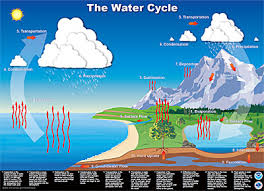
The model below shows the water cycle. What is the purpose of this model?

a)

to show how severe weather forms in the water

cycle

b)

to illustrate how water travels from Earth's

surface into the atmosphere and back to Earth's

surface again

c)

to show how Earth's water formed billions of

years ago

d)

to illustrate how some water is lost on Earth as

some of it never returns to Earth's surface once

it evaporates

27.

Which of the following terms refers to all of

Earth's water?

a)

hydrosphere

b)

dew point

c)

water cycle

d)

precipitation

28.

Wyatt takes a bottle of juice out of the

refrigerator. He notices that water begins to form

on the outside of the bottle. Which of the

following explains why the water started to form?

a)

Evaporation occurs on the bottle because the

room is cooler than the bottle.

b)

The bottle is freezing because the room is

cooler the bottle.

c)

The bottle is melting because the room is

warmer than the bottle.

d)

Condensation forms on the bottle because the

room is warmer than the bottle.

29.

Which of the following is the cup in the picture

NOT modeling?

a)

condensation caused by cooled water

b)

clouds

c)

the heat produced by the Sun

d)

rainfall

30.

What would happen if the lamp were removed

from this model?

a)

The clay in the mountain would harden more

quickly.

b)

The ice would continue to stay frozen in the cup

and not change states.

c)

The water at the bottom of the aquarium would

evaporate more slowly.

d)

The temperature of the aquarium would greatly

increase.
31.
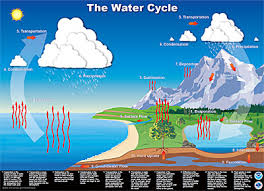
During which stage do clouds form?
a)
condensation
b)
evaporation
c)
precipitation
d)
runoff
32.
Which stages does liquid water from the ocean turn into water vapor?
a)
condesantion
b)
evaporation
c)
precipitation
d)
run off
33.
The release of moisture by living plants.
a)
evaporation
b)
precipitation
c)
condensation
d)
transpiration
34.
Any type of moisture that falls to the Earth.
a)
evaporation
b)
precipitation
c)
condensation
d)
transpiration
35.
The flow of water from land into a body of water.
a)
groundwater
b)
headwaters
c)
run-off
d)
infiltration
36.
What drives the water cycle?
a)
evaporation
b)
precipitation
c)
the sun
d)
the moon
37.

In which area would the rate of evaporation be the lowest?

a)

Over the ocean

b)

Over the mountains

c)

Over the rainforest

d)

Over the desert

38.

As a part of the water cycle, water from Earth's surface enters the clouds and finally falls back to the ground in the form of rain. What is the correct sequence of processes water undergoes?

a)

Evaporation, Condensation, Precipitation

b)

Precipitation, Condensation, Evaporation

c)

Condensation, Evaporation, Precipitation

d)

Evaporation, Precipitation, Condensation

39.

What would happen if the Sun is removed from the water cycle?

a)

The water cycle would not include precipitation but would continue with groundwater flow.

b)

The water cycle would no longer occur because the Sun provides the energy for evaporation and transpiration.

c)

The water cycle would no longer occur because the Sun provides energy for the formation of clouds.

d)

The water cycle would not include evaporation and transpiration but would continue with condensation.

40.

A student draws a model to represent the precesses involved in the water cycle, as shown. To which process is the formation of clouds related?

a)

Condensation

b)

Evaporation

c)

Freezing

d)

Melting

41.

The image shows various stages in the water cycle. During which stage does water flow back towards the sea as runoff?

a)

W

b)

X

c)

Y

d)

Z

42.

On Earth, what process generates most of the water vapor?

a)

Condensation

b)

Evaporation

c)

Precipitation

d)

Transpiration

43.

Rain and snow are two different forms of precipitation that fall on Earth's surface. Which factor is responsible for there being different forms of precipitation?

a)

Evaporation

b)

Run-off

c)

Temperature

d)

Transpiration

44.

What is another name or synonym for the water cycle?

a)

Geologic cycle

b)

Hydrologic cycle

c)

Geosphere

d)

Carbon cycle

45.
What is it called when plants give off water vapor as a waste product?
a)
condensation
b)
evaporation
c)
sublimation
d)
transpiration
46.

Water in its gas form is called ____________________,

a)

water vapor

b)

precipitation

c)

ice

d)

air

47.
Which best explains why runoff is important?
a)
It returns water to other locations on Earth
b)
It increases the chance of flooding
c)
It makes evaporation occur faster
d)
It increases condensation
48.
Snow, sleet, hail, and rain are all examples of  ________________. 
a)
evaporation
b)
condensation
c)
accumulation
d)
precipitation
49.
What is it called when WATER is FORMED from an LIQUID to a WATER VAPOR Oor an [GAS]?
a)
EVAPORATION
b)
PRECIPITATION
c)
TRANSPIRATION
50.
What is precipitation?
a)
The part of the water cycle when the sun heats up water, turning it from a liquid into water vapor or steam. It rises from the ground into the air.
b)
The part of the water cycle when the water vapor in the air gets cold. The water turns back into a liquid and forms clouds.
c)
The part of the water cycle when clouds get heavy and can no longer hold the liquid water. This causes the water to fall from the sky to the earth as rain, snow, sleet, or hail.
51.

Runoff water that is absorbed by subsurface of soil and rock.

a)

Groundwater

b)

Infiltration

c)

Wetland

d)

Saturation

52.

Water tables are located between

a)

Ground water

b)

Unsaturated soil

c)

Bedrock

d)

Surface water

e)

Saturated soil

53.

Having pores or openings that permit liquids or gases to pass through is called

a)

Absorption

b)

Permeable

c)

Impervious

d)

Saturation

54.

the process of a liquid slowly passing through a porous substance.

a)

Permeable

b)

Percolation

c)

Precipitation

55.

The warm, top layer of ocean water

a)

surface zone

b)

bio-luminescence

c)

deep zone

d)

transition zone

56.

What covers 70% of the earth's surface

a)

Ocean

b)

Rivers

c)

Lakes

d)

Ponds

57.

Which word descries how deep the water is in a given location

a)

Ocean Trench

b)

Sediment

c)

Depth

d)

Abyssal Plain

58.

Valleys cut deep into the ocean floor

a)

Plankton

b)

Salinity

c)

Surface Current

d)

Ocean Trench

59.

Flat, deep, and smooth part of the ocean floor. Cold temperatures are found here.

a)

Continental Shelf

b)

Abyssal Plain

c)

Continental Slope

d)

Seamounts

60.

Amount of salt found in water

a)

Photic Zone

b)

Gulf Stream

c)

Photosynthesis

d)

Salinity

61.

The amount of mass per unit of volume

a)

Density

b)

Metric Units

c)

Mass

d)

Volume

62.

Underwater Volcanoes and Mountains?

a)

Seamounts or Mid- Ocean Ridge

b)

Mountain Ridge

c)

Coastal Plains

d)

Abyssal Plains

63.

gently sloping shelf of land extending from the shoreline to the continental edge

a)

Continental Slope

b)

Continental Shelf

c)

Continental Rise

d)

Abyssal Plain

64.

Sharp underwater hill connecting the continent to the ocean floor?

a)

Ocean

b)

Coral Reef

c)

Plankton

d)

Continental Slope

65.
Which best represents the order of seafloor features as you move from the shoreline to the deep ocean?
a)
 Continental slope – continental shelf- continental rise – mid-ocean ridge
b)
 Continental rise – continental shelf – mid-ocean ridge -  continental slope
c)
 Continental shelf – continental slope – continental rise – mid-ocean ridge
d)
   Mid-ocean ridge – continental rise – continental shelf- continental slope
66.
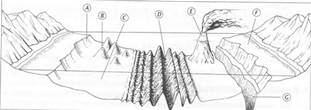
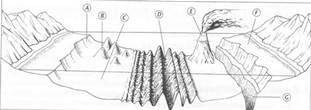
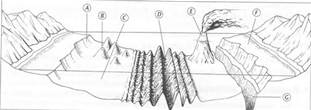
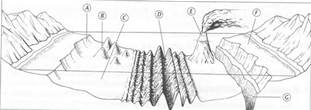
What is letter D?
a)
Cont. Shelf
b)
Mid-Ocean Ridge
c)
Volcanic Island
d)
Seamount
67.
What is letter E?
a)
Volcanic Island
b)
Seamount
c)
Mid-Ocean Ridge
d)
Abyssal Plain
68.
What is letter G?
a)
Mid-Ocean Ridge
b)
Rift
c)
Trench
d)
Cont. Shelf
69.
The gradually sloping part of a continent that extends under the ocean is the...
a)
continental slope
b)
continental shelf
c)
abyssal plain
d)
trench
70.
Seamount is similiar to...
a)
a volcanic island
b)
a small mountain or volcano
c)
The Great Plains
d)
The Grand Canyon
71.
The continental slope is located at the end of the...
a)
shoreline
b)
continental shelf
c)
mid ocean ridge
d)
abyssal plain
72.
The place where new ocean floor forms is called the...
a)
mid ocean ridge
b)
abyssal plain
c)
trench
d)
continental shelf
73.
What is the difference between a volcanic island & a seamount?
a)
A volcanic island rises above the water & a seamount does not
b)
A seamount rises above the water & a volcanic island does not
c)
Both the seamount & volcanic island are underwater
d)
Both the seamount & the volcanic island rise above the water
74.
What is letter A?
a)
Cont. Shelf
b)
Cont. Slope
c)
Seamount
d)
Abyssal Plain
75.
Scientists use ______ to determine the oceans depth.
a)
Submarines
b)
Sonar
c)
Helicopters
d)
Radiowaves
76.
How many oceans are there?
a)
1
b)
10
c)
5
d)
2
77.
What is an underwater mountain formed by a volcano?
a)
trench
b)
rift zone
c)
seamount
d)
mid ocean ridge
78.
What are valleys between the mountain ridges?
a)
rift zones
b)
trenches
c)
abyssal plains
d)
continental slope
79.
Where is the shallowest part of the ocean floor?
a)
continental slope
b)
continental shelf
c)
abyssal plains
d)
rift zones
80.
What is the flat land located on either side of the mid-ocean ridge?
a)
continental slope
b)
continental shelf
c)
abyssal plain
d)
ocean basin
81.
What is an opening in the surface where lava may flow?
a)
trench
b)
seamount
c)
rift zone
d)
valley
82.
Which of the following is the corresponding Continental land form for the Abyssal Plain. 
a)
Plains
b)
Mountain
c)
Dessert 
d)
Valley 
83.
When you are building a sand castle on the beach, what feature are you standing on? 
a)
abyssal plain
b)
continental shelf
c)
seamount
d)
continental rise
84.
Which of the following describes a trench
a)
it rises above the water
b)
flat, low lying area of the ocean floor
c)
a stretch of underwater mountains
d)
deep cuts in the ocean floor, canyon-like 
85.
What is letter C pointing to? 
a)
abyssal plain
b)
seamount
c)
mid-ocean ridge
d)
continental shelf
86.
Some ______________ of the ocean floor are mountains, valleys, trenches, plains, and even volcanoes. 
a)
geography 
b)
features
c)
floor
d)
animals 
87.
The shoreline is where ____________ and __________ meet. 
a)
land and ocean
b)
ocean and lakes
c)
rivers and mountains
d)
continental slope and continental rise