wayground logo

Free Printable Worksheets

NEW

Font size

S
M
L
XL
Worksheets

Genetics Review

Total questions: 63

Worksheet time: 38mins

Name
Class
Date
1.
An organism's phenotype describes its __________.
a)
genetic makeup
b)
physical appearance
2.
What do you call a section of DNA that codes for a specific trait?
a)
nucleus
b)
chromosome
c)
gene
d)
DNA
3.
How many chromosomes are found in human egg and sperm cells?
a)
20
b)
23
c)
26
d)
46
4.
__________ worked with pea plants to prove that traits are passed from parent to offspring.
a)
Reginald Punnett
b)
Gregor Mendel
5.
An organism's genotype describes its __________.
a)
genetic makeup
b)
physical appearance
6.
A dominant trait shows up __________.
a)
only when two dominant alleles are present
b)
only when one dominant allele is present
c)
when at least one recessive allele is present
d)
when at least one dominant allele is present
7.
A recessive trait only shows up when __________.
a)
two dominant alleles are present
b)
one dominant allele is present
c)
two recessive alleles are present
d)
at least one dominant allele is present
8.
If you cross two parents, both with genotype Bb, what percentage of children will have brown eyes?
a)
25%
b)
50%
c)
75%
d)
100%
9.
Purebred is another word for __________, while hybrid is another word for __________.
a)
dominant; recessive
b)
recessive; dominant
c)
homozygous; heterozygous
d)
heterozygous; homozygous
10.
The two different forms of a gene are called _________.
a)
zygotes
b)
traits
c)
phenotypes
d)
alleles
11.
What word describes how traits are passed from parent to offspring?
a)
Alleles
b)
Dominance
c)
Probability
d)
Heredity
12.
Scientists use __________ to show what genotype combinations are possible.
a)
Punnett Square
b)
Mendel Square
c)
Madison Square
d)
Times Square
13.
------is the combination of two alleles that are different from one another.
a)
homozygous
b)
heterzygous
c)
phenotype
d)
trait
14.
The letters that make-up the genetic code for a trait
a)
genotype
b)
heterzygous
c)
phenotype
d)
trait
15.
---- Is the combination of two alleles that are the same
a)
genotype
b)
homozygous
c)
phenotype
d)
trait
16.
Black fur (B) is dominant. Find the probability of a black offspring in a cross: bb x bb. 
a)
0%
b)
25%
c)
50%
d)
100%
17.
Look at the Punnett Square. What's the probability of having the recessive offspring?
a)
100%
b)
75%
c)
50%
d)
25%
18.
What are the parents' genotypes?
a)
Homozygous for brown eyes
b)
Heterozygous for brown eyes
c)
Homozygous for blue eyes
d)
Heterozygous for blue eyes
19.
What is the phenotype for the recessive trait?
a)
brown eyes
b)
green eyes
c)
blue eyes
20.
A type of gene that can be hidden is called
a)
genotype
b)
recessive
c)
dominant
d)
allele
21.
What is NOT a possible offspring genotype? 
a)
BB
b)
Bb
c)
bb
22.

The device used to predict genetic outcomes.

a)

Geneticist

b)

Fate

c)

Punnett Square

d)

Pedigree

23.
The study of heredity:
a)
Genetics
b)
Biology
c)
Physiology
d)
Cytology
24.
A change in DNA:
a)
Mutation
b)
Phenotype
c)
Genotype
d)
Albinism
25.
When a plant fertilizes another plant:
a)
self-pollination
b)
cross-pollination
c)
true-breeding
d)
allele-breeding
26.
He is known as the "Father of Genetics":
a)
Mendel
b)
Punnett
c)
Sutton
d)
Hooke
27.
When gene pairs are written, the dominant allele is shown as a(n):
a)
D in front of it
b)
Capital Letter
c)
Bold letter
d)
Underlined letter
28.
Using the letter "P", what is the genotype of a heterozygous individual?
a)
Pp
b)
PP
c)
pp
d)
Ppp
29.
The mathematical chance that something will happen:
a)
homozygous
b)
genotype
c)
probability
d)
heterozygous
30.
A plant that fertilizes itself is called: 
a)
self-pollinating
b)
true-breeding
c)
cross-pollinating
d)
allele-pollinating
31.
Which sex chromosomes do females have?
a)
XX
b)
XY
c)
AB
d)
BA
32.
Which sex chromosome do males have?
a)
XX
b)
XY
c)
AB
d)
BA
33.

The alleles of a gene pair in a heterozygote are both expressed with no blending.

a)

codominance

b)

incomplete dominance

c)

polygenic

d)

multiple alleles

34.

A trait associated with a gene that is carried on the X or Y chromosome.

a)

sex linked

b)

polygenic

c)

multiple alleles

d)

codomiance

35.

Neither allele is dominant. Heterozygote has a blended phenotype.

a)

incomplete dominance

b)

codominance

c)

multiple alleles

d)

sex linked

36.

Color blindness is an example of what type of trait?

a)

codominance

b)

incomplete dominance

c)

polygenetics

d)

multiple alleles

e)

sex linked

37.

Blood types are an example of what type of trait?

a)

codominance

b)

incomplete dominance

c)

polygenetics

d)

multiple alleles

e)

sex linked

38.

This picture is example of what type of trait?

a)

codominance

b)

incomplete dominance

c)

polygenetics

d)

multiple alleles

e)

sex linked

39.
A calico cat shows both the traits for orange fur and black fur. What kind of allele expression is this?
a)
Incomplete Dominance
b)
Co dominance
c)
Independent assortment
d)
Recessive inheritance
40.
What is the symbol for an Affected Male? 
a)
Half Circle 
b)
Half Square 
c)
Full Shaded Circle 
d)
Full Shaded Square 
41.
How many affected females are present? 
a)
1
b)
2
c)
3
d)
4
42.
How many offsprings did generation 2 have? 
a)
5
b)
8
c)
9
d)
10
43.
How many carrier males are present? 
a)
2
b)
4
c)
6
d)
8
44.
A carrier is represented by what symbol? 
a)
Clear 
b)
Shaded 
c)
Half Shaded
d)
1:4 ratio 
45.
How many generations are shown in this pedigree?
a)
1
b)
2
c)
3
d)
4
46.
What does an open circle represent?
a)
Not Affected Male
b)
Not Affected Female
c)
Affected Male
d)
Affected Female
47.
Is this trait (the shaded individuals) dominant or recessive?
a)
dominant
b)
recessive
48.
Which gender can be carriers of colorblindness and not have it?
a)
Just males
b)
Just females
c)
Both genders
49.
What is the mode of inheritance shown here?
a)
Autosomal Dominant
b)
Autosomal Recessive
c)
Sex Linked Recessive
50.
What is the mode of inheritance shown here?
a)
Autosomal Recessive
b)
Autosomal Dominant
c)
Sex Linked
51.
Which disease or disorder is the result of having an extra chromosome?
a)
Cystic Fibrosis
b)
Down Syndrome
c)
Colorblindness
d)
Sickle-cell Disease
52.
A doctor may use a _________ to examine the chromosomes in a cell.
a)
x-ray
b)
blood test
c)
karyotype
d)
hemoglobin
53.
What chromosome is affected by hemophilia?
a)
x
b)
y
c)
21
d)
13
54.
In order to trace occurrence of a trait through several generations of a family, you could create a ____________.
a)
karyotype
b)
hemoglobin
c)
pedigree
d)
chromosomal map
55.
Photograph of chromosomes grouped in ordered pairs
a)
pedigree
b)
Punnett Square
c)
Venn Diagram
d)
Karyotype
56.
A couple that have a family history of a genetic disorder might wish to receive advice from a ___________.
a)
mutated allele
b)
genetic counsellor
c)
family dentist
d)
brother or sister
57.
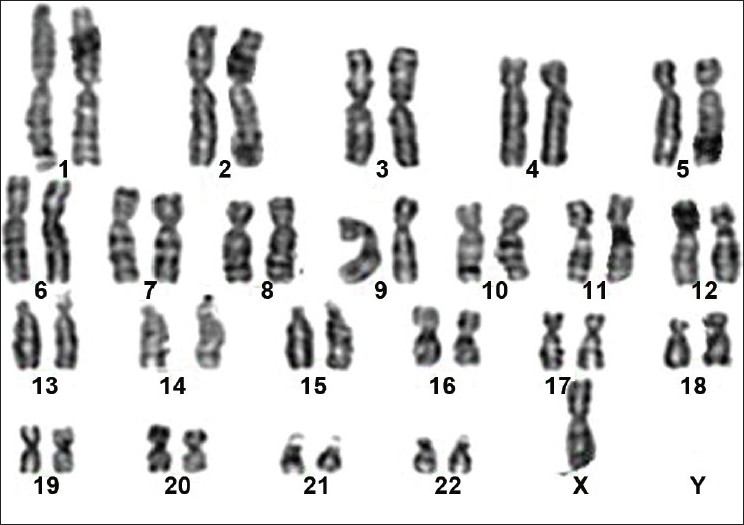
What is the gender of the individual whose karyotype is seen in the image?
a)
Male
b)
Female
58.
a)
This karyotype shows Trisomy 21
b)
This karyotype has no abnormality
c)
This karyotype is missing a sex chromosome (monosomy x)
d)
This karyotype is from a gamete
59.
What is the chromosomal condition of the individual whose karyotype is seen in the image?
a)
Trisomy 21 (Down's Syndrome)
b)
Trisomy 13 (Patau Syndrome)
c)
Trisomy 18 (Edward's Syndrome)
d)
XXY Sex Chromosomes (Klinefelter's Syndrome)
60.
What disease is characterized by abnormally shaped red blood cells?
a)
hemophilia
b)
sickle cell anemia
c)
phenylketonuria
d)
Huntington's 
61.
Which genetic disorder is sex-linked?
a)
Huntington's
b)
cystic fibrosis
c)
red-green colorblindness
d)
sickle cell anemia
62.

Disease that caused the body to produce thick and sticky mucus that can clog the lungs and obstruct the pancreas.

a)

hemophilia

b)

cystic fibrosis

c)

tay sachs

d)

sickle cell anemia

63.

Because it is a recessive trait, to get the disorder, a person would have to

a)

inherit only one gene for it.

b)

to inherit two genes for it (one from mom and one from dad)

c)

inherit three genes for it

d)

inherit no genes for it