wayground logo

Free Printable Worksheets

NEW

Font size

S
M
L
XL
Worksheets

AP Chem Fall Final

Total questions: 68

Worksheet time: 2hrs 26mins

Name
Class
Date
1.

A sample of a solid substance conducts electricity in both the solid and liquid phase. Which of the following types of interactions is most likely found between particles in the substance?

a)

ionic bonds

b)

metallic bonds

c)

covalent bonds

d)

hydrogen bonds

2.

Which of the following shows the molecules F2, Cl2, and Br2 in order of their bond enthalpies from least to greatest?

a)

F2 < Cl2 < Br2

b)

Cl2 < Br2 < F2

c)

Br2 < Cl2 < F2

d)

Br2 < F2 < Cl2

3.

Based on Coulomb’s Law and the data in the table above, which of the following would have the weakest interactions with an adjacent water molecule in an aqueous solution?

a)

Hg2+

b)

Ba2+

c)

Al3+

d)

Mg2+

4.

On the basis of the data in the table above, which of the following arranges the bonds in molecules from least to most polar?

a)

NF3 < NO2 < CF4 < OF2

b)

CF4 < NO2 < OF2 < NF3

c)

NO2 < OF2 < NF3 < CF4

d)

NF3 < NO2 < OF2 < CF4

5.

For element X, which of the following most likely explains the large difference between the 3rd and 4th ionization energies?

a)

The effective nuclear charge decreases with each successive ionization energy

b)

The distance between the nucleus and the electron being removed increases with each successive ionization energy

c)

The electron removed for the 4th ionization energy has much less energy than the electron removed for the 3rd ionization energy

d)

The ionic radius increases with each successive ionization energy

6.

A sample of a compound contains 24.0 g C, 5.0 g H, and 8.0 g O. Which of the following is the empirical formula of the compound?

a)

C2H5O

b)

C4H10O

c)

C6H15O2

d)

C8H20O2

7.

Which of the following molecules is least soluble in water?

a)

CH2F2

b)

CH3OH

c)

CH2O

d)

CH3CH3

8.
Which particles make up the nucleus of an atom?
a)
protons and neutrons
b)
electrons and protons
c)
electrons, protons, and neutrons
d)
electrons and neutrons
9.
How many electrons does Si contain? (click to see image)
a)
14
b)
28
c)
2
d)
4
10.
Group 18 elements are known as the _____ _____ and have full valence shells.
a)
royal gases.
b)
supreme solids.
c)
noble gases.
d)
legit liquids.
11.

What period and group is Silver (Ag)?

[Need your periodic table handy.]

a)

Period 2, Group 1

b)

Period 3, Group 16

c)

Period 5, Group 11

d)

Period 2, 14

12.
Which elements have the most similar chemical properties?
a)
K and Na
b)
K and Ca
c)
K and Cl
d)
K and S
13.
An element's identity is determined by the number of
a)
electrons.
b)
protons.
c)
neutrons.
d)
valence.
14.
 Why does group number 18 have the least reactive elements?
a)
They all have an odd number of protons.
b)
They all have an even number of protons. 
c)
They have the largest masses.
d)
Their electron shells are the most filled and do not need to be very reactive.
15.
How many Valance electrons does Iodine Have?
a)
6
b)
16
c)
7
d)
17
16.
a)

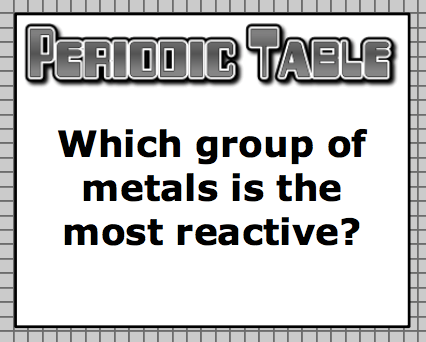
Group 1 Alkali Metals

b)

Group 17 Halogens

c)

Group 18 Noble Gases

d)

Group 2 Alkaline Earth Metals

17.
a)
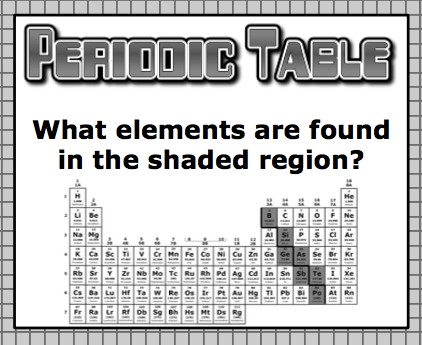
Metals
b)
Nonmetals
c)
Metalloids
18.
Which problem is balanced?
a)
PbO2 + 2H2
b)
SO2 + H20 --> H2SO4
c)
2Na + 2H2O --> 2NaOH + H2
19.
 Mg  +  ___ HCl  →   MgCl2  +   H2
a)
1
b)
2
c)
3
d)
4
20.

__ Al + __ FeO → Al2O2 + __ Fe

a)

1, 1, 2

b)

2,1,2

c)

2, 2, 2

d)

2,4,2

21.

Determine the number of moles in 5.2 x 10²² atoms of gold.

[need your periodic table and calculator]

a)

0.086 mole

b)

0.52 mole

c)

8.63 x 1044 moles

d)

3.1 x 1046 moles

22.

What is the molar mass of Ca(NO3)2?

[need your periodic table and calculator]

a)

148.096 g

b)

164.086 g

c)

102.055 g

d)

70.084 g

23.

How many moles are in 74 g of KCl?

[need your periodic table and calculator. should take one step]

a)

0.99 mole

b)

0.014 mole

c)

11 moles

d)

0.14 mole

24.
An isotope has three forms.  30% have a mass of 4 amu, 20% have a mass of 5 amu and 50% have a mass of 3 amu.  Average atomic mass will be closest to
a)
2 amu
b)
3 amu
c)
4 amu
d)
5 amu
25.
What is the empirical formula of the following molecular formula:  C3H6
a)
C3H6
b)
CH2
c)
C2H4
d)
CH3
26.
Which is the name of the kind of solid substance formed in this figure?  
a)
aqueous 
b)
precipitate
c)
acid
d)
synthesis 
27.

Which of the following compounds will not disassociate in water?

(Hint: check your solubility rules)

a)

NaCl

b)

PbCl2

c)

MgNO3

d)

Na2SO4

28.
Which type of reaction takes place in the presence of oxygen and produces carbon dioxide and water?
a)
double replacement 
b)
decomposition 
c)
combustion 
d)
single replacement
29.
Provides evidence that a chemical reaction has occurred. 
a)
dissolving 
b)
melting
c)
formation of a gas
d)
bending
30.
What is the probable product of a double-replacement reaction?
a)
A new compound and a replaced metal
b)
A new compound and a replaced nonmetal
c)
2 different compounds 1 aqueous and 1 that is a solid, liquid or gas
d)
A single compound
31.
What type of chemical reaction takes place when fluorine reacts with sodium bromide?
a)
single replacement 
b)
double replacement 
c)
combustion
d)
synthesis 
32.

A chemical reaction that shows the formation of a solid and identifies the spectator ions

a)

covalent equation

b)

double replacement

c)

ionic equation

d)

dissociation

33.

What are the predicted products of this reaction? Copper (II) is the form used in this reaction.


Cu+ AgNO3-->

a)

Cu(NO3)2+Ag

b)

CuNO3 + Ag

c)

CuAg+NO3

d)

no reaction

34.

Which of the following is a product of the equation:


AgNO3 + MgCl2 =>

a)

AgMg

b)

NO3Cl2

c)

MgNO3

d)

Mg(NO3)2

35.
Name the acid: HC2H3O2
a)
Acetic Acid
b)
Acetous Acid
c)
Hydrogen Acetate
d)
Hydrogen Dicarbon Trihydrogen Dioxygen
36.
What is the formula for phosphorous acid?
a)
H3PO4
b)
H2PO4
c)
H3P
d)
H3PO3
37.

Write formula for ammonium phosphate.

a)

(NH4)3PO4

b)

NPO4

c)

NH4PO4

d)

NH4(PO4)3

38.

Write the formula for zinc fluoride.

a)

ZnF2

b)

ZnF

c)

Zn2F

d)

Zn2F4

39.
Name this compound: 
NH4F
a)
Ammonia fluoride
b)
Ammonium fluorite
c)
Ammonia fluorate
d)
Ammonium fluoride
40.
How do covalent bonds form?
a)
Donating & receiving valence e- between atoms.
b)
Opposite slight charges attract each other between compounds.
c)
Scientists are still not sure how they form.
d)
Sharing valence e- between atoms.
41.

Which of the following is NOT formed by a covalent bond?

a)

K2S

b)

H2O

c)

I2

d)

CO2

42.
What do we call a covalent bond where electrons are shared UNEVENLY or UNEQUALLY?
a)
Ionic
b)
Polar Covalent
c)
Nonpolar Covalent
d)
Van der Waals Force
43.
In an electron dot diagram, two pairs of shared electrons represents a ...
a)
single bond
b)
double bond
c)
triple bond
d)
quadruple bond
44.
A Nitrogen molecule (N2) has one triple bond. How many electrons do the nitrogen atoms share?
a)
1
1
b)
3
c)
4
d)
6
45.
Which of the following is the correct Lewis dot structure for the molecule fluorine (F2)?
a)
A
b)
B
c)
C
d)
D
46.
Which of the following is the correct Lewis structure for the compound PBr3?
a)
structure A
b)
structure B
c)
structure C
d)
structure D
47.
Which element below is not diatomic?
a)
hydrogen
b)
oxygen
c)
nitrogen
d)
sulfur
48.
Ionic or covalent?
C  O
a)
Ionic
b)
Covalent
49.
Ionic or covalent?
Na  Br
a)
Ionic
b)
Covalent
50.
What is the correct name for C4H6?
a)
Carbon Hexahydride
b)
Pentacarbon Pentahydride
c)
Hexacarbon Tetrahydride
d)
Tetracarbon Hexahydride
51.
What is the correct name for NO?
a)
Mononitrogen Monoxide
b)
Nitrogen Monoxide
c)
Mononitrogen Dioxide
d)
Nitrogen Oxide
52.
2CO  +  O2  −-> 2CO2
How many liters of carbon dioxide are produced from 10L of carbon monoxide?
a)
10
b)
20
c)
1
d)
5
53.

When 12 moles of O2 reacts with 1.1 mole of C10H8 what is the limiting reactant? C10H8 + 12 O2 --> 10 CO2 + 4 H2O

[Hint: doesn't matter which product you consider]

a)

Oxygen

b)

C10H8

c)

Water

d)

Carbon Dioxide

54.

B2H6 + 3O2 -->2 HBO2 + 2 H2O

What mass of O2 will be needed to burn 36.1 g of B2H6?

a)

13.8 g O2

b)

3.86 mol of O2

c)

123.8 g O2

d)

12.4 g O2

55.

What is the measured amount of a product obtained from a chemical reaction during a lab activity?

a)

mole ratio

b)

theoretical yield

c)

percentage yield

d)

actual yield

56.
If a chemist calculates the maximum amount of product that could be obtained in a chemical reaction, he or she is calculating the
a)
theoretical yield
b)
mole ratio
c)
actual yield
d)
percentage yield
57.
When does a chemical reaction stop?
a)
When the lab is finished
b)
When the excess reactant is used up
c)
When the limiting reactant is used up
d)
Chemical reactions never stop
58.
What is the VSEPR theory used to predict?
a)
Bond Strength
b)
Polarity
c)
Molecular Shape
d)
Electronegativity
59.
According to VSEPR, molecules adjust their shapes to keep which of the following as far away as possible?
a)
Pairs of valence electrons
b)
Inner shell electrons
c)
Mobile Electrons
d)
Electrons closest to the nucleus
60.
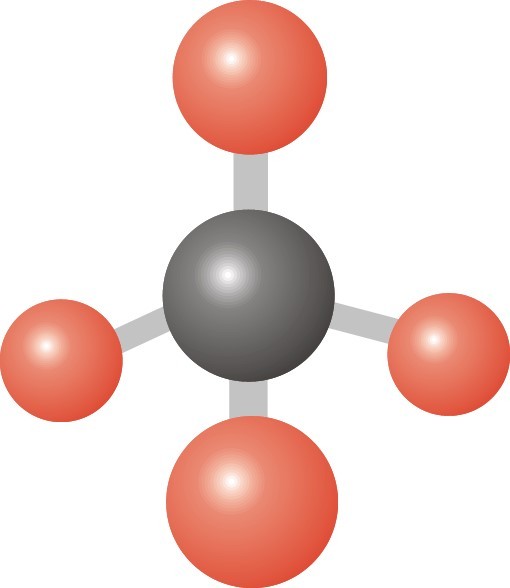
Which of the following shapes has unshared pairs of electrons on the central atom? 
a)
Bipyramidal
b)
Bent
c)
Trigonal Planar
d)
Tetrahedral
61.
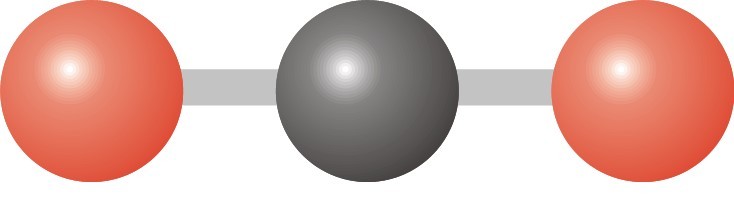
Which molecule would have this shape?
a)
BF3
b)
CH4
c)
PCl5
d)
CO2
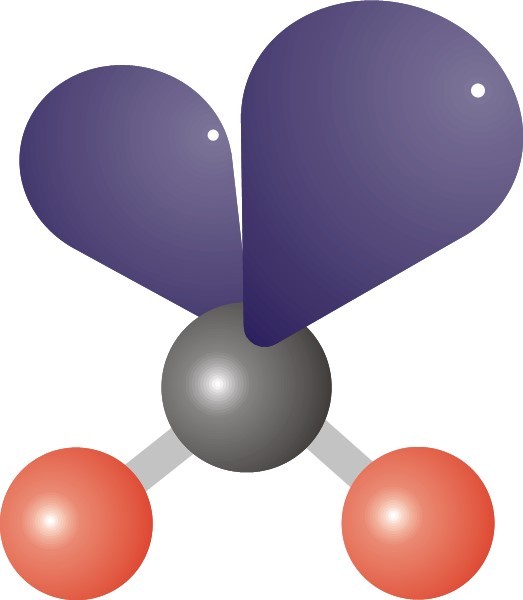
62.
What molecule could this be? 
a)
BF3
b)
CH4
c)
H2O
d)
CO2
63.
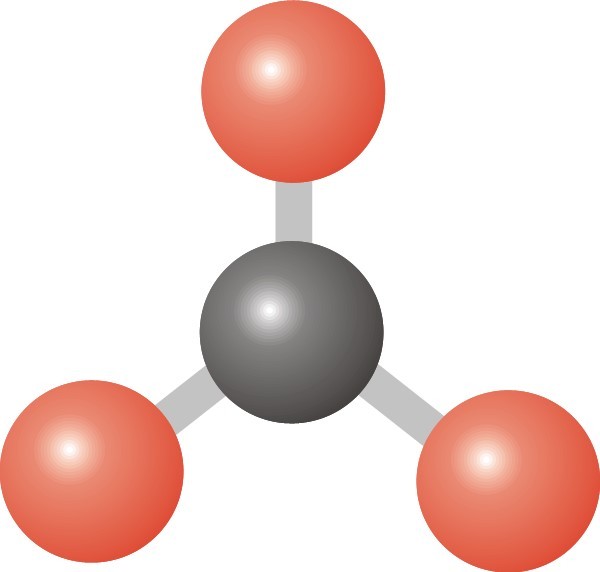
Who could this molecule be?
a)
CH4
b)
CO2
c)
PCl5
d)
BF3
64.
Who could this be? 
a)
CO2
b)
NH3
c)
H2S
d)
CH4
65.
In the Thomson Model, he discovered the existence of what particle?
a)
Electrons
b)
Protons
c)
Neutrons
d)
Quarks
66.
Which model involved gold foil?
a)
Thomson Model
b)
Rutherford Model
c)
Cloud Model
d)
Bohr Model
67.
Which model is this?
a)
Thomson Model
b)
Rutherford Model
c)
Cloud Model
d)
Bohr Model
68.
Believed that atoms are small, hard particles that were "indivisible"
a)
Democritus
b)
Aristotle
c)
Schrodinger
d)
Greek Philosophers