wayground logo

Free Printable Worksheets

NEW

Font size

S
M
L
XL
Worksheets

Cumulative Fall Semester Test Review

Total questions: 60

Worksheet time: 1hrs 13mins

Name
Class
Date
1.
The positive particles of an atom are 
a)
electrons 
b)
positrons 
c)
neutrons 
d)
protons 
2.
Particles in an atom that are neutral and have no charge are 
a)
negatrons 
b)
electrons 
c)
neutrons 
d)
protons 
3.
What is the atomic number for an element with three protons?
a)
2
b)
1
c)
3
d)
6
4.
A particle that moves around the nucleus is a(n)...
a)
Proton
b)
Neutron
c)
Electron
d)
Quark
5.
Beryllium has how many protons?
a)
4
b)
9.0122
c)
2
d)
13.0122
6.
What does the nucleus consist of?
a)
Protons + Electrons
b)
Neutrons + Electrons
c)
Atoms
d)
Protons + Neutrons
7.
Where are protons located in the atom?
a)
orbitals
b)
nucleus
c)
rings
d)
positive
8.
Where are neutrons located in the atom?
a)
shells/orbitals
b)
rings
c)
center
d)
nucleus
9.

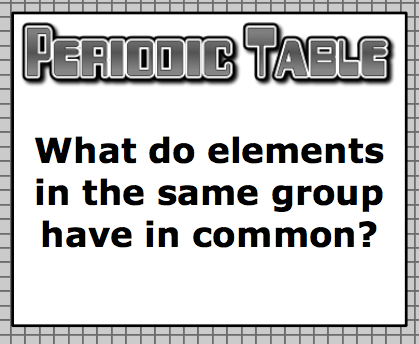
On the periodic table, Groups are

a)

Horizontal rows

b)

Vertical columns

10.

On the periodic table, Periods are

a)

Horizontal rows

b)

Vertical columns

11.

What is a valence electron?

a)

Electrons in the first energy shell

b)

Electrons in the second energy shell

c)

Electrons in the outer shell

d)

Total number of electrons

12.

The innermost energy level has a maximum of how many electrons?

a)

1

b)

2

c)

6

d)

8

13.

Which element is this?

a)

Nickel

b)

Neon

c)

Sodium

d)

Nitrogen

14.

Name this element.

a)

Argon

b)

Chlorine

c)

Aluminum

d)

Boron

15.
a)
energy levels
b)
valence electrons
c)
protons
d)
neutrons
16.
a)
energy levels
b)
valence electrons
c)
protons
d)
neutrons
17.
a)
Same group
b)
Same period
18.
a)
Group 1
b)
Group 17
c)
Group 2
d)
Group 18
19.
a)
Group 1
b)
Group 17
c)
Group 18
d)
Group 2
20.
a)
Group 1
b)
Group 17
c)
Group 18
d)
Group 2
21.
The substances listed on the right side of a chemical equation are the
a)
Yields
b)
Reactants
c)
Products
d)
Precipitates
22.
CaCO3 represents a chemical
a)
Symbol
b)
Formula
c)
Subscript
d)
Reaction
23.
The substances listed on the left side of a chemical equation are the
a)
Products
b)
Coefficients
c)
Precipitates
d)
Reactants
24.
In chemical reactions, what does the principle of conservation of mass mean?
a)
Matter is not created or destroyed.
b)
The total mass of the reactants is greater than the total mass of the products.
c)
The total mass of the reactants is less than the total mass of the products.
d)
Matter is not changed.
25.
How many Oxygen (O) atoms are in 2C2HO8Cl2
a)
2
b)
16
c)
8
d)
5
26.
How many Hydrogen (H) atoms are in NH3O5
a)
3
b)
4
c)
5
d)
1
27.
How many Hydrogen are in 4H2O?
a)
6
b)
8
c)
2
d)
4
28.
What equation do I use to calculate speed?
a)
S = D/T
b)
T = D/S
c)
D=TS
29.
A train travels 25 km in .5 hrs. How fast is the train going?
a)
25 miles/hr
b)
5 miles/hr
c)
125 km/hr
d)
50 km/hr
30.
A car travels 30 miles/hr for 3 hours, calculate the distance it will travel
a)
90 miles
b)
10 miles
c)
600 miles
d)
90 km
31.
A speed boat travels 200 miles at a speed of 20 miles/hr. How much time will it take to travel the 200 miles?
a)
10 hrs
b)
10 miles
c)
400 hrs
d)
100 km
32.
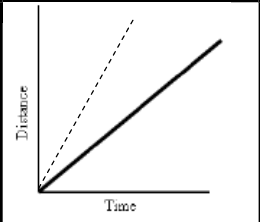
What does this graph represent?
a)
Constant Speed
b)
Acceleration
c)
Not moving
33.
How long did it take this object to travel 10 m?
a)
0 s
b)
10 s
c)
15 s
d)
20 s
34.
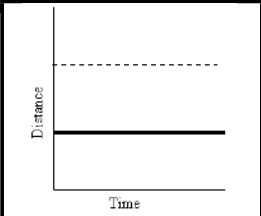
What does this graph represent?
a)
Constant speed
b)
Acceleration
c)
Not moving
35.

Which of the graphs shows that one of runners started 10 yards further ahead of the

other?

a)
b)
c)
d)
36.

Which runner won the race?

a)

Albert

b)

Bob

c)

Charlie

37.

Calculate Albert's average speed for the 100-meter race.

a)

8.33 m/s

b)

5 m/s

c)

7.14 m/s

d)

5.88 m/s

38.
A magician pulls a tablecloth out from under dishes and glasses on a table without disturbing them.
a)
Newton's 1st Law
b)
Newton's 2nd Law
c)
Newton's 3rd Law
d)
None of them
39.

A person’s body is thrown outward as a car rounds a curve on a highway.

a)

Newton's 1st Law

b)

Newton's 2nd Law

c)

Newton's 3rd Law

d)

None of them

40.
A picture is hanging on a wall and does not move.
a)
Newton's 1st Law
b)
Newton's 2nd Law
c)
Newton's 3rd Law
d)
None of them
41.
Rockets are launched into space using jet propulsion where exhaust accelerates out from the rocket and the rocket accelerates in an opposite direction.
a)
Newton's 1st Law
b)
Newton's 2nd Law
c)
Newton's 3rd Law
d)
None of them
42.
Acceleration is produced when a force acts on a mass. The greater the mass (of the object being accelerated) the greater the amount of force needed (to accelerate the object).
a)
Newton's 1st Law
b)
Newton's 2nd Law
c)
Newton's 3rd Law
d)
None of them
43.

Pushing a child on a swing is easier than pushing an adult on the same swing, because the adult has more mass.

a)

Newton's 1st Law

b)

Newton's 2nd Law

c)

Newton's 3rd Law

d)

None of them

44.

If the man pushes with an equal amount of force, which object will accelerate more?

a)

Car because it has more mass

b)

Lawnmower because it has less mass

c)

Car because it has less mass

d)

Lawnmower because it has more mass

45.
The larger the mass you have the _____ force you need to change its motion.
a)
more
b)
less
46.
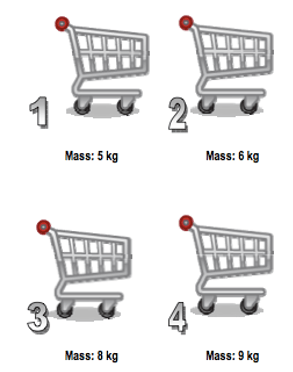
A force of 90N is applied to each cart below, which one will accelerate the fastest?
a)
Cart 1
b)
Cart 2
c)
Cart 3 
d)
Cart 4
47.

Newton’s law states that for every action, there is an ________ reaction.

a)

unequal and opposite

b)

equal and similar

c)

stronger and opposite

d)

equal and opposite

48.

If two people with the same mass collide, they experience the same amount of force.

a)

True

b)

False

49.

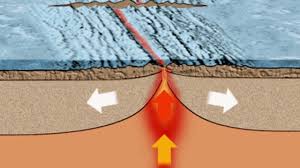
In sea-floor spreading, molten material rises from the mantle and erupts

a)

along the edges of all the continents.

b)

along mid-ocean ridges.

c)

in deep-ocean trenches.

d)

at the north and south poles.

50.

The process by which the ocean floor sinks beneath a deep-ocean trench and back into the mantle is known as _______

a)

convection.

b)

continental drift.

c)

subduction.

d)

conduction.

51.

Most geologists think that the movement of Earth’s plates is caused by _______

a)

convection.

b)

continental drift.

c)

subduction.

d)

conduction.

52.

The geological theory of _______ states that pieces of Earth’s lithosphere are in constant, slow motion.

a)

subduction

b)

plate tectonics

c)

deep-ocean trenches

d)

sea-floor spreading

53.

A place where two plates slip past each other, moving in opposite directions, is known as a _______

a)

transform boundary

b)

divergent boundary.

c)

convergent boundary.

d)

rift valley.

54.

The place where two plates come together is known as a _______

a)

transform boundary.

b)

divergent boundary.

c)

convergent boundary.

d)

rift valley.

55.
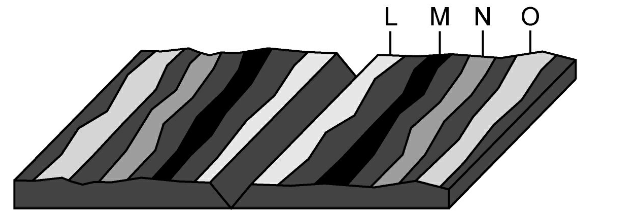
Where would the oldest rock be found?
a)
L
b)
M
c)
N
d)
O
56.
How is it possible for new crust to be formed without increasing the surface area of the Earth?
a)
Crust is destroyed at the same time it is created
b)
New crust is underwater where it sinks
c)
New crust breaks more easily than old crust
57.
The Himalayas in Asia are an example of what type of plate boundary?
a)
divergent
b)
continent-to-continent convergent
c)
ocean-to-continent convergent
d)
transform
58.

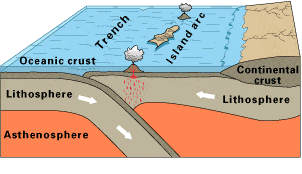
Observe this diagram of a plate boundary. One statement BEST describes what is happening. It is that

a)

the oceanic crust is melting.

b)

the denser ceanic crust is subducting under the less dense oceanic crust

c)

volcanic islands are forming.

d)

the tectonic plates are moving away from each other.

59.
Created by a divergent boundary.
a)
Rocky Mountains
b)
Mariana Trench
c)
Mid Atlantic ridge
60.
This land formation occurs at a divergent continental/ continental boundary.
a)
mid ocean ridge
b)
deep ocean trench
c)
pacific hot spot
d)
rift valley