
 Worksheets
Seasons
Total questions: 75
Worksheet time: 1hrs 12mins


Which season will have the same amount of daylight hours?
Because of the direction that the Earth rotates on it's axis, what direction do objects appear to move across the sky?
north to south
south to north
east to west
west to east
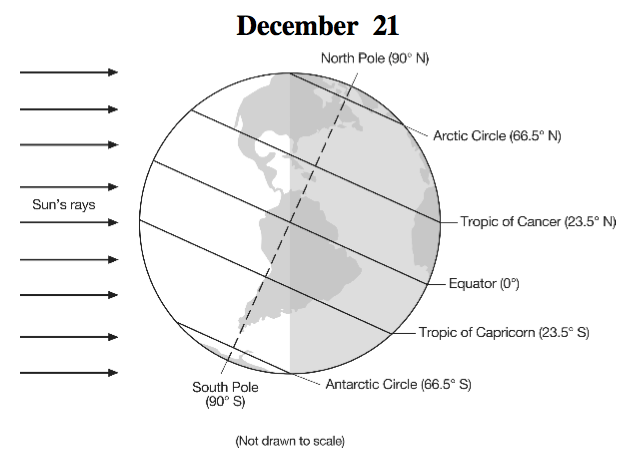
Where is the sun directly overhead on December 21?
The Tropic of Capricorn (23.5 degrees S)
The south pole
The Tropic of Cancer (23.5 degrees N)
The equator
Where is the sun directly overhead on June 21?
The Tropic of Capricorn (23.5 degrees S)
The north pole
The Tropic of Cancer (23.5 degrees N)
The equator

Which date is represented by the diagram?
March 21
June 21
September 21
December 21
Where is the sun directly overhead on March 21?
The Tropic of Capricorn (23.5 degrees S)
The north pole
The Tropic of Cancer (23.5 degrees N)
The equator

What season in the northern hemisphere is represented at point B?
Winter
Spring
Summer
Fall
What equation is used to determine Earth's rate of rotation?
360 degrees / 365 days
24 hours / 360 degrees
360 degrees / 24 hours
24 hours / 365 days

What time is at position 1?
12 p.m. (noon)
9 a.m.
3 p.m.
6 a.m.

Which date is represented by the diagram?
March 21
June 21
September 21
December 21
What equation is used to determine Earth's rate of revolution?
360 degrees / 365 days
24 hours / 360 degrees
360 degrees / 24 hours
24 hours / 365 days
What season, in the Northern hemisphere, is represented at point D?
Winter
Spring
Summer
Fall
On which day do observers in New York State experience the greatest duration of insolation?
March 21
June 21
September 23
December 21
What time is at position 3?
12 p.m. (noon)
9 a.m.
3 p.m.
6 p.m.
How many degrees per hour does the Sun appear to move across the sky?
41 degrees
23.5 degrees
90 degrees
15 degrees
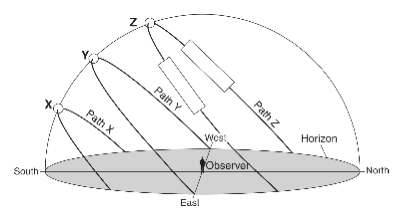
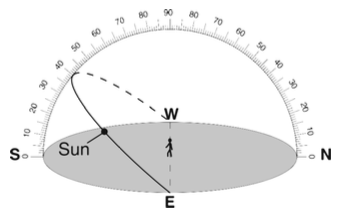

The diagram represents the apparent path of the Sun as seen by an observer at 65° N on March 21. The Sun's position shown in the diagram was observed closest to which time of day?
9am
12pm
3pm
6pm

The model shows the apparent path of the Sun as seen by an observer in New York State on the first day of one of the four seasons.
Spring
Summer
Fall
Winter

What would most likely happen to New York State's summer and winter temperatures if the tilt of Earth's axis increased from 23.5° to 30°?
Both the summers and winters would become cooler.
Both the summers and winters would become warmer.
The summers would become cooler and the winters would become warmer
The summers would become warmer and the winters would become cooler.

The diagram represents the horizon and the Sun's apparent paths, A, B, and C, on three different dates, as viewed from the same location in New York State. Which table correctly shows the dates on which the apparent paths of the Sun were observed?


When Earth is closest (at perihelion) to the Sun, which season is occurring in the Northern Hemisphere?
summer
winter
fall
spring

A tree in New York State casts a shadow as shown in the diagram below.
What time of day and season are represented by the diagram?
early morning in winter
late afternoon in winter
early morning in summer
late afternoon in summer

Which location (letter) represents March 21?
A
B
C
D

How many hours occurred between sunrise and solar noon on September 23?
6 hours
12 hours
24 hours
8 hours

For an observer in Freeport, NY in what direction will sunrise occur on June 21?
north of due west
south of due east
north of due east
south of due west

Which motion causes the observer to see different constellations at midnight on July 7 compared to midnight on January 3?
rotation of the Earth on its axis
revolution of Earth in its orbit
rotation of the stars in the constellations
rotation of the sun around the earth

The diagram represents a view of Earth from above the North Pole, showing longitude lines at 15 degree intervals. Letters A and B represent surface locations on the equator.
Check off 2 possible dates represented by this diagram,
March 21
December 21
September 23
June 21

Positions 1, 2, and 3 in the diagram below represent the noon Sun above the horizon on three different days during the year, as viewed from Binghamton, NY. At which position was the noon Sun on January 21, as viewed from Binghamton?
between position 2 and position 3
above position 1
below position 3
between position 1 and position 3

Identify the season when the earth is at aphelion?
winter
fall
summer
spring

Describe the change that takes place in the apparent size of the Sun, as viewed from Earth, as Earth moves from perihelion to aphelion.
The sun appears to get larger.
The sun never changes in apparent size.
The sun appears to get smaller.
The sun can be seen during day and night.

The map below shows four locations, A, B, C, and D, on the continent of South America.
Which location is the first to experience sunset on September 23?
A
B
C
D
Which diagram represents the apparent path of the Sun on March 21 for an observer at the equator?


Which location receives 24 hours of daylight on December 21?
90 degrees North
90 degrees South
41 degrees North
0 degrees- Equator
Which location on earth receives 12 hours of day and 12 hours of night all year long?
90 degrees North
90 degrees South
41 degrees North
0 degrees- Equator

The diagram below represents Earth as viewed from space. Letter A represents the angle of tilt of Earth's rotational axis. Line XY is perpendicular to the plane of Earth's orbit.
What is the value of the angle represented by letter A?
23.5 degrees
15 degrees
66.5 degrees
90 degrees

In the Northern Hemisphere, the intensity of insolation (sunlight) during the year is greatest when
shadow C' is shortest
shadow A' is longest
shadow D' is longest
shadow E' is shortest

For an observer in the Northern Hemisphere- from September 23 to December 20, the length of the shadow at noon will
increase
decrease
remain the same

Which change in seasons occurs in the Northern Hemisphere at position D?
Fall is ending and winter is beginning.
Winter is ending and spring is beginning.
Summer is ending and fall is beginning
Spring is ending and summer is beginning
Which diagram correctly shows the directions of Earth's revolution and rotation?


What is the primary reason each city's duration of daylight hours changes throughout the year?
Earth's rotation rate is 15° per day
Earth's axis is tilted 23.5° to the plane of its orbit.
The cities are located at different elevations.
The cities are located at different longitudes

The diagram below represents the apparent path of the Sun as seen by an observer at 65° N on March 21.
The Sun's position shown in the diagram was observed closest to which time of day?
9 AM
3 PM
6 PM
11 AM

What season is beginning in the Northern Hemisphere?
summer
fall
winter
spring
Which diagram best represents the apparent path of the Sun on June 21 in the N Hemisphere?


Sunlight hits the ground at a 90 degree angle
Intensity of rays
Direct ray
Slanted ray
Duration of insolation


How many hours (h) of daylight are received at the Arctic Circle when Earth is at position A?
0hrs
12hrs
18hrs
24hrs

The change in the apparent position of the Big Dipper between the first day of summer and the first day of winter is best explained by Earth

Base your answers on the diagram, which shows the tilt of Earth on its axis in relation to the Sun on one particular day. Points A through E are locations on Earth’s surface. Point D is located in New York State. The dashed line represents Earth’s axis.
Which diagram best represents the angle of the Sun’s rays received at location C at noon on this day?


Base your answers on the diagram, which shows the tilt of Earth on its axis in relation to the Sun on one particular day. Points A through E are locations on Earth’s surface. Point D is located in New York State. The dashed line represents Earth’s axis.
What is the latitude of location A?
0°
23 1/2 ° N
63 1/2 ° S
90° N
Base your answers on the diagram, which shows the tilt of Earth on its axis in relation to the Sun on one particular day. Points A through E are locations on Earth’s surface. Point D is located in New York State. The dashed line represents Earth’s axis.
On this day, which location has the greatest number of hours of daylight?
E
B
C
D

Base your answer on the diagram, which represents the position of the Sun with respect to Earth’s surface at solar noon on certain dates. The latitudes of six locations on the same line of longitude are shown. The observer is located at 42° N in New York State. The date for the Sun at position A has been deliberately left blank.
At which New York State location could the observer be located?
Plattsburgh
Mount Marcy
New York City
Slide Mountain
Base your answer on the diagram, which represents the position of the Sun with respect to Earth’s surface at solar noon on certain dates. The latitudes of six locations on the same line of longitude are shown. The observer is located at 42° N in New York State. The date for the Sun at position A has been deliberately left blank.
When the Sun is at position A, which latitude receives the most direct rays of the Sun?
Tropic of Cancer (23.5° N)
Tropic of Capricorn (23.5° S)
Equator (0°)
Antarctic Circle (66.5° S)
Base your answer on the diagram, which represents the position of the Sun with respect to Earth’s surface at solar noon on certain dates. The latitudes of six locations on the same line of longitude are shown. The observer is located at 42° N in New York State. The date for the Sun at position A has been deliberately left blank.
When the Sun is at the March 21 position, New York State will usually have
longer days than nights
12 hours of daylight and 12 hours of darkness
the lowest annual altitude of the Sun at solar noon
the highest annual altitude of the Sun at solar noon

Base your answer on the diagram, which shows a model of the apparent path and position of the Sun in relation to an observer at four different locations, A, B, C, and D, on Earth’s surface on the dates indicated. The zenith (z) and the actual position of the Sun in the model at the time of the observation are shown. [The zenith is the point directly over the observer.]
According to the Sun’s actual position shown in the diagrams, the most intense insolation is being received by the observer at location
A
B
C
D
Base your answer on the diagram, which shows a model of the apparent path and position of the Sun in relation to an observer at four different locations, A, B, C, and D, on Earth’s surface on the dates indicated. The zenith (z) and the actual position of the Sun in the model at the time of the observation are shown. [The zenith is the point directly over the observer.]
Where on Earth’s surface is the observer at location C located?
at the Equator
at the South Pole
at the North Pole
in Oswego, New York
Base your answer on the diagram, which shows a model of the apparent path and position of the Sun in relation to an observer at four different locations, A, B, C, and D, on Earth’s surface on the dates indicated. The zenith (z) and the actual position of the Sun in the model at the time of the observation are shown. [The zenith is the point directly over the observer.]
From sunrise to sunset at location B, the length of the observer’s shadow will
increase, only
decrease, only
increase, then decrease
decrease, then increase

Base your answer on the diagram, which shows sunlight entering a room through the same window at three different times on the same winter day.
The apparent change in the Sun’s position shown in the diagram is best explained by
the Sun rotating at a rate of 15° per hour
Earth rotating at a rate of 15° per hour
the Sun’s axis tilted at an angle of 23.5 °
Earth’s axis tilted at an angle of 23.5 °
Base your answer on the diagram, which shows sunlight entering a room through the same window at three different times on the same winter day.
This room is located in a building in New York State. On which side of the building is the window located?
north
south
west
east

Base your answer on the diagram, which shows the angle of the Sun’s noontime rays received at different Earth latitudes on May 1.
Which changes can be expected to occur at 45° N over the next 30 days?
The duration of insolation will decrease and the temperature will decrease.
The duration of insolation will decrease and the temperature will increase.
The duration of insolation will increase and the temperature will decrease.
The duration of insolation will increase and the temperature will increase.
Base your answer on the diagram, which shows the angle of the Sun’s noontime rays received at different Earth latitudes on May 1.
At which latitude can the noontime Sun be observed in the northern part of the sky?
0°
30° N
60° N
90° N
Which model best represents the apparent path of the Sun observed at various times during the year at the Equator?


How many times will the Sun’s perpendicular rays cross Earth’s Equator between March 1 of one year and March 1 of the next year?
1
2
3
4

Base your answers on the diagram and on your knowledge of Earth science. The diagram shows a pin perpendicular to a card. The card was placed outdoors in the sunlight on a horizontal surface. The positions of the pin’s shadow on the card were recorded several times on March 21 by an observer in New York State.
Which diagram best represents the length of the pin’s shadow at 2 p.m. on March 21?


Base your answers on the diagram and on your knowledge of Earth science. The diagram shows a pin perpendicular to a card. The card was placed outdoors in the sunlight on a horizontal surface. The positions of the pin’s shadow on the card were recorded several times on March 21 by an observer in New York State.
The changing location of the pin’s shadow on March 21 is caused by
the Sun’s rotation
the Sun’s revolution
Earth’s rotation
Earth’s revolution
The intensity of insolation at solar noon from November 1 to February 1 in New York State will
decrease, only
increase, only
decrease, then increase
increase, then decrease
In New York State, the number of hours of daylight each day increases continuously from
March 1 to May 1
June 1 to August 1
September 1 to November 1
December 1 to February 1

