
 Worksheets
CHAPTER 6 (PLC)
Total questions: 110
Worksheet time: 2hrs 50mins
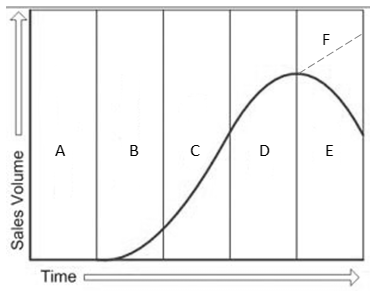
What is happening at point F of the Product Life Cycle?
Growth
Maturity
Extension Strategy
Introduction

Which one is NOT a stage in the PLC?
maturity
decline
growth
continues

Which stage has rapid sales?
introduction
maturity
decline
growth

Which stage has lots of competitors?
growth
maturity
introduction
decline

What is a product extension?
longer production time
products with extension features
strategies to keep the product from declining
products that keep going through the different stages

Which stage requires lots of advertising?
introduction
growth
maturity
decline
Which stage has the least production costs?
introduction
maturity
decline
growth

What should a business do in the intro stage?
make lots of their product
build up sales
increase staff numbers
increase customer awareness
What could a business do in the decline stage?
remove the product from the market
use a product extension strategy
increase production
sack the directors and start again

Which stage has economies of scale?
introduction
growth
maturity
decline

What stage would Netflix be in? Discussion.
introduction
growth
maturity
decline

What stage would Kleenex handee towels be in? Discuss.
Introduction
Maturity
Decline
Growth

What stage has numbers of prototypes?
development
growth
maturity
decline

What stage would a business have large market share?
Intro
growth
maturity
decline

What stage could encourage niche markets?
intro
growth
maturity
decline

What stage would gluten free sausages be in?
intro
growth
maturity
decline

What has Coke Cola done to its product to survive?
change the recipe
change the bottle
change the size
change the logo

What stage will have decreases in production?
intro
growth
maturity
decline

What stage has least competitors?
intro
maturity
decline
growth

Which stage would Nivea men's moisturiser be in? Discuss.
intro
maturity
decline
growth

What is the MAIN purpose of using a PLC?
to help with staffing issues
to improve customer service
to help make better marketing decisions over time
to lift salaries for directors
What does increase mean?
Sales go up
Sales go down
What does decrease mean?
Sales go up
Sales go down
What is the product life cycle?
Sales of a product from introduction to decline
The price of a product over time
How many stages are in the product life cycle?
3
5
6
7
What is the second stage of the product life cycle?
Growth - product sales increase
Introduction - new product to the market
Maturity - product sales start to slow down
Decline - product sales decrease

An example of the Introduction phase is when the First iPhone was released by Apple
True
False
What is the third phase of the product life cycle?
Introduction - new product released
Maturity - product sales start to slow down
Growth - product sales increase
Decline - product sales decrease
What is the 3rd stage of the product life cycle?
Maturity - product sales start to slow down
Decline - product sales decrease
Growth - product sales increase
Introduction - new product release

What is the final stage of the product life cycle?
Growth - product sales increase
Introduction - new product release
Decline - product sales decrease
Maturity - product sales start to slow down
How can a business increase sales?
Innovative marketing
Add new features e.g. iPhone 12 - 4 cameras
Innovation - create a new product
All of the above
Which is not a stage of the product life cycle?
Product development
Introduction
Decline
Maturity
Competitive growth
Select the products that do not follow the product life cycle.
Fads
Styles
Automobiles
Fashions
In this stage:
•Begins when the company develops a new-product idea
•Sales are zero
•Investment costs are high
•Profits are negative
Product development
Introduction
Growth
Maturity
Decline
In this stage:
•Low sales
•High cost per customer acquired
•Negative profits
•Innovators are targeted
•Little competition
Product development
Introduction
Growth
Maturity
Decline
In this stage:
•Low sales
•High cost per customer acquired
•Negative profits
•Innovators are targeted
•Little competition
Product development
Introduction
Growth
Maturity
Decline
In this stage:
•Rapidly rising sales
•Average cost per customer
•Rising profits
•Early adopters are targeted
•Growing competition
Product development
Introduction
Growth
Maturity
Decline
In this stage:
•Sales peak
•Low cost per customer
•High profits
•Middle majority are targeted
•Competition begins to decline
Product development
Introduction
Growth
Maturity
Decline
In this stage:
•Declining sales
•Low cost per customer
•Declining profits
•Laggards are targeted
•Declining competition
Product development
Introduction
Growth
Maturity
Decline
During this stage, a business will research and devlop the product. Product testing and trials takes place.
Development
Introduction
Growth
Maturity
Decline
During this stage, the product is launched. Usually a loss is made during this phase as Sales are low (but increasing)
Development
Introduction
Growth
Maturity
Decline
During this stage, products sales increase profits start to be made. A business may need to increase outlets to reach new markets.
Development
Introduction
Growth
Maturity
Decline
During this stage, sales rate starts to slow, perhaps a competitor has launched something similar or customers just want something new.
Development
Introduction
Growth
Maturity
Decline
During this stage, sales start to fall. Extension strategies needed to pick up sales again.
Development
Introduction
Growth
Maturity
Decline
Actions a business can take to extend the life of a product and increase sales.
Extension strategies
Introduction
Growth
Maturity
Decline
Which stage has rapid sales?
introduction
maturity
decline
growth
Which stage has lots of competitors?
growth
maturity
introduction
decline
Which stage has the least production costs?
introduction
maturity
decline
growth
What is happening at point D on the Product Life Cycle?
Introduction
Decline
Maturity
Growth
What is happening at point F of the Product Life Cycle?
Growth
Maturity
Extension Strategy
Introduction
What is happening at point C on the Product Life Cycle?
Introduction
Decline
Maturity
Growth
A possible extension strategy is to add value. This means
Increasing the price of the product
Decreasing the price of the product
Add new features to the existing product
A possible extension strategy is to invest in advertising. The drawback of this is that...
Adverts can be very expensive and do not gurantee increased sales.
It may attract new customers
The business may not have full control
Adverts are repetitive
A possible extension strategy is to invest in new packaging. The advantage of this is that...
the improved packaging can give the impression of better quality.
Packaging is not very expensive
Packaging may look attractive
Which one of the following is NOT an extension strategy
advertising
change the price of a product
add value
Explore new markets
Lower production and eventually discountiue the product.
What is the Product Life Cycle?
The estimation of how long it will take the product to falter in the market.
The entire existence of a product from its origins to its death.
The length of time it takes for a product to enter the market
The cycle of how many times a product is copied in the market.
What is the correct pattern of stages of product life cycle?
Introduction-Maturity-Growth-Decline
Introduction-Growth-Decline-Maturity
Introduction-Growth-Maturity-Decline
Introduction-Decline-Maturity-Growth
Which Industry will have shorter product life cycle?
Banking
Retail Products
Technology
All of the above
It is the stage that focuses on creating product awareness and trial.
Introduction
Growth
Maturity
Decline
It is a period of market acceptance and increasing profits.
Introduction
Growth
Maturity
Decline
It is a stage wherein sales volume peak.
Introduction
Growth
Maturity
Decline
It is the stage wherein demands for a product reduce.
Introduction
Growth
Maturity
Decline
You need to invest a lot in marketing during the ________ phase of the product life cycle.
Introductory
Growth
Maturity
Decline
Products will always reach maturity in the Product Life Cycle.
True
False
An example of a product that reached maturity and is declining very quickly is ___________.
Coca Cola
The iPhone
Movies
Crocs
Sales start to drop during the ___________ phase.
Introductory
Maturity
Growth
Decline
Once a product is on the decline, it cannot be saved.
True
False
A product that is selling rapidly but is still growing is in the _________ phase.
Introductory
Growth
Maturity
Right now, Coca Cola is in the ___________ phase.
Introductory
Growth
Maturity
Decline
This is where the product is coming into the market
Growth
Decline
Maturity
Introduction
This is where the business makes the most sales
Introduction
Growth
Maturity
Decline
This is where the product sales drop
Introduction
Maturity
Decline
Growth
This is where the sales continue to remain the same
Introduction
Growth
Maturity
Decline
The product life cycles shows the journey of a product
True
False
To save a product from failing and decline businesses can use a
Exit strategy
Exact Strategy
Extension Strategy
Expat Steategy
Advertising Costs are really high at this stage
Introduction
Growth
Decline
Maturity
During this stage, sales start to fall. Extension strategies needed to pick up sales again.
Introduction
Growth
Maturity
Decline
Product life cycle shows the different stages that a product passes through and sales that can be expected at each stage
TRUE
FALSE
Actions a business can take to extend the life of a product and increase sales.
Phase out product
Extension Strategies
Cost-cutting
Phase out unprofitable outlets
A possible extension strategy is to invest in advertising. The drawback of this is that...
It may attract new customers
Adverts can be very expensive and do not guarantee increased sales.
The business may not have full control
Adverts are repetitive
Sales rate starts to slow, perhaps a competitor has launched something similar or customers just want something new.
Decline
Development
Maturity
Introduction
Which stage has the least production costs?
Introduction
Growth
Maturity
Decline
Which one of the following is NOT an extension strategy?
Explore new markets
Change the price of a product
Lower production and eventually discontinue the product.
add value
What should a business do in the intro stage?
build up sales
make lots of their product
increase staff numbers
increase customer awareness

What is happening at point C on the Product Life Cycle?
Introduction
Maturity
Growth
Decline
During this stage, the product is launched. Usually a loss is made during this phase as Sales are low (but increasing).
Introduction
Growth
Maturity
Decline
Which stage has rapid sales?
Decline
Maturity
Growth
Introduction
A possible extension strategy is to add value. This means ___?
Increasing the price of the product
Decreasing the price of the product
Add new features to the existing product
None of the above.
Products sales increase profits start to be made. A business may need to increase outlets to reach new markets.
Decline
Growth
Maturity
Introduction
What could a business do in the decline stage?
increase production
use a product extension strategy
remove the product from the market
sack the directors and start again
What is the term used for extending a product life cycle?
Extension strategies
Product Sales
Service expansion
Business Growth


