Wayground logo

Free Printable Worksheets

Font size

S
M
L
XL
Worksheets

Env science Quarter 2 Review

Total questions: 39

Worksheet time: 26mins

Name
Class
Date
1.
____________ believed that those organisms that were best suited for their environment would survive and pass on their beneficial traits to their offspring. 
a)
Darwin
b)
Lamarck
c)
Watson
d)
Mendel
2.
Choose which scientist corresponds best with the statement: 
survival of the fittest
a)
Darwin 
b)
Lamarck
3.
The process in which organism with variations most suited to their local environment survive and leave more offspring.
a)
Natural Selection
b)
Survival of the Fittest
c)
Common Descent
d)
Phenotype
4.
What do we call change over time?
a)
Evolution
b)
Natural Selection
c)
Natural Variation
d)
Speciation
5.
Who would have stated "acquired traits" such as a giraffe needing a long neck so they stretch it over time
a)
Darwin
b)
Lamarck
c)
Malthus
6.
This salamander did not use its eyes so it lost its vision, Who said if you don't use it you lose it? 
a)
Darwin
b)
Lamarck
c)
Malthus
7.
succession that occurs in an area with no soil
a)
ecological succession 
b)
primary succession 
c)
secondary succession
d)
pioneer speciles
8.
succession that occurs in an area where soil is already present
a)
ecological succession 
b)
primary succession 
c)
secondary succession
d)
pioneer speciles
9.
the first organisms that appear in an ecological community
a)
ecological succession 
b)
primary succession 
c)
secondary succession
d)
pioneer speciles
10.
a stable ecological community that has reached equilibrium
a)
ecological succession 
b)
climax community
c)
secondary succession
d)
pioneer speciles
11.
starts with bare rock followed by lichen
a)
primary succession 
b)
secondary succession
c)
both types of succession
12.
Natural disasters such as flooding and tornadoes are linked to ________________.
a)
primary
b)
secondary
c)
old field
d)
ecosystem
13.
What is the order of succession shown in this figure?
a)
A, B, C, D
b)
B, A, D, C
c)
C, D, A, B
d)
D, A, B, C
14.

This is otherwise called/known as controlled burns, it helps to restore ecosystems that depend on fire

a)

wild fires

b)

prescribed burns

c)

unknown burns

d)

wildfire burns

15.
When land becomes more desertlike because of human activity or climate change.
a)
Erosion
b)
Desertification
c)
Salinization
d)
Compost
16.

Raising too many livestock on the land, which may lead to soil erosion, is called

a)

Overharvesting

b)

Erosion by animal

c)

Overgrazing

d)

Overeating

17.
A tree is a ....
a)
composer
b)
decomposer
c)
producer
18.
What is a producer?
a)
an organism that gets energy from eating other organisms
b)
an organisms that uses sunlight to make its own food
c)
an organism that gets energy from eating dead organisms, non-living material or waste
d)
an organism that uses chemical energy to make its own food
19.
The direction of the flow of energy in a food web is represented by ___.
a)
Light bulbs
b)
Dotted Lines
c)
Arrows
d)
Bubbles
20.
Energy increases as you move up the food pyramid (from bottom to top).
a)
True 
b)
False
21.
What percentage of energy is passed on to each tropic level?
a)
10%
b)
50%
c)
90%
d)
100%
22.

Which of the following is producer/autotroph?

a)

rabbit

b)

frog

c)

tree

d)

worm

23.

Using the food web which of the following is a primary consumer?

a)

butterfy

b)

snake

c)

fox

d)

frog

24.

Using food web which of the following is a secondary consumer?

a)

snake

b)

worm

c)

butterfy

d)

squirrel

25.

Using the food web which of the following is a tertiary consumer?

a)

frog

b)

bird

c)

eagle

d)

worm

26.

the variety of life in the world or in a particular habitat or ecosystem

a)

biodiversity

b)

demography

c)

carrying capacity

d)

poaching

27.

Which of the following would be most effective in slowing the loss of biodiversity?

a)

creating large parks/preserves in biodiversity hotspots

b)

requiring every country to maintain a seed bank

28.

Food Web B is an example of...

a)

Low biodiversity and low sustainability. If the producer dies then all the food web will suffer.

b)

High biodiversity and high sustainability. If an organism is removed the food web will continue with no effect.

29.

Which habitat exhibits the greatest biodiversity?

a)

A habitat with 15 different species with about 300 individuals each

b)

A habitat with 10 different species with about 75 individuals each

30.

What does the term carrying capacity describe?

a)

The maximum number of birth rates for a population.

b)

The ability of a population to accept new immigrants.

c)

The ratio of birth rates to death rates in a population.

d)

The population size that the environment can sustain.
31.
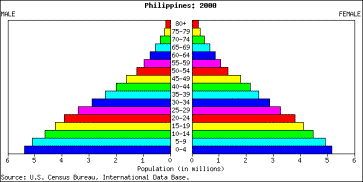
According to the population pyramid of this country, its population is most likely...
a)
growing slowly.
b)
growing rapidly.
c)
decreasing.
d)
not changing.
32.

What type of growth is the human population experiencing today?

a)

Exponential growth

b)

Zero population growth

c)

Slight decreases in growth

d)

Slight increases in growth

33.
When individuals join a population
a)
Aliens
b)
migration
c)
Immigration
d)
Emigration
34.
When a population grows past the ecosystem's carrying capacity, what happens to the population?
a)
Continues to grow
b)
The population starts to die off to return to carrying capcity
c)
The population will go extinct due to lack of resources
d)
The population grows then finds a new carrying capacity
35.
When you leave a population
a)
emigration
b)
mitigation
36.
How can a populaiton grow?
a)
Emigration and death
b)
Immigration and death
c)
Immigration and birth
d)
Emigration and birth
37.
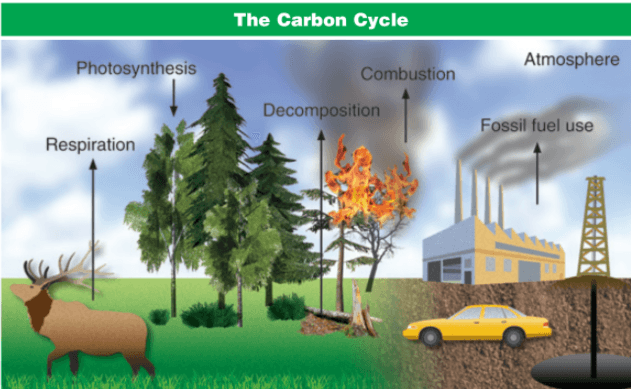
In this diagram, how many ways can carbon enter the living world?
a)
one
b)
two
c)
three
d)
four
38.
Burning fossil fuel has which effect in the carbon cycle?
a)
It removes carbon dioxide from the atmosphere.
b)
It puts carbon dioxide under the ground.
c)
It adds carbon dioxide to the atmosphere.
d)
It has no effect in the carbon cycle.
39.
Which process takes carbon dioxide out of the atmosphere?
a)
respiration
b)
combustion
c)
decomposition
d)
photosynthesis