
 Worksheets
Covalent Bonding Test Review
Total questions: 85
Worksheet time: 1hrs 4mins
If the atoms that share electrons have an unequal attraction for the electrons, the bond is called
nonpolar
polar
ionic
dipole
A neutral group of atoms held together by covalent bonds is a
molecular formula
chemical formula
molecule
monoatomic ion
Elements that form multiple covalent bonds include
oxygen
carbon
nitrogen
all of the above
What is the formula for dioxygen pentachloride?
OCl4
O2Cl5
O5Cl2
O4Cl
Why do most atoms form bonds?
to be more stable by completing the octet
to be less stable
to add more electrons
to carry out physical changes
If two covalently bonded atoms are identical, the bond is
coordinate covalent
polar covalent
dipole covalent
nonpolar covalent
What are shared in a covalent bond?
ions
Lewis structures
dipoles
electrons
The B-F bond in BF3 (electronegativity for B is 2.0; electronegativity for F is 4.0) is
polar covalent
ionic
nonpolar covalent
metallic
In a molecule of fluorine, the two shared electrons give each fluorine atom how many electron(s) in the outer energy level?
1
2
8
32
The following molecules contain polar bonds. The only polar molecule is
CCl4
CO2
NH3
CH4
Name the compound CF4.
calcium fluoride
carbon fluoride
carbon tetrafluoride
monocalcium quadrafluoride
How are atoms held together in covalent bonds?
By gaining and losing electrons
By sharing electrons
If the bond between two atoms, both of which are nonmetals, has the electronegativity difference of 0.4, what type of bond do the atoms have?
Ionic
Polar Covalent
Non-polar covalent
What types of elements combine to form ionic bonds?
Metals and metalloids
Metals and non metals
Non metals only
Metalloids only
Metals only
When diatomic fluorine creates a molecule, what type of bond is used? (Hint, you may have to draw the Lewis structure)
Single bond
Double bond
Triple bond
Which of the following is NOT one of the seven diatomic molecules?
Hydrogen
Carbon
Bromine
Iodine
Oxygen
What type of bond will N - H form?
Polar Covalent
Non-polar Covalent
Ionic
If the bond between two atoms has an electronegativity difference of 0.6, what type of bond do the atoms have?
Ionic
Polar Covalent
Non-polar Covalent
Which group has no electronegativity value?
Halogen
Transition Metals
Noble Gases
Alkaline Earth Metals
Which element is an exception to the octet rule?
K
H
N
O
What type of bond is present in the compound Co3N?
Covalent
Ionic
What type of bond does NO2 have?
Ionic
Covalent
How many atoms of oxygen are in the compound Al2(SO4)3
2
3
4
7
12
How many electrons are shared between two atoms in a double covalent bond?
1
2
4
6
Which of the following has the greatest electronegativity?
O
S
Br
Si
If a bond between two atoms has an electronegativity difference of 1.9, we can assume that bond is ________________
Ionic
Polar Covalent
Non Polar Covalent

The compound CBr4 has a tetrahedral shape, what is the molecular polarity?
Polar
Nonpolar

What is the molecular geometry (shape) of NH3?
Bent
Trigonal Planar
Trigonal Pyramidal
Tetrahedral
Linear

What is the correct molecular geometry AND molecular polarity of HCN?
Tetrahedral, nonpolar
Tetrahedral, polar
Bent, polar
Linear, polar
Linear, nonpolar
Which of the following bonds is the most polar?
O-F
N-F
H-F
S-F
When drawing the structure of diatomic oxygen (O2), what type of bond is used?
single
double
triple
quadruple
How many valence electrons are in an atom with a 1s22s22p3 electron configuration?
1
2
3
5
Which family on the periodic table is unreactive because of the octet rule?
Noble gases
Alkaline Earth
Alkali Earth
Transition Metals
Electrons are ______________ in ionic bonds
shared
buried
transferred
A substance has a high boiling point and conducts electricity. Is this an ionic or covalent substance?
ionic
covalent
Write the formula for dihydride monoxide.
HMo
HO
HO2
H2O
How many electrons are shared in a triple bond?
2
3
4
6
Polar bonds exist because a difference in
electronegativity
ion charges
atomic radius
magnetism
The chemical bond between a metal and a non-metal will be a _____ bond.
metal
ionic
covalent
polar

In an ionic bond the metal wants to ______ electrons.
lose
gain
share

When a metal loses an electron(s) it becomes a ...
positive ion
negative ion
metalloid
nonmetal
Carbon and Oxygen will make a ___________ bond.
ionic
covalent
metallic
Sodium and Bromine will make a _____ bond.
ionic
covalent
metallic
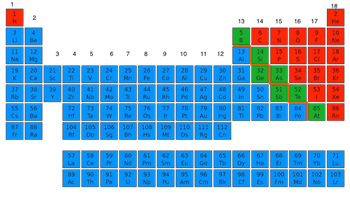
Which of the following names matches the chemical formula N2O3?
Dinitrogen triople oxide
Nitrogen oxide
Dinitrogen trioxide
Trioxide nitrogen
How many atoms are in this molecule? C6H12O6
6
12
18
24

When trying to figure out how many electron shells an atom has, do you look at the Period (rows) or the Group (columns)?
Period (Rows)
Group (Columns)
When trying to figure out how many valence electrons an atom has, do you look at the Period (rows) or the Group (columns)?
Period (Rows)
Group (Columns)

Which 2 elements have the same number of valance electrons?
Aluminum (AL) and Sulfur (S)
Nitrogen (N) and Silicone (Si)
Oxygen (O) and Sulfur (S)
In forming covalent bonds, why do atoms share electrons?
To achieve noble-gas notation
To become charged
To form ions
What are atoms used to complete an octet but not used in bonding called?
Shared pair
Lone pair
Bonded pair
unshared pair


When drawing a Lewis structure, after drawing in your bonds and lone pairs, what do you do if you don't have enough electrons to get each atom to its octet?
Place dots until everything has eight
Place dots only around the terminal atoms
Add a multiple bond
Have eight only around the central atom

Is this molecule polar or non-polar?
Polar
Non-polar

Is this molecule polar or non-polar?
Non-polar
Polar


Which substance has the weakest intermolecular forces?
Substance A, boiling point of 75 °C
Substance B, boiling point of 105 °C
Substance C, boiling point of 25 °C
Substance d, boiling point of 45 °C
Water has an unusually high boiling point for a molecular compound because it has
hydrogen bonding
ion-ion attractions
a high density
a large gram formula mass
Which sample has hydrogen bonding?
H2S
CH4
NH3
HI
________________________ have the strongest intermolecular forces of attraction.
Dipole- Dipole
Dispersion
Hydrogen Bonds

Intermolecular forces for: CO2
Dispersion Force
Dipole dipole
Hydrogen bonding
covalent bond
London forces
hydrogen bond
dipole-dipole attraction

