
 Worksheets
Chemistry Final Exam Review
Total questions: 120
Worksheet time: 3hrs 6mins
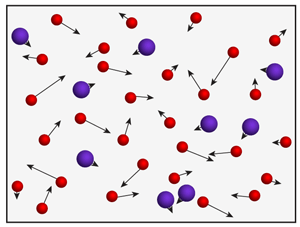
What happens to the atoms of a substance in a physical change?
Atoms get bigger
Atoms change their arrangement and motion
Atoms get smaller
Atoms bond together differently
What happens to the atoms of a substance in a chemical change?
Atoms get bigger
Atoms change their arrangement and motion
Atoms get smaller
Atoms bond together differently


Which of the following are examples of chemical changes?
Burning paper
Cutting paper
Iron rusting
Wrinkling paper

Determine the molecular geometry of the given structure.
Trigonal Pyramidal
Trigonal Bipyramidal
Trigonal Planar
Tetrahedral

What intermolecular forces would exist between molecules of HF?
London Dispersion Forces
Dipole-Dipole Forces
Hydrogen Bonding
All of the above
Which of the following would experience dipole-dipole forces of attraction between molecules?


Which of the following has T-shape molecular geometry?


Is this molecule polar or non-polar?
Polar
Non-polar


Is this molecule polar or non-polar?
Polar
Non-polar

Is this molecule polar or non-polar?
Non-polar
Polar

Is this molecule polar or non-polar?
Non-polar
Polar


Which is true of this molecule? (select ALL that apply)
bent, 109.5o bond angles
bent, 120o bond angles
linear, 180o bond angles
polar
nonpolar

Ionic bonds have an electronegativity difference of...
Under 1.7
Over 1.7
Between .4 and 1.7
Under .4
What is electronegativity?
An electron's charge
The same as atomic bonding
Whether they can easily repel electrons
How easily elements can attract electrons to themselves
If a molecule is trigonal pyramidal, how is that different from a tetrahedral?
A trigonal pyramidal has 1 lone pair and 3 atoms around the central atom ... a tetrahedral has 4 atoms around the central atom and no lone pairs
A trigonal pyramidal has 4 atoms around the central molecule and no lone pairs, and a tetrahedral has one lone pair and three atoms
A trigonal pyramidal has 2 lone pairs and 2 atoms around the central molecule ... a tetrahedral has 4 atoms and no lone pairs
Trick question, they aren't different.
Why do lone pairs affect molecular geometry?
They don't affect molecular geometry.
Lone pairs pull the atoms bonded to the central atom towards them.
Lone pairs are made of electrons, which repel other electrons in the molecule (such as the ones in the bonds)
Lone pairs are made of protons, which repel the protons in the atoms around the central atom
How do you take the electronegativity difference?
Subtract the two electronegativity values from each other
Divide the larger electronegativity value by the smaller one
Add the two electronegativity values
Multiply the electronegativity values
What are the bond angles between each H in BeH2?
90
120
109.5
180
What are the bond angles between each H in CH4?
109.5
120
180
360
If there are 2 atoms bonded around the central atom, and an unknown number of lone pairs, what is its molecular geometry?
Linear
Bent
Trigonal Pyramidal
We can't know without knowing if there are lone pairs.
What type of bond would H2S have, if H has an electronegativity of 2.2 and S has an electronegativity of 2.58?
Polar
Nonpolar
Ionic
None of the above
The polarity of a bond between two elements can be best determined by
The difference in electronegativity between the elements
The difference in first ionization energy between the elements
The number of electrons shared in the bond
The difference in atomic radius between the elements


non-polar

What is the electron-domain and molecular geometry of the pictured compound, respectively?
Trigonal Bipyramidal; See Saw
Octahedral; Square Pyramidal
Trigonal Bipyramidal; Trigonal Bipyramidal
Octahedral; T-shaped
Which is the correct Lewis structure for carbon dioxide?


Which of the following best explain how to determine the shape of the molecule above?
there are 3 atoms bonded to the central atom and 2 lone pairs
there are single bonds
there are 3 atoms bonded to the central atom and 0 lone pairs of electrons on the central atom
Which of the following bonds is least polar?
C--O
O--H
S--Cl
Br--Br
I--F
Choose the electron dot formula that most accurately describes the bonding in CS2.


In the Lewis structure for ICl2–, how many lone pairs of electrons are around the central iodine atom?
0
1
2
3
4

Which type of IMF is responsible for the attraction pictured above?
Dipole-Dipole Interaction
Ion-Dipole Interaction
Hydrogen Bonds
Covalent Bond
Ionic Bond

Which type of IMF is responsible for the attraction pictured above?
Dipole-Dipole Interaction
Ion-Dipole Interaction
Hydrogen Bonds
Covalent Bond
Ionic Bond

Which type of IMF is responsible for the attraction pictured above?
Dipole-Dipole Interaction
Ion-Dipole Interaction
Hydrogen Bonds
Covalent Bond
Ionic Bond

Which type of IMF is responsible for the attraction pictured above?
Dipole-Dipole Interaction
Ion-Dipole Interaction
Hydrogen Bonds
Covalent Bond
Ionic Bond

Which type of IMF is responsible for the attraction pictured above?
Dipole-Dipole Interaction
Ion-Dipole Interaction
Hydrogen Bonds
Covalent Bond
Ionic Bond

Which type of IMF is responsible for the attraction pictured above?
Dipole-Dipole Interaction
Ion-Dipole Interaction
Hydrogen Bonds
Covalent Bond
Ionic Bond

Which type of IMF is responsible for the attraction pictured above?
Dipole-Dipole Interaction
Ion-Dipole Interaction
Hydrogen Bonds
Covalent Bond
Ionic Bond

Which type of IMF is responsible for the attraction pictured above?
Dipole-Dipole Interaction
Ion-Dipole Interaction
Hydrogen Bonds
Covalent Bond
Ionic Bond
Intermolecular forces are attractions between ______.
Cations and anions
Atoms within a molecule
Neighboring molecules
Protons and electrons
Which of the following might cause a hydrogen bond to form?
Carbon
Phosphorus
Sulfur
Oxygen
Intermolecular forces are responsible for which of the following properties?
State of matter
Color
Odor
Conductivity

Which of the following gives the correct chemical formula for the compound Magnesium Phosphide?
Mg2P3
MgP
Mg3P2
MgP2

What is the correct chemical name for the ionic compound: Na2O
Sodium oxide
Sodium (II) oxide
Disodium monoxide
Disodium oxide

What is the correct chemical name for the ionic compound: Fe3N2
Iron nitride
Iron (III) nitride
Iron (II) nitride
TriIron dinitride

What is the correct chemical name for the molecular compound: CS2
Carbon Sulfide
Carbon diSulfide
diCarbide diSulfide
Carbon (II) Sulfide
(Sulfuric Acid) made up of?

What is the correct chemical name for the molecular compound: SF4
Sulfur Fluoride
Sulfur TetraFluoride
TetraSulfide Fluoride
Sulfur (IV) Fluoride
What do atoms that form positive ions tend to do?
Tend to lose electrons
Tend to lose protons
Tend to gain electrons
Tend to gain protons

Titanium(IV) oxide has the formula
Ti4O
TiO4
Ti(IV)O
TiO2
Ti4O2
The substance ClO3– is best described as
a molecule
a polyatomic ion
a polyatomic molecule
a mixture
Which part of the atom is responsible for chemical bonding?
Core Electrons
Valence Electrons
Protons
Neutrons
Ionic compounds are held together by
intermolecular forces
electrostatic forces
magnetic forces
nuclear forces
A compound that is a poor conductor and has low melting and boiling points is most likely
ionic
metallic
covalent
High Melting & Boiling Points
Ionic
Network Covalent
Metallic
Molecular Covalent
When writing the chemical formula of a compound that contains more than one of a particular polyatomic ion, _____ must be used.
ionic charges
parenthesis
Greek prefixes
lower case letters.
If there is no subscript, there is ______ atom(s) of that element present in the compound
0
2
only 1
1 million
What is the charge of an aluminum ion that has 13 protons and 10 electrons?
3+
3 -
no charge

Which is the correct lewis dot structure for calcium chloride?
A
B
C
Horizontal row in the periodic table
group
valence electrons
period
family
type of element that is a good conductor of energy
nonmetal
metalloid
metal
transition metal
Each period in the periodic table corresponds to a(n)
principle energy level
energy sublevel
orbital
suborbital
Which statement is true about electronegativity
electronegativity is the ability of an anion to attract another anion
electronegativity generally increases as you move from top to bottom within a group
electronegativity generally is higher for metals than for non metals
electronegativity generally increases from left to right across a period
For groups 13 through 18, the number of valence electrons is equal to the group number
plus 1
plus the period number
minus the period number
minus 10
How does atomic radius change from left to right across a period in the periodic table
it tends to decrease
it tends to increase
it first increases, then decreases
it first decreases, then increases

Which of the following will have a larger radius than Zinc (Zn)?
Gallium (Ga)
Aluminum (Al)
Magnesium (Mg)
Strontium (Sr)

All elements found on the left side of the Periodic Table of the Elements have what properties in common?
They conduct heat and electricity
They are all gases
They are brittle and dull
They are radioactive

Based on their locations in the periodic table, which element has chemical properties most similar to those of calcium, Ca?
beryllium, Be
potassium, K
titanium, Ti
yttrium, Y

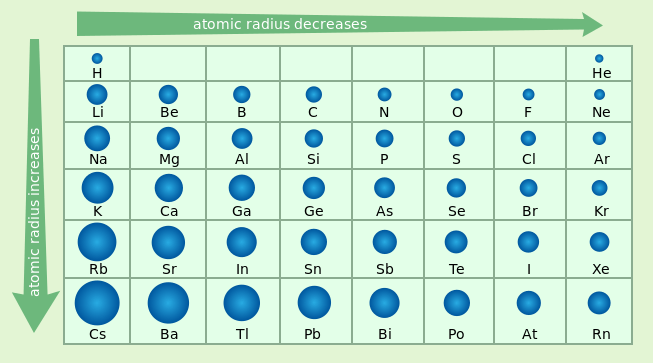
As you move across the periodic table atoms tend to get smaller because, ______________.
the atoms have more mass.
the atoms have more protons and increased electron shielding.
the atoms have more protons and electrons are added to the same energy level.
the atoms have more protons, electrons, and increased electron shielding.
The most dominant factor affecting the attraction between the outermost electrons and the nucleus is the
distance between the nucleus and outermost electrons.
none of these are correct.
total number of electrons.
number of protons/ nuclear charge.
What kind of element can conduct electricity, but be brittle (not malleable)?
some nonmetals
metalloids
some metals
all nonmetals
Chlorine has 17 electrons. According to the modern atomic theory, how many electrons are found in n = 2, the second energy level?
7
2
8
17
According to the Bohr model, what may happen when an atom gains energy?
The electron moves to a higher energy level.
The electron moves to a lower energy level.

What atom matches this electron configuration?
1s2 2s2 2p6 3s2
Neon
Magnesium
Aluminum
Potassium

What is this element?
1s22s22p63s23p64s23d104p6
Argon
Krypton
Selenium
Bromide

What is the shorthand electron configuration for Sulfur atom?
[Ar] 3p4
[He] 3s23p4
[Ne] 3s23p4
[Na] 3s23p3

Which element is pictured?
neon - 1s22s22p6
fluorine - 1s22s22p5
magnesium - 1s22s22p63s2
argon - 1s22s22p63s23p6

Identify the element in Period 5 that has 1 valence electron?
Rb
Nb
Ag
Sb

What element in Period 4 has 5 valence electrons?
Zr
As
V
Sb


Which element is depicted from this orbital diagram
Fluorine - 1s22s22p5
Neon - 1s22s22p6
Chlorine - 1s22s22p63s23p5
Argon - 1s22s22p63s23p6


When atoms _____________ energy, their electrons move to higher energy levels. These electrons _____________ energy by emitting light when they return to lower energy levels.
lose, absorb
absorb, lose
lose, lose
absorb, absorb
What is the difference in a 1s orbital and a 2s orbital?
The shape of the orbital
The size of the orbital
The number of electrons it can hold
None of the above

Why does Ca have a larger radius than Se?
It has more energy levels
It has fewer energy levels
It has a more effective nuclear charge
It has a less effective nuclear charge

Why is S smaller than Te?
It has more energy levels.
It has fewer energy levels.
It has a more effective nuclear charge.
It has a less effective nuclear charge.

Which of the following elements has the most "shielding" electrons?
nitrogen (N)
phosphorus (P)
arsenic (As)
bismuth (Bi)

