
 Worksheets
reproduction in animals(class 8)
Total questions: 55
Worksheet time: 57mins
After fertilisation, the ________ divides repeatedly to give rise to a ball of cells.
Ovum
Sperm
Zygote
Embryo
Which of the following is the site of fertilisation in humans?
Uterus
Fallopian tube
Ovary
Vagina
Which of the following is NOT a characteristic feature of sexual reproduction?
It involves the fusion of two reproductive cells.
It is common in most organisms.
Fertilization may take place inside or outside the body of the female.
The offspring receives its characteristics from one parent only.
Which of the following statements about the human female egg cell is incorrect?
It is produced when a female reaches puberty.
The two ovaries in a female alternately produce the egg cells.
One egg cell is usually produced by a female every 28 days.
An egg cell can live in the body of a female for about a month.
Budding is found in
Yeast
Hydra and Yeast
Hydra
None
Sexual reproduction requires ______ parent(s) and asexual reproduction requires ______ parent(s).
one, one
two, two
two, one
one, two
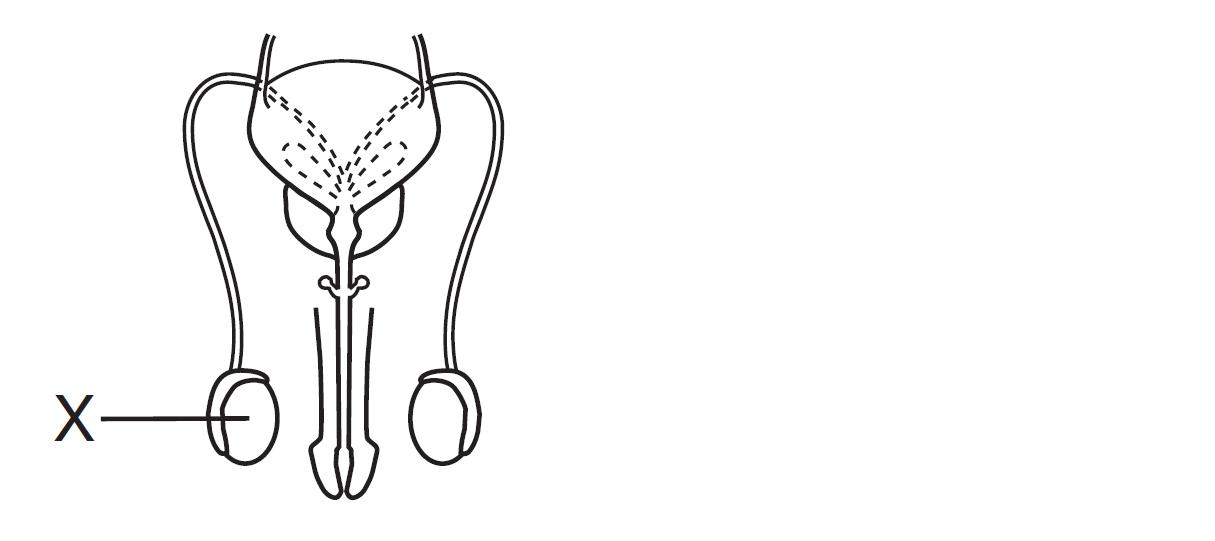
The diagram below represents a system in the human body. The function of structure X is to _____________
produce energy needed for sperm to move
provide food for the sperm to carry to the egg
produce and store urine
produce sperm
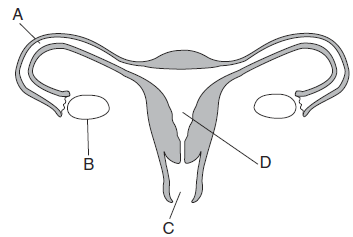
The human female reproductive system is represented below. Where will the embryo attach and develop?
A
B
C
D
The sperm moves because it has...
cilia
tail
hair
The fertilised egg is called
zygote
embryo
foetus
The release of the egg from the ovary is known as
menstruation
ovulation
fertilization
conception

A developing baby in a female's womb obtain its nutrients through the _________________________.
fallopian tube
pollen tube
umbilical cord
How similar is sexual reproduction in flowering plants and in humans?
It involves the fusion of pollen grain and sperm.
It involves the fusion of ovaries and ovules.
It involves the fusion of male and female reproductive cells.
It does not involve any fusion of male and female reproductive cells.
Hen is odd one out of human, cow, dog, hen because
It undergo internal fertilization
It is oviparous
It is viviparous
It undergo external fertilization
Animals having external fertilization usually produce large number of gametes because
Animals are small in size and want to produce more offspring
Food is available in plenty of water
To ensure better chance of fertilization
Water promotes production of large number of gametes
Which statement about Humans is correct
Involve external fertilization
Fertilization takes place in testes
During fertilization, egg move towards sperm
fertilization occur in female
In humans, the structure get embedded in the wall of uterus is
Ovum
Foetus
Zygote
Embryo
Aquatic animals in which fertilization takes place in water are called
Viviparous without fertilization
Oviparous with External fertilization
Viviparous with external fertilization
Oviparous with internal fertilization
Very first clone was of
Shelly
Riya
Dolly
Belly
Metamorphosis occur in
Human
Cow
Dog
Frog
Female reproductive organs are
Ovary, oviduct, uterus
Ovary, oviparous, penis
Penis, testes, spermduct
Uterus, penis, oviduct
How many cells are formed as a result of binary fission?
2
3
1
4

This form of reproduction creates clones
Sexual Reproduction
Asexual Reproduction
Egg Laying
Live Birth
With sexual reproduction the offspring will be genetically identical
True
False
A female external fertiliser will release a large number of eggs at one time because;
she only has one chance to reproduce in her lifetime
there is a lower chance of an egg being fertilised outside the body
external fertilsers are the most efficient reproducers
there is a higher risk of a fertilised egg being killed by a predator
How was Dolly different from virtually all other sheep on Earth?
She was grown in an incubator, not the womb of an ewe.
She lived much longer than ordinary sheep.
She had no father.
Her genetic code included goat pieces of DNA.
What does IVF stand for?
In vitro fertilisation
Insert viable foetus
Internal variable fertilisation
Internal vitro fertilisation
How many oviducts are there in a Female Reproductive System?
3
4
2
1
Sperm is produced by testes in numerous number throughout life from puberty onwards.
TRUE
FALSE
Number of eggs is determined at birth and will be released 500 mature eggs per month.
TRUE
FALSE
Ovum has a spherical in shape with a head, a neck, and a tail.
TRUE
FALSE
Sperm is bigger than ovum.
TRUE
FALSE
Sperm has a large nucleus with small amount of cytoplasm, but ovum has a large cytoplasm with small amount of nucleus.
TRUE
FALSE
Genetics material is located in nucleus.
TRUE
FALSE
Ovum is motile because it has cillia on the body of ovum.
TRUE
FALSE
The tail of sperm enables them to swim.
TRUE
FALSE

What happens to an ovum if it is not fertilized?
The ovum dries up and stays in the uterus
A zygote is formed
The ovum dies and leaves the body through the vagina (Period)

How many sperm are needed for fertilization to occur?
Millions
One
Thousands
Ten
Which of these journies does an ova make?
Fallopian tubes - ovary - uterus - vagina
ovary - Fallopian tubes - uterus - vagina
ovary - Fallopian tubes - vagina - uterus
vagina - uterus - Fallopian tubes - ovary
What do the sperm ducts connect?
the prostate gland to the penis
the testes with the prostate gland
the testes to the urethra
the prostate gland to the urethra
Choose the right order:
spermatozoa and ova - zygote - foetus - baby
spermatozoa and ova - foetus - zygote - baby
spermatozoa and ova - baby - foetus - zygote
Which type of reproduction results in offspring that is IDENTICAL to the parent?
Asexual Reproduction
Sexual reproduction
When a new organism grows on the body of its parent. The bud, or offspring is identical to the parent. The bud can break off of the parent and live on its own.
Regeneration
Vegetative propagation
Fission
Budding
Why is an offspring from Asexual rep. identical to the parent but an offspring from Sexual rep. is not?
Because in Sexual there are 2 different sets of DNA from each parent. In Asexual there is only 1 parent.
Because in Asexual they choose to be identical
Because sexual reproduction has mutations
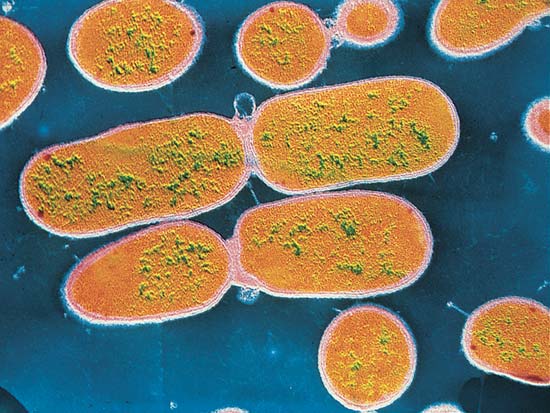

When a single-celled organism splits into 2 new organisms it is called _________________.
fragmentation
fission
budding
sporulation
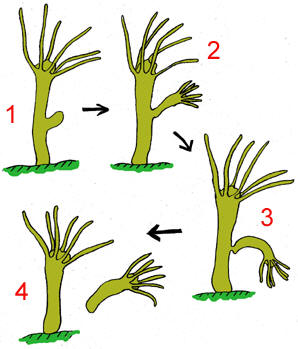
When an offspring grows off from the body of a parent organism it is called __________________.
budding
fission
fragmentation
sporulation
How does the DNA of the offspring formed from asexual reproduction compare to the parent?
none of the DNA is transferred to the offspring
half of the DNA is transferred to the offspring
the DNA of the offspring is identical to the DNA of the parent
none of these are correct
A multicellular organism that typically reproduces through budding.
bacteria
hydra
planaria
yeast
none of these
What was the name of the first cloned mammal?
Molly
Polly
Dolly
Holly
Mrs. Jung

Budding is a process in which a new individual is formed that is a clone of the parent. This type of reproduction is _____.
Sexual
Sporulation
Asexual
Binary Fission
Fragmentation
Which best describes one disadvantage of asexual reproduction?
It increases biodiversity
It decreases biodiversity
It decreases population size
It increases combination of traits
It produces diverse offspring
Amoeba reproduce asexually? Which of the following statements best describes the new amoeba cell?
The new amoeba cell only contains half of the genetic material from the parent amoeba cell.
The new amoeba cell is a different species than the parent amoeba cell
The new amoeba cell received half of its genetic material from each parent.
The new amoeba cell is genetically identical to the parent amoeba cell.

