
 Worksheets
Climate Review
Total questions: 57
Worksheet time: 37mins
rise in the average temperature of the land and water on earth
global warming
global climate
climate
greenhouse effect
______ causes surface currents.
The Coriolis Effect
gravity
density differences
wind
______ causes deep ocean currents
The Coriolis Effect
gravity
wind
density differences
Decreasing ocean temperature causes the density of the water to ______.
decrease
increase
stay the same
fluctuate
As plants and animals in the ocean die, the nutrients produced from their decay _____.
are recycled by the Global Conveyor Belt
sink to the bottom
are destroyed by sunlight
become coral reefs
Nutrients are brought to the surface for phytoplankton to use at _______.
gyres
eddies
upwellings
the equator
_______ causes the Coriolis Effect
Earth's rotation
gravity
wind
density
________ and _______ affect the ocean's density and cause the Global Conveyor Belt to travel
gravity and the Coriolis Effect
temperature and salinity
wind and climate
temperature and the Coriolis Effect
The amount of matter in a given volume
climate
weather
density
convection
Deep Ocean currents are primarily caused by
temperature and salinity
wind
gravity
precipitation
Differences in water temperature create movement in the Ocean because
bodies of water at different temperature have different densities.
warm water is pulled more by the force of gravity then cold water is.
warm and cold water mix until they reach the same temperature.
The ocean just likes to "move-it move-it".
which of these characteristics will produce the most dense water?
high salinity, high temperature
high salinity, low temperature
low salinity, high temperature
low salinity, low temperature
Which one cools down slower?
water
air
land

Ocean currents affect climates around the world. Based on the map, which area MOST likely has a warmer climate than expected?
1
2
3
4

Which is the desert climograph?
A
B
C
D
Which climograph has the most precipitation during the winter?
A
B
C
D
Which climograph has the most precipitation during the summer?
A
B
C
D
Which climograph has the largest degree difference between the average high and average low?
A
B
C
D

Which climograph do you think matches the place in the picture?


Why does Oregon have seasons?
Because of Earth is tilted slightly on its axis
Because we travel closer and farther away from the sun during the year

Which side of Oregon receives more precipitation?
East
West
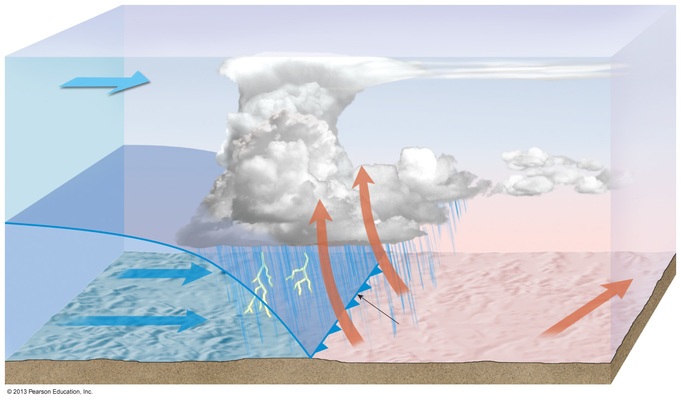
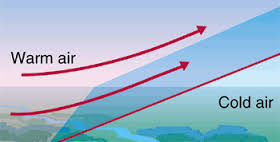

What type of front is shown?
Warm Front
Cold Front
Occluded Front
Where the warm and cold air meet and stall, clouds and fog form, and it may rain or snow. It could bring many days of clouds and precipitation.
Warm Front
Cold Front
Occluded Front

The picture below is of a(n) ____ event.
Non-El Nino (Normal)
El Nino
La Nina
During a(n) ____ event, trade winds are much stronger than usual.
El Nino
La Nina
Normal
Partly sunny
El Niño ___________________ the trade winds causing the warm pool to move ___________.
weakens or reverses; west
intensifies; east
weakens or reverses; east
intensifies; east
Objects in the NORTHERN Hemisphere deflect to which direction due to the Coriolis Effect?
Left
Up
Down
Right
Objects in the SOUTHERN Hemisphere deflect to which direction due to the Coriolis Effect?
Left
Up
Down
Right
The Coriolis Effect is caused by what?
The wind blowing
Earth's gravity pulling things down
The rotation of the Earth
The pull of the Moon
Winds blow from areas of what to what?
High temperature to high pressure
Low temperature to high pressure
High pressure to low temperature
Low temperature to high temperature
A polar air mass will have what kind of air in it?
Warm
Cold
Humid
Dry
The Coriolis effect causes ___________.
the Earth to rotate on its axis
earthquakes
global winds to move in a curved path instead of a straight line
the Earth to revolve around the sun
When hot air rises, what weather pattern is usually observed?
Dry and hot
Rain
Strong winds


Hadley, Ferrel, and polar are the names of
bears
feuding Kentucky families
atmospheric circulation cells
cloud types
Air that is cooler than the air surrounding it
rises
sinks (descends)
stays where it is
Air that is warmer than the air surrounding it
rises
sinks
stays where it is

Rising air leads to ____ pressure at ground level
High
Low
Descending air leads to ____ pressure at ground level
High
Low

Fast-flowing currents of air high in the troposphere are
Hadley cells
Jet streams or "atmospheric jets"
Trade winds
Altostratus
The jet streams
All flow in the same direction, from west to east
Flow in different directions depending if they are north or south of the equator
Flow in different directions depending if they are above rising or falling air
All flow in the same direction, from east to west

What is the effect of global circulation on temperatures around the Earth?
global atmospheric circulation does not affect temperature
global atmospheric circulation makes hot places hotter and cold places colder
global circulation moderates temperatures, warming the poles and cooling the equator
temperatures change in a random fashion

