
 Worksheets
Term 3 recap
Total questions: 66
Worksheet time: 1hrs 7mins

Which of these things are NOT attracted to a magnet?
paper clip
nail
rubber band
scissors

When "like" poles meet, they ______________.
Attract
Pull
Repel
Melt

What is the space around a magnet where the force is?
Magnetic pole
Magnetic field
Magnetic needle

When two magnets "click together", that means ...
magnets are magical.
opposite poles were near
they had glue on them.
When the north and south poles meet, they will __________ each other.
push
attract
freeze
Which one is magnetic?
sand
plastic
iron
wood
The 2 ends of a magnet are called _________.
bars
ends
poles
Because of Earth's magnetic field, which way will the North side of the arrow on a compass always point towards?
East
North
South
West
What is an example of a permanent magnet?
Paperclip
Iron
Refrigerator magnet
a nail
Magnetism is a type of what?
gravity
relationship
chemical element
force
What is a temporary magnet?
a magnet that lasts forever
a magnet with a strong force
material that has been magnetized but cannot hold its magnetism for long
any magnet that attracts metals

In which part of a magnet is the magnetic force strongest?
In the Center
At the Poles
In the middle
At the North Pole only
What do you call the group of objects that are attracted to magnets?
Non-Magnetic Objects
Metallic Objects
Transparent Objects
Magnetic Objects
9. Which is an example of a natural magnet?
Disc magnet
U shape magnet
Ring magnet
Lodestone

How is magnet used in the picture?
hold objects
show direction
produces movements
lift heavy objects
A magnet is placed near a group of steel and plastic paper clips. The magnet will_________.
attract both steel and plastic paper clips
attract only the plastic paper clips
attract only the steel paper clips
repel the plastic paper clips


Magnets on refrigerator cannot be turned off. Which type of magnets they belong?
electromagnets
battery
permanent magnets
copper wire
What type of magnet that can turned on and off?
electromagnet
permanent magnet
electricity
battery
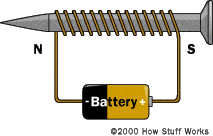
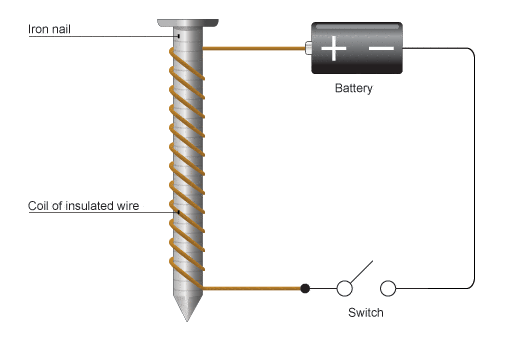

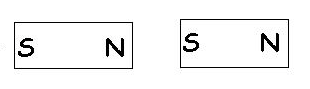

Diagram 4 shows the graph of volume of carbon dioxide gas against time when 5 g of marble chips is added to
50 cm3 of 0.2 mol dm-3 hydrochloric acid.
At what time the rate of reaction the highest?
t1
t2
t3
t4

Diagram 7 shows a graph of the volume of gas produced against time for the reaction between zinc granules and hydrochloric acid.
The gradient of the graph decreases with time because
catalyst is not used
volume of mixture decreases
temperature of reaction decreases
concentration of hydrochloric acid decreases
List four factors that affects the rate of a reaction
temperature
concentration
surface area
volume
catalysts
A temperature increase causes the particles ......
to slow down
move faster
collide higher
in the right order
How does a catalyst work in speeding up a reaction?
By lowering the activation energy or reaction
by giving them more energy
by making them more available
The ______________is required to break the bonds of the reactants.
Carbonic energy
Activation energy
Plutonic energy
Energi Gaib
Which unit is correct for the rate of reaction?
g mol-1
g min-1
mol dm-3
kJ mol-1
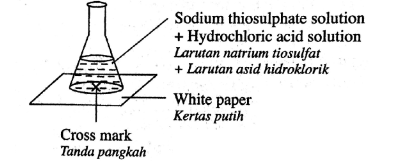
Diagram shows the apparatus set up for an experiment to determine the rate of reaction.
Which of the following techniques is the most suitable to determine the rate of reaction?
Record the time as soon as precipitate is formed
Record the time taken to obtain the maximum temperature
Record the times as soon as the cross mark cannot be seen
Record the times taken for the change of the pH value until a fixed pH value is obtained
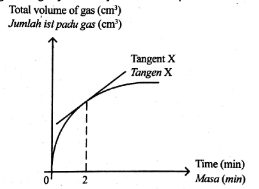
Diagram shows a graph to study the effect of total surface area on the rate of reaction.
What is represented by gradient tangent X?
Average rate of reaction in the first 2 minutes
Average rate of reaction in the 2nd minute
Overall average rate of reaction
Rate of reaction at the 2nd minute
Diagram shows a graph to study the effect of total surface area on the rate of reaction.
What is represented by gradient tangent X?
Average rate of reaction in the first 2 minutes
Average rate of reaction in the 2nd minute
Overall average rate of reaction
Rate of reaction at the 2nd minute

Icing sugar has a greater ______ _____ than a solid cube of
sugar.
Surface Area
Catalyst
Temperature
Objects hitting each other
Collision
Catalyst
Explosion
Reaction
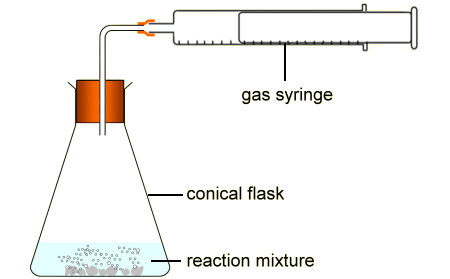
How is this equipment being used to measure the rate of reaction?
The gas syringe measures how much gas is produced in a certain time
The reaction mixture will increase in volume in a certain time

The amount of something; how many particles in a volume of a mixture
Rate
Collision
Catalyst
Concentration
1. ___________ are the smallest unit of an element that maintains the properties of that element.
Atoms
Elements
Compounds
mixtures
3. A/an _____________ contains a variety of elements and compounds that are not chemically combined with each other.
atom
element
compound
mixture
2. A/An _______________ is made up of one or more of the same kind of atom chemically combined.
atom
element
compound
molecule
5. True or False: elements and compounds are pure substances.
True
False

Does this show an element, a mixture or a compound?
Compound
Mixture
Element
Is water an element, compound or mixture?
Element
Compound
Mixture
Is air an element, compound or mixture?
Element
Compound
Mixture
What name is given to a substance that contains two types of atom that are not chemically joined together?
Element
Compound
Mixture
What process allows you to smell freshly baked bread in a supermarket, even when you are far from the bakery aisle?
Evaporation
Diffusion
Chromatography
To separate a mixture of salt and water what separation tool/method is used?
Filter
Sieve
Magnet
Evaporation
What is a formulation?
A mixture of two or more different substances
A pure substance
A mixture of metals
A mixture made up of set proportions
Which of the following are formulations?
Medicines
Air
Pure iron
Does the amount of each substance in the formulation need to be equal?
Yes
No
Does the proportion of each substance need to be the same each time the formulation is made?
Yes
No
If you want to make double the amount of formulation what do you need to do?
Double the amount of each substance.
Double the amount of the most important substances.
Half the amount of each substance.
Use the same amount of each substance.
Submit

