wayground logo

Free Printable Worksheets

Font size

S
M
L
XL
Worksheets

DNA History and Replication

Total questions: 60

Worksheet time: 2hrs 31mins

Name
Class
Date
1.

Erwin Chargaff's rule of base pairing states that:

a)

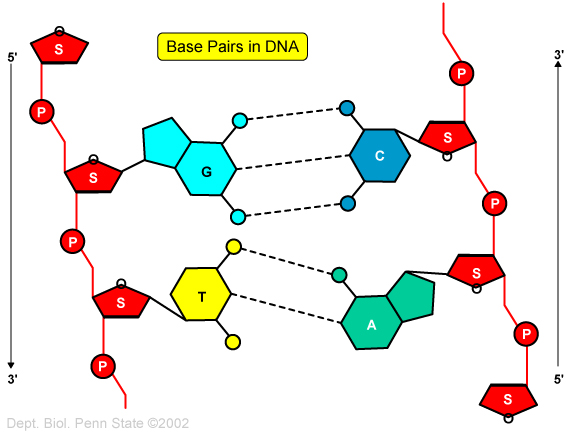
adenine pairs with thymine and guanine pairs with cytosine

b)

adenine pairs with guanine and thymine pairs with cytosine

c)

purines pair with pyrimidines

d)

pyrimidines pair only with pyrimidines

2.

Rosanlind Franklin's x-ray diffraction image of her study of DNA was noticed by Watson and Crick and led them to model what they thought the shape and structure of DNA was. What was that shape?

a)

the double helix

b)

the single strand

c)

the sugar and phosphate

d)

the four nitrogen bases

3.

Thymine, adenine, guanine, cytosine, and uracil are classified as:

a)

sugars

b)

codons

c)

nitrogen bases

d)

nucleotides

4.

What is the backbone of this DNA molecule made of?

a)

sugars

b)

nitrogen bases

c)

sugar and phosphate

d)

sugar and nitrogen bases

5.

What type of bonds hold together nitrogen bases?

a)

water bonds

b)

covalent bonds

c)

peptide bonds

d)

hydrogen bonds

6.

Using the bases on the template strand of DNA, what are the new complimentary bases for replication? Template: AGTCA

a)

AGTCA

b)

TCAGT

c)

UCAGU

d)

TCUGT

7.

What enzyme unzips the DNA strands to allow replication to occur?

a)

polymerase

b)

ligase

c)

helicase

d)

primase

8.

All of the following are differences between DNA and RNA except

a)

they are both nucleic acids

b)

the shape of the strand

c)

the type of sugar

d)

the specific nitrogen bases

9.

Which of the following is not part of a molecule of DNA?

a)

ribose sugar

b)

deoxyribose sugar

c)

nitrogen base

d)

phosphate group

10.

A strand of DNA has these bases: AGCCATGTATAC. What is the complementary DNA strand?

a)

UCGCUACAUAUG

b)

TGCCTAGATATAC

c)

TCGGTACATATG

d)

ACGGATCTATAG

11.

How did Rosalind Franklin's x-ray diffraction image of DNA affect the work of Watson and Crick?

a)

It was used to develop the theory of independent assortment.

b)

It was used to determine the physical structure of DNA.

c)

It was used to determine the four bases that make up DNA.

d)

It was used to show that DNA was the molecule of inheritance.

12.

Semi-conservative replication of DNA refers to the idea that___.

a)

the two strands of DNA molecules run in opposite directions.

b)

each new DNA molecule contains 2 new single RNA strands.

c)

each half of the original DNA molecule is joined with a new complementary DNA strand.

d)

DNA molecules need to unwind before duplication begins.

13.

RNA from a chipmunk is compared to RNA from a worm. Both will contain:

a)

the sugar ribose and the base thymine

b)

the sugar dexoyribose and the base thymine

c)

the sugar deoxyribose and the base uracil

d)

the sugar ribose and the base uracil

14.

Which nitrogenous base is normally used in the synthesis (making) of RNA but not in the synthesis (making) of DNA?

a)

uracil

b)

adenine

c)

guanine

d)

cytosine

15.

The structure of DNA is described as a ________ formed by two strands of nucleotides.

a)

protein molecule

b)

double helix

c)

polymerase chain

d)

single spiral

16.
Cystosine is an example of a single ringed nitrogen base called...
a)
Purine
b)
Peptide
c)
Ribose
d)
Pyrimidine
17.
If a sample of DNA has 20% ADENINE, how much GUANINE will it have?
a)
30%
b)
20%
c)
80%
d)
60%
18.
The image illustrates which of the following structures?
a)
Amino acid
b)
Nucleotide
c)
Protein
d)
Peptide Bond
19.
Which of the following units are repeatedly joined together to form a strand of DNA?
a)
amino acids
b)
nucleotides
c)
fatty acids
d)
polysaccharides
20.
Which 2 molecules form the sides (backbone) of the DNA ladder?
a)
deoxyribose sugar and adenine
b)
deoxyribose sugar and a hydrogen bond
c)
deoxyribose sugar and the nucleus
d)
deoxyribose sugar and phosphate
21.
Nitrogenous bases are joined by which type of bond?
a)
polar bonds
b)
ionic bonds
c)
covalent bonds
d)
hydrogen bonds
22.
The enzyme that unzips the DNA to prepare for replication
a)
helicase
b)
replicase
c)
polymerase
d)
synthase
23.
What are the three components of a nucleotide?
a)
sugar, hydrogen, nitrogen base
b)
sugar, oxygen, nitrogen base
c)
sugar, phosphate, nitrogen base
d)
sugar, phosphate, protein
24.

The picture below shows the steps of DNA replication beginning with step one and ending with step three.


​Because you are reusing the old, or parent, DNA strand DNA replication is said to be

a)

Semi- Conservative

b)

Semi-discontinuous

c)

Continuous

d)

Fully-Conserveative

25.

Which enzyme is responsible for adding the free nucleotides to the replicating DNA? ​

a)

DNA Helicase

b)

DNA Ligase

c)

DNA polyermase

d)

RNA Polymerase

26.

Enzyme that connects the DNA to the backbone (glues)

a)

Ligase

b)

Polymerase

c)

Helicase

d)

Primase

27.

Enzyme that breaks hydrogen bonds (unzips)

a)

Ligase

b)

Polymerase

c)

Primase

d)

Helicase

28.
Who is responsible for producing this image?
a)
Francis Crick
b)
James Watson
c)
Rosalind Franklin
d)
Watson and Crick
29.
How did Rosalind Franklin's photo 51 affect the work of Watson and Crick?
a)
It was used to determine the physical structure of DNA
b)
It was used to identify the four bases that make up DNA
c)
It was used to determine the theory of independent assortment
d)
It was used to show DNA was the molecule of inheritance
30.
From his work with mice and pneumonia-causing bacteria, Frederick Griffith discovered what?
a)
Replication
b)
Transcription
c)
Transformation
d)
Translation
31.
By using radioactive isotopes, Hershey and Chase were able to conclude that _____ is the carrier of genetic information.
a)
DNA
b)
Protein
c)
Carbohydrate
d)
Lipid
32.
The work of Erwin Chargaff allowed Watson and Crick to determine the rules of.......
a)
protein synthesis
b)
transcription
c)
hydrogen bonding
d)
nitrogen base pairing
33.
What does DNA stand for?
a)
Deoxyribonucleic acid
b)
Denitrogenous acid
c)
Deribonucleic acid
d)
Diribonucleic acid
34.
A five-carbon sugar found in DNA.
a)
ribose
b)
guanine
c)
deoxyribose
d)
helicase
35.
DNA polymerase is a(n)
a)
lipid
b)
enzyme
c)
sugar
d)
starch
36.

The base pairs are held together by weak attractive forces that allow DNA to separate or unzip itself when it is time for replication. What do we call these bonds between nitrogenous bases?

a)

Covalent Bonds

b)

Hydrogen Bonds

c)

Filial Bonds

d)

Phosphodiester Bonds

37.
This picture is illustrating the ____ nature of DNA.
a)
anti-parallel
b)
deoxyribosic
c)
helical
d)
radioactive
38.
These are the "smaller", single ringed bases such as thymine and cytosine
a)
complementary
b)
 cytosine
c)
purine
d)
pyrimidine
39.
These are the "larger", double-ringed bases such as adenine and guanine.
a)
complementary
b)
 cytosine
c)
purine
d)
pyrimidine
40.

Which enzyme is responsible for adding the RNA primer to the template strand?

a)

Helicase

b)

DNA Polymerase

c)

Ligase

d)

Primase

41.
After analyzing a sample of DNA, a scientist recorded the data shown in the table. What percentage of the DNA sample is cytosine?
a)
22%
b)
25%
c)
28%
d)
56%
42.
When does replication occur?
a)
G0 phase
b)
G1 phase
c)
G2 phase
d)
S phase
43.
Any change in the sequence of DNA is...
a)
transgenic shift
b)
Single Genotype
c)
Monohybrid Trait
d)
Mutation
44.
Identify the SUBSTITUTION mutation from the following: 
ATG CCA AAT
a)
ATG TCA AAT
b)
ATG CCT AAA T
c)
ATC CA  AT
d)
ATG CCA AAT
45.
Which of the following does DNA polymerase NOT do?
a)
connects nucleotides (in the new strand) through covalent bonds
b)
Matches the template nucleotides with free nucleotides
c)
proofreads
d)
It does all of these functions
46.
Sometimes, DNA is called "semi-conservative." Why might this be?
a)
The old strand is "conserved" and used to make the new strands
b)
Uracil is "conserved" in that it is only used to make the new strands
c)
ATP is "conserved" via the usage of facilitated diffusion
d)
Ligase is "conserved" in that it is denatured by the process
47.
The 5' end of DNA is marked by a(n)
a)
Phosphate Group
b)
Hydroxyl Group
c)
Purine
d)
Pyrimidine
48.
The "Double Helix Model" of DNA was proposed by:
a)
Watson & Crick
b)
Meselson & Stahl
c)
Beadle & Tatum
d)
Gosling & Watkins
49.
In the Hershey-Chase experiment DNA was tagged using isotopes of:
a)
Sulfur
b)
Nitrogen
c)
Carbon
d)
Phosphorus
50.
Small segments of DNA made on the lagging strand are called:
a)
Okazaki Fragments
b)
ERVs
c)
Transposable Elements
d)
Telomeres
51.
For what reason does DNA copy itself?
a)
to replace worn out DNA
b)
so cells can divide
c)
to export DNA to other parts of the body
d)
more DNA is better
52.

DNA polymerase moves in the _________ to ____________ direction

a)

3' to 5'

b)

easiest

c)

5" to 3"

d)

9 to 5

53.

The separation of the two single strands of DNA creates a ‘Y’ shape?

a)

enzyme

b)

unzip

c)

A replication fork

54.
Identify #2.
a)
nitrogen base
b)
phosphate group
c)
deoxyribose sugar
d)
nucleotide
55.
Which component of DNA specifies the traits of an organism?
a)
5-carbon sugar (deoxyribose)
b)
hydrogen bonds
c)
phosphate groups
d)
nitrogenous base pairs
56.

Who proposed that DNA was not a protein?

a)

Oswald Avery

b)

James Watson

c)

Martha Chase

d)

Harry Styles

57.

Primase is used to

a)

Form new strand of DNA

b)

Form Okazaki fragment

c)

Produce helicase

d)

Form RNA primer before DNA replication start

58.
A DNA nucleotide contains all of the following, except...
a)
Deoxyribose
b)
Phosphate group
c)
Nitrogenous base
d)
Cholesterol
59.

Which of the following is the function of DNA? (SELECT TWO)

a)

Store and transfer genetic information from parent to offspring

b)

Contains the codes for building proteins

c)

Makes energy for the cell

d)

Stores excess material in the cell

60.

Place the following events in DNA Replication in order

1 - Hydrogen bonds between nucleotides form

2 - Hydrogen bonds between nucleotides break

3 - Strands of DNA seperate

4 - Free nucleotides are attracted to exposed bases on the loose strands of DNA

a)

2, 3, 4, 1

b)

1, 2, 3, 4

c)

1, 3, 4, 2

d)

4, 3, 2, 1