wayground logo

Free Printable Worksheets

Font size

S
M
L
XL
Worksheets

Phy Sci Midterm

Total questions: 136

Worksheet time: 2hrs 6mins

Name
Class
Date
1.
What is the unit for speed?
a)
Meter
b)
Newton
c)
Meter/second
d)
Kilogram
2.
What is the unit for mass?
a)
Gram or Kilogram
b)
Meter
c)
Liter
d)
Newton
3.
What is the unit for volume?
a)
Kilogram
b)
Meter
c)
Liter
d)
Newton
4.
What is the unit for distance?
a)
Kilogram
b)
Meter
c)
Liter
d)
Newton
5.
The total length covered during a journey is the definition for what?
a)
Speed
b)
Velocity
c)
Acceleration
d)
Distance
6.
The straight line from the ending point to the starting point is the definition for what? 
a)
Displacement
b)
Velocity
c)
Speed
d)
Acceleration
7.
On a Friday evening, you drive 25 miles straight west to a football game. After the game you drive 20 miles east back the way you came to visit a friend. What is your displacement?
a)
5 Miles North
b)
5 Miles South
c)
5 Miles West
d)
5 Miles East
8.
On a Saturday afternoon, you drive 30 miles directly east to visit grandma. You then drive 20 miles back the way you came to stop at a friend’s house. What is your total distance traveled? 
a)
10 miles
b)
20 miles
c)
50 miles
d)
600 miles
9.
A change in distance over time with direction is the definition for what? 
a)
Acceleration
b)
Speed
c)
Velocity
d)
Momentum
10.
What is the total distance traveled divided by the total time of travel?
a)
Acceleration
b)
Displacement
c)
Average Speed
d)
Velocity
11.
.001 meter equal to 1 what?
a)
Millimeter
b)
Kilometer
c)
Dekameter
d)
Hectometer
12.
100 meters is equal to 1 what?
a)
Kilometer
b)
Decimeter
c)
Centimeter
d)
Hectometer
13.
The amount of matter in an object is 
a)
pressure
b)
weight
c)
mass
d)
force
14.

The elements neon and argon are not reactive. Which statement gives the best reasoning for this?

a)

They are not readily available on Earth.

b)

They have the maximum possible number of electrons in their outermost shell.

c)

They tend to give up all of their valence electrons easily.

d)

They are not stable atoms.

15.

Evaporating water produces gaseous water. Which has occurred during this process?

a)

A physical change has NOT resulted in a new substance.

b)

A chemical change has NOT resulted in a new substance.

c)

A chemical change has resulted in a new substance.

d)

A physical change has resulted in a new substance.

16.

What is the best reason why group 18 noble gases are inert?

a)

Their outermost energy level is missing one electron.

b)

They can have either a positive or negative charge.

c)

Their outermost energy level is full.

d)

They readily form positive ions.

17.

According to the periodic table, which pair of elements has similar chemical properties?

a)

Al and Ga

b)

Ge and Se

c)

Ba and Bi

d)

K and Kr

18.

What coefficients must be used in order to balance the equation shown below?


_____Fe + ____O2 ----> ______Fe2O3

a)

4,3,2

b)

2,3,2

c)

2,1,2

d)

4,1,2

19.

Which statement describes the behavior of molecules when a substance changes from a gas to a liquid?

a)

The speed of the molecules increases, because they have higher kinetic energy in the liquid state.

b)

The speed of the molecules decreases, because they have higher kinetic energy in the liquid state.

c)

The speed of the molecules decreases, because they have lower kinetic energy in the liquid state.

d)

The speed of the molecules increases, because they have lower kinetic energy in the liquid state.

20.

The chemical formula for water, H2O, means that each water molecule contains which of the following?

a)

Two hydrogen atoms and one oxygen atom

b)

Two hydrogen atoms and two oxygen atoms

c)

Two hydrogen atoms and zero oxygen atoms

d)

One hydrogen atom and two oxygen atoms

21.

A neutral atom of chlorine has an atomic number of 17 and a mass number of 35. How many protons, neutrons, and electrons does this atom have?

a)

35 protons, 35 electrons, and 17 neutrons

b)

18 protons, 18 electrons, and 17 neutrons

c)

17 protons, 17 electrons, and 18 neutrons

d)

17 protons, 17 electrons, and 35 neutrons

22.

The molecules in a given sample of matter move independently of one another. The substance takes the shape of its container. When the substance is moved from one container to another, its shape changes, but its volume remains the same. What type of substance is being described?

a)

solid

b)

liquid

c)

gas

d)

plasma

23.

Salt is added to water to form a solution. What could be done to speed up the rate at which the salt dissolves?

a)

Put in a larger piece of salt.

b)

Remove the ions.

c)

Heat the water.

d)

Do not stir the solution.

24.

According to placement in the periodic table, which of these BEST explains why an ionic bond is the most likely type of bond formed between a metal and a nonmetal?

a)

An ionic bond forms when two atoms share electrons; a metal and nonmetal are likely to share electrons.

b)

An ionic bond forms between oppositely charged ions; metals and nonmetals are likely to be oppositely charged.

c)

An ionic bond forms when one of the atoms is nonreactive; metals tend to be nonreactive and form ionic bonds.

d)

An ionic bond forms when one of the atoms is nonreactive; nonmetals tend to be nonreactive and form ionic bonds.

25.

Which of the following best describes why alkali metals are extremely reactive?

a)

They have two valence electrons that form compounds.

b)

They have one valence electron that is easily removed.

c)

They are not solids at room temperature.

d)

They have very small atomic masses.

26.

When atoms are neutral, what is the best explanation for this?

a)

The number of protons and the number of neutrons are equal.

b)

The number of protons and the number of electrons are equal.

c)

All atoms contain neutrons, which have no charge.

d)

The number of neutrons and the number of electrons are equal.

27.

The chemical equation shown below is an example of which type of chemical reaction?


Cr + Fe(NO3)2 ----> Fe + Cr(NO3)3

a)

single displacement

b)

decomposition

c)

combustion

d)

double displacement

28.

Which of the following chemical reactions represents a synthesis reaction?

a)

Cu + AgNO3 ----> Ag + CuNO3

b)

2 CH4 + 4 O2 ----> 2 CO2 + 4 H2O

c)

2 N2 + 3 H2 ----> 2 NH3

d)

AlCl3 + 3 NaOH ----> 3 NaCl + Al(OH)3

29.

Which of the following describes the process of grinding quartz down to produce sand?

a)

Chemical change

b)

Change of state

c)

Physical change

d)

Chemical reaction

30.

If calcium and chlorine form a compound, what would the resulting chemical formula be?

a)

CaCl3

b)

CaCl2

c)

Ca2Cl

d)

CaCl

31.

Which statement best describes compounds with covalent bonds?

a)

They tend to be soluble in water.

b)

They are formed between metals and nonmetals.

c)

They conduct electricity well

d)

They share electrons to form bonds.

32.

Which of the following is an example of a chemical reaction?

a)

A substance is dissolved in water.

b)

Two solutions mixed in a beaker produce a solid.

c)

A solution freezes in the freezer.

d)

A metal strip bends when heated

33.

In order for the following equation to be balanced, what coefficient must be placed in front of Al2O3?

4 Al + 3 O2 ----> ___ Al2O3

a)

1

b)

2

c)

3

d)

6

34.

Which of the following is used to determine the identify of an atom?

a)

number of neutrons

b)

mass number

c)

number of protons

d)

number of valence electrons

35.

After you burn a piece of wood, only a small pile of ash remains. Which statement describes what has occurred?

a)

A large amount of mass has been destroyed and lost.

b)

The total mass of the remaining ash & gases is equal to the mass of the original wood & oxygen.

c)

The total mass of the remaining ash & gases is greater than the mass of the original wood & oxygen.

d)

A small amount of mass has been converted into potential energy.

36.

Compared to the entire atom, the nucleus of the atom is

a)

larger and contains very little of the atom’s mass.

b)

smaller and contains very little of the atom’s mass.

c)

larger and contains most of the atom’s mass.

d)

smaller and contains most of the atom’s mass.

37.

The density of aluminum is 2.70 g/cm3. If a piece of aluminum has a volume of 54.0 cm3, what is its mass?

a)

14.6 g

b)

146 g

c)

20.0 g

d)

0.050 g

38.

What is the chemical formula for the ionic compound formed between aluminum and oxygen atoms?

a)

Al2O2

b)

Al3O2

c)

Al2O3

d)

Al3O3

39.
Approved eye protection devices (such as goggles) are worn in the laboratory
a)
to improve vision
b)
only if you don't wear glasses
c)
anytime heat, chemicals, or glassware are used
d)
to avoid eye strain
40.
If you do not understand a direction or part of a lab procedure, you should
a)
figure it out as you do the lab
b)
try several methods until something works
c)
skip it and go to the next part
d)
ask your teacher
41.
You are heating a substance in a test tube. Always point the open end of the tube
a)
towards your body
b)
toward your lab partner
c)
towards another classmate
d)
away from all people
42.
The proper technique for smelling chemicals is ______________
a)
keeping your nose close to the glassware
b)
wafting
c)
to sniff only a small amount
d)
Trick question; you never are allowed to smell chemicals in class
43.
Which item measures more precisely?
a)
test tube
b)
beaker
c)
graduated cylinder
d)
measuring cup
44.
What is used to hold test tubes?
a)
Test tube rack
b)
Magnifying glass
c)
Petri dish
d)
Funnel
45.
Name the tool pictured
a)
scalpel
b)
Pipette
c)
Tweezer
d)
Forceps
46.
These are used to hold liquids and dry materials. 
a)
ignition tubes
b)
test tubes
c)
graduated cylinders
d)
burets
47.
The variable the is changed on purpose is..
a)
Constant
b)
Control
c)
Independent Variable
d)
Dependent Variable
48.
The things that are kept the same to ensure the results are due to the experiment is called..
a)
Control
b)
Constant
c)
Independent Variable
d)
Dependent Variable
49.

What is the DEPENDENT variable (effect) in this experiment?

"Does eating breakfast improve test score?"

a)

eating breakfast or not

b)

the grade you got on the test

c)

what time you get up in the morning

d)

how tasty the breakfast is

50.
What is scientific notation?
a)
A long way to write really short  numbers
b)
A short way to write really long numbers
c)
I don't know...
d)
None of the above
51.
How would you write 564,000,000 in scientific notation?
a)
5.64 x 10⁻⁷
b)
5.64 x 10⁶
c)
5.64 x 10⁸
d)
56.4 x 10⁷
52.
Express the following in scientific notation:
.000457
a)
457 x 106
b)
457 x 10-6
c)
4.57 x10⁴
d)
4.57 x 10⁻⁴
53.
UNDERSTANDING
If the exponent is a positive number...
a)
you will get a large number
b)
you will get a smaller number
54.

What kind of matter is salt (NaCl)?

a)

Element

b)

Compound

c)

Homogeneous Mixture

d)

Heterogeneous Mixture

55.

What kind of matter is Calcium (Ca)?

a)

Element

b)

Compound

c)

Homogeneous Mixture

d)

Heterogeneous Mixture

56.

What kind of matter is Kool-Aid?

a)

Element

b)

Compound

c)

Homogeneous Mixture

d)

Heterogeneous Mixture

57.

What kind of matter is orange juice with pulp?

a)

Element

b)

Compound

c)

Homogeneous Mixture

d)

Heterogeneous Mixture

58.
Is burning wood a chemical or physical change?
a)
chemical
b)
physical
59.
Freezing juice is an example of a(n) ________
a)
physical change
b)
chemical change
c)
chemical reaction
d)
heredity
60.
Exploding fireworks is an example of a(n) __________ .
a)
physical change 
b)
chemical change 
c)
static electricity
d)
heredity
61.
Melting a chocolate bar is an example of a(n)  ______________ .
a)
physical change
b)
chemical change 
c)
photosynthesis
d)
heredity
62.
Blue Color: Chemical or Physical Property
a)
Chemical Property
b)
Physical Property
63.
Density: Chemical or Physical Property
a)
Chemical Property
b)
Physical Property
64.
Reacts with Acid: Chemical or Physical Property
a)
Chemical Property
b)
Physical Property
65.
Solubility (dissolves): Chemical or Physical Property
a)
Chemical Property
b)
Physical Property
66.
Melting Point: Chemical or Physical Property
a)
Chemical Property
b)
Physical Property
67.
Odor: Chemical or Physical Property
a)
Chemical Property
b)
Physical Property
68.
The state of matter having no definite shape or volume.
a)
solid
b)
liquid
c)
gas
69.
The amount of energy needed to change a material from a solid to a liquid state.
a)
Heat of Solids
b)
Heat of Liquids
c)
Heat of Fusion
d)
Heat of Vaporization
70.
As a material is heated, it's particles....
a)
get smaller
b)
slow down
c)
get cooler
d)
move more quickly
71.
Are particles of matter always in motion?
a)
yes
b)
no
72.
The motion energy of particles is called...
a)
kinetic energy
b)
connecting energy
c)
electrostatic energy
d)
gravitational energy
73.

How many valence electrons are shown in this Bohr diagram?

a)

2

b)

3

c)

5

d)

8

74.

This Bohr diagram has only one orbit (shell) with electrons in it. It must come from which row of the Periodic Table?

a)

1

b)

2

c)

3

d)

4

75.

Which row of the Periodic Table must this element come from?

a)

1

b)

2

c)

3

d)

4

76.

How many valence electrons?

a)

5

b)

6

c)

7

d)

8

77.
How many electrons does Si contain? (click to see image)
a)
14
b)
28
c)
2
d)
None of these
78.
What is the mass number of this atom?
a)
1
b)
3
c)
4
d)
7
79.
Carbon-12 has 6 protons and 6 neutrons. How many electrons will orbit the nucleus?
a)
12
b)
6
c)
3
d)
18
80.
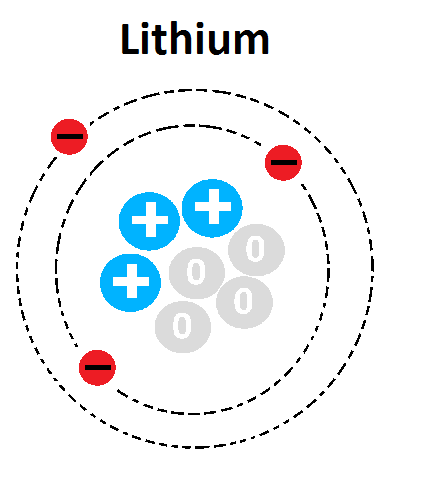
Identify the element in the picture
a)
Boron
b)
Carbon
c)
Nitrogen
d)
Lithium
81.

How many electrons can go in the first energy level?

a)

2

b)

8

c)

18

d)

32

82.

What is the atom called when there is adding or removing electrons creates atoms with (+) or (-) charges?

a)

isotopes

b)

ions

c)

neutral

d)

stable

83.

What is an isotope?

a)

changing the number of neutrons; same atom with different weights.

b)

adding or removing electrons creates atoms with (+) or (-) charges

c)

par;cle inside nucleus, does not have a charge

d)

resists changing, stays the same

84.

Which is the correct Lewis Dot Structure for Oxygen?

a)
b)
c)
d)
85.

Which is the correct Lewis Dot Structure of Carbon?

a)
b)
c)
d)
86.
How many neutrons does the isotope of lithium have?
a)
8
b)
3
c)
4
d)
5
87.
How many neutrons in C-14?
a)
6
b)
7
c)
14
d)
8
88.
Four isotopes of lead include lead-204, lead-206, lead-207, and lead-208.  The average atomic mass of lead is 207.2.  Which isotope of lead is likely to be the most abundant.
a)
204
b)
206
c)
207
d)
208
89.

The positive ions tend to _____________ electrons.

a)

lose

b)

gain

90.

Why do all bonds form?

a)

so the number of protons equals the number of electrons

b)

so an atom can become unstable

c)

to fill the outermost energy level

91.
Ionic bonds are between...
a)
Metal and Non-metal
b)
Non-metal and Non-metal
c)
Metal and Metal
92.
How are ionic bonds formed?
a)
Transfer of electrons
b)
Sharing of electrons
93.
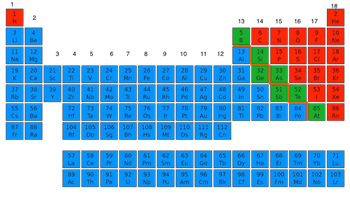
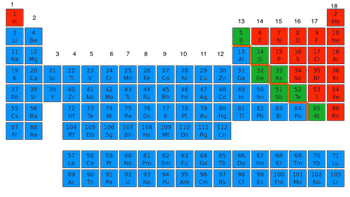
Where are the nonmetals located on the periodic table? 
a)
Blue
b)
Red
c)
Green
94.
Where are metals located on the periodic table?
a)
Blue
b)
Green
c)
Red
95.

What type of elements form cations?

a)

metals

b)

nonmetals

c)

metalloids?

96.

How many valence electrons do elements in Group 15 have?

a)

15

b)

5

c)

4

97.

What is the charge, or oxidation number, for elements in Group 2?

a)

-2

b)

+2

c)

-3

98.
How do covalent bonds form?
a)
Donating & receiving valence e- between atoms.
b)
Opposite slight charges attract each other between compounds.
c)
Scientists are still not sure how they form.
d)
Sharing valence e- between atoms.
99.

What is the Law of Conservation of Mass?

a)

It states that matter cannot be created or destroyed.

b)

It states that energy cannot be created or destroyed.

c)

It states that matter can be created or destroyed.

d)

It states that sound can be created or destroyed.

100.
What is a coefficient?
a)
The small number on the right of the chemical symbol.
b)
The large number in front of a chemical formula.
c)
The number in between the chemical symbols.
d)
The number behind a chemical formula.
101.
What is the part of the chemical equation in green called? 
Fe + S --> FeS
a)
products
b)
reactants
c)
yield
d)
chemical formula
102.
What coefficient should be used to make the following equation balanced?
N2+O2--> _NO 
a)
1
b)
2
c)
3
d)
4
103.
Which problem is balanced?
(Check ALL answers)
a)
PbO2 + 2H2
b)
SO2 + H20 --> H2SO4
c)
2Na + 2H2O --> 2NaOH + H2
104.
How many elements are in C6H12O6?
a)
1
b)
2
c)
3
d)
4
105.
How many HCl molecules do you need to balance this equation? 
Mg +  __HCl --->  MgCl2 + H2
a)
1
b)
2
c)
3
d)
4
106.
Classify
Zn + H
2S → ZnS + H2
a)
synthesis
b)
combustion
c)
single replacement
d)
double replacement
107.
Classify
CH4 + O2 → CO2 + H2
a)
single replacement
b)
double replacement
c)
synthesis
d)
combustion
108.
Pb(NO3)2  +  KI --> PbI2 + KNO3
What type of reaction is this? 
a)
Synthesis 
b)
Decomposition 
c)
Single Replacement
d)
Double Replacement 
109.
A car is driven for 3 hours. What else do you need to know to describe this car’s speed?
a)
the road the car in driven on
b)
the time of day
c)
the distance the car is driven
d)
the number of passengers in the car
110.

What is the speed of a runner who runs 400 meters in 40 seconds?

a)

10 meters/second

b)

40 meters/second

c)

100 meters/second

d)

1,600 meters/second

111.

Describe the motion in the graph:

a)

Constant Speed (positive slope)

b)

Stopped (at rest)

c)

Acceleration (increasing speed)

d)

Return Home (negative slope)

112.

Describe the motion in the graph:

a)

Constant Speed (positive slope)

b)

Stopped (at rest)

c)

Acceleration (increasing speed)

d)

Return Home (negative slope)

113.

Describe the motion in the graph:

a)

Constant Speed (positive slope)

b)

Stopped (at rest)

c)

Acceleration (increasing speed)

d)

Return Home (negative slope)

114.

Describe the motion in the graph:

a)

Constant Speed away from home (positive slope)

b)

Deceleration (decreasing speed)

c)

Acceleration (increasing speed)

d)

Return Home constant speed (negative slope)
115.

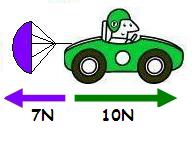
What is the net force?

a)

3 N

b)

3 N, right

c)

17 N, right

d)

3 N, left

116.
What is the net force?
a)

20 N Up

b)

Material Girl

c)

400 N Left

d)

40 N Right

117.
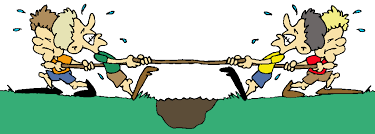
If these teams are pulling with the same amount of force what will happen?
a)
The boy in blue will win.
b)
They will not move at all.
c)
The boy in red will win.
d)
Both will fall down.
118.
What force holds the planets in motion around the sun?
a)
Magnetic
b)
Electrical
c)
Gravitational
d)
Air Resistance
119.
Jupiter has about 317 times more mass than Earth. What can you infer from this fact? 
a)
That Jupiter’s gravitational force is much weaker than on Earth’s gravitational force.
b)
That Jupiter’s gravitational force is much stronger than Earth’s gravitational force.
c)
That Jupiter’s and Earth’s gravitational forces are equal.
d)
Mass has no effect on the gravitational force between two objects
120.
This type of force resist motion between two surfaces that are pressed together
a)
contact
b)
gravity
c)
friction
121.

It is defined as a push or a pull.

a)

Elements

b)

Force

c)

Friction

d)

Fracture

122.
What is Newtons 1st law of motion?
a)
Force= Mass multiplied by acceleration 
b)
An object at rest stays at rest unless acted on an unbalanced force. (inertia)
c)
For every action there is a equal and opposite  re-action.
d)
law of gravity 
123.
What law of motion does this picture represent?
a)
Newtons 1st law
b)
law of gravity 
c)
Newtons 4th law 
d)
Newtons 2nd law
124.
What law of motion does this picture represent?
a)
Newtons 1st law
b)
Newtons 4th law 
c)
Newtons 3rd law 
d)
Newtons 2nd law
125.
A net force of 15 N is exerted on an encyclopedia to cause it to accelerate at a rate of 5 m/s2. Determine the mass of the encyclopedia?
a)
 m = 3.0 kg
b)
m = 4.0 kg 
c)
m = 3.0 ml 
d)
m = 30.0 g
126.
Determine the accelerations that result when a 12-N net force is applied to a 3-kg object. 
a)
3 m/s
b)
4 ft/s 
c)
13 m/s
d)
4 m/s 
127.
What Newtons law does this picture represent
a)
Newtons 2nd law 
b)
Law of gravity 
c)
Newtons 1st law
d)
Newtons 5th law
128.
Mass is a measure of an object's inertia. Objects with greater mass have a greater inertia; objects with less mass have less inertia.
a)
true 
b)
false 
129.
What is the tendency of an object to resist a change in motion?
a)
coffee
b)
motion
c)
inertia
d)
gravity
130.
Which car is accelerating?
a)
A car that is not moving
b)
A  car that rounds a curve at a constant speed
c)
A car traveling  at a constant speed 
d)
A car that has a set speed of 60mph
131.
What is the SI unit used to measure force? 
a)
pounds 
b)
grams 
c)
newtons 
d)
friction
132.
The force of gravity acting on an object is the object's ______.
a)
mass
b)
matter
c)
weight 
d)
friction 
133.
The amount of matter in an object is 
a)
pressure
b)
weight
c)
mass
d)
force
134.
Which of the following never changes no matter where in the universe?
a)
weight
b)
force
c)
mass
d)
pounds
135.
A person would weigh less on on the Moon than on the Earth because . . .
a)
Moon has more mass, and therefore more gravity
b)
Moon has less mass, and therefore more gravity
c)
Moon has more mass, and therefore less gravity
d)
Moon has less mass and therefore less gravity
136.
If an object mass =30 Kg on the Earth, what would be it's weight on Earth?
a)
30 N
b)
300 kg
c)
3000N
d)
300 N