Wayground logo

Free Printable Worksheets

Font size

S
M
L
XL
Worksheets

Bio Unit 1 Test Review

Total questions: 38

Worksheet time: 39mins

Name
Class
Date
1.
Any living thing is called an
a)
organ
b)
organization
c)
organism
2.
All living organisms are made up of ____.
a)
Cells
b)
Bacteria
c)
Organs
d)
Tissue
3.
A worm turns away from light is an example of a worm
a)
reproducing
b)
doing cellular respiration
c)
having cells
d)
responding to its environment
4.
Which of the following characteristics of living things best explain a cat having a litter of kittens?
a)
living things respond to their environment
b)
living things maintain homeostasis
c)
living things reproduce
d)
living things are based on a genetic code
5.
Which of the following characteristics of living things best explains why humans sweat when they get hot?
a)
maintaining a stable internal enviornment
b)
growth and development
c)
using energy
d)
ability to reproduce
6.
Before a soccer game Charlie always eats a big dinner. Which characteristic of life does this face best describe? 
a)
living things use energy
b)
living things reproduce
c)
living things grow and develop
d)
living things are based on a universal genetic code
7.
Which of the following characteristics of living things best explains why your legs and arms get longer and stronger as you get older? 
a)
living things respond to their environment
b)
living things maintain internal balance
c)
living things are made of cells
d)
living things grow and develop
8.

What does Biotic mean?

a)

Living

b)

Non Living

9.

What does abiotic mean?

a)

Living

b)

Non Living

10.

Select the examples of biotic things

a)

Plants

b)

Soil

c)

Sun

d)

Animals

11.

Select examples of abiotic things

a)

Soil

b)

Air

c)

Rocks

d)

Water

e)

Animals

12.

Select the answer that has the levels of ecology from broadest to narrowest. (biggest to smallest)

a)

Biosphere, Ecosystem, Community, Population, Organism

b)

Community, Organism, Population, Ecosystem, Biosphere

c)

Organism, Population, Community, Ecosystem, Biosphere

13.

What is a niche?

a)

A Job, or what the thing does.

b)

where the thing is located

c)

who the thing likes

d)

a tasty treat.

14.

What is a habitat?

a)

A place where an organism lives

b)

An Ecosystem

c)

Where many things live together supporting one another

d)

A cool hat.

15.
What are the biotic factors in this image?
a)
sunlight, elephants, and grasses
b)
sunlight, water,  and air
c)
elephants, plants, trees 
16.
What are the abiotic factors in this image? 
a)
water, sunlight, dirt, air
b)
birds and plants
c)
water, plants, and birds 
17.

Image "B" shows more biodiversity than image "A". Why?

a)

Because "B" shows more different species than image "A"

b)

Because image "B" has less different species than "A"

c)

"A" has a greater number of same species plants so this statement is wrong.

d)

Both images show the same biodiversity

18.

A mosquito feeds off of the blood of different organisms. This usually causes discomfort to the organism and sometimes disease and death. This is an example of:

a)

Parasitism (+/-)

b)

Commensalism (+/0)

c)

Mutualism (+/+)

19.

This is known as a relationship in which both organisms involved benefit.

a)

Predator-Prey

b)

Commensalism (+/0)

c)

Mutualism (+/+)

d)

Parasitism (+/-)

20.

A feeder fish usually follows behind sharks to pick up food scraps that they leave behind. The fish gets food and the shark is unaffected. This is an example of:

a)

Mutualism (+/+)

b)

Commensalism (+/0)

c)

Parasitism (+/-)

d)

Predator-Prey

21.

Lions typically fight to the death for territory, mates, and food sources. Lions are most likely fighting due to:

a)

Commensalism (+/0)

b)

Mutualism (+/+)

c)

Competition

d)

Parasitism (+/-)

22.

Plover birds typically eat parasites trapped inside of crocodiles' mouths. The plover receives a meal, while the crocodile is rid of parasites. What type of relationship does this represent?

a)

Mutualism (+/+)

b)

Predator/Prey

c)

Competition

d)

Commensalism (+/0)

e)

Parasitism (+/-)

23.

Antlions are insects that build traps in sand to catch ants, which they eat. This relationship is a type of __.

a)

parasitism

b)

predation

c)

mutualism

d)

competition

24.
number of organisms per certain area
a)
carrying capacity
b)
limiting factor
c)
total population
d)
population density
25.
Food, water, sunlight, shelter, and space are resources that are often __________.
a)
limiting factors
b)
wet
c)
messy
d)
found in rocks
26.
Largest number of individuals of a population that the environment can support...  
a)
carrying capacity
b)
population crash
c)
lag phase
d)
mutualism
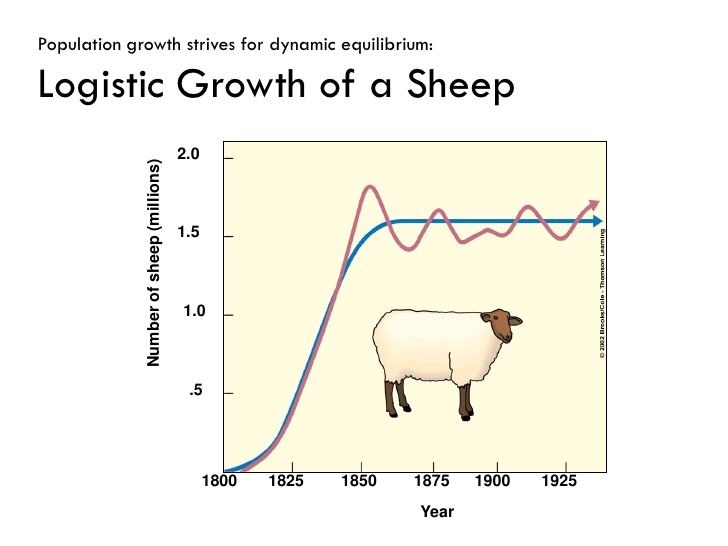
27.
What is the carrying capacity for this sheep population?
a)
1.8 million
b)
1.25 million
c)
1.6 million
d)
1.o million
28.

This would lead to

a)

primary succession

b)

secondary succession

29.

This would lead to

a)

primary succession

b)

secondary succession

30.
a)

exponential growth curve

b)

logistic growth curve

31.
a)

logistic growth curve

b)

exponential growth curve

32.
 American bison, which are large grazing mammals, are most often found clumped in small groups.    What might you infer about the spatial distribution of American bison?
a)
A clumped group provides better protection from predators.
b)
A clumped group attracts more prey.
c)
A clumped group can graze a larger area.
d)
A clumped group takes better advantage of water resources.
33.
A flowering plant has seeds that are carried by the wind. Infer the most likely dispersion pattern of the plants that grow from these seeds.
a)
uniform
b)
clumped groups
c)
random
d)
spatial
34.
What is the order of succession shown in this figure?
a)
A, B, C, D
b)
B, A, D, C
c)
C, D, A, B
d)
D, A, B, C
35.

There are 15 wolves living in a 10 km2 forest. Calculate the population density.

(a)  

36.

In a herd of zebras, there are 7 births and 5 deaths over a 1 year period. That same year, 3 zebras leave the herd and no zebras join the herd. What is the growth rate for the year?

(a)  

37.

When otters are removed from an ecosystem..

a)

The urchin population rises

b)

The kelp population drops

c)

The kelp gets eaten more quickly than it can regrow

d)

All of the answers occur

38.

Which of these is a keystone species of the kelp forest?

a)

The kelp

b)

The sea otter

c)

The sea urchin

d)

All 3 are keystone species