wayground logo

Free Printable Worksheets

Font size

S
M
L
XL
Worksheets

Ionic Bonding

Total questions: 62

Worksheet time: 57mins

Name
Class
Date
1.
Which of the following is NOT a step in forming an ionic bond?
a)
One atom shares its electrons with another one.
b)
Opposite charged ions form due to e- transfer
c)
One atom gives electrons to another one
d)
Opposite charged ions attract
2.
Why do ionic bonds form?
a)
So the number of protons equals the number of electrons.
b)
To stabilize the atom with a full outer shell.
c)
So an atom can become unstable.
d)
So atoms will stick together to form molecules.
3.
What is the charge on a noble gas & why?
a)
0; they don't exchange electrons
b)
+1; they give away an electron
c)
-1; they gain an electron
d)
1; they form only single bonds
4.
An ionic bond is the attraction between:
a)
oppositely charged ions
b)
similarly charged ions
c)
neutral ions
d)
neutral atoms
5.
 Which of the following is the correct formula for these two ions:
Al+3 +  S-2
a)
AlS3
b)
Al2S3
c)
Al3S2
d)
Al3S
6.
Whats the formula
Sr+2  +  (CO3)-2
a)
Sr(CO3)
b)
Sr(CO3)2
c)
Sr1(CO)5
d)
Sr(CO5)
7.
What type of elements will form an ionic bond?
a)
Metals + Metals
b)
Nonmetals + Nonmetals
c)
Metals + Nonmetals
d)
None of the above
8.
Which of the following describes the strength of an ionic bond?
a)
Middle - Each atom shares an octet
b)
Middle - One atom gains an octet & the other loses.
c)
Weakest - it only forms because of another bond forming
d)
Strongest - each atom receives a "permanent" octet.
9.
To form a charge of +2 an atom must _ electrons.  To form -3 it must _ electrons.
a)
Gain 2; Lose 3
b)
Gain 3; Lose 2
c)
Lose 2; Gain 3
d)
Lose 3; Gain 2
10.
Beryllium will ____ valence electrons when forming an ionic bond.
a)
lose 4
b)
gain 4
c)
lose 2
d)
gain 2
11.
In the chemical formula for an ionic compound, which item is written first?
a)
positive ion
b)
negative ion
c)
subscript
d)
the female
12.
Magnesium bromide is an ionic compound with the chemical formula MgBr₂.  What does the "2" tell you?
a)
There are 2 bromide ions for every magnesium ion
b)
Bromide has a 2- charge
c)
Bromide has a 2+ charge
d)
There are 2 magnesium ions to every bromide ion
13.
Which is the correct name for CaBr2?
a)
Calcium Bromine
b)
Bromine Calcium
c)
Calcium Bromide
d)
Carbon and Bromine
14.

Which of the following is true for ionic bonding & ionic compounds?

a)

They must be made of ions with like charges.

b)

The negative ion must be written first.

c)

Compounds must have an overall charge of zero.

d)

They are made of metals and nonmetals.

e)

The positive ion must be written first.

15.

Oxygen has (a)   valence electrons.

16.
Metals tend to 
a)
gain electrons
b)
lose electrons
17.

What is the charge of ion "X" in the formula XF3?

a)

+3

b)

-3

c)

+1

d)

-1

18.

What is the charge of ion "X" in CaX?

a)

+1

b)

-1

c)

+2

d)

-2

19.

Which of the following pairs of elements will NOT form an ionic compound?

a)

sodium and fluorine

b)

phosphorous and aluminum

c)

potassium and magnesium

d)

strontium and oxygen

20.
A charged particle that has gained or lost electrons is called a _____.
a)
molecule
b)
ion
c)
isotope
d)
element
21.
A cation is a ____ ion.
a)
negative
b)
positive
c)
neutral
d)
ficticious
22.
A anion will be a ____ ion.
a)
negative
b)
positive
c)
neutral
d)
ficticious
23.

Ionic bonds happen because of the ____ of valence electrons.

a)

sharing

b)

transfer

c)

keeping

d)

covering

24.
Ionic bonds form between metals and ____.
a)
metalloids
b)
metals
c)
nonmetals
25.
How many electrons are needed in the outer energy levels of an atom to be stable?
a)
2
b)
4
c)
6
d)
8
26.
Which of the following would produce an anion?
a)
Ca
b)
Al
c)
K
d)
F
27.

Select all of the statements below that are correct to describe the structure and properties of ionic compounds...

a)

They have high melting and boiling points

b)

They have a lattice structure

c)

The ions are held together by intermolecular forces

d)

They can conduct electricity when molten

e)

They can conduct electricity when solid

28.

Which of the below is an ionic compounds?

a)

Ni

b)

MgCl2

c)

H2O

d)

CH4

29.
What is the oxidation number of O in CO2?
a)
+2
b)
-1
c)
+4
d)
-2
30.
The sum of all oxidation numbers in a neutral compound is ___.
a)
0
b)
1
c)
-1
d)
depends on the compound
31.
What element always has an oxidation number of +1?
a)
Hydrogen
b)
Fluorine
c)
Chlorine
d)
Iodine
32.
Which of the following elements does NOT have an oxidation number of +2?
a)
Ca
b)
Sr
c)
K
d)
Ba
33.
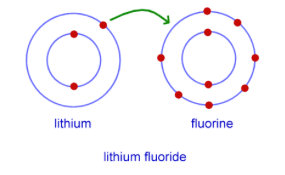
What type of bond is this?
a)
ionic
b)
covalent
34.
What determines ionic bonds to form?
a)
Number of protons
b)
Mass of the atom
c)
Number of total electrons
d)
Number of valence electrons
35.

Valence electrons are transferred

a)

Ionic bonds

b)

Covalent bonds

36.

Conducts electricity well when melted or dissolved

a)

Ionic compounds

b)

Covalent compounds

37.

Poor electrical conductivity

a)

Ionic compounds

b)

Covalent compounds

38.

Always a solid at room temperature

a)

Ionic compounds

b)

Covalent compounds

39.

Can be a solid, liquid, or gas at room temperature

a)

Ionic compounds

b)

Covalent compounds

40.

Generally high melting & boiling points

a)

Ionic compounds

b)

Covalent compounds

41.

Generally, atoms form bonds so that _______________.

a)

Each atom loses its electrons

b)

Each atom has a stable electron configuration

c)

Each atom has an unstable electron configuration

d)

Each atom gains electrons

42.

What kind of bond does this show?

a)

Ionic

b)

Covalent

43.

What happens when you put an ionic compound in water?

a)

The ions separate

b)

The ions pack more closely together

c)

Nothing happens

44.

Which of the following is NOT a property of ionic compounds?

a)

They conduct electricity when molten

b)

They conduct electricity when in solution

c)

They have high boiling points

d)

They are insoluble in water

45.
Which of the following is a characteristic property of ionic compounds?
a)
They form hard, brittle crystals with characteristic shapes
b)
They have low melting points
c)
They have low boiling points
d)
They contain no charged particles
46.
In what form can an ionic compound conduct electricity?
a)
when dissolved in water
b)
as a solid
c)
as a crystal
d)
when warmed slightly
47.
How many electrons has an oxide ion lost?
a)
1
b)
2
c)
6
d)
0
48.
If the name of a compound ends in "IDE", what does that tell us about the atoms that make it up?
a)
That it is a molecule
b)
That it contains two different elements
c)
That it contains two atoms
d)
That it is an ionic compound
49.
If an aluminum atom has 13 protons (+) and 10 electrons (-), what is it's charge?
a)
Al3+
b)
Al13+
c)
Al10+
d)
Al10-
50.
If an oxygen atom has 8 protons (+) and 10 electrons (-), what is it's charge?
a)
O10-
b)
O8+
c)
O2-
d)
O10+
51.
Elements on the LEFT side of the periodic table will most likely form:
a)
Positive ions
b)
Negative ions
c)
Neutral Ions
d)
None of these
52.

Which of the following pairs of elements would NOT react to form an IONIC compound?

a)

sulfur and phosphorus

b)

sodium and iodine

c)

iron and oxygen

d)

aluminum and bromine

53.

Which of the following is the correct ionic compound formula for barium nitride?

a)

Ba2N3

b)

Ba2N

c)

BaNO2

d)

Ba3N2

54.
Ionic compounds are ordinarily found as
a)
plasma
b)
liquids
c)
gasses
d)
crystalline solids 
55.
What is the name of the compound PbO2?
a)
lead oxide
b)
lead(II) oxide
c)
lead oxide(II)
d)
lead(IV) oxide
56.

Which of these are the correct formula for Iron (III) Oxide?

a)

FeO2

b)

Fe2O3

c)

Fe3O32

d)

FeO3

57.
In what form can an ionic compound conduct electricity?
a)
when dissolved in water
b)
as a solid
c)
as a crystal
d)
when warmed slightly
58.
Ions that are made of more than one atom are examples of:
a)
polyatomic atoms
b)
negative ions
c)
positive ions
d)
neutral ions
59.
What is the formula for copper(II) sulfate?
a)
CuSO4
b)
Cu2SO8
c)
CuS
d)
Cu(SO4)2
60.
How many valence electrons does calcium have?
a)
2
b)
4
c)
6
d)
7
61.
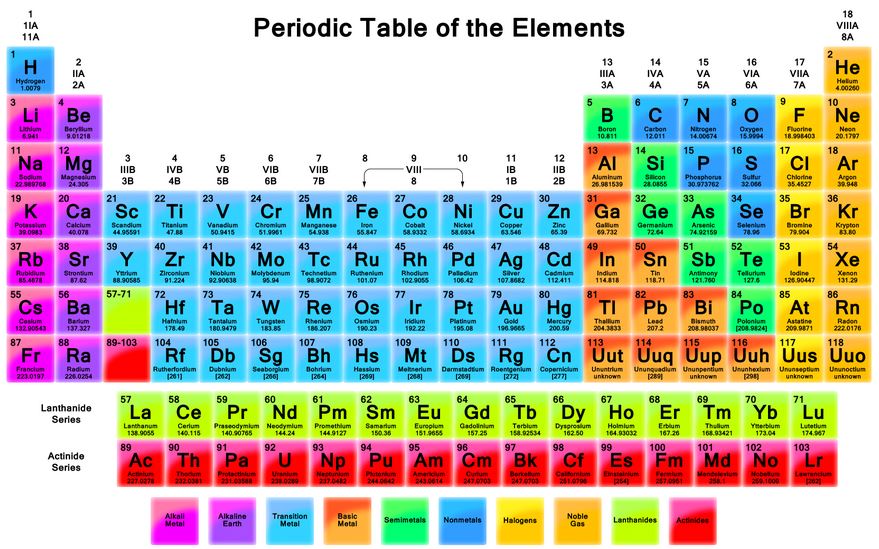
Which two elements could form an ionic compound?
a)
#6 carbon and #8 oxygen
b)
#1 hydrogen and #7 nitrogen
c)
#3 lithium and #9 fluorine
d)
#5 boron and #10 neon
62.
Which of the following compounds is not an ionic compound?
a)
barium oxide
b)
lithium oxide
c)
carbon dixoide
d)
calcium chloride