Wayground logo

Free Printable Worksheets

Font size

S
M
L
XL
Worksheets

ELL Level 3 - Periodic Trends (Working)

Total questions: 66

Worksheet time: 1hrs 18mins

Name
Class
Date
1.

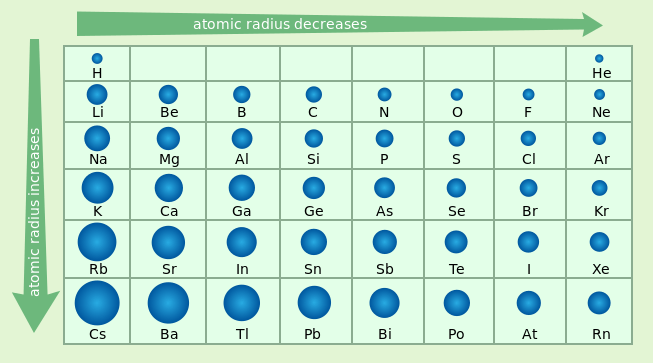
As you move down a group, atomic radius increases because -

a)

you add more and more neutrons

b)

you add more and more protons

c)

you add shielding and more shells (energy levels)

d)

you add more atomic mass

2.
The atom with the largest atomic radius in Group 18 is - 
a)
Ar
b)
He
c)
Kr
d)
Rn
3.

As you move across the periodic table from left to right, the atomic radius decreases. This is because -

a)

the number of protons increases, so attraction to electrons increases

b)

the number of energy levels increases (shells)

c)

the number of electrons and shielding increases

d)

the molar mass increases

4.

The atom with the largest atomic radius in Period 4 (row 4) is -

a)

K

b)

Kr

c)

Ca

d)

Fe

5.

Francium (Fr) has the lowest ionization energy in Group 1 because -

a)

it has the least shielding form filled inner shells (energy levels)

b)

it has the greatest amount of nuclear charge

c)

it has the greatest number of protons, so it attracts its electrons the strongest

d)

it has the most shielding and the largest atomic radius

6.

The element with the smallest ionization energy in Period 6 is -

a)

Ba

b)

Cs

c)

Pt

d)

Hg

7.

As you move across the periodic table atoms tend to get smaller because, ______________.

a)

the atoms have more shielding

b)

the atoms have less shielding

c)

the atoms have more nuclear charge

d)

the atoms have less nuclear charge

8.

The energy required to remove a electron is the definition of:

a)

Electronegativity

b)

Atomic Number

c)

Atomic Radius

d)

Ionization

9.

Electronegativity is...

a)

the ability of an atom to attract bonded electrons

b)

the ability of an atom to lose electrons

c)

the energy required to remove an electron from a specific atom

d)

how easy it is to make friends.

10.
Which has the greater Electronegativity: 
N or C?
a)
C
b)
N
11.

Electronegativity __________ from left to right within a period and __________ from top to bottom within a group.

a)

decreases, increases

b)

increases, increases

c)

increases, decreases

d)

stays the same, increases

12.

Which element in Period 2 has the greatest atomic radius?

a)

Be

b)

C

c)

Na

d)

Li

13.

Which of the group 13 elements has the largest atomic radii?

a)

B

b)

Ti

c)

Fr

d)

Ga

14.

Of the halogens, which has the smallest radius?

a)

F

b)

Br

c)

Cl

d)

I

15.

Of the halogens, which has the smallest electronegativity?

a)

F

b)

Cl

c)

I

d)

Br

16.

Which of the period 3 elements has the largest electronegativity?

a)

Ar

b)

Cl

c)

S

d)

Na

17.
Which has the greater EN: 
Cl or Al?
a)
Cl
b)
Al
18.

Which has the greater EN:

S or O?

a)

S

b)

O

19.
Which has the greater EN: 
H or F?
a)
H
b)
F
20.
Which of the following will have a larger radius than Zinc?
a)
Gallium
b)
Aluminum
c)
Magnesium
d)
Strontium
21.
Which of the following will have a higher electronegativity than arsenic (As)?
a)
Carbon (C)
b)
Neon (Ne)
c)
Antimony (Sb)
d)
Germanium (Ge)
22.
Which of the following will have a lower ionization energy than Scandium (Sc)?
a)
Helium (He)
b)
Titanium (Ti)
c)
Calcium (Ca)
d)
Magnesium (Mg)
23.
As atoms of elements in group 16 are considered in order from top to bottom, the electronegativity of each successive element....
a)
decreases
b)
increases
c)
remains the same
d)
none of the above
24.
Which atom has the largest atomic radius?
a)
potassium
b)
rubidium 
c)
francium
d)
cesium
25.
As you move down the periodic table atoms get bigger.  This is because ____________.
a)
The atoms have more mass.
b)
The atoms have more protons.
c)
The atoms have more energy levels
d)
The atoms have more nuetrons
26.
As you move across the periodic table atoms tend to get smaller because, ______________.
a)
the atoms have more mass.
b)
the atoms have less mass
c)
the atoms have more protons.
d)
the atoms have less electrons.
27.
Atoms that have a high electronegativity, _______________.
a)
give up their electrons more easily.
b)
hold on to their electrons more tightly.
c)
have more electron shells.
28.
Electronegativity is...
a)
how good an atom is at attracting electrons
b)
the ability of an atom to lose electrons
c)
the energy required to remove an electron from a specific atom
d)
how easy it is to make friends. 
29.
Ionization energy is...
a)
the energy required to add an electron to a specific atom
b)
how much energy it takes to remove an electron from an atom
c)
the energy required to shield the outer electrons from the nucleus
d)
a measure of the ability of an atom to attract electrons
30.
The atom with the largest atomic radius in Group 18 is - 
a)
Ar
b)
He
c)
Kr
d)
Rn
31.
Which statement correctly and completely identifies a trend?
a)
Atomic radius decreases across a period and increases down a group.
b)
Electronegativity decreases across a period and decreases down a group.
c)
Ionization energy increases across a period and increases down a group.
d)
Ionic radius increases across a period and increases down a group.
32.
The element with the largest electronegativity in the halogens is - 
a)
At
b)
F
c)
Cl
d)
Br
33.

The element with the lowest electronegativity in Period 3 is -

a)

Na

b)

Cl

c)

Ar

d)

Mg

34.
Which periodic group has the smallest atomic radius?
a)
Alkali metals
b)
Halogens
c)
Noble Gases
d)
Transition metals
35.
Atomic radius generally increases as we move __________.  
a)
down a group and from right to left across a period 
b)
up a group and from left to right across a period 
c)
down a group and from left to right across a period 
d)
up a group and from right to left across a period 
36.
Electronegativity __________ from left to right within a period and __________ from top to bottom within a group.
a)
decreases, increases 
b)
increases, increases
c)
increases, decreases 
d)
stays the same, increases
37.
Atomic Radius is...
a)
the relative size of the atom's nucleus
b)
the relative size of the atom's electron cloud
c)
the energy required to shield the outer electrons from the nucleus
d)
a measure of the ability of an atom to attract electrons
38.
As you move down the periodic table atoms get bigger.  This is because ____________.
a)
The atoms have more mass.
b)
The atoms have more protons.
c)
The atoms have more energy levels
d)
The atoms have more nuetrons
39.
As you move across the periodic table atoms tend to get smaller because, ______________.
a)
the atoms have more mass.
b)
the atoms have less mass
c)
the atoms have more protons.
d)
the atoms have less electrons.
40.
Which atom has the largest atomic radius?
a)
potassium
b)
rubidium 
c)
francium
d)
cesium
41.
The atom with the largest atomic radius in Group 18 is - 
a)
Ar
b)
He
c)
Kr
d)
Rn
42.
Which periodic group has the smallest atomic radius?
a)
Alkali metals
b)
Halogens
c)
Noble Gases
d)
Transition metals
43.
Ionization energy is...
a)
the energy required to add an electron to a specific atom
b)
how much energy it takes to remove an electron from an atom
c)
the energy required to shield the outer electrons from the nucleus
d)
a measure of the ability of an atom to attract electrons
44.
Which of the following will have a lower ionization energy than Scandium (Sc)?
a)
Helium (He)
b)
Titanium (Ti)
c)
Calcium (Ca)
d)
Magnesium (Mg)
45.
Which of the following will have a higher ionization energy than arsenic (As)?
a)
Gallium (Ga)
b)
Neon (Ne)
c)
Antimony (Sb)
d)
Germanium (Ge)
46.
Electronegativity is...
a)
how good an atom is at attracting electrons
b)
the ability of an atom to lose electrons
c)
the energy required to remove an electron from a specific atom
d)
how easy it is to make friends. 
47.
Atoms that have a high electronegativity, _______________.
a)
give up their electrons more easily.
b)
hold on to their electrons more tightly.
c)
have more electron shells.
48.
Which of the following will have a higher electronegativity than arsenic (As)?
a)
Carbon (C)
b)
Neon (Ne)
c)
Antimony (Sb)
d)
Germanium (Ge)
49.
What term is used to describe "an atom's tendency to attract electrons to itself when is is chemically combined with another element"
a)
electronation
b)
electron affinity
c)
electronegativity
d)
electrolysis
50.
What term is used to describe "The energy required to remove an electron from gaseous atoms"
a)
excitation energy
b)
ionization energy
c)
polarization energy
d)
electrolytic energy 
51.
What term is used to describe "A measure of the size of an atom"
a)
chemical reactivity
b)
atomic radius
c)
energy levels
d)
orbit
52.
The electronegativity of Cl is the highest in Period 2.  Why?
a)
Cl is the largest and has the greatest effective nuclear charge
b)
Cl is the smallest and has the lowest effective nuclear charge
c)
Cl is the largest and has the lowest effective nuclear charge
d)
Cl is the smallest and has the greatest effective nuclear charge
53.
What term is used to describe "A measure of the size of an atom"
a)
chemical reactivity
b)
atomic radius
c)
energy levels
d)
orbit
54.

Which element in Period 2 has the greatest atomic radius?

a)

Be

b)

C

c)

Na

d)

Li

55.
Which of the following will have a lower ionization energy than Scandium (Sc)?
a)
Helium (He)
b)
Titanium (Ti)
c)
Calcium (Ca)
d)
Magnesium (Mg)
56.
Francium (Fr) has the lowest ionization energy in Group 1 because - 
a)
it has the smallest number of valence electrons
b)
it has the greatest atomic mass
c)
it has the greatest number of protons, so it attracts its electrons the strongest
d)
its 1 valence electron is very far from the nucleus, so little energy is needed to remove it
57.
Which has the greater Electronegativity: 
N or C?
a)
C
b)
N
58.
As atoms of elements in group 16 are considered in order from top to bottom, the electronegativity of each successive element....
a)
decreases
b)
increases
c)
remains the same
d)
none of the above
59.
As you move across the periodic table atoms tend to get smaller because, ______________.
a)
the atoms have more mass.
b)
the atoms have less mass
c)
the atoms have more protons.
d)
the atoms have less electrons.
60.
Elements in the same column of the periodic table always have the same # of _______ as one another.
a)
Protons
b)
Neutrons
c)
Electrons
d)
Valence Electrons
61.
How many valence electrons are in an atom of K?
a)
3
b)
8
c)
4
d)
1
62.
The symbols W, X, Y, and Z represent four elements shown on the outline of a periodic table.
Which element has the highest electronegativity?

a)
W
b)
X
c)
Y
d)
Z
63.

Which of these has the smallest atomic radius?

a)

K

b)

Rb

c)

Fr

d)

Cs

64.

Which has the smaller ionization energy?

a)

P

b)

Mg

65.

Which has the highest ionization energy?

a)

Ca

b)

As

c)

Br

66.

As you move to the right across the periodic table atoms tend to get smaller because, ______________.

a)

the atoms have more mass.

b)

the atoms have more neutrons

c)

the atoms have more protons.

d)

the atoms have more electrons.