wayground logo

Free Printable Worksheets

Font size

S
M
L
XL
Worksheets

APH Biology Genetics - Inheritance (AP2)

Total questions: 148

Worksheet time: 3hrs 32mins

Name
Class
Date
1.

What did Gregor Mendel conduct his experiments on?

a)

Pea plants

b)

Rose flowers

c)

Apple trees

d)

Corn plants

2.
The observable traits of an organism are known as its
a)
allele
b)
dominance
c)
phenotype
d)
genotype
3.
Each parent contributes one of the genes for a particular trait. The genes of the pair are called:
a)
variables
b)
gametes
c)
hybrids
d)
alleles
4.
If green is dominant over purple, then what is the genotype for this individual?
a)
Purple
b)
Green
c)
GG
d)
gg
5.

The genotype 'Tt' is...

a)

homozygous dominant

b)

homozygous recessive

c)

heterozygous

d)

none of these

6.
If a pea plant were homozygous recessive for height, how would its alleles be represented?
a)
TT
b)
Tt
c)
tt
d)
tT
7.
A __________ is a segment of DNA that codes for a particular protein, which leads to a particular trait.
a)
Gene
b)
Allele
c)
Codon
d)
Nucleotide
8.
Which of the following best describes a GENOTYPE?
a)
The allele/genetic makeup of an organism.
b)
The physical expression of a trait.
9.
The letters on the TOP AND SIDE of a punnett square represent ______________.
a)
The combination of alleles in offspring.
b)
The possible alleles given by the parents following meiosis.
c)
The genotype and phenotype of offspring.
d)
The results of genetic mutations in offspring.
10.

What is the predicted percentage of homozygous recessive offspring in this cross?

a)

0%

b)

25%

c)

50%

d)

75%

11.

The dominant trait in this punnett square is

a)

yellow peas

b)

green peas

c)

there is no dominant pea color

d)

They are codominant

12.

Two brown eyed parents (Bb x Bb) have a baby. What is the chance the baby is blue eyed?

a)

0 %

b)

25%

c)

50%

d)

75%

13.

Which term refers to an organism's physical appearance

a)

recessive allele

b)

dominant

c)

genotype

d)

phenotype

14.
What do we call the result of the genotype (for example, the color of the peas)?
a)
Visible traits
b)
Physiotrait
c)
Genotype 2
d)
Phenotype
15.
Gregor Mendel's "P" generation consisted of purple flower plants crossed with white flower plants. What were the results of this cross?
a)
All purple flower offspring
b)
All white flower offspring
c)
Some purple flowers and some white flowers
16.
This type of inheritance pattern shows BOTH traits in possible offspring
a)
complete dominance
b)
incomplete dominance
c)
co-dominance
d)
dominant pattern
17.
How are Incomplete Dominance and Co Dominance different than a normal Mendelian cross?
a)
There is no difference
b)
The heterozygous genotype has a unique phenotype
c)
There is no heterozygous genotype
d)
There is only one phenotype regardless of genotype.
18.
this image is an example of
a)
codominance
b)
dominance
c)
incomplete dominance
19.
A breed of chicken shows codominance for feather color. One allele codes for black feathers, another codes for white feathers. The feathers of heterozygous chickens of this breed will be:
a)
all black
b)
all white
c)
all gray
d)
speckled black and white
20.
Green peas are dominant (G) to yellow peas (g). What is the genotype for a hetereozygous dominant offspring?
a)
Gg
b)
gg
c)
GG
21.

Who is the "father" of modern genetics?

a)

Gregor Mendel

b)

Andreas Vesalius

c)

James Watson

d)

Charles Darwin

22.

a trait that is always expressed if present is _____________________

a)

Recessive

b)

Dominant

c)

Strong

d)

True

23.

a trait that is masked unless 2 copies are present is ________________________

a)

recessive

b)

dominant

c)

weak

d)

hidden

24.

the organism's genetic makeup

a)

phenotype

b)

genotype

25.

Select all that would be considered phenotypes:

a)

Blonde

b)

Rr

c)

Short

d)

rr

26.

Select all that would be considered genotypes:

a)

Blonde

b)

Rr

c)

Short

d)

rr

27.

Law of segregation states:

a)

the two alleles for each trait separate during meiosis

b)

the two alleles for each trait separate during mitosis

c)

a random distribution of alleles occur during gamete formation

d)

a ordered distribution of alleles occur during gamete formation

28.

Law of independent assortment states:

a)

the two alleles for each trait separate during meiosis

b)

the two alleles for each trait separate during mitosis

c)

a random distribution of alleles occur during gamete formation

d)

a ordered distribution of alleles occur during gamete formation

29.

Independent assortment happens:

a)

during metaphase I of meiosis I

b)

during metaphase II of meiosis II

c)

during metaphase of mitosis

30.

New combinations of genes are produced by:

a)

crossing over

b)

independent assortment

c)

random fertilization

31.

New combinations of chromosomes are produced through:

a)

crossing over

b)

independent assortment

c)

random fertilization

32.

What genotype is homozygous dominant?

a)

RR

b)

Rr

c)

rr

33.

What genotype is homozygous recessive?

a)

RR

b)

Rr

c)

rr

34.

What genotype is heterozygous?

a)

RR

b)

Rr

c)

rr

35.
What do we call the table used to calculate the probability of an offspring's genotype?
a)
Punnett square
b)
Venn diagram
c)
Golden ratio
d)
Fibonacci sequence
36.
Which is the correct phenotype for this organism?
a)
BB
b)
blue
c)
green
d)
bb
37.
What is the genotype for this organism?
(E= 3 eyes, e= 1 eye)
a)
EE
b)
Ee
c)
ee
d)
EE or Ee
38.
This image shows a...
a)
Punnett Square
b)
Phenotype
c)
Genotype
d)
Dominant allele
39.
A phenotype is the...
a)
letter combination
b)
dominant gene
c)
recessive gene
d)
physical appearance
40.
 Dominant alleles are-
a)
capital
b)
lowercase
c)
both
d)
neither
41.
 Recessive alleles are-
a)
capital
b)
lowercase
c)
both
d)
neither
42.
Which represents the genotype of a homozygous condition?
a)
Bb
b)
BC
c)
bb
d)
bc
43.
If a trait is heterozygous, the letters (alleles)are 
a)
The same 
b)
Different
44.
If a trait is homozygous the letters are the 
a)
Same
b)
Different
45.

A single gene has 3 or more alternative forms. These are called

a)

heterozygotes

b)

multiple alleles

c)

epistatic

d)

polygenic

46.
In mice, the homozygous mice are black and white. The heterozygous mice are gray. What pattern of inheritance is expressed in fur color in mice?
a)
complete dominance and recessiveness
b)
co-dominance
c)
incomplete dominance
d)
pleiotropy
47.
If this image were real, it would represent what type of inheritance?
a)
incomplete dominance
b)
codominance
c)
polygenic inheritance
d)
compete dominance
48.
AB blood type is an example of what type of inheritance?
a)
complete dominance
b)
incomplete dominance
c)
codominance
d)
polygenic inheritance
49.

A red flowered plant (RR) breeds with a White flowered plant (rr). The gene for petal color in these plants expresses incomplete dominance. What percentage of the offspring will have pink (Rr) flowers?

a)

0%

b)

25%

c)

50%

d)

100%

50.
This is an example of ___________?
a)
Incomplete dominance
b)
Co-Dominance
51.
What type of inheritance is shown?
a)
complete
b)
incomplete
c)
codominance
d)
sex-linked
52.
Blood types are an example of co dominance and
a)
incomplete dominance
b)
sex linked traits
c)
multiple alleles
d)
polygenics
53.
How many PAIRS of chromosomes do humans have?
a)
23
b)
46
c)
1
d)
2
54.
Snap dragon color is a incomplete dominant trait.  A red flower (RR) is crossed with white flower (rr)? What color are flowers that are Rr?
a)
Red
b)
Red and White
c)
White
d)
Pink
55.
An offspring will receive how many alleles from each parent to determine a specific trait?
a)
one
b)
two
c)
three
d)
five
56.
A calico cat shows both the traits for orange fur and black fur. What kind of allele expression is this?
a)
Incomplete Dominance
b)
Co dominance
c)
Independent assortment
d)
Recessive inheritance
57.
How are Incomplete Dominance and Co Dominance different than a normal Mendelian cross?
a)
There is no difference
b)
The heterozygous genotype has a unique phenotype
c)
There is no heterozygous genotype
d)
There is only one phenotype regardless of genotype.
58.
In a Punnett square each box represents a(n)....
a)
offspring
b)
parent
c)
gene
d)
trait
59.
In butterfly bushes, dark purple and pink parents will produce offspring with lavender flowers. This is a result of 
a)
codominance
b)
incomplete dominance
c)
complete dominance
d)
recessive dominance
60.
What percentage of the offspring will have this recessive disease?
a)
0%
b)
25%
c)
50%
d)
75%
61.
Looking at this pedigree, how many female family members are carriers?
a)
1
b)
3
c)
10
d)
7
62.
What percentage of the female offspring will be a carrier for this recessive disease (a)?
a)
0%
b)
50%
c)
100%
d)
25%
63.
How many PAIRS of sex chromosomes do humans have?
a)
23
b)
46
c)
1
d)
2
64.
If a gene is found only on the X chromosome and not the Y chromosome, it is said to be what?
a)
sex-linked trait
b)
polygenic trait
c)
codominant trait
d)
incomplete dominance trait
65.
How many alleles does an individual have for each trait?
a)
1
b)
2
c)
3
d)
4
66.
What type of inheritance do two alleles have if their traits blend together? 
a)
Incomplete Dominance
b)
Co-Dominance
c)
Mendelian Inheritance
d)
Homozygous Inheritance
67.
I have 1 X chromosome and 1 Y chromosome. What am I?
a)
Male
b)
Female
68.
I have 2 X chromosomes. What am I?
a)
Male
b)
Female
69.
What genotype is missing from this Punnett Square?
a)
RrYy
b)
RRYY
c)
rryy
d)
RrYY
70.

Which one carries genetic information, and is responsible for the transmission of traits?

a)

RNA

b)

DNA

c)

Ribosomes

d)

Mitochondria

71.

An alternative form of a gene:

a)

Homozygous

b)

Genotype

c)

Phenotype

d)

Allele

72.

A long condensed strand of DNA forming in the nucleus of a cell prior to cell division is called:

a)

Chromatid Pair

b)

Chromosome

c)

Ribosome

d)

RNA

73.

Heterozygous individuals carry one dominant allele and one _____________ allele.

a)

Repeating

b)

Dorset

c)

Recessive

d)

Ruminant

74.

What percentage of peas will be homozygous?

a)

10%

b)

30%

c)

50%

d)

75%

75.

What type of trait is the color green in this problem?

a)

Dominant

b)

Recessive

c)

Repeating

d)

Nucleic

76.

If a two dogs with brown fur reproduce and have a litter of three puppies with brown fur and one puppy with white fur, what must be true about the parents?

a)

The parents both have homozygous dominant alleles for fur color.

b)

The parents both have homozygous recessive alleles for fur color.

c)

The parents both have heterozygous alleles for fur color.

d)

One parent has homozygous dominant alleles and one parent has heterozygous alleles.

77.

DNA stands for:

a)

Dominant Normal Alleles

b)

Dominant Nucleic Alleles

c)

Diploid Nucleic Acid

d)

Deoxyribonucleic Acid

78.
An allele whose trait always shows up in the organism when the allele is present.
a)
recessive allele
b)
dominant allele
c)
hidden allele
d)
present allele
79.
An allele whose trait only shows up when no dominant allele is present.
a)
hidden allele
b)
dominant allele
c)
recessive allele
d)
present allele
80.
having two of the same genes for the trait (sometimes called purebred).
a)
homozygous
b)
hetrozygous
c)
protein
d)
chromosome
81.
having two different genes for a trait (sometimes called hybrid).
a)
protein
b)
homozygous
c)
heterozygous
d)
genotype
82.
What gender has an X and a Y chromosome?
a)
male
b)
female
c)
transgender 
d)
all of the above
83.
How many people in this whole pedigree have the trait/disease?
a)
2
b)
3
c)
4
d)
6
84.
How many kids did the mother and father from the first generation have?
a)
2
b)
4
c)
5
d)
6
85.
In fruit flies eye color is carried on the X chromosome. RED is dominant to WHITE. What is the sex and color of the following: XrY
a)
female red
b)
female white
c)
male red
d)
male white
86.
In fruit flies eye color is carried on the X chromosome. RED is dominant to WHITE. What is the sex and color of the following: XRXR
a)
female red
b)
female white
c)
male red
d)
male white
87.
A couple has 4 girls. What are the odds of the couple having a boy?
a)
1/4
b)
1/5
c)
1/2
d)
1/8
88.
The law that states that the inheritance of one trait has no effect on the inheritance of another is
a)
the law of independent assortment
b)
the law of dominance
c)
the law of segregation
89.
What is the genotypic ratio in this cross?
R= round r= wrinkled
a)
3:1 (3 round to 1 wrinkled)
b)
1:2:1 (1 RR, 2 Rr, 1 rr)
c)
75% round, 25% wrinkled
d)
1:3 (1 round to 3 wrinkled)
90.
How many alleles does a gamete carry for each gene?
a)
1
b)
2
91.

Long hair is a dominant trait. Choose the BEST statement.

a)

This guinea pig definitely received two dominant traits. (HH)

b)

This guinea pig cannot have a recessive allele. (h)

c)

This guinea pig could be homozygous dominant (HH) or heterozygous (Hh)

d)

This guinea pig is homozygous recessive (hh)

92.

This little guy has a recessive trait. Choose the best statement.

a)

Both parents gave him an "h". (hh)

b)

He has one "H" and one "h".

c)

He will die without hair.

d)

He is a baby and his hair will grow in a few more days.

93.

Choose the best statement.

a)

It is impossible for this snake to produce an albino baby.

b)

This snake could have had two albino parents.

c)

This snake can produce an albino baby if it has a recessive allele and the other parent has a recessive allele.

d)

This snake cannot produce an albino baby because I can tell by looking at it that it is AA.

94.

Mendel concluded that alleles for tall pea plants is dominant. If you cross a TT with a Tt, how many plants would be tall?

a)

50%

b)

100%

c)

25%

d)

75%

95.

Another name for traits:

a)

genetics

b)

heredity

c)

characteristics

d)

allele

96.

In the Punnett square what is the probability that flowers will have a white flower?

a)

3 in 4

b)

1 in 4

c)

2 in 4

d)

4 in 4

97.

The parent flowers could both be described as ____

a)

homozygous recessive

b)

homozygous dominant

c)

heterozygous

d)

phenotypes

98.

Why do we use capitals and lowercase letters for traits?

a)

Capital and lower case letters are easier to read.

b)

Not everyone understands English numbers so we use English letters instead.

c)

To show only the color of the organism's offspring.

d)

The capital letter shows a dominant trait and the lower case shows a recessive trait.

99.

Which statement about passing traits from parent to offspring through sexual reproduction is true?

a)

Different offspring of the same parents can have different characteristics

b)

All offspring of the same species will be identical to each other

c)

Traits are genetically determined after an organism is born

d)

Only one parent contributes traits to its offspring

100.

A roan cow shows codominance in fur color (brown and white). What is the phenotype ratio expected in offspring a female roan and a male roan mate together?

a)

All four would be brown and White

b)

Half would be orange, half would be white

c)

2 Brown: 2 Brown and White: 0 White

d)

1 Brown: 2 Brown and White: 1 White

101.

True or False: Males always inherit their X chromosome from their mother

a)

True

b)

False

102.

If a woman is a carrier for an X-linked recessive trait of hemophilia and her husband has hemophilia, which of the following is true?

a)

All sons will have hemophilia but daughters would not have hemophilia

b)

all daughters will have hemophilia

c)

50% of daughters and 50% of sons could have hemophilia

d)

100% of sons could have hemophilia and 100% of daughters could be carriers

103.

A woman is heterozygous for blood type A and a male is homozygous for blood type B- what blood types are possible in their children?

a)

A, B, AB, and O

b)

A, B, and AB

c)

AB and B

d)

Just B

104.

If a female fruit fly heterozygous for red eyes (XRXr) crossed with a white-eyed male (XrY), what percent of their offspring would have white eyes?

a)

0%

b)

25%

c)

50%

d)

75%

105.

What is the percent probability of a single male sperm cell containing an Y chromosome?

a)

25%

b)

50%

c)

100%

d)

0%

106.

Objective #13

This is a pedigree that follows blue eyes which is a recessive trait. What is the phenotype of the mother (circle) in generation 1?

a)

Brown

b)

Blue

c)

1 blue, 1 brown

107.

Objective #13

This is a pedigree that follows blue eyes which is a recessive trait. What is the phenotype of the father (square) in generation 1?

a)

Brown

b)

Blue

c)

1 blue, 1 brown

108.

Objective #13

On a pedigree how do we know if they have the trait?

a)

Not shaded

b)

Shaded

109.
Which individual in the first generation is a carrier?
a)
The male
b)
The female
c)
individual 1
d)
None of the above
110.
In the second generation-how many people have the disease or display the physical trait?
a)
2
b)
4
c)
5
d)
6
111.
How many people in this whole pedigree have the trait/disease?
a)
2
b)
3
c)
4
d)
6
112.
What is the mode of inheritance shown here?
a)
Autosomal Recessive
b)
Autosomal Dominant
c)
Sex Linked
113.
Color Blindness is a sex linked disease.  Therefore, it HAS to affect which pair of chromosomes?
a)
21
b)
23
c)
24
d)
1-22
114.
Achondroplasia is an autosomal disease, there for in affects chromosome pair-
a)
4
b)
23
115.

What does this pedigree symbol mean?

a)

Not affected Female

b)

Not affected Male

c)

Affected Male

d)

Affected Female

116.

What does this symbol mean on a pedigree?

a)

Not Affected Male

b)

Not Affected Female

c)

Affected Male

d)

Affected Female

117.
The genotype of the affected son and daughter at the bottom of this pedigree...
a)
homozygous dominant
b)
homozygous recessive
c)
heterozygous
d)
Can't tell
118.
Y for yellow body is dominant over y for blue body.  What alleles would produce yellow bodies?
a)
YY,yy
b)
Yy,yy
c)
YY only
d)
YY,Yy
119.
G = green, g = yellow
The genotype for a yellow plant is...
a)
GG
b)
Gg
c)
gg
d)
all of the choices result in yellow
120.
Where, in the eukaryotic cell, is DNA located?
a)
ribosomes
b)
nucleus
c)
E.R.
d)
cytoplasm
121.
Sex cells are produced through the process of
a)
mitosis
b)
cytokinesis
c)
binary fission
d)
meiosis
122.
What is the relationship between DNA and chromosomes?
a)
Chromosomes are made of DNA
b)
DNA is made of chromosomes
c)
DNA and chromosomes are the same thing.
d)
All of the above are correct
123.
How many pairs of chromosomes exist in each of your cells?
a)
10
b)
12
c)
23
d)
46
124.
Why are your chromosomes arranged in pairs?
a)
Scientists have no idea
b)
Because you get one from your mom and one from your dad
c)
Because pairs can divide easier
d)
Because DNA is awesome
125.
Put in order smallest to largest:
a)
Chromosome - DNA - Gene
b)
Gene - DNA - Chromosome 
c)
DNA - Gene  Chromosome
d)
Chromosome - Gene  - DNA
126.
Which is true about DNA?
a)
Only animals have DNA in their cells
b)
DNA research is simple and quick
c)
DNA contains many genes
d)
None of the above are true.
127.
A chart that traces the history of traits in a particular family
a)
DNA
b)
pedigree
c)
chromosome
d)
variation
128.
What are the nucleotides made of?
a)
Sugar, Phosphate, nitrogen base
b)
Phosphate, Adenine, nitrogen base
c)
Thymine, Adenine, Cytomine
d)
Phosphate, Nitrogen, Adenine
129.

In a strand of DNA, A pairs with...

a)

G

b)

T

c)

C

d)

A

130.

In a strand of DNA, G bonds with...

a)

A

b)

G

c)

C

d)

T

131.
Which sequence of DNA bases would pair with this partial strand
ATG TGA CAG
a)
ATG TGA CAG
b)
TAC ACT GTC
c)
GTA AGT GAC
d)
CAT TCA CTG
132.
The sugar in DNA is ?
a)
sucrose
b)
glucose
c)
deoxyribose
d)
fructose
133.
Which of the following monomers are repeatedly joined together to form a strand of DNA?
a)
amino acids
b)
nucleotides
c)
fatty acids
d)
polysaccharides
134.
What determines the code, or information, of a DNA molecule?
a)
the shape (structure) of the nitrogen bases
b)
the order (sequence) of the nitrogen bases
c)
the color of the nitrogen bases
d)
the frequency (number) of nitrogen bases
135.
The drawing shows the structure of what molecule?
a)
A DNA molecule
b)
A lipid molecule
c)
A carbohydrate molecule
d)
A protein molecule
136.
A long chain of amino acids is a/an
a)
protein
b)
nucleic acid
c)
tRNA
d)
mRNA
137.
Traits that are passed from generation to generation are called ____________________
a)
Excited Traits
b)
Inherited Traits
c)
Inclined Traits
d)
Special Traits
138.

What is number 1 called?

a)

chromosome

b)

centromere

c)

sister chromatids

d)

chromatin

139.

This picture which illustrates the structure and number of chromosome is called? (Hint: start with k...)

(a)  

140.

How many chromosomes are there in this picture? (please type only number)

(a)  

141.

Down Syndrome is also known as _________.

a)

Trisomy 18

b)

Trisomy 21

c)

Monosomy X

d)

Trisomy 13

142.

Edward Syndrome is also known as __________.

a)

Monosomy X

b)

Trisomy 13

c)

Trisomy 18

d)

Trisomy 21

143.

Turner Syndrome is also known as _______.

a)

Monosomy X

b)

Trisomy 13

c)

Trisomy 18

d)

Trisomy 21

144.
What is the gender of the individual whose karyotype is seen in the image?
a)
Male
b)
Female
145.

Based on the karyotype, what is the sex of this baby?

a)

Male

b)

Female

146.
Is this Karyotype human?
a)
Yes
b)
No
c)
Impossible to Determine
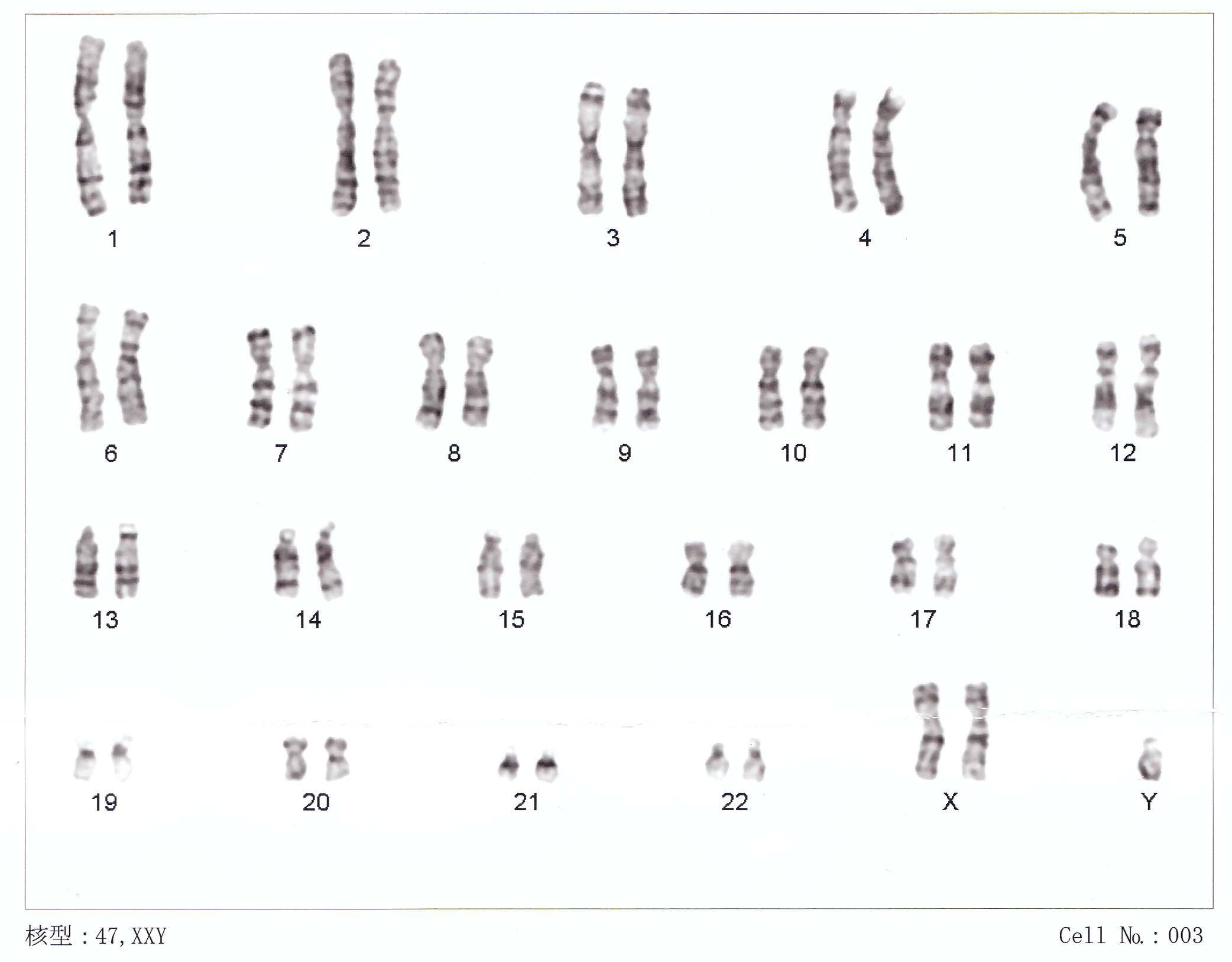
147.

These are the chromosomes of someone with Kleinfelters syndrome. What is different about their chromosomes?

a)

There is only one Y chromosome

b)

One of the 5th chromosomes is too curved

c)

There is an extra X chromosome

d)

There are too few chromosomes

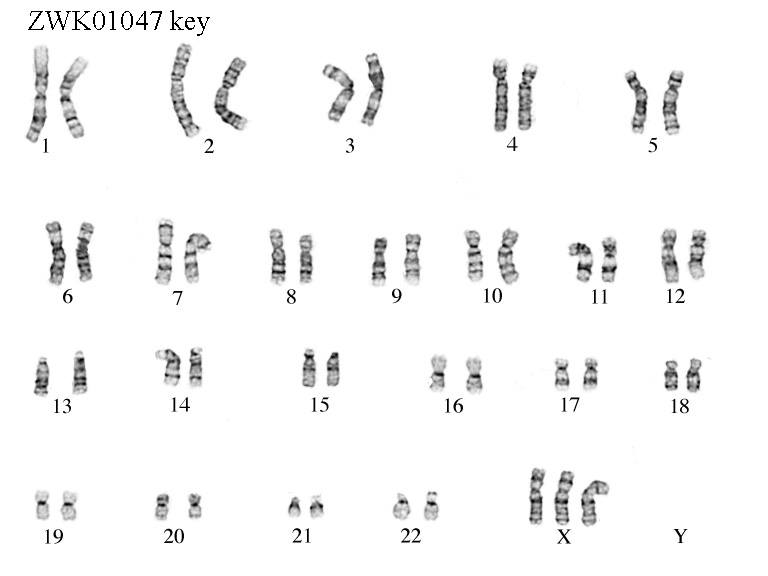
148.

Based on the karyotype, can you guess the name of this genetic disorder?

a)

Curvy 3

b)

Jacob's syndrome

c)

Triple X

d)

Superwoman syndrome