Wayground logo

Free Printable Worksheets

Font size

S
M
L
XL
Worksheets

🏆🏆VL7: Quest 3.11

Total questions: 85

Worksheet time: 53mins

Name
Class
Date
1.
Which of these is an advantage of sexual reproduction? Choose all that apply.
a)
Faster to reproduce offspring.
b)
Genetic Variation
c)
All babies are exactly the same.
d)
Slower Process
e)
Less energy involved.
2.
Which of these is a disadvantage of sexual reproduction? Choose all that apply.
a)
Faster to reproduce offspring.
b)
Genetic Variation
c)
All babies are exactly the same.
d)
Slower Process
e)
Less energy involved.
3.
Which of these is an advantage of asexual reproduction? Choose all that apply.
a)
Faster to reproduce offspring.
b)
Genetic Variation
c)
All babies are exactly the same.
d)
Slower Process
e)
Less energy involved.
4.
A squirrel and an oak tree are both examples of individual
a)
cells
b)
populations
c)
communities
d)
organisms
5.
Which list represents the levels of organization in a multicellular organism from the simplest level to the most complex level?
a)
tissue, cell, organ system
b)
organ system, organ, tissue, cell
c)
organ, tissue, organ system
d)
cell, tissue, organ, organ system
6.
Which organizational level includes all of the other levels?
a)
biome
b)
biosphere
c)
ecosystem
d)
community
7.
Which statement correctly describes part of the photosynthetic process in plants?
a)
Oxygen is used in Dark Reactions.
b)
Carbon Dioxide is released in Dark Reactions.
c)
Water is a reactant in Ligt Reactions.
d)
Alcohol is produced in Light Reactions
8.
Which process provides most of the oxygen found in Earth's atmosphere?
a)
Aerobic Respiration
b)
Fermentation
c)
Photosynthesis
d)
Lactic Acid Fermentation
9.
Which organelles must be present withi the cell of a leaf for respiration and photosynthesis to occur? (Select all that apply)
a)
Mitochondria
b)
Lysosome
c)
Centrosomes
d)
Chloroplast
e)
Endoplasmic Reticulum
10.
During aerobic respiration, energy stored in food is transferred to molecules of
a)
Glucose
b)
DNA
c)
Enzymes
d)
ATP
11.
Which process requires oxygen to release energy?
a)
Fermentation
b)
Photosynthesis
c)
Anaerobic Respiration
d)
Aerobic Respiration
12.
Term: Many ecosystems to include specific weather and precipitation.
a)
Organism
b)
Community
c)
Population
d)
Biome
13.

What is the formula for sodium bromide?

a)

NaBr

b)

NaBr2

c)

Na2Br

d)

SoBr

14.

What is the formula for diphosphorus pentoxide?

a)

P2O5

b)

PO5

c)

P5O2

d)

Po2O5

15.

What is the chemical formula of sulfur hexabromide?

a)

SBr₆

b)

S₆Br

c)

S(VI)Br

d)

SBr4

16.

Name the following compound: NaNO3

a)

Sodium Nitrogen Oxide

b)

Sodium nitrate

c)

Sodium nitrite

d)

Sodium nitride

17.

What is the name of K3PO4?

a)

Tripotassium Phosphate

b)

Tripotassium Phosphite

c)

Potassium phosphide

d)

Potassium phosphate

18.

What is the name of Al(NO3)3?

a)

Aluminum trinitrate

b)

Monoaluminum nitrate

c)

Aluminum (III) nitrate

d)

Aluminum Nitrate

19.

Name the following ionic compound: LiNO3

a)

lithium nitrate

b)

lithium III nitrate

c)

lithium nitride

d)

lithium oxide

20.

What is the name of NH4Cl?

a)

nitrogen tetrahydrogen chloride

b)

ammonium chlorine

c)

ammonium chloride

d)

ammonium chlorate

21.

What is the chemical formula for iodine heptafluoride?

a)

IF7

b)

I7F

c)

I7F7

d)

IF

22.

What is the formula for the following compound:

iron (III) oxide

a)

FeO3

b)

Fe3O2

c)

FeO

d)

Fe2O3

23.

P3F4

a)

Phosphorous fluoride

b)

Triphosphorous tetrafluoride

c)

Phosphate Fluoride

d)

Trifluoride hexafluoride

24.

What is the name for SiCl4?

a)

silicon tetrachloride

b)

silicon quadchloride

c)

monosilicon tetrachloride

d)

silicon chloride

25.

What is the chemical name of Ag2O?

a)

Disilver monoxide

b)

Silver (II) Oxide

c)

Silver (I) Oxide

d)

Silver Oxide

26.

What is the chemical name for MnCl3?

a)

Manganese (I) Chloride

b)

Manganese Trichloride

c)

Manganese Chloride

d)

Manganese (III) Chloride

27.

Which of the following correctly lists the levels of biological organization from LEAST complex to MOST complex?

a)

cell, tissue, organ, organ system, organism

b)

cell organism organ system organ tissue

c)

organ system organism organ tissue cell

d)

organism organ system organ tissue cell

28.

Which of the following are macromolecules?

a)

Carbohydrates

b)

Carbon dioxide

c)

Lipids

d)

proteins

e)

nucleic acid

29.

A group of cells that come together to perform a specific function is a

a)

cell

b)

tissue

c)

organism

d)

organ

30.
What are the products of photosynthesis?
a)
water and carbon dioxide
b)
oxygen and glucose
c)
oxygen and carbon dioxide
d)
oxygen and water
31.
Where does the Calvin Cycle occur?
a)
thylakoid
b)
stroma
c)
lumen
d)
mitochondria
32.
Which of the following is the correct equation for PHOTOSYNTHESIS?
a)
CO2 + light + H2O --> O2 + Sugar
b)
CO2 + sugar + H2O --> O2 + light
c)
O2 + light + H2O --> CO2 + Sugar
d)
CO2 + O2 + H2O --> Light+ Sugar
33.

Plants release ________ during photosynthesis.

a)

oxygen

b)

water

c)

carbon dioxide

d)

sugar

34.

What molecules enter the chloroplasts for photosynthesis?

a)

Water

b)

Oxygen

c)

Carbon Dioxide

d)

Solar energy (light)

e)

Glucose

35.

What molecules leave the chloroplasts during photosynthesis?

a)

Water

b)

Oxygen

c)

Carbon Dioxide

d)

Solar energy (light)

e)

Glucose

36.

Which of the following helps with plant reproduction?

a)

Pollen

b)

Stem

c)

Roots

d)

Leaves

37.
What pigment absorbs sunlight for photosynthesis?
a)
chloroplast
b)
thylakoid
c)
grana
d)
chlorophyll
38.
What are the reactants of cellular respiration?
a)
glucose & carbon dioxide
b)
glucose & oxygen
c)
water & oxygen
d)
water & carbon dioxide
39.
The purpose of cellular respiration is to 
a)
make water
b)
make ATP
c)
make glucose
d)
make  oxygen
40.
In which way are photosynthesis and cellular respiration different?
a)
Cellular respiration stores ATP, while photosynthesis releases ATP.
b)
Cellular respiration produces oxygen, while photosynthesis uses oxygen.
c)
Photosynthesis releases energy, while cellular respiration stores energy.
d)
Photosynthesis uses carbon dioxide, while cellular respiration produces carbon dioxide.
41.
What is the correct equation for cellular respiration?
a)
6O2 + C6H12O6 -> 6CO2 + 6H2O + Energy
b)
6O2 + C6H12O6 + Energy -> 6CO2 + 6H2O
c)
6CO2 + 6H2O -> 6O2 + C6H12O6 + Energy
d)
6CO2 + 6H2O + Energy -> 6O2 + C6H12O6
42.
If oxygen is not present what process will occur in yeast cells?
a)
Alcoholic fermentation
b)
Respiration
c)
Photosynthesis
d)
Lactic acid fermentation
43.
During fermentation, yeast produces CO2 and
a)
lactic acid
b)
alcohol
c)
hydrogen 
d)
water
44.

What are the reactants (taken into) of cellular respiration? (Mark all of them!)

a)

oxygen

b)

glucose

c)

carbon dioxide

d)

water

e)

energy

45.

Which stage of the cellular respiration process produces the most ATP?

a)

Glycolysis

b)

Acetyl CoA

c)

Kreb's Cycle

d)

Electron Transport Chain

46.
Cells spend 90% of their time in this stage of the cell cycle. This is the reason you would see most cells in this stage if viewed under a microscope.
a)
Prophase
b)
Metaphase
c)
Anaphase
d)
Interphase
47.

Which of these are part of Mitosis?

a)

Metaphase

b)

Prophase

c)

Anaphase

d)

Telophase

e)

Cytokinesis

48.
The sister chromatids of each chromosome are separated (come apart) and move to opposite ends of the cell. Name that Stage!
a)
Prophase
b)
Metaphase
c)
Anaphase
d)
Telophase
49.
Nucleolus and nuclear membrane start to disappear, chromatin condenses into chromosomes, and spindle fibers start to form. Name that Stage!
a)
Interphase
b)
Prophase
c)
Metaphase
d)
Anaphase
50.
The chromosomes start to line up in the middle of the cell.
a)
Prophase
b)
Metaphase
c)
Anaphase
d)
Telophase
51.
What do the cells look like at the end of mitosis?
a)
different from original cell
b)
similar to the original cell
c)
identical to the original cell
d)
none of these
52.
Name the phase:
a)
Anaphase
b)
Telophase
c)
Metaphase
d)
Prophase
53.
Name the phase:
a)
Prophase
b)
Metaphase
c)
Anaphase
d)
Telophase
54.
Name the phase:
a)
Prophase
b)
Metaphase
c)
Anaphase
d)
Telophase
55.
The stages of mitosis in order
a)
Metaphase, Anaphase, Prophase, Telophase
b)
Prophase, Anaphase, Metaphase, Telophase
c)
Prophase, Metaphase, Anaphase, Telophase
d)
Anaphase, Prophase, Telophase, Metaphase
56.
When a cell is not actively dividing, it is in what phase?
a)
interphase
b)
anaphase
c)
prophase
d)
telophase
57.
When a cell divides, what do we call the 2 new cells?
a)
mother cells
b)
father cells
c)
daughter cells
d)
son cells
58.
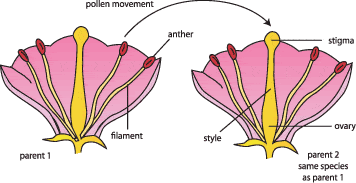
True/False: Pollination can occur between flowers of the same plant. 
a)
True 
b)
False 
59.
Pollination is the process by which the pollen grains are transferred from the ________ to the _________. 
a)
anther... ovary
b)
anther ... stigma
c)
stigma ... ovary 
d)
stigma ... filament
60.
What does an ovule become when it is pollinated?
a)
a seed
b)
a sprout
c)
a fruit
d)
it stays an ovule
61.
Fertilization is the process by which an 
a)
egg and pollen combine
b)
embryo grows into a plant
c)
animal carries pollen between plants
62.
What is the sticky part of the flower that catches pollen?
a)
style
b)
stigma
c)
ovary
d)
petal
63.
Which does not belong in the female part (pistil) of the flower?
a)
style
b)
stigma
c)
filament
d)
ovaries
64.
What is an ovary?
a)
the female part of the flower that becomes a fruit
b)
the female part of the flower that accepts the pollen
c)
the male part of the flower that produces pollen
d)
another name for the stem of the plant
65.
What is #1 pointing to?
a)
ovary
b)
petal
c)
stigma
d)
stamen
66.
What is #8 pointing to?
a)
petal
b)
stamen
c)
pistil
d)
ovary
67.
What is #2 pointing to?
a)
anther
b)
filament
c)
ovary
d)
style
68.
What is #3 pointing to?
a)
stigma
b)
filament
c)
ovary
d)
anther
69.
What is #4 pointing to?
a)
anther
b)
style
c)
stigma
d)
ovary
70.
What is #5 pointing to?
a)
anther
b)
filament
c)
stigma
d)
style
71.
What is #6 pointing to?
a)
stigma
b)
style
c)
ovary
d)
petal
72.
What is #7 pointing to?
a)
anther
b)
ovary
c)
ovule
d)
petal
73.
Where is pollen made?
a)
ovary
b)
petal
c)
pistil
d)
anther
74.

Whats is the function of the mitochondrion?

a)

Energy production

b)

Store water

c)

Conduct photosynthesis

d)

None of the above

75.
Plant cell structures that turn energy from sunlight into food.
a)
Cell Wall
b)
Mitochondria
c)
Chloroplast
d)
Cytoplasm
76.
Another name for a sex cell is a:
a)
gamete
b)
embryo
c)
bone cell
d)
muscle cell
77.
Which is Metaphase?
a)
A
b)
E
c)
C
d)
F
78.
the two halves of the doubled chromosome structure 
a)
centromeres
b)
sister chromatids
c)
spindle
d)
tissues
79.

Which of the following are TRUE statements? (Select ALL that apply)

a)

Photosynthesis takes place in the chloroplasts of leaf cells

b)

Photosynthesis means "making food using sun"

c)

Photosynthesis can occur in the dark

d)

All plants, plant-like protists, and some bacteria go through photosynthesis

80.
Granum is a ____________.
a)
stack of chloroplasts
b)
stack of thylakoids
c)
membrane in the thylakoid
d)
a pigment molecule
81.
What is 3 pointing to?
a)
Thylakoid space
b)
Thylakoid
c)
Stroma
d)
Stomata
82.
What is 4 pointing to?
a)
Stroma
b)
Thylakoid
c)
Granum
d)
Stomata
83.
What is 5 pointing to?
a)
Thylakoid
b)
Granum
c)
Thylakoid Space
d)
Stroma
84.
This means that oxygen is needed
a)
anaerobic 
b)
aerobic
85.
Which type of respiration is most efficient?
a)
Aerobic
b)
Anaerobic