
 Worksheets
The Great Minds - 2nd Round
Total questions: 70
Worksheet time: 35mins


a mature haploid male or female germ cell that is able to unite with another of the opposite sex in sexual reproduction to form a zygote.
absorption
asexual reproduction
fertilization
gamete
What is true of tubers?
They are a result of sexual reproduction
They contain seeds
They are swollen ovaries
They produce identical copies of the parent
Which of the following is a chemical formula?
H2SO4
Si
Hg
C
An atom has 4 protons.
How many electrons does it have if the atom has a -1 charge?
6
5
4
3
How many elements are in C6H12O6?
1
2
3
6
Humans absorb oxygen from the air they breathe in and exhale carbon dioxide gas, CO2. Carbon dioxide gas is
an element made of carbon and oxygen atoms.
a solution made of carbon and oxygen atoms.
a compound of carbon and oxygen atoms.
a mixture of carbon and oxygen atoms.
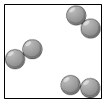


What characteristics are shared by all alkali metals and alkaline earth metals?
They conduct electricity very well.
They are strong and shiny.
They form alkaline solutions when mixed with water.
They do not react with water at all.

Noble gases are sometimes called "inert gases." What can you infer about the meaning of the word "inert" in chemistry?
It refers to substances that easily lose electrons.
It refers to substances that do not react with other substances.
It refers to substances that have strong electrochemical charges.
It refers to gases.

Which of the following is a true statement?
Periods form horizontal rows; groups form vertical columns.
Groups form horizontal rows; periods form vertical columns.
Categories form horizontal rows; gases form vertical columns.
Gases form horizontal rows; categories form vertical columns.

To become positively charged, an atom must:
Gain a proton.
Lose a proton.
Gain an electron.
Lose an electron.
What happens when salty water is boiled?
The salt becomes a new compound and water evaporates as it has a low boiling point
The water evaporates and the salt remains in the beaker as it has a high melting point
The water becomes a new compound and evaporates while salt remains in the beaker
The water will disappear and the salt remains in the beaker as it is a solid
What happens when sugar is mixed with water?
The sugar and water become a new compound that can be separated by crystallization
The sugar dissolves as it is a solid and can be separated by crystallization
The sugar and water become a mixture that can be separated by crystallization
The sugar and water become a mixture that can be separated by filtration

The table below list four liquids with four different densities. Liquid 1,2,3 and 4 are immiscible and you are asked to separate them using a decantation funnel. In what order would the liquids form layers from TOP to BOTTOM?
3, 2, 1, 4
4, 1, 2, 3
1, 2, 3, 4
3, 2, 4, 1

Matter can be classified by analyzing its composition as it is shown in the diagram. Steel is a material that contains two elements: iron (Fe) and carbon (C). Two different samples of steel have different quantities of these two elements, but both have uniform composition. Using the diagram above, how would you classify steel?
As pure substance, because it has uniform composition and it is a compound
As a heterogeneous mixture, because is formed by two different elements
As a homogeneous mixture, because is formed by two different elements and it is uniform
As pure substance, because different samples have different composition
What is the correct order for obtaining salt from a mixture of sand and salt?
Dissolving in water - filtration – evaporation
Evaporation - filtration - dissolving in water
Filtration - dissolving in water - evaporation
Dissolving in water – evaporation - filtration

Name the separation technique shown in the diagram
Filtration
Chromatography
Centrifugation
Distillation

Which of these items is not needed to make a working circuit?
connecting wires
a switch
a component such as a bulb
a component such as a bulb
Which instrument would you use to measure current?
an ammeter
a cell
a motor
a voltmeter

One ammeter in this circuit is reading 3 A. What is the reading on the other ammeter?
1 A
2 A
3 A
4 A
A light bulb comes on when a switch is pressed. Which statement is the best explanation for why this happens?
When you press the switch you make a gap in the circuit.
The switch is made of metal.
The switch is made of metal.
The switch turns all the bulbs on or off at once.
An electric current is:
a source of energy.
a kind of liquid inside the wires.
tiny particles called charges flowing through the wires.
tiny particles called volts flowing through the wires.
We need to use models to help us to think about electricity because:
it makes electricity more fun.
charges are too small to see.
charges are imaginary.
electricity is not real.
1 A central heating system can be used as a model for a circuit. Which of these statements is not true?
The boiler and pump represent the cell.
The pipes represent the wires.
The radiators represent the bulbs.
The pump represents an ammeter.
Which statement describes a way in which the central heating model is not like an electric circuit?
The radiator transfers energy to the surroundings.
Water leaks out of the pipes if you make a gap in the pipes.
The pump pushes the water through the pipes.
You can put more radiators into a central heating circuit.

Which of these circuits are parallel circuits?
X and Y only
X and Z only
Y and Z only
all of them

Which switches must be pressed to make bulb X come on?
1 and 2 only
1 and 3 only
2 and 3 only
all three of them
What does the voltage across a component measure?
The number of charges that pass through the component.
The size of the cell in the circuit.
How hard it is for the current to flow through the component.
The energy transferred by the current.
Which of these combinations will give the largest current in a circuit?
high voltage, high resistance
low voltage, high resistance
high voltage, low resistance
low voltage, low resistance
An obstacle in a race represents:
a high resistance, because it is hard for runners to get over it.
a low resistance, because it is hard for runners to get over it.
a high resistance, because it is easy for runners to get over it.
a wire, because people move along the race track.
What can forces do?
make things start or stop moving
change the shape of things
make moving things change direction
all of the above
Which answer shows three non-contact forces?
magnetism, gravity, friction
gravity, friction, upthrust
gravity, static electricity, magnetism
upthrust, static electricity, friction
Which statement is true?
Your weight would be the same on the Earth and on the Moon.
Your mass would be the same on the Earth and on the Moon.
Your weight would be more on the Moon than on the Earth.
Your mass would be less on the Moon than on the Earth.
What is the extension of a spring?
The stretched length of the spring.
The length of a compressed spring.
The stretched length minus the original length.
The length of the spring before it has been stretched

At which point on this graph does the extension stop being proportional to the force?
A
B
C
D
Which of the following sentences about friction is not correct?
Friction can make an object get hotter.
Friction wears car tires away.
Friction slows down a ball rolling in grass.
Friction can speed up a falling object.
Which part may develop into a fruit?
E
D
C
A
Which example shows unhelpful friction?
friction between a tire and the road
friction in the wheel axles of a bicycle
friction between paper and the point of a pencil
friction between your shoes and the floor
A stretched bow is a store of energy (strain energy). What happens to the energy when the arrow is fired?
Forces transfer the energy to kinetic energy in the arrow.
Energy is stored as chemical energy.
Movement energy is transferred to sound energy.
Force energy is transferred by movement.
How could people in cold countries use less fuel for heating their homes?
Keep the house warmer and open the windows.
Keep the house cooler and wear more clothes.
Make sure they leave the heating on when they are out.
Turn the heat up at night, so they don’t need blankets on the bed.
Which of these is not a problem with using energy resources?
Burning fossil fuels releases carbon dioxide into the atmosphere.
Wind turbines do not produce carbon dioxide.
Solar energy is not available during the night.
Nuclear fuel gives off dangerous radiation.
Fertilization is the process by which an
egg and pollen combine
embryo grows into a plant
animal carries pollen between plants


Which of these will repel each other?
Negatively charged balloon and positively charged sphere.
Negatively charged balloon and neutral sphere.
Negatively charged balloon and negatively charged sphere.
Negatively charged balloon and neutral wall.

If the light bulb in the middle burned out, what would happen to the other two?
The light bulb to the left would stay lit, but the one to the right would turn off.
They would both stay lit.
The light bulb to the right would stay lit, but the one to the left would turn off.
They would both turn off.

Acid + Alkali --> Salt + Water
neutralization reaction
synthesis
decomposition
single displacement


