Wayground logo

Free Printable Worksheets

Font size

S
M
L
XL
Worksheets

Waves

Total questions: 86

Worksheet time: 2hrs 30mins

Name
Class
Date
1.

What is transferred from place to place by waves?

a)

matter

b)

energy

c)

particles

d)

waves

2.

This is the distance between two peaks. What is this called?

a)

amplitude

b)

wavelength

c)

longitude

d)

trough

3.

What does this picture represent?

a)

wavelength

b)

echolocation

c)

amplitude

d)

peak

4.

When energy increases, amplitude _______?

a)

increases

b)

decreases

c)

stays the same

5.

The highest point of a wave is called what?

a)

Trough

b)

energy

c)

Peak

d)

amplitude

6.

What emits sound waves?

a)

Phone

b)

desk

c)

chair

d)

light bulb

7.

What is a wavelength?

a)

How many waves pass a certain point

b)

The distance from one wave crest to another

c)

The entire length of a wave

8.
What is the longest wavelength on the EMS (electromagnetic spectrum)?
a)
Radio Waves
b)
Micro Waves
c)
Gamma Rays
d)
X-Rays
9.
Which color has the longest wavelength?
a)
Orange
b)
Green
c)
Blue
d)
Indigo
10.

What happens to all of the light when it hits this object?

a)

reflection

b)

absorption

c)

transmission

11.

What is the process called for how rainbows are formed?

a)

Reflection

b)

Refraction (bending)

c)

Transmission

d)

Scattering

12.
Which state of matter has molecules that move fastest and spread to fill the space they are in?  They do not form any pattern.
a)
solid 
b)
liquid 
c)
gas
13.
What is matter?
a)
a pure substance
b)
anything that occupies space and possesses mass
c)
an element
d)
a compound
14.
A measure of the amount of matter in an object. 
a)
Weight
b)
Mass
15.
Which of the following is not a chemical property? 
a)
rusting 
b)
boiling 
c)
rotting 
d)
burning 
16.
What is reactivity?
a)
how a substance combines physically with another substance
b)
how a substance combines chemically with another substance 
17.
What is the measure of how much space an object takes up?
a)
matter
b)
volume
c)
substance
d)
properties
18.
Which one of these is a chemical property?
a)
melting point
b)
boiling point
c)
color
d)
flammability
19.
Ability to rust is this type of property:
a)
Physical property
b)
Chemical property
20.
Which is an example of a physical property?
a)
ability to react with acid
b)
 state of matter
c)
flammability
d)
ability to react with oxygen
21.
Which of the following is a chemical change?
a)
human digestion
b)
cutting a tree down
c)
melting a chocolate bar
d)
Has a density of 1 gm/mL
22.
What kind of properties can only be observed when a substance changes into a different substance?
a)
physical properties
b)
chemical properties
c)
liquid properties
d)
real properties
23.
Properties that can be observed without trying to change the identity of the substance.
a)
Physical
b)
Chemical
24.
Jack has a rock. The rock has a mass of 14g and a volume of 2cm3. What is the density of the rock?
a)
7 mL
b)
7 g/cm3
c)
28 g/cm3
d)
1/7 g/cm3
25.
What is the volume of Object X?
a)
10.0 cm3
b)
15.0 cm3
c)
20.0 cm3
d)
25.0 cm3
26.
Which units of measurement are used for volume?
a)
grams
b)
centimeters
c)
grams/milliliter
d)
milliliter
27.
Frank has an eraser. It has a mass of 4g, and a volume of 2cm3. What is its density?
a)
8 g/cm3
b)
2 g/cm3
c)
1/2 g/cm3
d)
24 g/cm3
28.
Frank has a paper clip. It has a mass of 9g and a volume of 3cm3. What is its density?
a)
3 g/cm3
b)
1/3 g/cm3
c)
27 g/cm3
d)
39 g/cm3
29.

How many carbon atoms are there in C3H12O5?

a)

1

b)

3

c)

12

d)

5

30.

How many sodium atoms are there in NaCl2?

a)

1

b)

2

c)

3

d)

4

31.

During a chemical reaction shown in the image, if the mass of C = 12 amu and the mass of O = 16 amu, what would be the mass of the product CO2 (CO2 has 1 carbon atom and 2 oxygen atoms).

a)

12 amu

b)

16 amu

c)

28 amu

d)

44 amu

32.

Subatomic particles with a negative charge

a)

Electrons

b)

Neutrons

c)

Protons

d)

Quarks

33.
subatomic particles found on the outermost shell & responsible for the atom's reactivity
a)
neutrons
b)
valence electrons
c)
isotopes
d)
ions
34.
Subatomic particles with a positive charge
a)
neutrons
b)
atomic mass
c)
protons
d)
isotopes
35.
Measure mainly of the nuclear particles: protons + neutrons
a)
Subatomic Particles
b)
Atomic Number
c)
Atomic Mass
d)
Gluons
36.
Value representing the number of protons in an element
a)
Atomic Mass
b)
Mass Number
c)
Valence Electrons
d)
Atomic Number
37.
Atoms of the same element with a different number of neutrons
a)
Ion
b)
Gluons
c)
Isotope
d)
Quarks
38.
The smallest particle of an element that shows all the properties of that element.
a)
Subatomic Particles
b)
Atom
c)
Quarks
d)
Gluons
39.
Where electrons are likely to be found as they travel around the nucleus
a)
Nucleus
b)
Electron Cloud
c)
Within a Proton
d)
Within a Neutron
40.
A tiny but very dense, positively charged portion of the atom that holds most of the atomic mass
a)
Electron Shells
b)
Orbitals
c)
Electron Cloud
d)
Nucleus
41.
Arrangement of elements organized by atomic number
a)
Electron Cloud 
b)
Periodic Table 
c)
Electron Configuration
d)
None of these
42.
Calculation used to find the number of neutrons in an atom
a)
Atomic Mass - Atomic Number
b)
Atomic Number - Atomic Mass
c)
Atomic Mass - Electrons
d)
none of these
43.
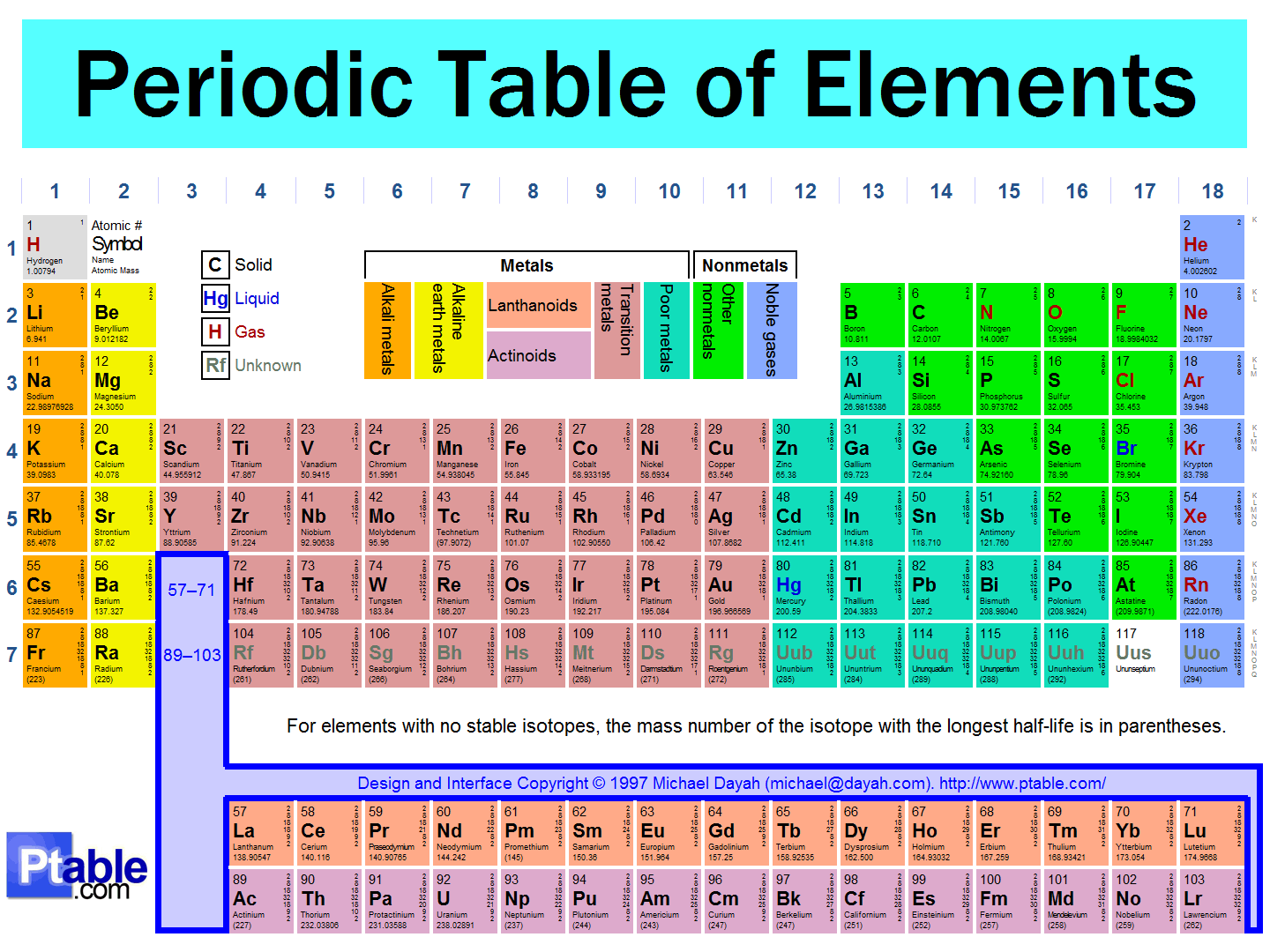
How many protons does an aluminium atom have? (Use the image to help you)
a)
27
b)
14
c)
40
d)
13
44.
How many neutrons does a sodium atom have? (Use the image to help you)
a)
23
b)
11
c)
12
d)
34
45.

Mass number:

a)

the average isotope mass for an element

b)

the mass an electron

c)

the total number of protons and neutrons in the nucleus

d)

number of electrons and protons in an atom

46.

The number of protons for the following would be:

a)

12

b)

24

c)

2

d)

0

47.

The number of electrons for the following would be:

a)

12

b)

24

c)

14

d)

10

48.
How many valence electrons are represented here?
a)
7
b)
5
c)
2
d)
8
49.
What are Valence electrons defined as ?
a)
as electrons in the atom's outermost orbitals. 
b)
as electrons in the atom's innermost orbitals.
50.
How many valence electrons does Si contain? 
a)
14
b)
28
c)
2
d)
4
51.

A horizontal row of elements in the periodic table

a)

Molecule

b)

Period

c)

Family

d)

Atom

52.

What is the atomic mass of Arsenic?

a)

33

b)

107

c)

75

53.

The vertical (up and down) columns in the Periodic Table are called

a)

groups

b)

towers

c)

periods

d)

atomic numbers

54.
Each column in the periodic table is called a 
a)
period
b)
group
c)
cluster
d)
unit
55.
Which group of the periodic table is composed of inert (not reactive)  gases?
a)
alkali metals
b)
alkaline earth metals
c)
halogens
d)
noble gases
56.
Elements which are shiny, conduct electricity and heat are called
a)
metal
b)
nonmetal
c)
metalloid
d)
nonexistent
57.
The atoms along the staircase are called 
a)
metals
b)
nonmetals
c)
metalloids
d)
noble gases
58.
Which is a halogen?
a)
Helium
b)
Chlorine
c)
Oxygen
d)
Neptune
59.
Which is an alkali metal?
a)
Magnesium
b)
Iron
c)
Sodium
d)
Europium
60.

An element has the mass number 12 and atomic number 6. The number of neutrons in it is:

a)

6

b)

10

c)

4

d)

8

61.

Which describes how elements are arranged in the periodic table?

a)

by increasing atomic mass

b)

by increasing atomic number

c)

by chemical name

d)

by chemical symbol

62.

Which two elements share similar properties?

a)

Oxygen and Sulfur

b)

Oxygen and Nitrogen

c)

Oxygen and Helium

d)

Oxygen and Chlorine

63.

Which is NOT true about all of these elements?

a)

They are all in the same group

b)

They all have the same number of valence electrons

c)

They all have the same number of protons

d)

They all share similar properties

64.

Based on the periodic table of elements, which of the following sets of elements have similar properties?

a)

O,S,Y

b)

Cl, Br, I

c)

Ne, N, O

d)

Pb, Sn, Kr

65.

What are the products of the chemical reaction pictured?

a)

CH4 and CO2

b)

CH4 and O2

c)

CO2 and H2O

d)

O2 and H2O

66.

If the reactants' mass is 18g , what is the mass of the products?

a)

15 g

b)

36 g

c)

81 g

d)

18 g

67.
Consider the chemical equation CH4 + 2 O2 → CO2 + 2 H2O. In this equation, CH4 is a
a)
product
b)
reactant
c)
displacement
68.
What is the left part of a chemical equation called?
H2 + O → H2O
a)
Reactants
b)
Products 
c)
Yields 
d)
Chemical Equation 
69.
Identify the reactant(s) and product(s) of the reaction.
a)
All three are reactants and none are products.
b)
Hydrogen and water are the reactants, and oxygen is the product.
c)
Water and oxygen are the reactants, and hydrogen is the product.
d)
Hydrogen and oxygen are the reactants, and water is the product.
70.

In chemical reactions, what does the principle of conservation of mass mean?

a)

The total mass of the reactants is equal to the total mass of the products.

b)

The total mass of the reactants is greater than the total mass of the products.

c)

The total mass of the reactants is less than the total mass of the products.

71.
2H2 + O2 ----> 2H2O What is the product?
a)
------>
b)
2H2O
c)
2H2+ O2
72.
How many Hydrogen are in 4H2O?
a)
6
b)
8
c)
2
d)
4
73.
Which of the following shows the correct way to balance the chemical equation?
Fe + O2 -> Fe2O3
a)
4Fe + 3O2 -> 2Fe2O3
b)
2 Fe + 3O2 -> Fe2O6
c)
4 Fe + O6 -> 2Fe2O3
d)
None of the options are correctly balanced.
74.
What does the Law of Conservation of Mass state?
a)
Matter cannot be gained or lost in a chemical reaction.
b)
Matter can only be lost in a chemical reaction.
c)
Matter can only be gained in a chemical reaction.
d)
Matter can be gained and lost in a chemical reaction. 
75.
What is the total number of atoms present in 5Na3PO4
a)
5
b)
40
c)
55
d)
8
76.
Is the following equation balanced?...
Al + O2 --> 2Al2O3
a)
Yes!
b)
No!
77.
Balance this equation-
__P4 + __O2 --> __P2O3
a)
it is already balanced
b)
2, 1, 3
c)
1, 2, 3
d)
1, 3, 2
78.
Balance this equation.
_Mg + _Cl2 --> _MgCl2
a)
1, 2,1
b)
already balanced
c)
2,1,1
d)
1,1,2
79.
When the equation
Na + H2O --> NaOH + H2 is correctly balanced using the smallest whole numbers, the coefficient of the water is
a)
1
b)
2
c)
3
d)
4
80.
Balance this equation.
_CF4 + _Br2 -- _CBr4 + _F2
a)
2,1,2,1
b)
1,2,2,1
c)
1,2,1,2
d)
2,2,2,2
81.
When we describe the size, shape, smell, feel of an object, we are describing its _______________________________.. 
a)
mass
b)
properties
c)
volume
d)
matter
82.
The following are examples of solids except
a)
syrup
b)
text book
c)
desk
d)
lunchbox
83.
All of these are examples of gases except
a)
oxygen
b)
carbon dioxide
c)
helium
d)
shampoo
84.
__________ is any thing that takes up space.
a)
Mass
b)
Matter
c)
Volume
d)
Length
85.
___________________ this state of matter has a definite shape and definite volume. 
a)
solid
b)
liquid
c)
gas
d)
matter
86.
does not have a definite shape or volume
a)
volume
b)
solid
c)
liquid
d)
gas