
Font size
 Worksheets
Nervous System
Total questions: 103
Worksheet time: 57mins
Neurons are excitable cells because their membranes are in a –
Depolarised state
Polarized state
Repolarized state
None of the above is correct
Ion channels present on neural membrane are –
Impermeable
Semipermeable
Selective permeable
Fully permeable
A polarized neuron is said to be in –
Action potential
Spike potential
Resting potential
None of these
When a neuron is not conducting any impulse i.e. resting, the axonal membrane is –
Comparatively more permeable to K+ and impermeable (nearly impermeable) to Na+
Impermeable to negatively charged proteins present in the axoplasm
Both a and b
More permeable to Na+ ions than K+ ion.
What generally maintains the electrical charge across the neuronal membrane?
Na+ - K+ pump
Action potential
resting potential
Voltage - gated channels
Na+ - K+ pump
I. No needs energy (ATP) to work
II. Expels 3 Na+ for every 2K+ ions imported
III. Works against a concentration gradient
IV. Maintains resting potential
All are correct
Only II and III are correct
Only I and III are correct
Only I is incorrect
During depolarization of the neuronal membrane –
Na+ ions rapidly move to the inside of the cell
Na+ ions rapidly move to the outside of the cell
K+ ions rapidly move to the outside of the cell
K+ ions rapidly move to the outside of the cell
A segment of neuronal membrane showing action potential is said to be –
Polarized
Depolarized
Repolarized
None of the above
The electrical potential difference across the depolarized membrane is called –
Action potential
Resting potential
Water potential
Solute potential
Which of the following diagram illustrates the distribution of Na+ and K+ ions in a section of non-myelinated axon which is at resting potential?


How do parasympathetic neural signals affect the working of the heart ?
Reduce both heart rate and cardiac output.
Heart rate is increased without affecting the cardiac output.
Both heart rate and cardiac output increase.
Heart rate decreases but cardiac output increases.
Which one of the following statements is not correct ?
Retinal is the light absorbing portion of visual photo pigments.
In retina the rods have the photopigment rhodopsin while cones have three different photopigments.
Retinal is a derivative of Vitamin C.
Rhodopsin is the purplish red protein present in rods only.
Which one of the following is not a refractive medium of the eye?
Lens
Vitreous humour
Aqueous humour
Pupil
In mammalian eye, the ‘fovea’ is the center of the visual field, where
Only rods are present
More rods than cones are found
High density of cones occur, but has no rods
The optic nerve leaves the eye
The fovea of eye
has the lowest light threshold
is the region of highest visual activity
contains only green and red cones
contains only rods
Cavity of vitreous humour (gel) is –
Behind the lens
In front of lens
Between choroid and retina
Between choroid and sclera
Cavity of aqueous humour (watery fluid) is –
Behind the lens
Between choroid and retina
Between cornea and lens
Between lens and retina
Which of the following options is wrong?
Eye muscles are attached with sclera
Visual purple is concerned with dim light, while visual violet is concerned with bright light
The colour differentiation is done by cones
None
Which of the following statements is not correct ?
In the knee-jerk reflex, stimulus is the stretching of muscle and response is its contraction
An action potential in an axon does not move backward because the segment behind is in a refractory phase
Depolarisation of axon causes outside negatively and inside positively charged
Rods are very sensitive and contribute to daylight vision
Which of the following systems transmits impulse from CNS to involuntary organs and smooth muscles?
Somatic neural system
Sympathetic neural system
Parasympathetic neural system
Autonomic neural system
Bipolar neuron –
Has two dendrons
Has one dendron and one axon
Is interneuron
Has no dendron
Which of the following system relays impulse from CNS to skeletal muscles?
Somatic neural system
Sympathetic neural system
Parasympathetic neural system
Autonomic neural system
Which of the following cells form myelin sheath around axon –
Neuroglial cell
Neuron
Schwann cell
Astrocyte
When a neuron is not conducting any impulse i.e. resting, the axonal membrane is –
Comparatively more permeable to K+ and impermeable (nearly impermeable) to Na+
Impermeable to negatively charged proteins present in the axoplasm
Both a and b
More permeable to Na+ ions than K+ ion.
What generally maintains the electrical charge across the neuronal membrane?
Na+ - K+ pump
Action potential
resting potential
Voltage - gated channels
The impulses from CNS to skeletal muscles are relayed through
SNS
Somatic neural system
PSNS
All of these
Unidirectional transmission of the nerve impulse is maintained by –
Interneurons
Myelin sheath
Synapse
Membrane polarity
The new potential developed on post-synaptic membrane is –
Always excitatory
Always inhibitory
May be excitatory or inhibitory
Neither excitatory nor inhibitory
Which of the following regions of the brain is incorrectly paired with its function?
Cerebellum – Language comprehension
Medulla oblongata – Homeostatic control
Cerebrum – Calculation and contemplation
Corpus callosum – Communication between the left and right cerebral cortices
I. Cerebellum has very convoluted surface in order to provide the additional space for more neurons
II. The medulla is connected to the spinal cord
III. Medulla contains controlling centres for respiration, cardiovascular reflexes and gastric secretion
All are correct
Only I is correct
Only I and III are correct
Only II is correct
Immediate involuntary response to stimulus is –
Reflex action
Autonomic response
Action control
None of these
Reflex action is controlled by –
CNS
PNS
ANS
None of these
Which of the following structures or regions is incorrectly paired with its functions?
Hypothalamus : production of releasing hormones and regulation of temperature, hunger and thirst.
Limbic system : consists of fibre tracts that interconnect different regions of brain; controls movement.
Medulla oblongata : controls respiration and cardiovascular reflexes.
Corpus callosum : band of fibers connecting left and right cerebral hemispheres.
Five events in the transmission of nerve impulse across the synapse –
A. Opening of specific ion channels allows the entry of ions, a new action potential is generated in the post-synaptic neuron.
B. Neurotransmitter binds to the receptor on post synaptic membrane
C. Synaptic vesicle fuses with pre-synaptic membrane, neurotransmitter releases into synaptic cleft.
D. Depolarization of pre-synaptic membrane
E. Arrival of action potential at axon terminal.
In which sequence do these events occur?
E→D→C→B→A
A→B→C→D→E
A→B→D→C→E
E→D→C→A→B
The junction between the axon of one neuron and the dendrite of the next is called –
A joint
Constant bridge
Junction point
Synapse
During repolarization of nerve –
K+ gate closes and Na+ gate opens
Na+ channels are closed and K+ channels are opened
Both K+ and Na+ gates are closed
Both gates remain opened
The new potential developed on post-synaptic membrane is –
Always excitatory
Always inhibitory
May be excitatory or inhibitory
Neither excitatory nor inhibitory
The hind brain develops into which structure?
Medulla
Pons
Cerebellum
All
The forebrain develops into –
Diencephalon and Cerebrum
Diencephalon and Cerebellum
Diencephalon and Medulla
Diencephalon and Pons
The thalamus and hypothalamus develop from –
Telencephalon
Diencephalon
Cerebrum
Cerebellum
The correct sequence meninges from inner to outerside is –
Arachnoid→Duramater→Piamater
Duramater→Arachnoid→Piamater
Piamater→Arachnoid→Duramater
Piamater→Duramater→Arachnoid
The name of nervous band connecting the cerebral hemispheres is –
Corpus albicans
Corpus callosum
Corpus striatum
Corpus spongiosum
Myelinated fibres of the tract forms –
White matter
Grey matter
White and grey matter
Red matter
Which excitatory neurotransmitter is involved in the transmission of impulse at the neuro-muscular junction?
Epinephrine
Serotonin
Acetyl choline
Glycine
Acetylcholine is a :
Hormone
Brain peptide
Neurotransmitter
Digestive enzyme
Myelin sheath is produced by :
Astrocytes and Schwann cells
Oligodendrocytes and Osteoclasts
Osteoclasts and Astrocytes
Schwann cells and Oligodendrocytes
Receptor sites for neurotransmitters are present on :
Pre-synaptic membrane
Tips of axons
Post-synaptic membrane
Membrane of synaptic vesicles
If myelin sheath present completely around axon what will be happened?
Conduction will be as usual
Conduction is slow
Conduction is fast
Conduction is stoppped
In nerve resting membrane potential is maintained by :
Active transport
Passive diffusion
Both (a) and (b)
Unidirectional flow of ion
Nissl bodies are mainly composed of
Nucleic acids and SER
DNA and RNA
Proteins and lipids
Free ribosomes and RER

In the above diagram showing axon terminal and synapse A, B, C, D and E respectively represents:
axon terminal, synaptic cleft, synaptic vesicles, neurotransmitters and receptors
axon terminal, synaptic vesicles, synaptic cleft, receptors and neurotransmitters
synaptic cleft, synaptic vesicles, axon terminal, neurotransmitters and receptors
synaptic cleft, axon terminal, synaptic vesicles, neurotransmitters and receptors
The impulses from CNS to skeletal muscles are relayed through
SNS
Somatic neural system
PSNS
All of these
Unidirectional transmission of the nerve impulse is maintained by –
Interneurons
Myelin sheath
Synapse
Membrane polarity
Pituitary dwarfism is caused due to the deficiency of
Oxytocin
Growth hormone
Prolactin
Luteinizing hormone
Which element is required for the synthesis of thyroxine?
Magnesium
Iodine
Calcium
Iron
Thyroxine has an important role in regulating
Blood calcium level
Basal metabolic rate
Water and electrolyte balance
Both (b) and (c)
How many parathyroid glands are present in human beings?
3
4
5
8
Which of the following is a hypercalcemic hormone?
Thyroxine
Parathyroid hormone
Insulin
Glucagon
Which hormone increases blood calcium level ?
Thyroxine
Thyrocalcitonin
PTH
All of the above
Which hormone regulates colour of skin ?
MSH
LH
PTH
LTH
It is required for differentiation of T-cells
T3
Thymosin
T4
Melatonin
Chemically the hormones are
Steroids only
Proteins, steroids and biogenic amines
Proteins only
Biogenic amines only
Children who have damaged thymus may result in_____________
Loss of an antibody-mediated immunity
Reduction in stem cell production
Deafness
Loss of cell-mediated immunity
Deficiency of this element causes the thyroid gland to swell up
Calcium
Iodine
phosphorous
None of the above
The hormone that participates in metabolizing calcium and phosphorous are called _____
Glucagon
Calcitonin
Glycogen
None of the above
_______ controls the concentration of urine
ADH
Oxytocin
ACTH
GH
Endocrine glands produce or action of endocrine glands is mediated through:
Hormones
Enzymes
Minerals
Vitamins
Which of the following does not secrete any hormone?
Spleen
Ovary
Testes
Pancreas
The posterior pituitary gland is not a 'true' endocrine gland because :- …[NEET 2016]
a) It is under the regulation of hypothalamus
b) It secretes enzymes
c) It is provided with a duct
d) It only stores and releases hormones
Which hormone 's secretion increases in emergency?
Thyroxine
Parathormone
Adrenaline
Aldosterone
It is correct for the functions of pineal gland ?
To maintain ovarian follicle
Self defence capability
To maintain mineral ions in the body
Loss of water from body
FSH and LH hormones together are called :
GTH
Stress removing hormones
Emergency hormones
Neurohormones
Vasopressin is found in
Posterior lobe of pituitary
Intestine
Kidney
Liver
On seeing a tiger the heart-beat and blood pressure increases due to release of hormone.
Corticoids
Thyroxine
Adrenaline
Parathormone
Which hormone is secreted by zona fasciculata?
ADH
Mineralocorticoids
Glucocorticoids
Hydrocorticoids
Secretions of which of the following is necessary for increase in uptake of glucose by liver and adipose cells ?
Alpha cells of islets of langerhans
Beta cells of islets of langerhans
Delta cells
Beta cells of pancreatic acini
Which of the following stimulates adrenal gland in an emergency ?
Adrenal medulla
CNS
PNS
Mid-brain
The calcium level is increased in blood by promoting
Dissolution of skeletal structures
Excretion of calcium in urine
Mineralisation of bones
Mineralisation of teeth
Glucocorticoids are produced by
Zona reticularis
Adrenal medulla
Zona fasciculata
Zona glomerulosa
Which of the following is caused due to hypersecretion of thyroxin hormone?
Goitre
Exophthalmic goitre
Cretinism
Myxoedema
Glucagon acts on liver cells and stimulates the conversion of glycogen into
Fructose
Sucrose
Glucose
Ribose
Which of the following hormones control the homeostasis of glucose?
Aldosterone and insulin
Insulin and glucagon
Thymosin and relaxin
Insulin and glycogen
Which of the following statements is incorrect?
Insulin increases cellular uptake of glucose
Insulin decreases fat synthesis
Insulin increases synthesis of proteins
Insulin promotes glycogenesis in liver
__________ is synthesised by the growing ovarian follicles.
Estrogen
Testosterone
Cortisol
Prolactin
Juxtaglomerular cells of kidney produce a hormone called
Cholecystokinin
Erythropoietin
ADH
ANF
Which of the following is an amino acid derivative hormone?
Estrogen
Epinephrine
Cortisol
Insulin
Vasopressin is found in
Posterior lobe of pituitary
Intestine
Kidney
Liver
Secretions of which of the following is necessary for increase in uptake of glucose by liver and adipose cells ?
Alpha cells of islets of langerhans
Beta cells of islets of langerhans
Delta cells
Beta cells of pancreatic acini
On seeing a tiger the heart-beat and blood pressure increases due to release of hormone.
Corticoids
Thyroxine
Adrenaline
Parathormone
Which of the following option is not correct for the state of body in stress ?
Increased heart-beat
Increased alertness
Increased glucose level of blood
Rate of protein synthesis increases
It is correct for the functions of pineal gland ?
To maintain ovarian follicle
Self defence capability
To maintain mineral ions in the body
Loss of water from body
Correct sequence of electrical impulse transmission in a neuron is from
dendrite, axon, axonal end,cell body
cell body, dendrite, axon,axonal end
dendrite, cell body, axon, axonal end
axonal end, axon, cell body, dendrite
Which is the correct sequence of the components of a reflex arc
Receptors, spinal cord,sensory neuron, motor neuron, muscle
Receptors, muscle, sensory neuron, motor neuron, spinal cord
Receptors, sensory neuron, spinal cord, motor neuron, muscle
Receptors, motor neuron, spinal cord, sensory neuron, muscle
Taste receptors are
Phonoreceptors
Statoreceptors
Olfactory receptors
Gustatory receptors
The microscopic gap between two adjacent neurons throgh which a nerve impulse passes is
Neurotransmitter
Synapse
Axon terminal
Dendrite
Which nerves arise from the brain and emerges through the skull
Spinal nerves
Thoracic nerves
Cranial nerves
Lumbar nerves
The microscopic gap between two adjacent neurons throgh which a nerve impulse passes is
Neurotransmitter
Synapse
Axon terminal
Dendrite
What causes the release of neurotransmitters into the cleft?
an action potential reaches the terminal
ligand gated ion channels open
excititory neurotransmitters bind to ligand gated ion channels
an action potential on the post synaptic neuron triggers nearby voltage gated ion channels

What chemical is activated by the action potential in the presynaptic neuron that causes the vesicles containing neurotranmitters to move toward the synaptic cleft?
calcium
potassium
sodium
phosphorus
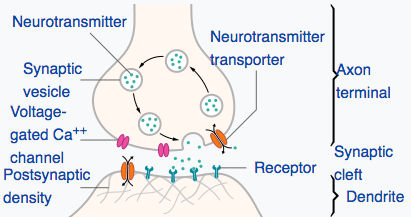
What is the response in the postsynaptic cell once the acetylcholine has bound to it?
In opens the Na+ gated channels and Na+ rush in
It opens the Ca2+ gated channels and Ca2+ rush in
It closes the K+ channels creating a resting potential
It releases its own neurotransmitter into the synaptic cleft

