
 Worksheets
S2 Final Review 2
Total questions: 99
Worksheet time: 3hrs 18mins

Which image shows a neutral conductive pith ball after a positively charged balloon is brought near the left side, but doesn't touch?
A
B
C
D
What is the end result of charging by friction?
Both object have the same charge, so they will attract one another
Both object have the same charge, so they will repel one another
Both object have the opposite charge, so they will attract one another
Both object have the opposite charge, so they will repel one another

This image shows the before picture, when a balloon is rubbed with polyester. Identify the correct after picture, assuming the polyester becomes negatively charged and the two stick together.


If balloon B is negatively charged, what conclusion can you draw about A and C?
A and C are both positively-charged.
A and C are both negatively-charged.
A is positively-charged and C is negatively-charged.
A is negatively-charged and C is positively-charged.

If the charge on one of the objects is doubled, what would happen to the force?
It would double in magnitude but remain in the same direction.
It would quadruple in magnitude but remain in the same direction.
It would double in magnitude and reverse direction.
It would quadruple in magnitude and reverse direction
If the two objects were twice as far apart, what would happen to the force between them?
It would quadruple in magnitude and continue to attract.
It would double in magnitude and continue to attract.
It would halve in magnitude and continue to attract.
It would quarter in magnitude and continue to attract.
If the charge on blue both doubled and became negative , the electrostatic force between them would _________.
It would increase in magnitude and continue to attract.
It would decrease in magnitude and continue to attract.
It would increase in magnitude and repel.
It would decrease in magnitude and repel.

The electrostatic force and the universal gravitation force are similar in that _________.
both depend on fundamental quantities such as mass and charge
both depend on universal constants such as G and k
both depend on the inverse-square of the distance apart
all of the above
The electrostatic force and the universal gravitation force are dissimilar in that __________.
gravity occurs between with much smaller objects than electricity
gravity is a much stronger force than electricity
gravity can only attract while electricity can both attract and repel
gravity only occurs in space while electricity occurs everywhere

As a result of the proximity of the negatively charged stick, __________.
electrons would flow from A to B
electrons would flow from B to A
protons would flow from B to A
protons would flow from A to B

The two conductive spheres as shown in A are briefly touched together, charges flow between them, and then the spheres are separated. What is the charge on the right sphere after separation?
0
+2
+4
+8
What causes electric charges to flow in a circuit?
Conductance
Current
Resistance
Voltage difference
What is the voltage difference in a circuit with a resistance of 50 ohms if the current is 0.5 amperes?
10 V
15 V
20 V
25 V
What is the resistance of a filament if a current of 0.83 amperes flows in a 100 W lightbulb with a voltage difference of 120 V?
125Ω
135Ω
145Ω
155Ω
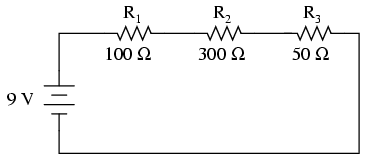
The total current in this circuit is
0.02 A
0.03 A
50 ohms
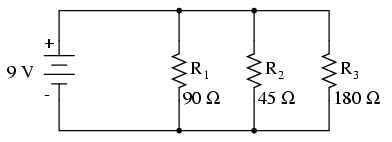
The total voltage of this circuit is
9 V
0.04 V
36 V
0.35 V
If a refrigerator uses 47 W of power when plugged in, it uses --- of energy over the course of 24 hours (1 day).
47 kW·h
1128 kW·h
1.96 kW·h
1.128 kW·h
A 40-W light bulb that is connected to 120 V of potential has a current flow through it that is ---.
3 A
30 A
480 A
0.333 A
Which of the following is an advantage of AC current?
Efficient long-distance power transmission
Causes less damage to electrical appliances
Requires less maintenance
Is cheaper to produce than DC current
Which type of current is more suitable for battery-powered devices?
Indirect current (IC)
Static current (SC)
Alternating current (AC)
Direct current (DC)


What is the total resistance in the circuit?
10 ohms
6 ohms
4 ohms
2.4 ohms

An oscilloscope shows the current flow above what type of current is it showing?
DC
AC
Rectified Current
Non rectified current

DC
AC
rectified current
non rectified current

What conclusion can you draw from this graph?
As current increases, magnetic strength decreases.
As current increases, magnetic strength increases.
As current decreases, magnetic strength increases.
There is no relationship between current and magnetic strength.
Motors are devices that convert _____ energy into _____ energy.
chemical; mechanical
mechanical; electrical
electrical; mechanical
potential; kinetic

How can you decrease the magnetic field strength in an electromagnet?
Increase the number of coils.
increase the voltage
decrease the current by increasing the resistance of the coil
all of the above

According to the diagram, which pair could both be north poles?
A and B
B and C
A and C
C and D

Why does the compass needle move at different locations?
Because the needle is attracted to the magnetic field produced by the magnet
Because north is up
Because it is being attracted to the Magnetic North Pole
Because north is down
What must occur for a magnetic field to induce an electric current?
The magnetic field must be really big
The magnetic field must be stable
The magnetic field must be changing
The magnetic field must be from a permanent magnet

Electricity is produced by using steam to _____________.

When a conductor is moved to cut through the magnetic flux, an _______________ is produced.
induced current
electromotive force
electromagnetic induction
internal resistance


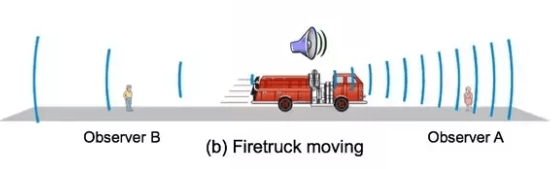
Look at the picture. Who is experiencing a lower pitched sound?
Observer A
Observer B
There is no difference
Look at the picture. Who is experiencing a louder sound?
Observer A
Observer B
There is no difference

The car below emits sound waves, represented by red circles, that are heard by an observer. Based on the pattern of sound waves, what is the direction and speed of the car?
toward the observer, faster than the speed of sound
toward the observer, slower than the speed of sound
away from the observer, faster than the speed of sound
away from the observer, slower than the speed of sound

Assuming the speed of sound is 340 m/s, what is the most likely speed of the jet shown below?
200 m/s
500 m/s
100 m/s
340 m/s

The higher the frequency of a wave, the ______________ the wavelength
shorter
longer

When you increase the amplitude of a wave, its frequency _____
increases
decreases
stays the same

Musical notes travel through the air as waves. Higher frequency notes travel _________ lower frequency notes.
faster than
at the same speed as
slower than

The longer a boomwhacker tube, the ________ its pitch.
lower
higher

If a wave has a frequency of 2 cycles per second and its wavelength is 5 meters, the wave speed is
2.5 meters per second
2.5 meters
10 meters per second
10 meters

a longer string makes a ____________ -pitched sound than a short string
higher
lower
A sound wave is produced in a metal cylinder by striking one end. Which of the following occurs as the wave travels along the cylinder?
Its amplitude increases.
Its frequency increases.
It transfers matter.
It transfers energy.
A radio station transmits to a receiving antenna. The radio wave sent is a
Transverse Wave
Longitudinal Wave
Sound Wave
Compression Wave
In a vacuum, radio waves, visible light waves, and x-rays all have the same
wavelength
speed
frequency

The two waves in the images are traveling at the same speed. Which statement best describes the difference between the waves?
Wave A has a higher frequency than wave B.
Wave A has a lower frequency than wave B.
Wave A has a higher amplitude than wave B.
Wave A has a lower amplitude than wave B.

Which of the following diagrams shows how the ray is refracted after it travels through the plastic?
A
B
C

Which diagram represents the two wave pulses traveling toward each other?
A
B
C
D


Look at the diagram. At which positions will the overlapping waves have the most constructive interference?
Positions #1 & #5
Positions #2 & #3
Positions #3 & #4
Positions #4 & #5
Look at the diagram. At which positions will the overlapping waves have the most destructive interference?
Positions #1 & #5
Positions #2 & #3
Positions #3 & #4
Positions #4 & #5

Two wave pulses with equal positive amplitudes travel on a cord approaching each other. What is the result of the oscillations when the pulses reach the same point?
It is constructive interference with twice the amplitude
It is destructive interference with zero amplitude
It is constructive interference with slightly greater amplitude
It is constructive interference with the negative amplitude
The standing wave is produced

What type of interference is represented in this diagram?
Constructive
Destructive

What type of interference is represented in the diagram?
Constructive
Destructive

Which is correct?
The longer the wavelength + the lower the frequency = lower the energy
The shorter the wavelength + the higher the frequency = higher the energy
The shorter the wavelength + the lower the frequency = the lower the frequency
None of the above
What happens to the intensity of non-polarized light when it goes through a single, horizontal linear polarizer?
The light intensity drops by 50%.
No light will pass through the filter
The light intensity remains the same.
In an experiment light of specific wavelength moves through a glass cube. The experiment is repeated with light that has double the wavelength, then the frequency of the light would
half.
not change.
double.

Approximately how much light will pass through two polarizing filters that are perpendicular to each other?
0%
100%
50%
75%

Polarized light of intensity I0 is incident on a polarizing filter. The angle between the plane of polarization of the incident light and the transmission plane of the polarizer is θ. Which graph shows how the intensity I of the light transmitted through the polarizer varies with θ?
A
B
C
D

The p-wave of an earthquake at the crust is incident on the crust-mantle boundary. From this model, in which medium does the p-wave have the faster speed?
Crust
Mantle
Same
Not enough information

Light is incident on an air-glass boundary at 60-degrees from the normal but refracts such that its refracted angle is only 35-degrees. Calculate the index of refraction of glass assuming air's index to be ni = 1.
0.67
1.00
1.33
1.50

Two waves E and G are shown. The waves have the same speed.
Which statement is correct?
Wave E has a greater amplitude than wave G.
Wave E has a greater intensity than wave G.
Wave E has a smaller frequency than wave G.
Wave E has a smaller wavelength than wave G.

A ray of light is incident towards a plane mirror at an angle of 30-degrees with the mirror surface. What will be the angle of reflection?
60o
30o
90o
45o

Put the following in order of density of material.
Glass > Diamond > Water = Air
Diamond > Glass > Water > Air
Air > Water > Glass > Diamond
Diamond < Water = Glass > Air

The diagram shows a ray of light AB striking the interface of medium X and medium Y. BC is the refracted ray. Which one of the following statements is correct?
Medium X is optically less dense than Y and ray BC travels faster than AB.
Medium X is optically denser than Y and ray BC travels slower than AB.
Medium X is optically denser than Y and ray BC travels faster than AB.
Medium X is optically less dense than Y and ray BC travels slower than AB.
A ray of light enters air from glass. The angle of incidence is 35o and the angle of refraction is 69o. Find the refractive index of the glass.
1.62
1.63
1.64
1.65
A ray of light travels from air into glass at an incident angle of 30o. Find the angle of refraction. (The refractive index of glass is 1.5)
19.7o
19o
19.5o
19.3o

Diagram shows light colour addition. What colour is P?
Magenta
Yellow
Cyan
White
Diagram shows light color addition. What color would R be when viewed through a cyan filter THEN a blue filter?
cyan
blue
black
White
A white light is shined through a cyan filter, and then a yellow filter. What color will appear?
blue
green
red
black

How will this object appear when looking at it through a blue filter?
Blue
Green
Black
Orange

What is the angle of reflection?
650
500
250
400
An object .25 m away from a lens produces a focused image on a film .15 m away. What is the focal length of the converging lens?
0.094 m
0.230 m
0.012 m
0.032 m
A tree 20 m high is located 40 m from the converging lens of focal length 0.08 m.Calculate the distance from the lens to the image.
0.08 m
0.01 m
0.10 m
0.20 m
Which lens represents the path light takes through a diverging lens?


An object 8.5 cm high is placed 28 cm from a converging lens. The focal length of the lens is 12 cm. Determine the height of the image.
*Hint: find di first
6.38 cm
8.5 cm
12cm
21 cm

Which do you think correctly describes the image formed that will be formed in this diagram?
Upright
Real
Virtual
Reduced

Which best describes the image formed in this diagram?
Reduced
Inverted
Real
Upright
Which figure represents the path light takes through a converging lens?
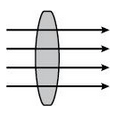
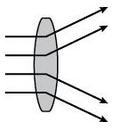
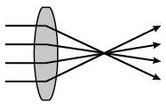
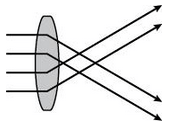
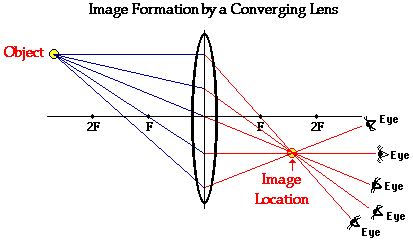

Which of the following is a correct ray diagram for convex lens?


Which ray diagram is correct for convex lens?


Which of the diagram shows the correct refraction of light ray after passing through a concave lens?


An object is located 35.0 cm from a convex lens. The lens forms a real image at a distance of 15.0 cm. What is the focal length?
0.0953 cm
10.5 cm
26.2 cm
0.0678 cm

The graph shows maximum kinetic energy of emitted electrons against frequency of incident light for a number of different metals.
Wat is the relationship between energy and frequency?
direct
inverse
no relationship

