wayground logo

Free Printable Worksheets

NEW

Font size

S
M
L
XL
Worksheets

Conservation of Energy and Momentum Test

Total questions: 55

Worksheet time: 2hrs 50mins

Name
Class
Date
1.
A 2.5 kg ball moving at 5 m/s collides with a 2.5 kg stationary ball in a perfectly elastic collision.  What is the velocity of the second ball after the collision? 
a)
5 m/s
b)
2.5 m/s
c)
10 m/s
d)
7.5 m/s
2.
A 9300 kg railroad car traveling at a velocity of 5 m/s strikes a second boxcar that weighs 5000 kg at rest. At what speed will the second boxcar move?
a)
18.6 m/s
b)
9.3 m/s
c)
7.5 m/s
d)
1.86 m/s
3.
A .030 kg bullet is fired from a gun with a speed of 350 m/s. If the gun has a mass of 0.9 kg, What is the recoil speed of the gun?
a)
11.7 m/s
b)
9.0 m/s
c)
10.5 m/s
d)
10 m/s
4.

A 9 kg blob moving at 5 m/s collides and sticks to a second blob with a mass of 5 kg. If the two blobs stick together, what will the velocity of the two blobs move at?

a)

3.57 m/s

b)

3.2 m/s

c)

10.0 m/s

d)

9.0 m/s

5.
When two objects collide, the Pbefore is ____________ the Pafter.
a)
more than 
b)
less than 
c)
equal to
d)
unrelated to
6.
The recoil speed of a rifle is much less than the exit velocity of a bullet because...
a)
the rifle experiences a smaller force
b)
the rifle experiences a smaller change in momentum
c)
the rifle has a much greater mass
d)
the rifle does not obey the laws of physics
7.
While playing pool, the white cue ball strikes the 8 ball. Before the collision, the cue ball's velocity was 10 m/s and the 8 ball was at rest. If both ball's have a mass of 0.15 kg and the cue ball's velocity after the collision is 2 m/s, what is the 8 ball's velocity?
a)
2 m/s
b)
8 m/s
c)
-2 m/s
d)
1.5 m/s
8.
In a physics experiment, two carts of mass 1.5 kg each are rolled towards each other.  The orange cart has a velocity of 2 m/s and the blue cart has a velocity of -1m/s.  The carts stick together when they collide.  Calculate their final speed.
a)
0.5 m/s
b)
1.0 m/s
c)
0.33 m/s
d)
0.67 m/s
9.
Two football players with mass 75 kg and 100 kg run directly toward each other with speeds of 6 m/s and 8 m/s respectively. If they grab each other as they collide, the combined speed of the two players just after the collision would be:
a)
2 m/s 
b)
3.4 m/s 
c)
4.6 m/s 
d)
7.1 m/s
10.
An 1 kg object moving to the right at 2 m/s collides inelastically with a 1 kg object moving to the left at 2 m/s. The final velocity of both objects will be 
a)
0 m/s
b)
1 m/s
c)
2 m/s
d)
4 m/s
11.
A large box slides across a frictionless surface with a velocity of 12 m/s and a mass of 4 kg,  collides with a smaller box with a mass of 2 kg that is stationary.  The boxes stick together. What is the velocity of the two combined masses after collision?
a)
0 m/s
b)
4 m/s
c)
8 m/s
d)
12 m/s
12.
A large box slides across a frictionless surface with a velocity of 12 m/s and a mass of 4 kg,  collides with a smaller box with a mass of 2 kg that is stationary.  The boxes stick together. What is the velocity of the two combined masses after collision?
a)
0 m/s
b)
4 m/s
c)
8 m/s
d)
12 m/s
13.
The total momentum before a collision is _________ the total momentum after a collision.
a)
equal to 
b)
less than 
c)
more than
d)
It depends on the type of collision
14.
A 120 kg lineman moving at -2 m/s tackles an 80 kg fullback moving at +8 m/s. If the fullback's velocity after they collide is +2 m/s, what is the lineman's velocity?
a)
2 m/s
b)
8.7 m/s
c)
4.7 m/s
d)
6 m/s
15.
A 3,000 kg truck moving at +10 m/s hits a 1,000 kg parked car which moves off at +15 m/s. What is the velocity of the truck?
a)
10 m/s
b)
0 m/s
c)
5 m/s
d)
2 m/s
16.
Which object listed below has the greatest momentum?
a)
A 0.05 kg object rolling at 0.2 m/s.
b)
A 0.15 kg object rolling at 2 m/s.
c)
A 0.15 kg object rolling at 1 m/s
d)
A 0.4 kg object rolling at 2 m/s.
17.
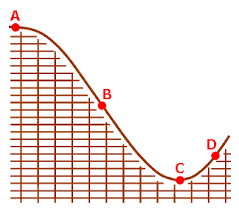
At which point(s) on the roller coaster is the gravitational potential energy at its maximum?
a)
A
b)
B
c)
C
d)
D
18.
At which point(s) on the roller coaster is the kinetic energy at its maximum?
a)
A
b)
B
c)
C
d)
D
19.
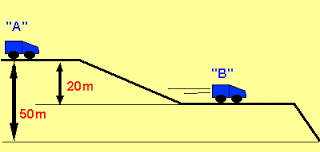
In diagram 2, if the mass of the car is 600 kg, what is the change in potential energy from point A to point B?
a)
411,600 J
b)
294,000
c)
176,400 J
d)
117,600 J
20.

1. A ball has a 17 J of kinetic energy and its mechanical energy is 25 J. If the ball has a mass of 3.2 kg, what is its height above the ground?

a)

0.26 m

b)

0.52 m

c)

5.2 m

d)

25 m

21.
What does the Law of Conservation of Energy state?
a)
Energy cannot be created or destroyed
b)
Nothing can exchange energy
c)
Energy will increase over time.
d)
Energy will decrease over time.
22.
Is energy always conserved?
a)
Always
b)
Often
c)
Never
d)
Sometimes
23.
Energy of motion is which type of energy?
a)
Potential
b)
Kinetic
c)
Sound
d)
Gravitational
24.

What is the KE at point B?

a)

14 J

b)

12 J

c)

6 J

d)

8 J

25.

What is the Total Energy of the system?

a)

14 J

b)

12 J

c)

6 J

d)

8 J

26.

What is the KE at point D?

a)

14 J

b)

12 J

c)

6 J

d)

8 J

27.

What is the GPE at point A

a)

14 J

b)

12 J

c)

6 J

d)

8 J

28.

What is the GPE at point E?

a)

14 J

b)

12 J

c)

6 J

d)

8 J

29.

What is the Kinetic Energy at point B?

a)

500,000 J

b)

400,000 J

c)

300,000 J

d)

50,000 J

30.

What is the Kinetic Energy at point C?

a)

500,000 J

b)

400,000 J

c)

300,000 J

d)

50,000 J

31.

What is the Kinetic Energy at point D?

a)

500,000 J

b)

250,000 J

c)

300,000 J

d)

50,000 J

32.

What is the GPE at point E?

a)

500,000 J

b)

250,000 J

c)

300,000 J

d)

100,000 J

33.

What is the GPE at point F?

a)

500,000 J

b)

250,000 J

c)

300,000 J

d)

0 J

34.

What is the KE at point F?

a)

500,000 J

b)

250,000 J

c)

300,000 J

d)

0 J

35.

What is the Total Energy at the top?

a)

15,000 J

b)

3,750 J

c)

7,500 J

d)

11,250 J

36.

What is the KE 1/4th of the way down?

a)

15,000 J

b)

3,750 J

c)

7,500 J

d)

11,250 J

37.

What is the KE 1/2 of the way down?

a)

15,000 J

b)

3,750 J

c)

7,500 J

d)

11,250 J

38.

What is the KE 3/4th of the way down?

a)

15,000 J

b)

3,750 J

c)

7,500 J

d)

11,250 J

39.

What is the KE at the bottom?

a)

15,000 J

b)

3,750 J

c)

7,500 J

d)

11,250 J

40.

What is the GPE at the top?

a)

50 J

b)

25 J

c)

0 J

d)

100 J

41.

What is the KE half way down?

a)

50 J

b)

25 J

c)

0 J

d)

100 J

42.

What is the Total Energy at the bottom?

a)

50 J

b)

25 J

c)

0 J

d)

100 J

43.

A car possesses a momentum of 20 000 kg-m/s, North. How would its momentum be affected if its velocity was doubled?

a)

Doubling the velocity will double the momentum.

b)

Doubling the velocity will cut the momentum in half.

c)

Doubling the velocity will triple the momentum.

d)

Doubling the velocity will quadruple the momentum.

44.

If an object with a mass of 12 kilograms is moving at 10 meters per second, what is its momentum?

a)

120 kg*m/s

b)

120 kg*m*s

c)

1.2 kg*m/s

d)

1.2 kg*m*s

45.

Determine the momentum of a 0.145 kg baseball thrown at 44.7 m/s.

a)

6.4815 kg*m/s

b)

3.0827 kg*m/s

c)

30.2 kg*m*s

d)

64.82 kg*m*s

46.

A projectile of mass 1 kilogram traveling at 9 meters per second collides with another projectile of mass 2 kilograms traveling at 6 meters per second in the same direction. If the projectiles "stick" together after their collision, what is their velocity after colliding?

a)

7 m/s

b)

8 m/s

c)

7.5 m/s

d)

9 m/s

47.

If each object is moving at the same velocity which will have the least momentum?

a)

Baseball

b)

Bowling Ball

c)

Golf Ball

d)

Tennis Ball

48.

How much kinetic energy (K) does a baseball with a mass of 0.143 kg have if it is travelling at a velocity of 41.1 m/s?

HINT: K = 1/2mv2

a)

120.8 joules

b)

89.7 joules

c)

108.3 joules

d)

156.6 joules

49.

If a ball tossed into the air has a maximum gravitational potential energy of 5.75 joules, what is its maximum kinetic energy in the same toss?

a)

5.75 joules

b)

11.14 joules

c)

2.88 joules

d)

7.93 joules

50.

A 1.0 kg ball is stationary at the top of a hill that is 10.0 meters in height. The ball rolls all the way down the hill. What is its gravitational potential energy at the bottom of the hill?

a)

0 joules

b)

98 joules

c)

49 joules

d)

38 joules

51.

What is the MECHANICAL energy of the roller coaster car?

a)

100 joules

b)

50 joules

c)

2500 joules

d)

1 joule

52.

What was the Kinetic energy of the car at near the bottom of the hill if the car still had 10 J of Potential energy?

a)

10 joules

b)

50 joules

c)

90 joules

d)

500 joule

53.

If a ball has a height of 10m and a mass of 0.5 kg, what will be it's KE after it has fallen halfway to a height of 5m?

(HINT: Find PE first. )

g = 9.8 m/s2

a)

5.10 J

b)

2.55 J

c)

10.2 J

d)

12.5 J

54.

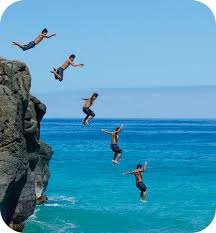
A cliff diver with a mass of 125 kg jumps off a 50m high cliff, how fast will he be traveling just before he hits the water? (His height at this point is 0m)

(HINT: Find PE first.) KE = 1/2mv2

g = 9.8 m/s2

a)

61,250 m/s

b)

980 m/s

c)

31.3 m/s

d)

247.5 m/s

55.

A cliff diver with a mass of 125 kg jumps off a 50 m high cliff, at a height of 10m he is moving at 15.5 m/s. What is his MECHANICAL energy.

(HINT: ME = KE + PE)

g = 9.8 m/s2

a)

15,015.6 J

b)

12,250 J

c)

27,265.6

d)

2,765.6