wayground logo

Free Printable Worksheets

Font size

S
M
L
XL
Worksheets

Malow Heredity 2

Total questions: 134

Worksheet time: 2hrs 14mins

Name
Class
Date
1.
What does DNA do?
a)
a.  It carries genetic codes from parents to offspring.
b)
a.  It carries oxygen from the lungs to the body.
c)
a.  It tells you who you are.
d)
a.  It defines the organism.
2.
What is the shape of a DNA?
a)
Double Helix
b)
Base Pairing
c)
The shape of you
d)
Hydrogen Bonding
3.
Adenine, Cytosine, Guanine and Thymine are examples of
a)
DNA structure
b)
DNA bases
c)
DNA double helix
d)
Paired bases
4.
The rules of DNA pairing states that Adenine (A) always pairs up with
a)
Thymine
b)
Cytosine
c)
Adenine
d)
Guanine
5.
The rules of DNA pairing states that Cytosine (C) always pairs up with
a)
Thymine
b)
Cytosine
c)
Adenine
d)
Guanine
6.
What holds the DNA bases together?
a)
Hydrogen bonds
b)
DNA bases
c)
Double Helix
d)
Paired bases
7.
How many hydrogen bonds do C and G have between them?
a)
1
b)
2
c)
3
d)
4
8.
What is a DNA molecule made of?
a)
Base, sugar, phosphate
b)
Base, sugar, coffee
c)
Base, roof, height
d)
DNA, sugar, phosphate
9.
Which sequence of DNA bases would pair with this partial strand
CAT TCA CTG
a)
ATG TGA CAG
b)
TAC ACT GTC
c)
GTA AGT GAC
d)
CAT TCA CTG
10.
Which of the following units are repeatedly joined together to form a strand of DNA?
a)
amino acids
b)
nucleotides
c)
fatty acids
d)
polysaccharides
11.
The enzyme that unwinds the DNA to prepare for replication
a)
helicase
b)
replicase
c)
polymerase
d)
synthase
12.
DNA replication results in two DNA molecules,
a)
each one with two original strands
b)
each one with two new strands
c)
each one with one new strand and one original strand
d)
one with two new strands and the other with two original strands
13.
order of replication
a)
3, 4, 2, 1
b)
3, 1, 4, 2
c)
2, 1, 4, 3
d)
3, 4, 1, 2
14.
A process in which DNA has the unique ability to make an exact copy of itself.
a)
Replication
b)
Translation
c)
Transcription
15.
In what phase of the cell cycle does DNA replication take place?
a)
G1
b)
S
c)
G2
d)
M
16.
Which enzyme is responsible for adding nucleotides?
a)
Topoisomerase
b)
DNA Polymerase
c)
Ligase
d)
Primase
17.
The process of DNA replication is called semi conservative because it results in
a)
none of these
b)
Two DNA molecules.  One original molecule and one with two new strands
c)
two exact copies with new strands
d)
two identical molecules, each with 1 original strand and one new.
18.
Based on the diagram, how many origins of replication are represented?
a)
1
b)
2
c)
3
d)
4
19.
Place the following in sequential order
1. Recoil
2. Straightens the double helix
3. Breaks Hydrogen bonds
4. Adds Free nucleotides
a)
1, 2, 3, 4
b)
3, 4, 2, 1
c)
3, 2, 4, 1
d)
2, 3, 4, 1
20.
Based on the diagram, the enzyme (represented in gray) is most likely...
a)
DNA polymerase
b)
DNA Ligase
c)
Nuclease
d)
Helicase
21.
What will the first four bases of the new DNA strand look like if copying the template strand?
a)
TGGT
b)
ACCA
c)
GTTG
d)
CAAC
22.
Why does DNA replicate?
a)
To create another copy for the new cell
b)
To create a duplicate copy in case the original gets damaged
c)
To create a new copy to replace the damaged original
23.
Which of the following does DNA polymerase NOT do?
a)
connects nucleotides (in the new strand) through covalent bonds
b)
Matches the template nucleotides with free nucleotides
c)
proofreads
d)
It does all of these functions
24.
Translation takes place in the 
a)
ribosome
b)
chloroplast
c)
nucleus
d)
mitochondria
25.
Brings the amino acids to the ribosome
a)
mRNA
b)
tRNA
c)
rRNA
d)
DNA
26.
What would be the tRNA anticodon for the mRNA codon CAG?
a)
GTC
b)
GUC
c)
CUG
d)
CAG
27.
What is the term for a three-nucleotide sequence that codes for an amino acid?
a)
base
b)
codon
c)
amine
d)
serine
28.
Which phrase best describes translation?
a)
converts mRNA into a polypeptide
b)
catalyzes bonds between amino acids
c)
produces RNA from DNA molecules
d)
recycles tRNA molecules for reuse
29.
What type of bonds are forming during translation?
a)
Peptide bonds
b)
Hydrogen bonds
c)
Acid bonds
30.
EXTRA AWESOME QUESTION: Which types of cells can begin the process of translation even before the mRNA has been completely transcribed?  
a)
Eukaryotes
b)
Prokaryotes
c)
Both Prokaryotes and Eukaryotes can
d)
No cells can can do this
31.
How many amino acids are coded for by this sequence of nucleotides:
ATG GGA ACT CCA
a)
4
b)
2
c)
6
d)
12
32.
Which phase of which process does this picture show?
a)
Transcription
b)
Translation
c)
Replication
33.
The job of tRNA is to
a)
carry amino acids to the ribisomes
b)
carry ribisomes to the ER
c)
carry glucose to mitochondria
d)
carry mRNA out of the nucleus
34.
What would be the tRNA anticodon for the mRNA codon CAG?
a)
GTC
b)
GUC
c)
CUG
d)
CAG
35.
Which of the following occurs first in translation?
a)
The small ribosomal subunit binds to mRNA
b)
The large ribosomal subunit binds to mRNA
c)
tRNA binds to the mRNA
d)
A peptide bond forms between amino acids
36.
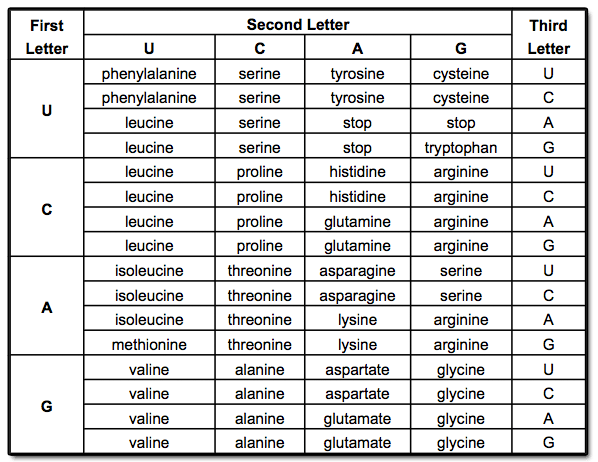
What is the correct amino acid sequence for the mRNA code AUGCCAGUAUGA
a)
Met-Pro-Ala-Val
b)
Met-Pro-Val
c)
Tyr-Gly-His
d)
Tyr-Gly-Arg-His
37.
Where does transcription take place?
a)
nucleus
b)
cytoplasm
c)
ribosome
38.
What is occurring in this picture?
a)
Translation
b)
Replication
c)
Translocation
d)
Transcription
39.
One difference between DNA and RNA is that....
a)
Only RNA has the base Uracil
b)
only RNA contains the base Thymine
c)
only RNA contains the base Cytocine
d)
only RNA contained the base Guanine
40.
what does mRNA do?
a)
carry info from genes to ribosomes
b)
carry amino acids to ribosomes
c)
help with RNA splicing
d)
make up ribosomes
41.
True or false:  RNA is double-stranded.
a)
true
b)
false
c)
it depends on the type
42.
True or false:  RNA is double-stranded.
a)
true
b)
false
c)
it depends on the type
43.
Which of these bases does not exist in RNA?
a)
C
b)
T
c)
U
d)
A
44.
Which of the following best describes a DNA molecule?
a)
double helix
b)
contains ribose
c)
made of amino acids
d)
contains Uracil
45.
Which RNA bases would pair with TACGAA in transcription
a)
AUGCUU
b)
ATGCTT
c)
GCATCC
d)
GCAUCC
46.
Which of these bases does not exist in RNA?
a)
C
b)
T
c)
U
d)
A
47.

RNA contains which sugar?

a)

deoxyribose

b)

Ribose

c)

glucose

d)

fructose

48.

RNA has what base that is instead of thymine?

a)

guanine

b)

adenine

c)

thymine

d)

uracil

49.

What enzyme does transcription use?

a)

DNA polymerase

b)

ligase

c)

RNA polymerase

d)

helicase

50.

Which RNA carries the message?

a)

mRNA

b)

rRNA

c)

tRNA

51.

Which RNA forms part of the ribosomes?

a)

tRNA

b)

mRNA

c)

rRNA

52.
A triplet of mRNA is called a
a)
codon
b)
anticodon
c)
amino acid
d)
peptide bond
53.
What does this picture represent?
a)
amino acid
b)
base pairing
c)
nucleotide
d)
the DNA molecule
54.
How many nucleotides make a codon?
a)
1
b)
2
c)
3
d)
6
55.

Transcribe the following DNA strand: CTG AAT

a)

GAC TTA

b)

CTG AAT

c)

GAC UUA

d)

CUG AAU

56.

Which macromolecule is made up of amino acids?

a)

carbohydrate

b)

lipid

c)

nucleic acid

d)

protein

57.

RNA polymerase reads the mRNA strand in which direction?

a)

3' to 5' direction

b)

5' to 3' direction

58.

mRNA is made in which direction?

a)

5' to 3' direction

b)

3' to 5' direction

59.

What makes up a codon?

a)

2 amino acids

b)

3 amino acids

c)

2 nucleotides

d)

3 nucleotides

60.

Where would you find the anti-codon?

a)

tRNA

b)

mRNA

c)

ribosome

d)

rRNA

61.

The tRNA binds to specific codons. What part of the tRNA binds with a specific codon?

a)

anti-codon

b)

mRNA

c)

rRNA

d)

antisense

62.

What do tRNA bring to the ribosome?

a)

glucose

b)

fatty acids

c)

nucleotides

d)

amino acids

63.

True or False: A protein can function in its tertiary structure.

a)

True

b)

False

64.

True or False: UGA is a codon that codes for STOP.

a)

True

b)

False

65.

True or False: There are 26 amino acids that make up proteins found in the human body.

a)

True

b)

False

66.
a)
Prophase
b)
Interphase
c)
Anaphase
d)
Telophase
67.
a)
Anaphase
b)
Cytokinesis
c)
Telophase
d)
Metaphase
68.
a)
Cytokinesis
b)
Interphase
c)
Anaphase
d)
Metaphase
69.
a)
Anaphase
b)
Cytonkinesis
c)
Interphase
d)
Prophase
70.
a)
Cytokinesis
b)
Anaphase
c)
Telophase
d)
Prophase
71.
Which is Metaphase?
a)
A
b)
E
c)
C
d)
F
72.
Which is Metaphase?
a)
A
b)
E
c)
C
d)
F
73.
Chromosomes condense from long stands into rod like structures. 
a)
Prophase
b)
Interphase
74.
The phase in mitosis where chromosomes move away and are pulled apart by spindles to opposite sides of the cell.
a)
prophase
b)
anaphase
c)
metaphase
d)
telephase
75.
A chromatid is attached to a spindle fiber by the
a)
nucleolus
b)
deep furrow
c)
centromere
d)
centriole
76.
The structures that hold together sister chromatids
a)
tissues
b)
chromosomes
c)
spindle
d)
centromeres
77.
The process by which the nuclear material is divided equally between two new cells
a)
mitosis
b)
cancer
c)
spindle
d)
centromere
78.
the two halves of the doubled chromosome structure 
a)
centromeres
b)
sister chromatids
c)
spindle
d)
tissues
79.
Why would it be important to replicate DNA before a cell divides in mitosis or meiosis?
a)
In order for genetic information to be transferred into daughter cells.
b)
In order for the cell to be able to increase in size.
c)
In order for the DNA to be contained in the nucleus.
d)
In order for the cell to re-order the DNA sequencing in the new cells.
80.
In mitosis, the two resulting cells are
a)
different from the starting cell and identical to each other.
b)
different from the starting cell and different from each other.
c)
identical to the starting cell and different from each other.
d)
identical to the starting cell and identical to each other.
81.
What is the name of the structure labeled X?
a)
Centriole
b)
Centrosome
c)
Chromatid
d)
Chromosome 
82.
Identify the phase:
a)
Metaphase I
b)
Metaphase II
c)
Anaphase I
d)
Anaphase II
83.
Identify the phase.
a)
Metaphase I
b)
Metaphase II
c)
Anaphase I
d)
Anaphase II
84.
Identify the process.
a)
Mitosis
b)
Meiosis I
c)
Meiosis II
d)
Interphase
85.
After meiosis II the daughter cells will contain ____ chromosomes if the original cell contained 78.
a)
78
b)
39
c)
23
d)
46
86.
Which of the following cells is a gamete?
a)
egg
b)
bone
c)
heart
d)
muscle
87.
The pair of chromosomes that contain the same genes (but may be coded differently) and are inherited from a male and female parent are termed ___.
a)
gametes
b)
alleles
c)
zygote
d)
homologs
88.
The fertilized egg is termed a/an _____.
a)
gamete
b)
allele
c)
homolog
d)
zygote
89.
In mitosis cells are genetically _______, but in meiosis cells are genetically ______.
a)
diverse, identical
b)
identical, diverse/different
90.

Is the following cell diploid or haploid?

a)

Diploid

b)

Haploid

91.
When does replication of chromosomes occur in animal cell meiosis?
a)
Before Meiosis I and Meiosis II
b)
Before Meiosis II Only
c)
Before Meiosis I Only
d)
During Prophase I and Prophase II
92.
Identify the phase.
a)
Telophase I
b)
Telophase II
c)
Metaphase I
d)
Metaphase II
93.
This type of RNA moves amino acids to the ribosomes.
a)
mRNA
b)
tRNA
c)
rRNA
94.
Meiosis is the _____.
a)
 nuclear division of gametes
b)
nuclear division of body cells
c)
division of body cells
d)
division of sex cells
95.
In sexual reproduction, chromosome reduction is necessary to ___.
a)
ensure that all offspring have the correct diploid number of chromosomes
b)
ensure that all offspring have the correct haploid number of chromosomes
c)
ensure that all daughter cells are identical
96.

1n indicates that the cell is ____.

a)

Diploid

b)

Haploid

97.

This type of asexual reproduction has the offspring growing off of the parent.

a)

Budding

b)

Regeneration

c)

Runner

d)

Binary Fission

98.

This type of asexual reproduction occurs when pieces of the parent divide to form new organisms.

a)

Regeneration

b)

Binary Fission

c)

Budding

d)

Runner

99.

Is this a normal human karyotype?

a)

YES

b)

NO

100.

Is this karyotype for a male or female?

a)

MALE

b)

FEMALE

101.

Mitosis makes sure that all daughter cells are _____.

a)

genetically identical, diploid

b)

genetically identical, haploid

c)

genetically diverse, diploid

d)

genetically diverse, haploid

102.

Which of the following chromosome abnormalities is also known as Turner syndrome?

a)

47, XY+13

b)

47, XXY

c)

46, XY

d)

45, X0

103.

Place on chromosome where spindle fibers are attached during cell division is called

a)

chromatid

b)

centriol

c)

centromere

d)

telomere

104.

The division of the cytoplasm is called:

a)

synapsis

b)

mitosis

c)

cytokinesis

d)

cytogenetics

105.

Which of the following represents the correct order of the phases of mitosis?

a)

prophase -> anaphase -> metaphase -> telophase

b)

prophase -> metaphase -> anaphase -> telophase

c)

prophase -> metaphase -> telophase -> anaphase

d)

metaphase -> prophase -> telophase -> anaphase

106.

Which of the following represents the correct order of the phases of mitosis?

a)

prophase -> anaphase -> metaphase -> telophase

b)

prophase -> metaphase -> anaphase -> telophase

c)

prophase -> metaphase -> telophase -> anaphase

d)

metaphase -> prophase -> telophase -> anaphase

107.

Approximately 15,000 years ago in China people started to domesticate wolves. They took desired qualities from each wolf and bred them with wolves with similar qualities to get the desired qualities they wanted. Some of these qualities may have been hair type, size, disposition, skills, etc. We can use this process for plants and animals to get the desired outcome. This process of breeding is called what?

a)

Hybrid

b)

Selective Breeding

c)

Selective mutationism

d)

Karyotyping

108.

We can use a process and take 2 different species of plant or animal and cross them to get a desired outcome. An example would be a tiger and a lion and get a liger. This process is called what?

a)

selective breeding

b)

hybrid

c)

domestication

d)

natural selection

109.

This image is of a what?

a)

Pedigree

b)

Karyotype

c)

Punnet square

110.
A polyploid individual that contains genetic material from 2 (or more) different parental species.
a)
Autopolyploid
b)
Allopolyploid
111.
A process that results in the doubling of chromosome number in an otherwise infertile hybrid.
a)
non- disjunction
b)
Mitosis
c)
Disjunction
d)
Meiosis
112.
Conditions of a karyotype 2n ± 1 and 2n ± 2 are called:
a)
Aneuploidy
b)
Polyploidy
c)
Allopolyploidy
d)
Monosomy
113.
Cause of polyploidy
a)
Mutation
b)
Fetilisation
c)
Non-disjunction
d)
Meiosis
114.

Turner syndrome is an example of a ____________condition

a)

Monosomic

b)

Disomic

c)

Trisomic

d)

Polyploid

115.

An organism with multiple sets of chromosomes from different species is called

a)

an autopolyploid

b)

an allopolyploid

c)

a hybrid polyploid

d)

a sterile hybrid

116.

Polyploidy is

a)

the presence of more than two of a certain chromosome

b)

more than two of a certain chromosome

c)

the presence of multiple sets of chromosome

d)

the general term for condition such as Down or Turner Syndrome

117.
Pho originated from what country?
a)
Thailand
b)
Indonesia
c)
Vietnam
d)
China
118.
A homozygous dominant dog with brown fur is crossed with a heterozygous dog with brown fur. What are the percentages of the possible genotypes?
a)
100% BB
b)
75% BB and 25%Bb
c)
50 % BB and 50% Bb
d)
50% Bb and 50% bb
119.
The man who studied genetics and came up with genetics is
a)
Watson
b)
Crick
c)
Mendel
d)
Darwin
120.
What law states that in Tt the person will only show the dominant allele
a)
law of segregation
b)
law of independent assortment
c)
law of dominance
d)
law of punnett squares
121.
Genotype refers to the ...
a)
physical expression of the genes
b)
the possible combination of alleles in a gene
c)
whether an allele is dominant or recessive
d)
how an organism will appear
122.

Squidward has light blue skin, and his genotype for this trait is Bb. Which of the following would describe Squidward?

a)

Purebred

b)

Hybrid

c)

Homozygous

d)

Sex-linked

123.
An offspring will receive how many alleles from each parent to determine a specific trait?
a)
one
b)
two
c)
three
d)
five
124.
Which of the following is a phenotype?
a)
BB
b)
Bb
c)
bb
d)
Blue eyes
125.
What is a phenotype
a)
The genetic make up (code)
b)
The physical trait
126.
the passing of genetic traits from parent to offspring.
a)
heredity
b)
trait
c)
gene
d)
allele
127.
having two of the same genes for the trait (sometimes called purebred).
a)
homozygous
b)
hetrozygous
c)
protein
d)
chromosome
128.
having two different genes for a trait (sometimes called hybrid).
a)
protein
b)
homozygous
c)
heterozygous
d)
genotype
129.
Magda is a tall, 11 year old drummer. She has a scar on her right cheek. She is good at swimming. Which of her traits did Magda most likely inherit?
a)
height
b)
the scar
c)
ability to swim
d)
ability to play drums
130.
Two brown eyed parents (Bb) have a baby. What is the chance the baby is blue eyed?
a)
0 %
b)
25%
c)
50%
d)
75%
131.
G = green, g = yellow
The genotype for a yellow plant is...
a)
GG
b)
Gg
c)
gg
d)
all of the choices result in yellow
132.
An allele whose trait only shows up when no dominant allele is present.
a)
hidden allele
b)
dominant allele
c)
recessive allele
d)
present allele
133.
Two heterozygous (Tt) tall pea plants are crossed. Which describes their offspring?
a)
50% tall and 50% short
b)
75%tall and 25% short
c)
100%short
134.
W=white hair
w= non-white hair
If you cross a horse with WW and a horse with ww what fraction of the offspring would be expected to have white hair?

a)
none
b)
3/4
c)
1/2
d)
all