Wayground logo

Free Printable Worksheets

Font size

S
M
L
XL
Worksheets

CHEMISTRY - CHAPTER 12 REVIEW

Total questions: 72

Worksheet time: 43mins

Name
Class
Date
1.

The attraction between particles gives solids a definite

a)

shape and volume

b)

shape and color

c)

shape and position

d)

flow and radius

2.

The temperature at which a solid begins to liquefy is its ______ point.

a)

freezing

b)

boiling

c)

melting

d)

mass

3.

According to the kinetic theory of matter, all matter is composed of

a)

waves

b)

particles

c)

solid material

d)

plasma

4.

When the temperature of a substance is lowered, its particles

a)

vibrate more quickly

b)

stop vibrating completely

c)

escape the attractive forces of the other particles

d)

vibrate more slowly

5.

Why can people on one side of a room smell the scent of an air freshener sprayed on the opposite side of the room?

a)

The molecules of air freshener have thermally expanded

b)

The air pressure where the freshener was sprayed is greater than in the rest of the room

c)

The molecules of air freshener spread out until they are evenly distributed throughout the room

d)

The molecules of air freshener are amorphous

6.

An example of an amorphous solid is

a)

glass

b)

dry ice

c)

liquid crystals

d)

water

7.

An example of a substance that can undergo sublimation is

a)

glass

b)

liquid crystals

c)

water

d)

dry ice (frozen carbon dioxide)

8.

When a gas becomes a liquid it is called

a)

condensation

b)

evaporation

c)

sublimation

d)

freezing

9.
The theory that states that all particles in matter are constantly moving; helps to describe the phases of matter
a)
behavior of gases
b)
kinetic theory 
c)
matter matters
d)
temperature 
10.
Solids are described as having a 
a)
definite shape and indefinite volume
b)
indefinite shape and indefinite volume
c)
definite shape and definite volume
d)
indefinite shape and definite volume
11.
Liquids are described as having a 
a)
definite shape and indefinite volume
b)
indefinite shape and indefinite volume
c)
definite shape and definite volume
d)
indefinite shape and definite volume
12.
Gases are described as having a 
a)
definite shape and indefinite volume
b)
indefinite shape and indefinite volume
c)
definite shape and definite volume
d)
indefinite shape and definite volume
13.
Gas particles have the ________ kinetic energy because they move the fastest.
a)
least
b)
most
14.
When a liquid changes its phase and turns into a solid it is known as
a)
condensation.
b)
melting.
c)
vaporization.
d)
freezing or solidification.
15.
When a gas changes its phase and turns into a liquid it is known as
a)
condensation.
b)
sublimation.
c)
vaporization.
d)
freezing or solidification.
16.
When a gas changes its phase and turns into a solid it is known as
a)
deposition.
b)
sublimation.
c)
condensation.
d)
freezing or solidification.
17.
When a solid changes its phase and turns into a gas it is known as
a)
deposition.
b)
melting.
c)
condensation.
d)
sublimation.
18.
All phase changes are
a)
chemical changes
b)
chemical reactions
c)
physical changes
d)
irreversable
19.
During a phase change, the temperature remains the same
a)
True
b)
False
20.
What kind of energy is added to or removed from matter to cause a phase change?
a)
Radiation
b)
Heat
c)
Solar
d)
Wind
21.
Which state of matter take up ALL the space inside a container? 
a)
solid
b)
liquid
c)
gas
d)
all of the above
22.
Which state of matter has a definite shape?
a)
solid
b)
liquid 
c)
gas
d)
plasma
23.
Liquids and gases are similar because __________________________.
a)
they both take the shape of their container
b)
they both have their own shape
c)
liquids pour and gases don't
d)
liquids take the shape of the container but gases have their own shape
24.
The drops of water that appear on the outside of a glass of cold juice on a warm day are an example of?
a)
Sublimation: A solid turning into a gas.
b)
Condensation: A gas changing to a liquid.
c)
Evaporation: A liquid changing to a gas.
d)
Deposition: A gas changing to a solid.
25.
A substance that has a definite shape and volume.
a)
evaporation
b)
gas
c)
liquid
d)
solid
26.
5. What is it called when a solid turns directly into a gas?
a)
Sublimation
b)
Condensation
c)
Liquid
27.
7. All phase changes (changing states) requires energy to be added or taken away.
a)
True
b)
False
28.

(a)   is liquids resistance to flow.

29.

Force of attraction that exist between molecules

a)

INTERMOLECULAR FORCE

b)

CHEMICAL BONDING

c)

ELECTROSTATIC FORCE

30.

A substance in which the particles are arranged in a regular, repeating geometric structure.

a)

SOLID

b)

AMORPHOUS

c)

CRYSTALLINE

31.

A solid in which all atoms are held together by covalent bonds to make a giant molecule

a)

NETWORK SOLIDS

b)

IONIC SOLIDS

c)

MOLECULAR SOLIDS

32.

the spontaneous rising of a liquid in a narrow tube

a)

Surface Tension

b)

Capillary Action

c)

Viscosity

d)

None of the above

e)

All of the above

33.

solids with considerable disorder in their arrangements

a)

Crystalline Solids

b)

Amorphous Solids

c)

Metallic Sollids

d)

All of the above

e)

None of the above

34.
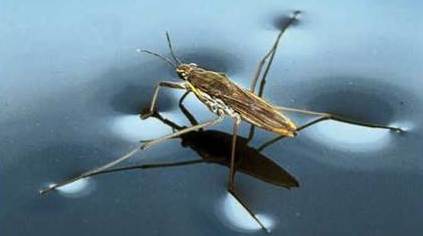
Refer to the picture; this is occurring due to:
a)
Adhesion
b)
Cohesion
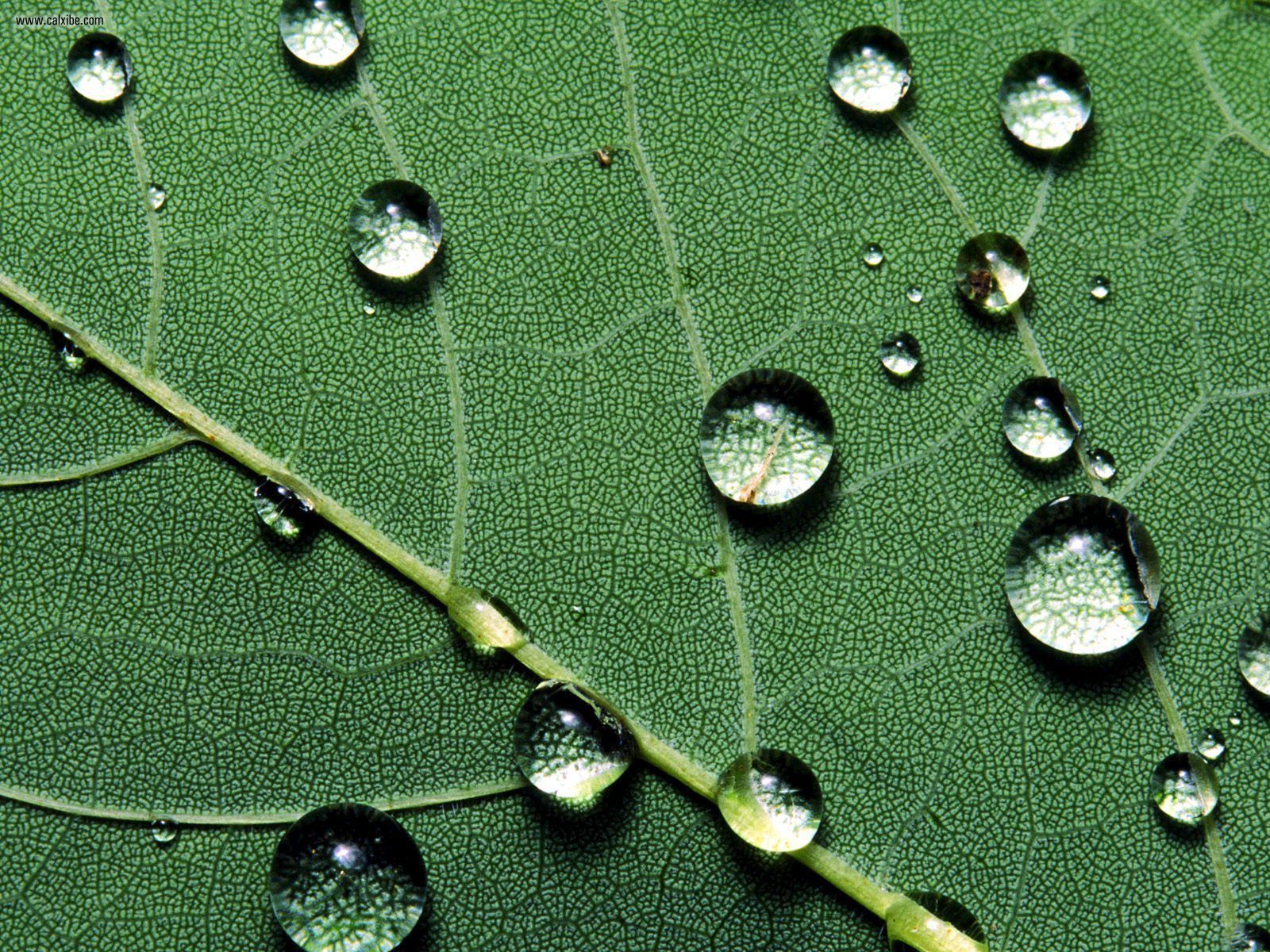
35.
Refer to the picture; this is occurring because of:
a)
Adhesion
b)
Cohesion
36.
When the temperature of matter increases the particles...
a)
speed up and move closer
b)
speed up and move farther apart
c)
slow down and move closer together
d)
slow down and move farther apart
37.

The ____ of a gas is the force of its outward push divided by the area of the walls of its container.

a)

pressure

b)

gravity

c)

surface tension

d)

structure

38.

The _______ is a measure of the average speed of the particles in a substance.

a)

temperature

b)

density

c)

volume

d)

mass

39.

This type of solid forms a regular repeating

three-dimensional structure called a crystal lattice. What type of solid is this?

a)

amorphous

b)

crystalline

c)

glass

d)

diamond

40.

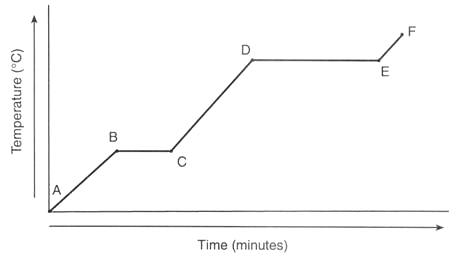
Is the substance gaining or losing energy?

a)

Gaining

b)

Losing

41.

Are the particles moving faster or slower as time goes on?

a)

Faster

b)

Slower

42.

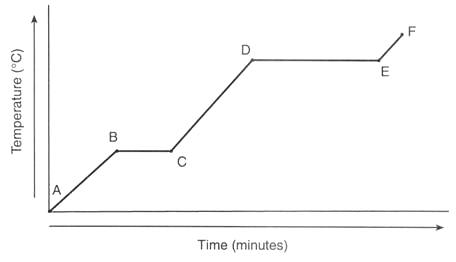
What state/phase is the object likely from points A to B?

a)

Solid

b)

Liquid

c)

Gas

d)

Plasma

43.

What is happening to the particles in the substance between points A and B?

a)

Melting

b)

Freezing

c)

Speeding Up

d)

Slowing Down

44.

What is happening to the particles in the substance between points D and E?

a)

Melting

b)

Freezing

c)

Vaporizing

d)

Sublimating

45.

Is the substance gaining or losing energy?

a)

Gaining

b)

Losing

46.

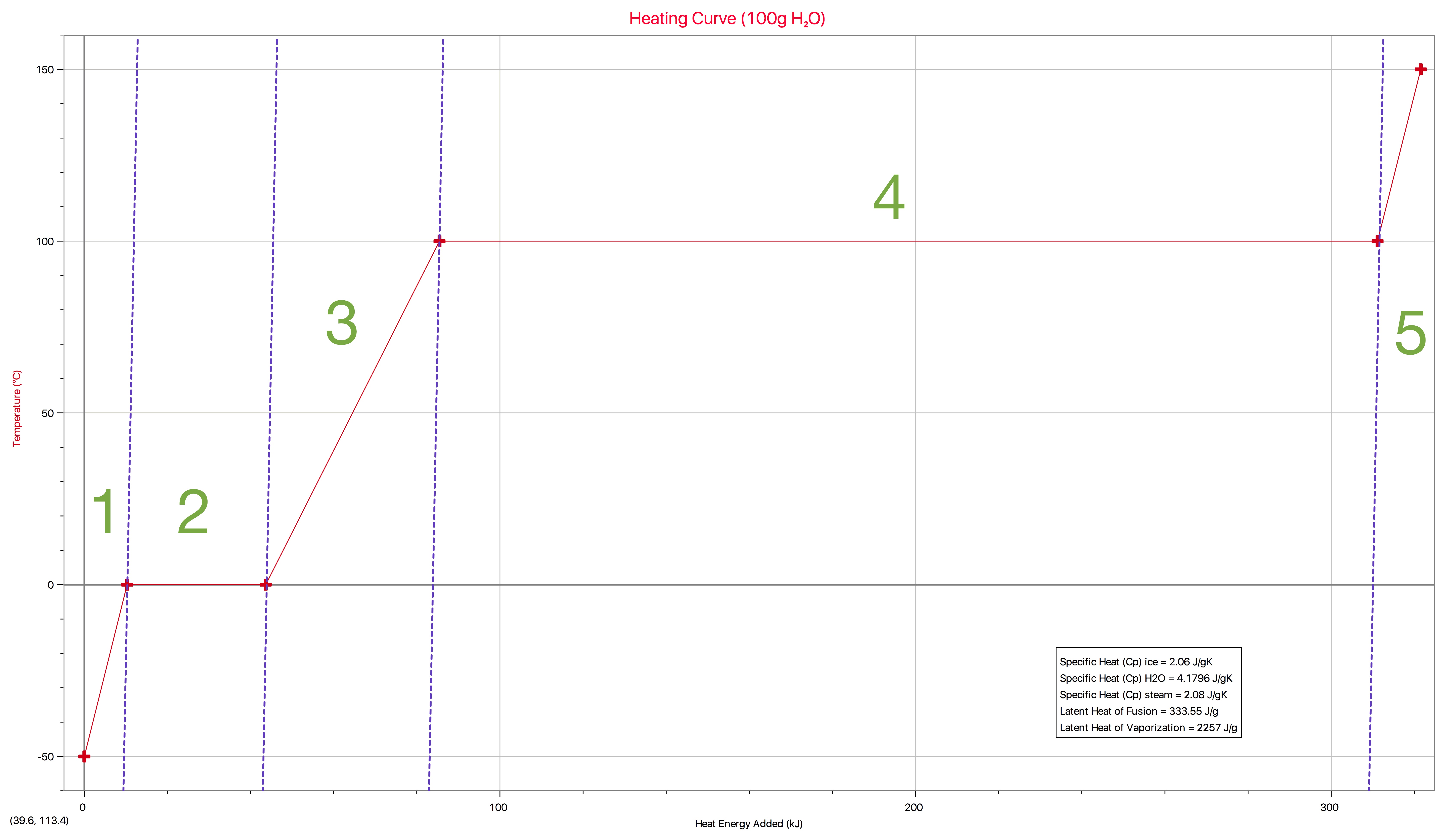
Where on the graph are phase changes taking place?

a)

1

b)

2

c)

3

d)

4

e)

5

47.

Between which two points is the solid cooling?

a)

A <---- B

b)

B <----> C

c)

C <---- D

d)

D <----> E

e)

E <---- F

48.

Between which two points is the gas heating up?

a)

A ----> B

b)

B <---- C

c)

C ----> D

d)

D ----> E

e)

E ----> F

49.

Between which two points is the gas condensing?

a)

A <---- B

b)

B <---- C

c)

C <---- D

d)

D <---- E

e)

E <---- F

50.
Between which points is the temperature of the substance remaining constant?
a)
A-B only. 
b)
A-B, C-D, E-F
c)
B-C only. 
d)
B-C, D-E
51.
The graph shows a cooling curve for an unknown substance.  What is happening during segment DE?
a)
boiling
b)
condensation
c)
freezing
d)
melting
52.
In which segment is the kinetic energy remaining constant?
a)
A-B
b)
B-C
c)
C-D
d)
E-F
53.
This curve indicates what about the heat energy?
a)
heat energy is being added or absorbed
b)
heat energy is being removed
54.

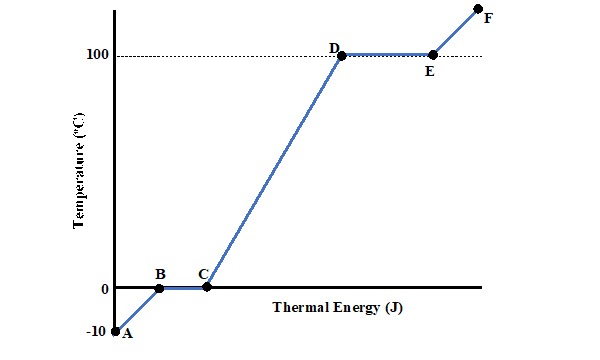
What is happening to the particles in the substance between points A and B?

a)

Melting

b)

Freezing

c)

Speeding Up

d)

Slowing Down

55.

Where on the graph are phase changes taking place?

a)

1

b)

2

c)

3

d)

4

e)

5

56.
Water exists as a _____________ at 700 mmHg and 50 °C.
a)
solid
b)
liquid
c)
gas
d)
supercritical fluid
57.
What phase change(s) may occur at pressures below 4.58 mmHg?
a)
sublimation/deposition
b)
melting/freezing
c)
all phase changes are possible at these pressures
d)
vaporization/condensation
58.
The pressure is increased on a sample of water at 0 °C from 0 mmHg to 800 mmHg.  In order, what changes occur?
a)
deposition, melting
b)
sublimation, melting
c)
condensation, freezing
d)
deposition, freezing
59.
What is true regarding CO2 for temperatures above 31 °C?
a)
It can never be liquified.
b)
It decomposes.
c)
It has a high pressure.
d)
It is a plasma.
60.
At 10 atm, dry ice is heated from -100 °C to 30 °C.  What changes occur?
a)
freezing, then condensation
b)
melting only
c)
sublimation only
d)
melting, then boiling
61.
What is the normal melting point of CO2?
a)
-78.5 °C
b)
-56.7 °C
c)
31 °C
d)
It doesn't have a normal melting point.
62.
What is the normal boiling point of CO2?
a)
-78.5 °C
b)
-56.7 °C
c)
31 °C
d)
It doesn't have a normal boiling point.
63.
What state of matter is X?
a)
solid 
b)
liquid
c)
gas
d)
supercritical fluid
64.
What state of matter is Z?
a)
solid 
b)
liquid
c)
gas
d)
supercritical fluid
65.
What state of matter is Y?
a)
solid 
b)
liquid
c)
gas
d)
supercritical fluid
66.
What change occurs from F to E?
a)
sublimation
b)
deposition
c)
melting
d)
condensation
67.
What change occurs from E to C?
a)
sublimation
b)
freezing
c)
melting
d)
boiling
68.
What change occurs from C to D?
a)
condensation
b)
vaporization
c)
melting
d)
sublimation
69.
What is the normal boiling point of this substance?
a)
150 °C
b)
100 °C
c)
-50 °C
d)
0 °C
70.
What is the normal melting point of this substance?
a)
150 °C
b)
100 °C
c)
-50 °C
d)
0 °C
71.
What is point A?
a)
triple point
b)
critical point
c)
equilibrium point
d)
normal melting point
72.
What is point A?
a)
triple point
b)
critical point
c)
equilibrium point
d)
normal melting point