wayground logo

Free Printable Worksheets

NEW

Font size

S
M
L
XL
Worksheets

8.5A, 8.5D, 8.6A, 8.6C

Total questions: 76

Worksheet time: 13hrs 40mins

Name
Class
Date
1.
The mass of one proton is equal to the mass of one...
a)
neutron
b)
electron
2.
All of the mass of an atom comes from what location?
a)
nucleus
b)
electron cloud
3.
Which letter represents a proton?
a)
A
b)
B
c)
C
d)
D
4.
Which letter represents a neutron?
a)
A
b)
B
c)
C
d)
D
5.
Which letter represents an electron?
a)
A
b)
B
c)
C
d)
D
6.
Which letter represents the nucleus?
a)
A
b)
B
c)
D
d)
E
7.
Which statement best describes the locations of the subatomic particles?
a)
The protons and electrons are found in the nucleus, while neutrons are in the cloud outside the nucleus
b)
The neutrons are in the nucleus, while the protons and electrons are in the cloud outside the nucleus
c)
The protons and neutrons are in the nucleus, while the electrons are in the cloud outside the nucleus
d)
The electrons and neutrons are in the nucleus, while the protons are in the cloud outside the nucleus
8.
An atom of an element contains 20 protons. What is the identity of the element? (NOTE: you will need to use your Periodic Table)
a)
Neon
b)
Calcium
c)
Potassium
d)
Argon
9.
What is the atomic mass of the atom pictured? 
a)
9
b)
10
c)
18
d)
19
10.
What is the atomic number of the atom pictured? 
a)
9
b)
10
c)
18
d)
19
11.
What is the element name of the atom pictured? 
a)
Fluorine
b)
Neon
c)
Argon
d)
Potassium
12.
What is the atomic mass of the atom pictured? 
a)
11
b)
12
c)
22
d)
23
13.
What is the atomic number of the atom pictured? 
a)
11
b)
12
c)
22
d)
23
14.
What is the element name of the atom pictured? 
a)
Sodium
b)
Magnesium
c)
Titanium
d)
Vanadium
15.
Which subatomic particle has a neutral or no charge?
a)
Proton
b)
Electron
c)
Neutron
16.
The subatomic particles in blue are...
a)
Neutrons
b)
Protons
c)
Electrons
17.
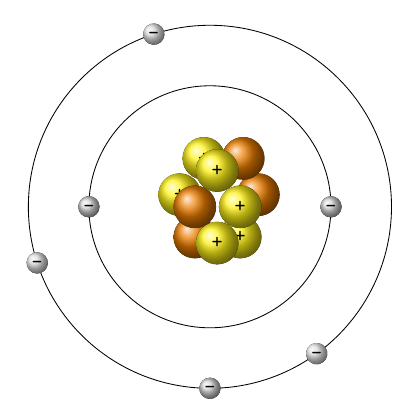
How many protons does this atom have?
a)
3
b)
6
c)
4
d)
2
18.
How many electrons does this picture show?
a)
4
b)
5
c)
6
d)
3
19.
What is the number of protons that the element in this image contain?
a)
14
b)
7
c)
15
d)
18
20.
the central region of an atom where its neutrons and protons are is its 
a)
nucleus 
b)
electron cloud
c)
core 
d)
center 
21.
What's a valence electron?
a)
electrons in the second energy level
b)
electrons in the outermost energy level
c)
the atomic number
d)
electrons in the first level
22.
how many electrons are in potassium? 
a)
19
b)
39
c)
58
d)
20
23.
What is the atomic mass of "F," Fluorine?
a)
9
b)
18
c)
17
d)
19
24.
How many the electrons does "Al," aluminum, have?
a)
5
b)
10
c)
13
d)
3
25.
Describe an Electron Cloud?
a)
the mist outside of an atom
b)
home of the protons
c)
where electrons are located
d)
nucleus
26.
An element with a mass number of 11 and an atomic number of 5 has how many neutrons?
a)
11
b)
5
c)
6
d)
16
27.
Which is the smallest?
a)
electron
b)
proton
c)
atom
d)
neutron 
28.
Which subatomic particle is found outside of the nucleus?
a)
Electron
b)
Proton
c)
Neutron
d)
Quark
29.
How many electrons does Si contain? (click to see image)
a)
14
b)
28
c)
2
d)
4
30.
What is atomic number?
a)
Number of protons in an atoms 
b)
Number of neutrons in an atom
c)
Mass of an atom
d)
Charge on an atom
31.
Which subatomic particles are found in the nucleus of an atom?
a)
Protons and Electrons
b)
Protons and Neutrons
c)
Neutrons and Electrons
d)
Protons, Neutrons and Electrons
32.
Atoms of the same element must always have the same number of _________
a)
electrons
b)
neutrons
c)
isotopes
d)
protons
33.
Complete the missing label on the diagram.
a)
Neutron
b)
Centre
c)
Nucleus
d)
Sub atomic particle
34.
How many Protons are in one atom of Lithium?
a)
3
b)
6
c)
7
d)
6.941
35.

How many protons are in Gold

a)

79

b)

197

c)

118

d)

276

36.

In which of these compounds are there twice as many oxygen atoms as hydrogen atoms?

a)

H3PO4

b)

H2SO4

c)

HCIO3

d)

H2O

37.

How many atoms of oxygen are in a molecule of glucose (C6H12O6)?

a)

4

b)

6

c)

12

d)

24

38.
This appears on the left side of a chemical formula, and represents how many molecules there are. 
a)
An Atom
b)
The Subscript
c)
A Molecule
d)
The Coefficient
39.
This is used to represent the number of each atom being represented. 
a)
An exponent
b)
The coefficient
c)
A molecule
d)
The subscript
40.

How many hydrogen atoms are in this chemical formula:

a)

4 hydrogen atoms

b)

1 hydrogen atom

c)

2 hydrogen atoms

d)

3 hydrogen atoms

41.
How many oxygen atoms are in this chemical formula?
a)
6 oxygen atoms
b)
2 oxygen atoms
c)
3 oxygen atoms
d)
4 oxygen atoms
42.
How many O's are in Al₂(SO₄)₃
a)
4
b)
12
c)
7
d)
24
43.
How many Magnesium are in 10MgCl2?
a)
10
b)
5
c)
20
d)
1
44.
What is the left part of a chemical equation called?
H2 + O → H2O
a)
Reactants
b)
Products 
c)
Yields 
d)
Chemical Equation 
45.
What is the right part of a chemical equation called?
H2 + O H2O
a)
Reactants
b)
Products 
c)
Yields 
d)
Chemical Equation 
46.

Which of the following correctly identifies the number of each element involved in the chemical formulas? NH4CO3

a)
b)
c)
d)
47.

2Li2BrO3

How many elements are in this chemical formula?

a)

2

b)

3

c)

9

d)

7

48.

Which is the correct formula for:

three hydrogen (H), one sulfur (S), four oxygen (O)?

a)

H3SO4

b)

HSO4

c)

H4S3O

d)

H2O

49.
How many atoms of Oxygen are in Fe(NO3)3 ?
a)
6
b)
3
c)
9
d)
1
50.

Which of the following molecules has the formula CH2O?

a)
b)
c)
d)
51.
What is the net force on this box?
a)
30 N left
b)
25 N right
c)
5 N left
d)
55 N right
52.

To calculate net force you must

a)

Add the forces

b)

Subtract the forces

53.

The forces acting an a toy car are shown.

In which direction will the race car move and with how much force?

a)

Right, 11 Newtons

b)

Left, 11 Newtons

c)

Right, 1 Newton

d)

Left, 1 Newton

54.

Provided is a diagram showing forces on a box. What is the net force on the box?

a)

5 Newtons ->

b)

5 Newtons <-

c)

15 Newtons ->

d)

15 Newtons <-

55.

Provided is a diagram showing forces on a box. What is the net force on the box?

a)

10 Newtons West

b)

10 Newtons East

c)

90 Newtons West

d)

90 Newtons East

56.
How will this object change its motion? 
a)
It will not change its motion. 
b)
It will accelerate to the right. 
c)
It will accelerate to the left. 
d)
It will move in both directions. 
57.
Balanced or Unbalanced?
a)
Balanced 
b)
Unbalanced
58.
Objects that have a net force of zero are...
a)
Balanced
b)
Unbalanced
c)
Accelerating
59.
Calculate the Net Force. 
a)
60N, Left unbalanced
b)
40N, Right unbalanced
c)
0N balanced
d)
60N, Right, unbalanced
60.
What is the net force?
a)
20 N 
b)
0 N 
c)
400 N 
d)
40 N 
61.
What is the net force?
a)
10 N
b)
0 N
c)
25 N
d)
1 N
62.

If an object was accelerating at 10 m/s2, and a force of 10 newtons was required to accelerate it, what was the object's mass?

a)

1kg

b)

10kg

c)

5kg

d)

2kg

63.

To calculate Force

a)

Force = m x a

b)

Force = m ÷ a

c)

Force = a ÷ m

d)

Force = m + a

64.

To calculate m

a)

m = Force × a

b)

m = Force ÷ a

c)

m = Force + a

d)

m = a ÷ Force

65.

To calculate a

a)

a = Force × m

b)

a = Force ÷ m

c)

a = Force + m

d)

a = m ÷ Force

66.

Mass = 10 kg. a = 10 ms2. Calculate the force.

a)

10N

b)

100N

c)

1 N

d)

1000N

67.

Force = 20 N and Mass = 4 kg. Calculate the acceleration.

a)

80 N

b)

80 ms-2

c)

5 ms-2

d)

0.2 ms-2

68.

Force = 25 N and Mass = 5 kg. Calculate the acceleration.

a)

5 ms-2

b)

125 ms-2

c)

30 ms-2

d)

4 ms-2

69.

A 2 kg brick is pulled by a force of 10N. Friction force is 4 N. What is the acceleration?

a)

3 N

b)

3 ms-2

c)

5 ms-2

d)

2 ms-2

70.
The mass of a car is 1000 kg.  How much force would be required to accelerate the car at a rate of 3 m/s2? The answer to this question is most likely (HINT: Look at the units!!!) - 
a)
3000 N
b)
3000 m/s2
c)
3000 kg
71.
What is the force on a 1000 kg elevator that is falling freely at 9.8 m/s2? The answer to this question is most likely (HINT: Look at the units!!!) - 
a)
9,800 N
b)
9,800 m/s2
c)
9,800 kg
72.

If a force of 26 N is exerted on two balls, one with a mass of 0.52 kg and the other with a mass of 0.78 kg, which ball will have the greater acceleration? (F=ma)

a)

The one with a mass of .78 kg will have the greatest acceleration.

b)

The one with a mass of .52 kg will have the greatest acceleration.

c)

They will both accelerate at the same rate.

73.

If an object was accelerating at 10 m/s^2, and a force of 10 newtons was required to accelerate it, what was the object's mass?

a)

1 kilogram

b)

10 kilograms

c)

2 kilograms

d)

5 kilograms

74.

If a 10 kilogram object accelerates suddenly at 15 m/s^2, how much force was applied to the object?

a)

150 Newtons

b)

15 Newtons

c)

150 kilograms

d)

100 kilograms

75.

The mass of a car is 1000 kg. How much force would be required to accelerate the car at a rate of 3 m/s2? The answer to this question is most likely (HINT: Look at the units!!!) -

a)

3000 N

b)

3000 m/s2

c)

3000 kg

76.

Force = 30 N and acceleration = 2 ms-2. Calculate the mass.

a)

15 ms-2

b)

60 N

c)

15 kg

d)

15 g