
 Worksheets
SoT Lesson 1 Test Review
Total questions: 60
Worksheet time: 38mins

What two particles are in the nucleus of an atom?
protons and electrons
electrons and neutrons
protons and neutrons

Which of these is the neutron?
A
B
C
D
Developing chemicals or products for useful purposes isn't one of the roles of a chemical engineer.
true
false
Studying atoms and how they join together is one of the roles of a chemist.
true
false
A molecule that has a partial positive end and a partial negative end because of unequal sharing of electrons is a _______________.
nonpolar molecule
polar molecule
ionic compound
metalic compound
Polar molecules have
no charges.
slight positive and negative charges on opposite ends of the molecules.
only positive charges.
either positive or negative charges, but not both.
How did the salt affect the melting/freezing point of the solid ice?
it increased
it decreased
it didn't affect it
none of these
How did the salt affect the melting/freezing point of the liquid water?
it increased
it decreased
it didn't affect it
none of these
The freezing point depression is caused by an increase in _______________ in the solution resulting in a greater total amount of energy that must be lost in order for the water to freeze.
temperature
energy
particles
all of these
The charged ions from the salt interrupt the polar water molecules from _________________. This is one reason why the temperature of the salt water solution during the ice cream lab was able to drop below the freezing point of water.
freezing
melting
slowing down
getting into fixed positions
Which of the following are examples of compounds?
copper
salt
water
iron
air
Describe COHESION.
Water molecules attracted to other substances.
Water molecules climbing upwards against the force of gravity.
Water molecules dissolving many substances because of its polarity.
Water molecules attracted to other water molecules.


Water's ability to stick to glass is
adhesion
cohesion
surface tention
capillary action
In which of the following industries might an engineer MOST likely work?
pharmaceuticals
hospitality
retail
all of these
Glass is an example of which kind of material?
raw
manufactured
processed
synthetic
Lumber is an example of which kind of material?
raw
manufactured
processed
synthetic
Oil sticks to the bodies and surfaces of birds, plants, fish, and other aquatic organisms because oil is ________ dense and ____________ water.
more, floats on
more, sinks below
less, sinks below
less, floats on
What is the name of the "force" that helps hold glue to its bonded material?
Van der Waal's force
adhesion
Van Wilder's force
cohesion
The technical name for superglue-type glue is
epoxy.
cyanoacrylate.
polyvinyl acetate.
all of these
Which of the following is a subject than an engineer might study?
physics
political science
mathematics
all of these
Which of the following is NOT an example of one of the earliest adhesive?
tar
bitumen
casein
beeswax
A pure substance made of only one kind of atom.
atom
compound
mixture
element
A group of atoms, chemically bonded together, representing the smallest fundamental unit of a compound.
atom
element
compound
molecule
A substance made up of two or more elements.
atom
element
compound
molecule
a group of atoms chemically bonded together, representing the smallest fundamental unit of a compound
molecule
atom
cell
quark
the smallest unit of a chemical element
molecule
atom
cell
quark
What type of system doesn't have a monitoring system to change the input?
Closed Loop System
Open Loop System
Reverse Loop System
Monitoring Loop System
What is the correct order or a technological system?
Input, Output, Process
Output, Process, Input
Input, Process, Output
Process, Resources, Output
What type of system uses a monitoring system to change the input?
Reverse Loop System
Closed Loop System
Monitor Loop System
Open Loop System

What type of Technological System does this example represent?
Open Loop System
Closed Loop System
Glue remaining on only one side of a substrate indicates
cohesive failure.
adhesive failure.
substrate/material failure
all of these
Glue remaining both sides of a substrate indicates
cohesive failure.
adhesive failure.
substrate/material failure
all of these
Select all of the ways below that wildlife can be affected by an oil spill.
They can die of hypothermia.
It can affect their ability to reproduce successfully.
Birds will have to fly even further south for the winter.
They can suffer from poisoning.
Select everything below that describes a step/part of the complex task of cleaning up an oil spill.
The oil is cleaned up and wildlife is given assistance.
Funds are obtained by legislators.
Wildlife is released to a safe environment.
The oil is contained.
Which of the following is NOT one of the 7 technological resources?
Internet
Information
Capital
People
Anything that has mass and takes up space is an example of
energy
matter
chemical change
temperature

The average speed of molecules in a substance is called
thermodynamics
heat
temperature
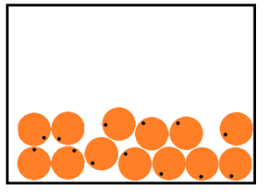
What happens to molecules when the temperature drops or lowers?
The molecules get closer together
The molecules start moving faster.
The molecules stop moving.
The molecules become smaller.
Select all of the phase changes that require a loss of energy.
melting
freezing
vaporizing
condensing
sublimating
Select all of the phase changes that require a gain of energy.
melting
freezing
vaporizing
condensing
sublimating
Which of the following accurately describes intermolecular forces?
weak attractions between molecules
weak bonds that form new substances
strong bonds that can not be broken
any bond that shares electrons
Select everything that occurs as temperature decreases.
particles slow down
intermolecular forces strengthen
energy is lost
energy is gained
intermolecular forces weaken
According to the Smithsonian website, which of the following was NOT listed as a way that deep-sea coral colonies were impacted by the BP oil spill?
tissue damage
lower survival rates
it soaked into the ground and could resurface later
all of these
Select all of the methods for cleaning up oil from a shoreline that are listed below.
vacuuming
mechanical removal
skimmers
dispersants
debris removal
What happens to molecules when the temperature drops or lowers?
The molecules get closer together
The molecules start moving faster.
The molecules stop moving.
The molecules become smaller.

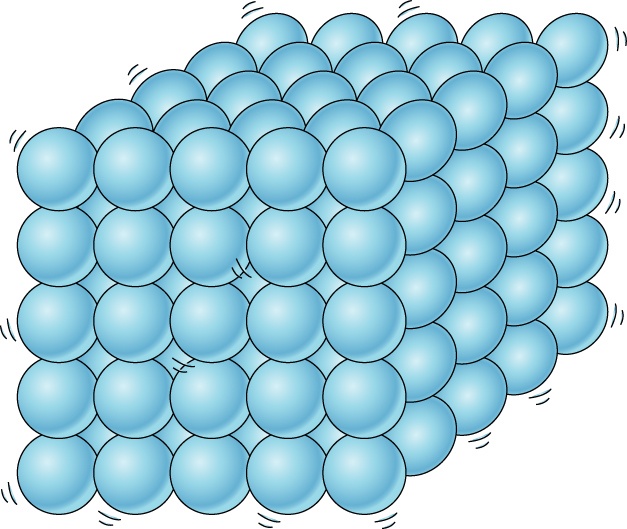
Which description best matches this particle model?
Closely packed, vibrating in fixed positions.
Particles are close together but can move a little.
Particles have lots of energy and can move around.

