wayground logo

Free Printable Worksheets

NEW

Font size

S
M
L
XL
Worksheets

Biology SOL Review #1

Total questions: 63

Worksheet time: 1hrs 17mins

Name
Class
Date
1.
A testable explanation to a problem that has not yet been tested. 
a)
data
b)
theory
c)
hypothesis
d)
fact
2.
This variable in an experiment is the one being changed by the scientist. 
a)
dependent variable
b)
independent variable
c)
data
d)
control group
3.
The summary at the end of an experiment that explains the results. 
a)
conclusion
b)
procedures
c)
materials
d)
responding variable
4.
If you increase the amount of spinach you eat, then you will increase the iron in your blood. 
What's the dependent variable?
a)
increase the amount of iron in your blood
b)
spinach you eat
5.
Which of the following would be considered quantitative data?
a)
Color
b)
Smell
c)
6.84 cm
d)
texture
6.
Explaining the color of a chemical would be what kind of observation?
a)
Qualitative 
b)
Quanitative
7.
What is the part of the experiment that is left alone or “natural", and is used to compare back to?
a)
Independent Variable
b)
Dependent Variable
c)
Control Group
d)
Experimental Group 
8.
You will want your experiment to have ____ independent variable(s) in it for the experiment to be valid.
a)
1
b)
2
c)
3
d)
4
9.

Molecules that stick to the same type of molecules.

a)

cohesion

b)

adhesion

c)

hydrophilic

d)

hydrophobic

10.

When salt is dissolved in water, water is the

a)

solvent

b)

solute

c)

solution

d)

reactant

11.

A substance with a pH of 6 is called a....

a)

Base

b)

Acid

12.

Capillary action is....

a)

adhesion

b)

cohesion

c)

change in matter (heat of fusion)

d)

both adhesion and cohesion

13.

Which acid listed is the strongest acid?

a)

Hydrochloric acid pH 1.0

b)

Sulfuric acid pH 1.2

c)

Tomatoes pH 4.2

d)

Water pH 7.0

14.
Which is the pH of the weakest base?
a)
13
b)
11.1
c)
8.5
d)
6.2
15.

Water in a cup will help prevent the cup from burning up over a flame due to this property of water

a)

high specific heat

b)

capillary action

c)

surface tension

d)

greatest density at 4 oC

16.

Water is a polar molecule, which means it has a positive and a negative side. Hydrogen bonds form when:

a)

The positive end of one water molecule bonds to the positive end of another water molecule.

b)

The negative end of one water molecule bonds to the negative end of another water molecule.

c)

The positive end of one water molecule bonds to the negative end of another water molecule.

17.

Why does ice float on water?


a)

When it freezes it becomes less dense

b)

When it freezes it becomes more dense

c)

When it freezes its density stays the same

18.
A(n) ______ is a substance with a pH less than 7
a)
Acid
b)
Alkaline
c)
Base
d)
Buffer
19.
A(n) _______ is a substance with a pH greater than 7.
a)
Base
b)
Acid
c)
Buffer
d)
Water
20.
What is the only substance with a neutral pH of 7?
a)
Milk
b)
Orange Juice
c)
Water
d)
Blood
21.
Proteins are made of monomers called ___________
a)
Nucleotides
b)
Monosaccharides
c)
Amino Acids
d)
Glycerol and fatty acids
22.
DNA and RNA are examples of 
a)
Carbohydrates
b)
Lipids
c)
Proteins
d)
Nucleic Acids
23.
Monosaccharides are monomers of
a)
Carbohydrates
b)
Lipids
c)
Proteins
d)
Nucleic Acids
24.
Waxes, oils and fats are examples of
a)
Carbohydrates
b)
Lipids
c)
Proteins
d)
Nucleic Acids
25.
What is the function of nucleic acids?
a)
store genetic information
b)
store energy (long-term)
c)
store energy (short-term)
d)
build skin, hair, nails, muscles
26.
Which macromolecule stores energy, insulates us, and makes up the cell membrane?
a)
lipids
b)
proteins
c)
carbohydrates
d)
nucleic acids
27.
Which group of biomolecules provide quick energy to organisms?
a)
proteins
b)
carbohydrates
c)
lipids
d)
nucleic acids
28.
All organic compounds contain the element
a)
carbon
b)
nitrogen
c)
phosphorus
d)
sulfur
29.
Is found in the cell membrane as a bilayer. 
a)
lipids
b)
protein
c)
nucleic acid
d)
carbohydrate
30.
Enzymes are..
a)
nucleic acids 
b)
carbohydrates 
c)
lipids 
d)
proteins 
31.
What is a substance called if it speeds up a chemical reaction?
a)
reusable
b)
catalyst
c)
specific
d)
fragile
32.
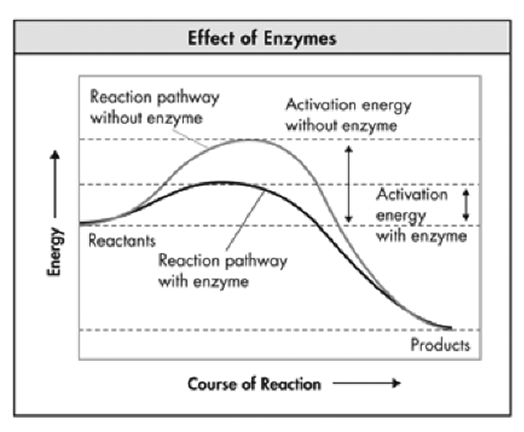
The graph shows how enzymes affect reactions in cells. Which statement best summarizes the information shown in the graph?
a)
Enzymes increase the energy of the reactants.
b)
Enzymes decrease the energy level of the products.
c)
Enzyme decrease the activation energy of the reaction.
d)
Enzymes reverse the direction of the reaction.
33.
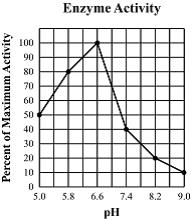
Which of the following conclusions can be drawn from this graph?
a)
The optimum pH of the enzyme is 6.6.
b)
The optimum pH of the enzyme is 5.8
c)
The enzyme’s activity increases as pH increases 5.0 to 9.0
d)
The enzyme’s activity is greater around pH of 8.0 .
34.
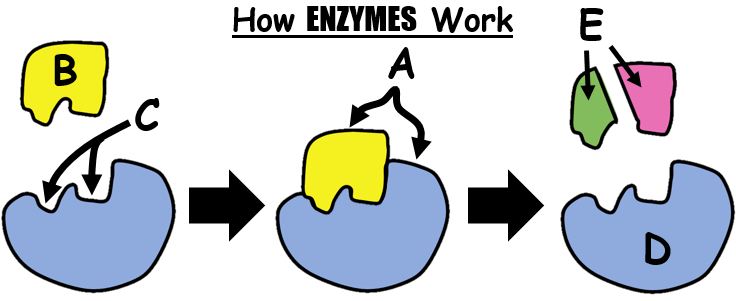
In the diagram, what is letter A? 
a)
product
b)
substrate
c)
enzyme-substrate complex
d)
active site
35.
What is the function of an enzyme?
a)
enzymes break themselves into small pieces
b)
enzymes slow down chemical reactions
c)
enzymes speed up chemical reactions
d)
enzymes combine products to form reactants 
36.
What happens when enzymes are heated to a high temperature?
a)
The enzymes die.
b)
The shapes of the enzyme are altered denature
c)
The enzymes' amino acid sequence changes.
d)
The enzymes remain the same
37.
Which enzyme is most efficient in a basic solution?
a)
A
b)
B
38.

_______ are the smallest units of life because they grow, reproduce, respond, and use energy.

a)

atoms

b)

elements

c)

cells

d)

all of the above

39.

Cells come from______.

a)

other preexisting cells

b)

cytoplasm

c)

organelles

d)

prokaryotes

40.

The cell theory states that_________

a)

cells come from cells

b)

all organisms are made of cells

c)

cells are the basic unit of structure and function for life

d)

all of the above

41.

________ is the scientist who saw small chambers when looking at cork, and named them “cells”.

a)

Newton

b)

Hooke

c)

Carson

d)

Manning

42.

A multicellular organism is made of

a)

one cell

b)

multiple cells

c)

unicellular cells

d)

there is no such thing as a "multicellular" organism

43.

What type of cell lacks a nucleus?

a)

eukaryotic

b)

prokaryotic

c)

human

d)

animal

44.

A cell in which the genetic material is enclosed within a nucleus is a

a)

eukaryotic cell

b)

prokaryotic cell

c)

human cell

d)

animal cell

45.

According to the information in the given chart, what type of cell is cell X?

a)

bacteria cell

b)

plant cell

c)

animal cell

d)

prokaryotic cell

46.

Ian is looking at a cell using a microscope. He sees a nucleus and a large vacuole in the center of a cell. What type of cell is he most likely looking at?

a)

animal cell

b)

plant cell

c)

blood cell

d)

human cell

47.

Select the group of organelles that is common to both plant cells and animal cells.

a)

cytoplasm, mitochondria, cell wall, nucleus

b)

ribosomes, cell membrane, mitochondria, cytoplasm

c)

nucleus, cytoplasm, ribosomes, chloroplasts

48.

Has membrane bound organelles

a)

Prokaryote

b)

Eukaryote

c)

Both

49.

Which type of cell?

a)

Prokaryote

b)

Eukaryote

50.

What is the function of this organelle?

a)

Sac that stores water, nutrients, and waste products

b)

Regulates what enters and leaves the cell

c)

Structures that transport and ship proteins like UPS

d)

Cite of cellular respiration also known as the powerhouse of the cell

51.

What can only be found in plant cells?

a)

Chloroplast

b)

Vacuole

c)

Nucleus

d)

Cell membrane

52.

Where are proteins made?

a)

Golgi Body

b)

Ribosomes

c)

Chromosomes

d)

Mitochondria

53.

This cell would be classified as a(n) ________________ cell.

a)

Prokaryotic

b)

Eukaryotic

c)

Both

54.

Another term for maintaining an internal balance is...

a)

Equality

b)

Equential

c)

Homeostasis

d)

Balance

55.
This forms a boundary between the inside of the cell and the outside of the cell. 
a)
Cell Membrane
b)
Lipid Cleric Layer
c)
Membrane Gate
d)
Protein Receptors 
56.
"Water Fearing" 
a)
Hydrophobic
b)
Hydrophilic 
c)
Hydroelectric 
d)
Hydroloric
57.
The majority of the cell membrane is made of which macromolecule?
a)
Lipids
b)
Carbs
c)
Proteins
d)
Nucleic acids
58.
Hydrophobic region of the cell membrane?
a)
E
b)
B
c)
C
d)
59.
What type of transport is this?
a)
facilitated diffusion
b)
active transport
c)
diffusion
d)
osmosis
60.
What are two types of passive transport?
a)
endo and exocytosis 
b)
in a minute and later
c)
hydrophobic and hydrophillic 
d)
osmosis and diffusion
61.
The cell membrane is selectively permeable, which means...
a)
All materials can enter and leave the cell
b)
Certain things can enter while others cannot
c)
The cell manually sorts through all materials
d)
Only certain cells can interact with the cell.
62.
Describes the arrangement of the cell membrane as bendable and made of many parts. 
a)
The Fluid Mosaic Model 
b)
The Major Mobility Model 
c)
The Crazy Cell Model
d)
The Maze Model
63.
Something is ___________ ____________
when some molecules can cross the membrane while others cannot. 

a)
Selectively (or Semi) Permeable 
b)
Totally Transparent
c)
Liquid Licorice 
d)
Heavily Patrolled