wayground logo

Free Printable Worksheets

Font size

S
M
L
XL
Worksheets

IIPA 8th SCIENCE STUDY GUIDE

Total questions: 66

Worksheet time: 3590secs

Name
Class
Date
1.

Atoms form ions because they want to have a (a)   outer shell.

2.

Ionic bonds are formed between...

a)

Non - metals

b)

A metal and a non-metal

c)

Metals

3.

How is an ionic bond formed?

a)

Sharing of electrons

b)

Delocalised electrons

c)

Transfer of electrons

4.

An example of an ionic compound is Sodium Chloride, which is made from Na+ and Cl- ions. Why do these ions form an ionic bond?

a)

They have like charges

b)

They are from the same group

c)

They are from the same period

d)

They have opposite charges

5.

Lithium is in group 1 of the periodic table, which ion would it form?

a)

Li-

b)

Li2-

c)

Li+

d)

Li2+

6.
Is Hydrogen considered a metal or a non-metal?
a)
Metal
b)
Non-metal
7.
What two types of atoms make a covalent bond?
a)
2 Nonmetals
b)
1 Nonmetal and 1 Metal
c)
2 Metals
d)
2 Noble Gases
8.
How are covalent bonds explained?
a)
When one atom takes the other atom's electron
b)
When the atom shares an electron with an another atom
c)
When the two nucleus merge
d)
When the neutrons leave the nucleus
9.
In chemical compounds, covalent bonds form when
a)
the electronegativity difference between two atoms is very large.
b)
electrons are completely transferred between two metals.
c)
pairs of electrons are shared between two nonmetal atoms.
d)
two nonmetal atoms are attracted to each other by opposite charges.
10.
What region of the periodic table contains atoms that form covalent bonds?
a)
the left side
b)
the middle
c)
the right side
d)
top left
11.
Is carbon considered a metal or a non-metal?
a)
metal
b)
nonmetal
c)
other
12.
How are ionic bonds formed?
a)
When atoms share an electron
b)
When opposite charged atoms attract
c)
When one atom takes a proton
d)
When one atom takes a neutron
13.
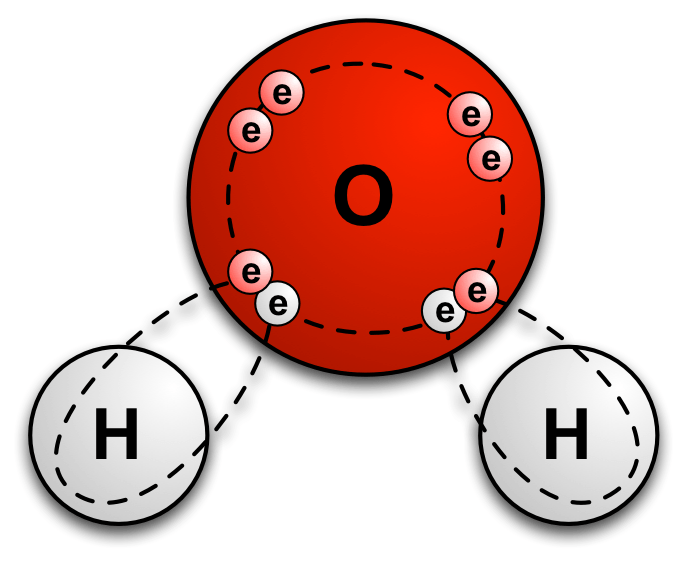
What would you name this molecule?
a)
SNa3
b)
H3O
c)
NaCl
d)
H2O
14.
What molecule is this?
a)
CO
b)
CO2
c)
C2O
d)
C2O2
15.

Network of bonded ions

a)

Ionic bonds

b)

Covalent bonds

16.

Molecules

a)

Ionic compounds

b)

Covalent compounds

17.

Valence electrons are shared

a)

Ionic bonds

b)

Covalent bonds

18.

Conducts electricity well when melted or dissolved

a)

Ionic compounds

b)

Covalent compounds

19.

Poor electrical conductivity

a)

Ionic compounds

b)

Covalent compounds

20.

Always a solid at room temperature

a)

Ionic compounds

b)

Covalent compounds

21.

Can be a solid, liquid, or gas at room temperature

a)

Ionic compounds

b)

Covalent compounds

22.

Generally, atoms form bonds so that _______________.

a)

Each atom loses its electrons

b)

Each atom has a stable electron configuration

c)

Each atom has an unstable electron configuration

d)

Each atom gains electrons

23.

What happens when you put an ionic compound in water?

a)

The ions separate

b)

The ions pack more closely together

c)

Nothing happens

24.

What type of bonding does this picture show?

a)

Ionic

b)

Covalent

25.

What type of bonding does this picture show?

a)

Ionic

b)

Covalent

26.

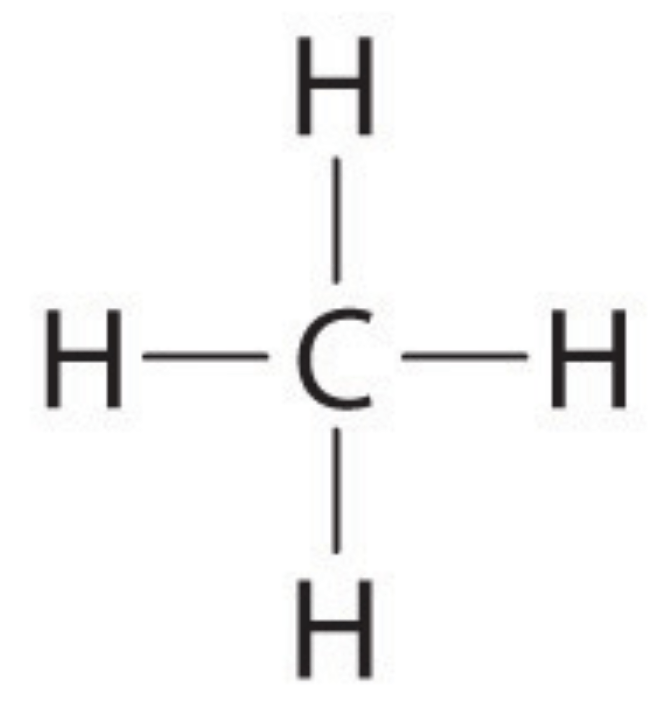
Classify the following molecule.

a)

polar

b)

nonpolar

27.

Classify the following molecule.

a)

polar

b)

nonpolar

28.

Is the following molecule polar or nonpolar?

a)

polar

b)

nonpolar

29.

Why is the molecule polar?

a)

There is a nonbonding pair on the central atom.

b)

There are different types of elements bonded to the central atom.

c)

There are no nonbonding pairs on the central atom and all of the atoms bonded to the central atom are the same.

30.
F2
a)
Polar 
b)
Nonpolar 
31.
H2O
a)
Polar 
b)
Nonpolar 
32.

A covalent bond is a chemical bond where two atoms share__________.

a)

protons

b)

neutrons

c)

valence electrons

d)

the same group on the periodic table

33.

A molecule that has a partial positive end and a partial negative end because of unequal sharing of electrons is a _______________.

a)

nonpolar molecule

b)

polar molecule

c)

ionic compound

d)

metalic compound

34.

Atoms of a polar molecule share their atoms ___________.

a)

Equally

b)

Unequally

35.

Why is it difficult to wash oil from your hands with plain water?

a)

Both substances are polar. Like polarities repel.

b)

Both substances are nonpolar. Like polarities repel.

c)

Water is nonpolar, and oil is polar, so they will not combine.

d)

Water is polar, and oil is nonpolar, so they will not combine.

36.

What is a chemical equation?

a)

a diatomic molecule

b)

a shorthand representation of a chemical bond

c)

a shorthand representation of a chemical reaction

d)

a substance

37.

What are substances on the left side of a chemical equation called?

a)

electrons

b)

groups

c)

products

d)

reactants

38.

What are substances on the right side of a chemical equation called?

a)

electrons

b)

groups

c)

products

d)

reactants

39.

What does the number in front of the molecular symbol mean?

a)

It shows that there is only one molecule present in a reaction

b)

It shows the number of molecules in the reaction

c)

It shows the number of reactions that took place

d)

All of the choices

40.
What is the best definition for subscript?
 
a)
The big number that tells you the number of molecules.
b)
The atomic number
c)
The little number that tells the number of atoms for each element.
41.
What is the best definition for molecule? 
a)
A molecule is formed when two or more atoms join together chemically.
b)
A molecule is made of only one atom. 
42.
What is the symbol of the element: gold?
a)
Ag
b)
As
c)
Ap
d)
Au
43.
What is the best statement for the picture. 
a)
The molecule has two carbon atoms and four hydrogen molecules. 
b)
The molecule has two carbon atoms and four hydrogen atoms. 
c)
The molecule has two carbon atoms. 
44.
What is the best formula for this molecule?
a)
2H2O
b)
H3O
c)
H2O2
d)
H2O
45.
What is the best formula for this molecule?
a)
C3H4O3
b)
C3H4O
c)
C3H4O2
d)
C3H4O4
46.
What is the best formula for these molecules?
a)
H2O
b)
H2O2
c)
3H2O
d)
4H2O
47.
Choose the correct statement.
a)
Atoms are the biggest particle in a element.
b)
Atoms are the smallest particle in a molecule.
c)
Atom is the smallest particle in a element.
d)
Atoms are nice.
48.

which of these example is a physical change?

a)
b)
c)
d)
49.

is the picture chemical or physical

a)

chemical

b)

physical

50.

ice melting is chemical

a)

true

b)

false

51.

what is a physical change

a)

its when a transformation doesn't change the nature of the molecules in matter

b)

its when a transformation change the nature of the molecules in matter

c)

its when a transformation change the nature of the molecules in substance

52.
Water freezing
a)
Chemical Change
b)
Physical Change
53.
Wood burned in a fireplace
a)
Chemical Change
b)
Physical Change
54.
Cake batter baked in an oven
a)
Chemical Change
b)
Physical Change
55.
Baking soda and vinegar combine to make carbon dioxide
a)
Chemical Change
b)
Physical Change
56.
Glass bottle that is shattered
a)
Chemical Change
b)
Physical Change
57.
Students observed as small drops of water collected on the outside of a glass.
Which statement BEST describes why the water vapor in the air formed liquid water on the outside of the glass?
a)
The humidity outside the glass turns the vapor to liquid water.
b)
The water vapor pulls the water from inside the glass to outside the glass.
c)
The temperature of the water inside the glass is colder than the air outside the glass.
d)
The temperature of the water inside the glass is warmer than the air outside the glass.
58.
How many elements are in C6H12O6?
a)
1
b)
2
c)
3
d)
4
59.
How many atoms of carbon (C) are in  C6H12O6?
a)
3
b)
6
c)
12
d)
24
60.
Element or compound?
H2O
a)
element
b)
compound
61.
How many atoms are there TOTAL in:
H2SO4
a)
6
b)
5
c)
7
d)
3
62.
How many Sodium (Na) are in 6NaCl?
a)
1
b)
12
c)
6
63.
How many TOTAL atoms are in the following chemical formula?
3H2O
a)
7
b)
6
c)
9
d)
8
64.
What is the Law of Conservation of Mass?
a)
It states that no matter can be created or destroyed.
b)
It states that no energy can be created or destroyed.
c)
It states that matter can be created or destroyed.
d)
It states that no sound can be created or destroyed.
65.
At the end of chemical reactions, what is the total mass of the reactants compared to the total mass of the products?
a)
the product is doubled
b)
the product is half the mass of the reactants
c)
the mass is the same
d)
the mass changes depending on the reaction
66.
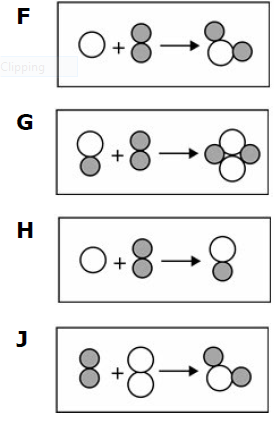
Which of the following models best demonstrates a balanced chemical equation?
a)
F
b)
G
c)
H
d)
J