wayground logo

Free Printable Worksheets

Font size

S
M
L
XL
Worksheets

Physical Science 2nd Semester Test Study guide

Total questions: 77

Worksheet time: 2hrs 21mins
Name
Class
Date
1.

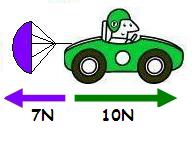
What is the net force?

a)

3 N

b)

3 N, right

c)

17 N, right

d)

3 N, left

2.
What is the net force?
a)
20 N 
b)
0 N 
c)
400 N 
d)
40 N 
3.

A ____________ is a push or a pull on an object.

a)

friction

b)

force

c)

magnet

d)

gravity

4.
What is the standard unit force is measured in?
a)
Newtons
b)
pounds
c)
grams
d)
meters
5.

A tennis ball with a mass of 0.1 kg is accelerated at a rate of 164 m/s when hit by a professional tennis player. What force does the racket exert on the ball?

a)

15.3 N

b)

16.4 N

c)

25 N

d)

13.3 N

6.

Two factors that determine work are...

a)

Force

b)

Mass

c)

Velocity

d)

Distance

7.

Units of work are...

a)

Newtons

b)

Grams

c)

Joules

d)

Meters

8.

If you push a cart with a force of 60 N for 2 m... how much work have you done?

a)

120 J

b)

30 J

c)

120 N

d)

30 N

9.

Kinetic energy is...

a)

energy carried in ultraviolet waves

b)

energy stored in food

c)

energy in motion

d)

energy from splitting an atom

10.

What two factors affect an object's kinetic energy?

a)

area and volume

b)

mass and weight

c)

weight and height

d)

mass and speed

11.

Kinetic energy is measured in

a)

Newtons (N)

b)

Joules (J)

c)

Kilograms (kg)

d)

miles per hour (mph)

12.
How much KE does a moving 6 kilogram object have if it moves with a velocity of 3 m/s?
a)
27 J
b)
18 J
c)
9 J
d)
2 J
13.

A 6kg cat misjudges a jump and falls 5 meters. How much gravitational potential energy does the cat have? (The cat is fine by the way.)

a)

294 J

b)

180000 J

c)

1225 J

d)

3920000 J

14.

What is the mechanical advantage of a lever that has an input arm of 3 meters and an output arm of 2 meters?

a)

1.5

b)

1

c)

0.67

d)

3

15.
The amount by which a machine multiplies input force is known as the 
a)
work.
b)
power.
c)
output force.
d)
mechanical advantage.
16.
An inclined plane wrapped around a rod forms this simple machine 
a)
lever
b)
pulley
c)
screw
d)
wedge 
17.
A simple machine is a device that helps to reduce the amount of _____ required to work.
a)
force
b)
energy
c)
work
18.
What would be the effect on the particles if more heat is supplied to the system?
a)
They would slow down
b)
They would stop moving
c)
They would speed up
d)
There would be no effect
19.
Heat transfers from ______ objects to cold objects. 
a)
Cold
b)
Hot
c)
Convection
d)
Radiation 
20.
Temperature is the measurement of the average ________ energy of the molecules in an object
a)
Kinetic 
b)
Heat
c)
Motion
d)
None of the above
21.
If I heat up 2 pans of water one has 100 mL in it and one has 1000mL. Which one heats up the fastest?
a)
100 mL
b)
1000 mL
c)
They both heat up at the same speed
d)
They cool down.
22.
A high specific heat means...
a)
It heats up quickly with energy added
b)
It requires more energy to change temperature
23.
Temperature is a measure of the...
a)
total energy in a substance
b)
total kinetic energy in a substance
c)
average potential energy in a substance
d)
average kinetic energy of molecules in a substance
24.
The second  law of thermodynamics states that entropy of a system  tends to ______________. 
a)
increase
b)
decrease
c)
stay constant
d)
fluctuate wildly
25.
The first law of thermodynamics states that energy is
a)
created
b)
destroyed
c)
conserved
d)
created and destroyed
26.
An object becomes charged when the atoms in the object gain or lose
a)
electrons
b)
protons
c)
neutrons
d)
all of the above
27.
Static electricity is 
a)
The balance of electrical charge on an object
b)
The imbalance of electrical charge on an object
c)
The discharge of electrical charge
d)
The build up of protons in the nucleus of an atom 
28.

What happens when you touch a metal doorknob after rubbing your shoes on the carpet?

a)

The doorknob sends a burst of electric current into your body

b)

Millions of electrons go from your finger into the doorknob

c)

The doorknob sends millions of electrons into your finger

d)

Your finger becomes negatively charged

29.
Two objects with LIKE static charges will
a)
attract each other
b)
even out in the end
c)
repel each other
d)
cause a spark
30.

What is a cation's charge?

a)

positive

b)

negative

c)

neutral

d)

depends on the element

31.

What is an anion's charge?

a)

positive

b)

negative

c)

neutral

d)

depends on the element's charge

32.

What is used to measure electric current?

a)

Voltmeter

b)

Ammeter

c)

Wattmeter

d)

pH meter

33.
In a ________ circuit there are multiple paths for the current to take.
a)
Series
b)
Parallel
34.
regular disturbances that carry energy through matter or space
a)
crest
b)
energy
c)
wave
d)
trough
35.
In a longitudinal wave, the particles move...?
a)
back and forth
b)
up and down
c)
vertically
d)
in the direction of the hertz
36.

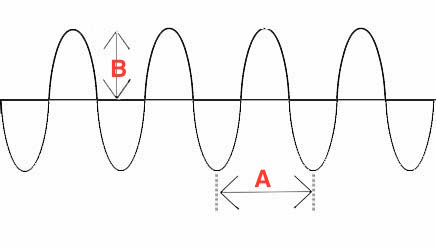
What property of this wave is represented by the letter "A"

a)

amplitude

b)

crest

c)

trough

d)

wavelength

37.
The type of waves that require medium to pass:
a)
Mechanical Waves
b)
Electromagnetic Waves
38.
A mechanical wave cannot travel through...
a)
a vacuum(empty space).
b)
water.
c)
air. 
d)
glass.
39.
The number of wavelengths that pass a point each per second is:
a)
frequency
b)
period
c)
longitudinal 
d)
transverse wave 
40.
Which type of wave is pictured here?
a)
Longitudinal
b)
Transverse
c)
Light 
d)
Electromagnetic
41.
When the sound source moves, the frequency changes
ex. police car siren sounding lower pitch after the car passes
a)
pitch
b)
frequency
c)
Doppler Effect
d)
medium
42.
What part is represented by the blue lines?
a)
Crest
b)
Resting Point
c)
Wavelength
d)
Amplitude
43.
What two factors effect the amount of energy a wave has?
a)
Frequency and wavelength
b)
Frequency and amplitude
c)
Amplitude and rest
d)
Wavelength and crest
44.
What do waves carry from place to place?
a)
Energy, but not matter or particles
b)
Energy and matter or particles
c)
Matter or particles but not energy
d)
Neither energy nor matter or particles
45.

The Doppler Effect causes an ambulance siren to sound ________________ as the ambulance travels towards you and ____________________ as the ambulance travels away from you.

a)

louder, quieter

b)

quieter, louder

c)

higher pitch, lower pitch

d)

lower pitch, higher pitch

46.
One end of the rope is vibrated to produce a wave with a wavelength of .25 m.  The Frequency of the wave is 3.0 Hz.  What is the speed of the wave?
a)
3.00 m/s
b)
2.50 m/s
c)
.75 m/s
d)
1.25 m/s
47.
 A wave has frequency of 50 Hz and a wavelength of 10 m. What is the speed of the wave?
a)
500 m/s
b)
50 m/s
c)
5 m/s
d)
0.5 m/s
48.
Increasing the amplitude of a wave, _________ the wave's energy.
a)
increases
b)
decreases
c)
does not change
49.

How are we able to see the color white?

a)

All colors except red are absorbed

b)

All colors are absorbed

c)

All colors are reflected

d)

All colors except red are reflected

50.

Velocity is speed with __________________________.

a)

a unicycle helmet

b)

direction

c)

fight

51.

What is motion?

a)

the stopping of an object to a frame of reference

b)

a change in position relative to a frame of reference

c)

the middle ground between light and shadow, between science and superstition, and it lies between the pit of man's fears and the summit of his knowledge

d)

a change in the time in which it takes to get an office referral

52.

Total distance divided by total time, for an object shows:

a)

acceleration

b)

the size of one's toupee

c)

absolute speed

d)

average speed

53.

The clown walked 27 feet in 9 seconds. what was his velocity?

a)

18 feet/sec

b)

243 feet/sec

c)

36 feet/sec

d)

3 feet/sec

54.
_____ is how fast an object moves in a specific direction.
a)
velocity
b)
speed
c)
displacement
d)
distance
55.
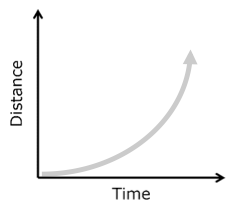
This graph demonstrates an object that is -
a)
Increasing speed
b)
At a constant speed
c)
Decreasing speed
d)
Stationary
56.
This graph demonstrates an object that is -
a)
Increasing speed
b)
At a constant speed
c)
Decreasing speed
d)
Stationary
57.
This graph demonstrates an object that is -
a)
Increasing speed
b)
At a constant speed
c)
Decreasing speed
d)
Stationary
58.
This graph demonstrates an object that is -
a)
Increasing speed 
b)
At a constant speed
c)
Decreasing speed 
d)
Stationary
59.
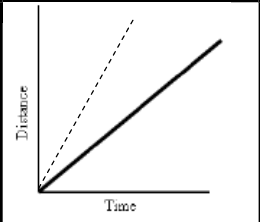
Which line represents an object moving at a faster speed?
a)
A
b)
B
60.
This graph demonstrates an object that is -
a)
At a constant speed
b)
Increasing speed
c)
Decreasing speed
d)
Stationary
61.
During which interval is the object traveling at a constant velocity?
a)
B to C
b)
D to E
c)
F to G
d)
it traveling at a constant velocity during all of the intervals shown.
62.
A car driving at 50 miles per hour drives for 2 hours. What distance did it cover?
a)
50 miles
b)
25 miles
c)
100 miles
d)
75 miles
63.

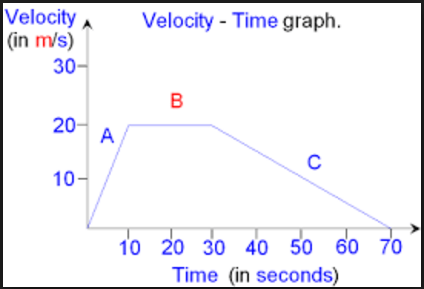
This is a velocity-time graph. What is the object doing in segment A?

a)

Speeding up

b)

Slowing down

c)

Constant Velocity

d)

Not moving

64.
This is a velocity-time graph.  What is the object doing in segment B?
a)
Positive acceleration
b)
Negative acceleration
c)
Constant Velocity
d)
Not moving
65.
What does this graph represent?
a)
Constant speed
b)
Acceleration
c)
Not moving
66.
What does this graph represent?
a)
Constant Speed
b)
Acceleration
c)
Not moving
67.
Scott travels north 5 miles and then goes west 3 miles before coming straight back south 2 miles. What is his distance?
a)
10
b)
7
c)
8
d)
6
68.
Distance and direction of an object's change in position from a starting point
a)
displacement
b)
distance
c)
motion
d)
reference point
69.
 Jermaine runs exactly 2 laps around a 400 meter track. What is the displacement?
a)
800
b)
400
c)
0
d)
200
70.
Bill runs 400 meters to Andy's house, turns around, and runs 400 meters back home.  What is Bill's distance?
a)
0 meters
b)
400 meters
c)
800 meters
d)
1600 meters
71.

When we rub our hands together _________.

a)

frictional force works between them

b)

energy is released

c)

our hands become warm

d)

all off the above

72.

Because of inertia, a resting object ________.

a)

will remain at rest

b)

will move at a constant speed

c)

will eventually move

d)

is unbalanced

73.

The first law of motion states that objects in motion will:

a)

stop

b)

accelerate

c)

stay in motion

d)

rest

74.

Newton's second law of motion states that an unbalanced force is equal to mass times:

a)

acceleration

b)

force

c)

motion

d)

inertia

75.

Newton's third law of motion states that for every action there is:

a)

an opposite and equal reaction.

b)

an opposite but unequal reaction.

c)

a reaction.

76.
Determine the momentum of 1000-kg car moving northward at 20 m/s......... 
a)
20000 N
b)
20000 Joules
c)
20000 Kg * m/s
d)
20000 kg * m/s north
77.
The equation to calculate momentum is
a)
p=mv
b)
p=1/2mv2
c)
p=mgh
d)
p=mg