Wayground logo

Free Printable Worksheets

Font size

S
M
L
XL
Worksheets

IPC SPRING FINAL REVIEW 2022-2023

Total questions: 100

Worksheet time: 2hrs 46mins

Name
Class
Date
1.
An example of a conductor is :
a)
a glass paperweight
b)
a plastic cap
c)
a metal screw
d)
a wooden handle
2.

What effect do like (similar) charges have on each other?

a)

They attract

b)

They repel

c)

No effect

d)

They reverse each other

3.

What is an electric current?

a)

a build up of electrons

b)

the difference in charge between 2 points

c)

the flow of electrons over a circuit

d)

the opposition to flow of electrons

4.
Electricity that flows in a closed path is called a
a)
path
b)
current
c)
circuit
5.

What is voltage?

a)

the rate of flow of charge

b)

the difference in charge between 2 points

c)

the amount of available charge

6.

What is resistance

a)

the rate at which a charge is flowing

b)

the material's tendency to resist flow of electrons

c)

the difference of charge between 2 points

d)

it is futile

7.

What is the unit we use to measure electric current?

a)

ampere (amp)

b)

ohm

c)

volt

d)

newton

8.
Resistance is measured in what unit?
a)
ohms
b)
amps
c)
watts
d)
volts
9.
Potential difference is another term for
a)
current
b)
voltage
c)
energy
d)
watts
10.

The symbol used to express the current is......

a)

V

b)

I

c)

R

d)

C

11.
This is the symbol for a _____?
a)
switch
b)
light 
c)
battery
d)
wires
12.
This is the symbol for a _____?
a)
an AC current source
b)
a DC current source
c)
a battery
d)
a single cell
13.
This is the symbol for a _____?
a)
Lamp
b)
Water wheel
c)
Loudspeaker
d)
Motor
14.
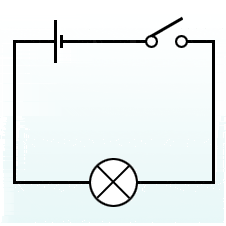
this circuit is .....?
a)
open
b)
parallel
c)
closed
d)
The cutest little circuit evah!
15.
What kind of circuit is this?
a)
Series
b)
Consecutive
c)
Parallel
d)
Training
16.
A series circuit has ____ path(s) that the electric current can take. 
a)
One
b)
Two 
c)
Three 
d)
Four
17.
What is the power source for this circuit?
a)
Battery
b)
Electric socket
c)
Wires
d)
Magic
18.
This is the symbol for a _____?
a)
an AC current source
b)
a DC current source
c)
an ammeter
d)
a voltmeter
19.
This is the symbol for a _____?
a)
an AC current source
b)
a DC current source
c)
an ammeter
d)
a voltmeter
20.
What types of charges attract?
a)
Positive and Positive
b)
Positive and Neutral
c)
Negative and Neutral
d)
Positive and Negative
21.
What charge does an electron have?
a)
negative (-)
b)
positive (+)
c)
neutral or no charge (0)
22.
Which of the following is caused by static electricity?
a)
a stove getting hot when it is turned on
b)
a magnet being attracted to a refrigerator
c)
a lightning strike during a storm
d)
a light bulb coming on when a switch is turned on
23.
Static electricity is:
a)
electricity flowing in a wire
b)
the buildup of electric charges on an object
c)
when protons move between objects
24.

the attraction between positive and negative charges

a)

repulsion attraction

b)

attraction repulsion

c)

electrostatic attraction

25.

What two poles attract to each other?

a)

north and north

b)

south and south

c)

east and west

d)

north and south

26.

What happens when the same poles are pushed together?

a)

The poles will repel.

b)

The poles will attract.

c)

The poles will float.

d)

The poles will sink.

27.
When two magnets repel, they ________________
a)
change color
b)
pull together
c)
push apart
d)
get colder
28.
What would we call a nail that can pick up a paperclip because it is touching a magnet?
a)
temporary magnet
b)
poles
c)
force
d)
detector
29.
What do the lines around this magnet represent?
a)
North Pole
b)
South Pole
c)
Magnetic Declination
d)
Magnetic Field
30.
What is responsible for the Magnetic Field around Earth?
a)
The Earth's crust
b)
The Earth's molton iron core
c)
The Earth's mantel
d)
The Sun
31.
Earth acts like a giant magnet because its center is made up MOSTLY of
a)
granite
b)
limestone
c)
iron
d)
nickel
32.
A device that uses a free-moving magnetic needle to show direction is a:
a)
lodestone
b)
magnet
c)
compass
d)
magnetic field
33.
Iron, Nickel and cobalt are all __________________ materials
a)
Shiny
b)
poles
c)
magnetic
d)
cold
34.
Which of the following is evidence of a chemical reaction?
a)
fizzing
b)
water changing to ice
c)
saltwater
d)
paper being cut in half
35.
The coefficient in  3H2O is
a)
6
b)
2
c)
3
d)
5
36.
What is the little number after an element in a chemical equation called.
Example: H2
a)
Coefficient 
b)
Subscript
c)
Atom
d)
Equation
37.
What is the right part of a chemical equation called?
H2 + O → H2O
a)
Reactants
b)
Products 
c)
Yields 
d)
Chemical Equation 
38.
What is the left part of a chemical equation called?
H2 + O → H2O
a)
Reactants
b)
Products 
c)
Yields 
d)
Chemical Equation 
39.
A + B = AB
a)
Double Replacement
b)
Synthesis
c)
Combustion
d)
Decomposition
40.
A + BC = B + AC
a)
Single Replacement
b)
Combustion
c)
Double Replacement
d)
Synthesis
41.

Symbol for gas

a)

(g)

b)

(l)

c)

(s)

42.

change in temperature, formation of bubbles, precipitate forms, color change, change in smell, and difficult to reverse describe

a)

the periodic table

b)

combustion

c)

signs of a chemical reaction

43.

The atomic number is the same as

the---

a)

atomic mass

b)

group number

c)

number of protons

44.

What determines the order of elements on today's periodic table?

a)

increasing atomic mass

b)

decreasing atomic mass

c)

increasing atomic number

d)

decreasing atomic number

45.

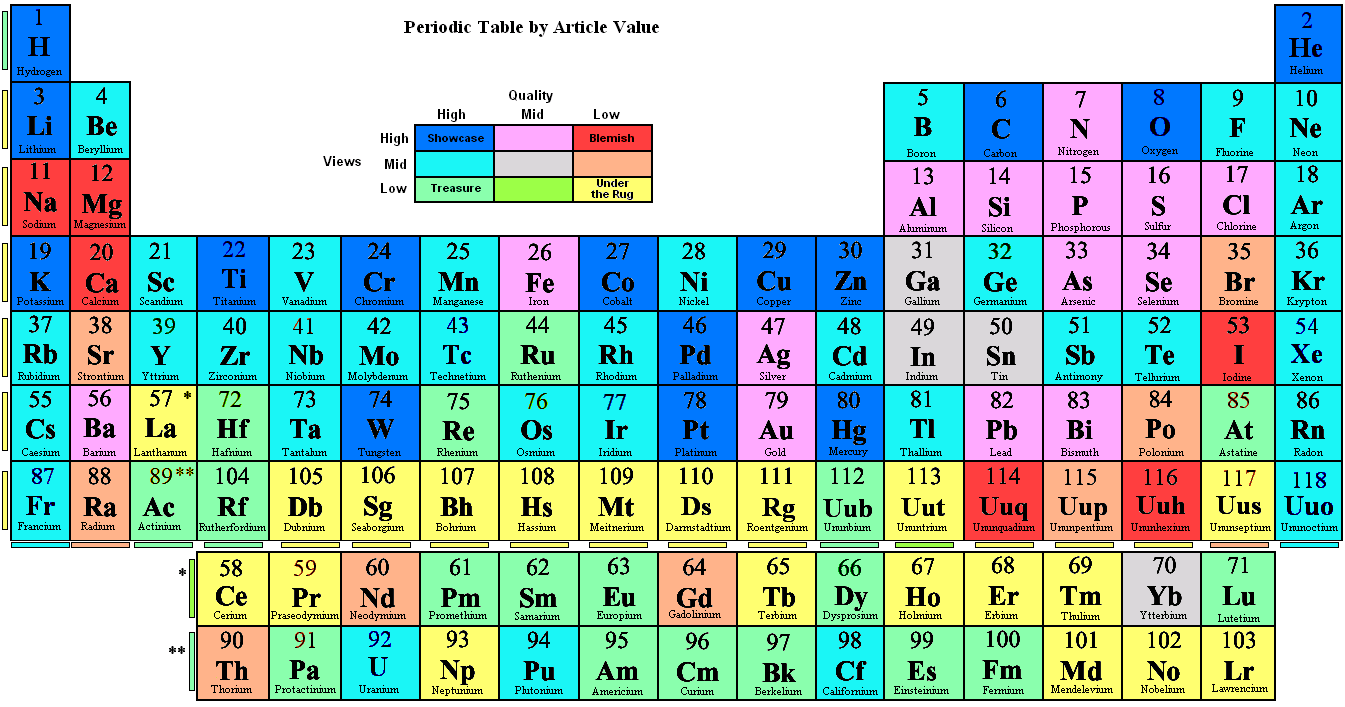
From this element key of Nitrogen, determine the atomic mass of nitrogen

a)

7

b)

7.01

c)

14.01

46.

What is one similarity among elements in a group?

a)

atomic mass

b)

atomic weight

c)

chemical properties

47.

The atomic number tells you what?

a)

number of electrons

b)

number of protons

c)

number of neutrons

48.

Elements which are shiny, conduct electricity and heat are called

a)

metal

b)

nonmetal

c)

metalloid

49.

Atoms of elements that are in the same group have the same number of

a)

protons.

b)

neutrons.

c)

valence electrons.

50.

Which of the following shows the correct symbol for helium?

a)

He

b)

he

c)

HE

51.

The 18 vertical columns on the Periodic Table are known as ______________.

a)

periods

b)

rows

c)

families

52.

The 7 horizontal rows on the Periodic Table are called ___________.

a)

families

b)

periods

c)

metals

53.

Beryllium is in group number______.

a)

Group 2

b)

Group 3

c)

Group 4

54.

Who arranged the periodic table by increasing atomic number?

a)

Mendeleev

b)

Mosely

c)

Bohr

55.
What is the symbol for Potassium?
a)
P
b)
K
c)
Pb
d)
Pd
56.

Which has a negative impact on land?

a)

composting

b)

reclamation

c)

mining

d)

reforestation

57.

Which has a positive impact on land?

a)

composting

b)

deforestation

c)

mining

d)

urbanization

58.

An impact of Technology on the environment can be...

a)

Global warming

b)

Toxic Waste

c)

Habitat Alteration

d)

All of them

59.

Pollution from cars and factories produce something called acid rain.

a)

True

b)

False

60.
“E-Waste” is short for “Electronic Waste”
a)
True
b)
False
61.

Which is a consequence of an increase in greenhouse gases?

a)

Ice caps freezing

b)

global cooling

c)

sea levels rising

62.
Acid mine drainage causes
a)
air pollution
b)
water pollution 
c)
subsidence
d)
erosion
63.

•Possible negative effects on an ecosystem caused by development (businesses, factories, houses, etc) or by the release of a substance in the environment.

a)

environment impacts

b)

environment

c)

biosphere

d)

atmosphere

64.

•The combination of physical, chemical, and biotic factors that act upon an organism or community of organisms.

a)

environment

b)

world

c)

biosphere

d)

atmosphere

65.

•Rainfall made sufficiently acidic by atmospheric pollution, typically by burning coal and other fossil fuels.

a)

Sulfur Dioxide

b)

Pollutants

c)

Acid Rain

d)

degradation

66.

•The warming of Earth due to the presence of certain gases in the atmosphere, which let sunlight come in but don't let heat go back out into space.

a)

Sulfur Dioxide

b)

Pollutants

c)

ozone depletion

d)

Greenhouse Effect

67.

The substance being dissolved is called the ________

a)

solvent

b)

solid

c)

solute

d)

solvate

68.

When no more solute dissolves the solution is _________

a)

supersaturated

b)

unsaturated

c)

saturated

d)

supercalifragilisticexpialidocious

69.
air is a 
a)
compound
b)
element
c)
heterogeneous mixture
d)
solution
70.
Kool-Aid - Powder, sugar, and water
Identify the solvent 
a)
water
b)
powder
c)
sugar
d)
powder and sugar
71.
When Koolaid mix is light colored and tastes watery it is a _______ solution.
a)
saturated 
b)
diluted
72.

You are given a small beaker of solution at room temp. You add a bit of solute to the solution and it dissolves. The solution was:

a)

saturated

b)

unsaturated

c)

concentrated

d)

warm

73.
A supersaturated solution is one that....
a)
contains the maximum amount of dissolved solute.
b)
contains less solute than a saturated solution.
c)
contains more solute than a saturated solution.
d)
is the amount of a substance required to form a saturated solution.
74.
What does it mean when an element is radioactive?
a)
atom emits radiation
b)
nucei unstable due to uneven p to n ratio
c)
nuclei changes to become stable
d)
all of the above
75.
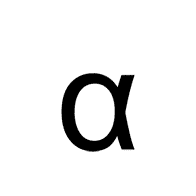
Has the symbol
a)
Alpha
b)
Beta 
c)
Gamma
76.

Which type of reaction is this?

a)

chemical

b)

fission

c)

fusion

d)

radioactive decay

77.

Which reaction occurs in stars like our sun?

a)

chemical

b)

fission

c)

fusion

d)

radioactive decay

78.

During nuclear fission, a nucleus _________.

a)

grows

b)

divides

c)

shrinks

d)

combines with another

79.

What is the term for an ongoing series of nuclear reactions?

a)

fission

b)

chain reaction

c)

fusion

d)

nuclear

80.
What sort of shield will block gamma rays?
a)
skin
b)
paper
c)
aluminum
d)
thick lead
81.
In a neutral atom, the number of protons always equals
a)
the number of neutrons.
b)
the number of electrons.
c)
the mass number.
d)
the average atomic mass.
82.
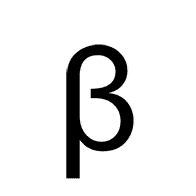
Has the symbol
a)
Alpha
b)
Beta
c)
Gamma
83.
Has the symbol
a)
Alpha
b)
Beta
c)
Gamma
84.
a change that produces matter with a different composition than the original matter
a)
extensive property
b)
intensive property
c)
plasma
d)
chemical change
85.
a property that depends on the type of matter in a sample, not the amount of matter
a)
extensive property
b)
intensive property
c)
plasma
d)
chemical change
86.
a property that depends on the amount of matter in a sample
a)
extensive property
b)
intensive property
c)
plasma
d)
chemical change
87.
a substance that contains two or more elements chemically combined in a fixed proportion
a)
atom 
b)
element
c)
compound
d)
chemical property
88.
the ability of a substance to undergo a specific chemical change
a)
atom
b)
element
c)
compound
d)
chemical property
89.
a quality or condition of a substance that can be observed or measured without changing the substance’s composition
a)
chemistry
b)
matter
c)
volume
d)
physical property
90.
Which of the following is a Chemical Property?
a)
Radicallity
b)
Color
c)
Boiling Point
d)
Reactivity
91.
Example for physical property
a)
odor
b)
burns in air
c)
reacts with water to create hydrogen gas
d)
rust
92.
Which is a physical change?
a)
burning match 
b)
vinegar in baking soda 
c)
melting butter
d)
cooking an egg
93.
Substance that consists of one type of atom.  It is a pure substance. Found on the Periodic Table. 
a)
Element
b)
Compound
c)
Mixture
d)
I don't know
94.
mass, volume, weight are all what type of property
a)
intensive
b)
extensive
95.
Combinations of 2 or more substances (elements and compounds) that are physically blended together. 
a)
Compound
b)
Mixture
c)
Element
d)
Substance
96.
If a mixture has components you can see it is a...
a)
solution
b)
compound
c)
homogeneous mixture
d)
heterogeneous mixture
97.
What is Kool-aid?
a)
element
b)
Heterogeneous Mixture
c)
Homogeneous Mixture
d)
Compound
98.

Definite shape and definite volume

a)

Solid

b)

Liquid

c)

Gas

99.

Liquid to Gas

a)

Condensation

b)

Evaporation

c)

Sublimation

100.

Solid to Gas

a)

Deposition

b)

Sublimation

c)

Evaporation