
 Worksheets
AP Exam Review Pt 1
Total questions: 112
Worksheet time: 2hrs 14mins


Shorter error bars mean:
lower precision in data
less accurate data
smaller range in data
Longer error bars mean:
lower precision in data
more accurate data
smaller range in data

Repeating the experiment for Sample two would most likely give a result between:
6-12
8-15
0-16
11-12

What is the independent variable?
Time of glowing
Temperature of glow stick
Brand of glow stick
Temperature of room.
Set 1-Standard Deviation=3.1
Set 2-Standard Deviation=4.9
Set 3-Standard Deviation=1.7
Set 4-Standard Deviation=3.2
Which set of data probably has the points closest to the mean?

The hypothesis that two groups are the same.
Alternative hypothesis
Experimental hypothesis
Null hypothesis
Statistical hypothesis
Suppose that your answer is higher than the chi-square value in a dataset using a p-value of .05, what is the appropriate conclusion?
a) Reject the null hypothesis
b) Reject the alternative hypothesis
c) Fail to reject the null hypothesis
d) Fail to reject the alternative hypothesis

Based on the data, it can be concluded that
there is no statistically significant difference between the amount of carbohydrates from all three species
there is a statistically signficant difference between the amount of carbohydrates in each species compared to the amount of proteins and lipids in each species
Lipids are not important for these species, which is indicated by the low amounts that are present within each organism
A and B
A, B and C


Hydrogen Bonds typically occur between atoms of hydrogen involved in this type of bond:
Ionic
Nonpolar Covalent
Polar Covalent
Nonpolar AND Polar Covalent

The Hydrogen atoms in the molecule shown have this charge:
Positive
Partial Positive
Negative
Partial Negative

A substance that cannot be decomposed into simpler substances by chemical means - made up of the same atoms
atom
element
molecule
organism

An atom that has a different number of neutrons than the standard for that element.
element
isotope
molecule
organism
The correct order for the organization of living things is
cell -> tissue -> organ -> organ system -> organism
cell -> atom -> organ system -> organism -> tissue
cell -> atom -> molecule -> organism -> organ system
tissue -> cell -> organism -> organ -> organ system
a major component of genes and proteins
nitrogen
sulfur
iron
oxygen

is an important part of dna molecules
phosphorus
hydrogen
sulfur
iron
What is the abbreviation for the 6 elements that make up almost all of the weight of an organism?
SNOPES
CHNOPS
KHDMDCM
ZNMGFE
Carbon can form _____ bonds with other elements.
1
2
3
4
In order to break apart a polymer ________ must be added.
carbon
water
oxygen
hydrogen

What type of reaction is shown?
Dehydration synthesis
Hydrolysis

Which type of reaction is shown?
Dehydration Synthesis
Hydrolysis


All carbohydrate names end with which ending:
-ise
-ase
-ese
-ose
Which of the following are storage polysaccharides?
Cellulose
Starch
Glycogen
Glucose
Chitin
Which of the following are structure polysaccharides?
Cellulose
Starch
Glycogen
Glucose
Chitin
Which is in order from largest to smallest structure?
chromosome, DNA strand, gene, nucleotide
chromosome, gene, DNA strand, nucleotide
gene, DNA strand, chromosome, nucleotide
DNA strand, chromosome, gene, nucleotide
The 'backbone' or 'ribbon' of the DNA strand is made of:
phosphate and sugar
phosphate only
phosphate and base
sugar and base


Cytosine makes up 38% of the nucleotides in a sample of DNA from an organism. Approximately what percentage of the nucleotides in this sample will be thymine?
12
24
31
38
It cannot be determined from the information provided.
An Okazaki fragment has which of the following arrangements?
primase, polymerase, ligase
3ʹ RNA nucleotides, DNA nucleotides 5ʹ
5ʹ RNA nucleotides, DNA nucleotides 3ʹ
DNA polymerase I, DNA polymerase III
5ʹ DNA to 3ʹ
In a DNA strand, a phosphate connects a 3′ carbon atom in one deoxyribose to
a 5′ carbon in an adjacent deoxyribose.
a 3′ carbon in an adjacent deoxyribose.
a base in an adjacent nucleotide.
none of the above.
How is the nuclear membrane similar to a cell membrane?
Has pores
Has proteins
Consist of bilayers
Has no holes
Where are the ribosomes made?
Chromatin
Nuclear pores
Nuclear membrane
Nucleolus
What are the two locations that ribosomes can be allocated into?
Nucleus
Cytoplasm
Smooth Endomembrane Reticulum
Rough Endomembrane Reticulum


The presence of double bonds in the fatty acid tail will
decrease fluidity because of the attraction between the unsaturated tails.
increase fluidity due to the difficulty of the kinked acyl tail to interact.
decrease fluidity by increasing the space between the phospholipids.
increase fluidity by allowing more room for cholesterol to move into the membrane.
Which of the following best explains how compartmentalization within a cell “improves efficiency” of cellular processes
A cell that has external membranes that decrease competing interactions
Compartmentalization within a cell results in a high SA:V ratio
It minimizes the surface area where cellular processes occur
Has internal membranes that increase competing interactions within the cell
Compartmentalization means a cell
has membrane bound organelles.
is undivided.
is simple.
All of the above
the membranous compartmentalization of a cell
divides the cell into two equal halves
allows different chemical conditions in the cell
requires the presence of a cell wall
common to prokaryotes and eukaryotes
In the Golgi Apparatus macromolecules, such as lipids and proteins, are transported within the cell using____.
Vesicles
Ribosomes
Rough endoplasmic reticulum
DNA
What happens in the Golgi apparatus?
Proteins are created
Proteins are sorted, packaged, and tagged
Stores proteins and other substances
Deposits contents outside of the cell

Letter F is which structure of the mitochondria?
inner membrane
outer membrane
cristae
matrix
Letter G is which structure of the mitochondria?
mtDNA
intermembrane space
mitochondrial ribosome
matrix


Which statements are true about active transport?
molecules move from low to high.
molecules move from high to low.
ATP is required
ATP is not required
Which is true about passive transport?
molecules move from low to high
ATP is required
molecules move from high to low
ATP is not required

Which is true?
prokaryotes evolved from eukaryotes
eukaryotes are larger than prokaryotes
eubacteria and archaebacteria are eukaryotes
eukaryotic cells are the most abundant inhabitants on Earth
Small polar molecules like O2 and CO2enter a cell through
diffusion
osmosis
facilitated diffusion
Phagocytosis and pinocytosis are both forms of
endocytosis
exocytosis

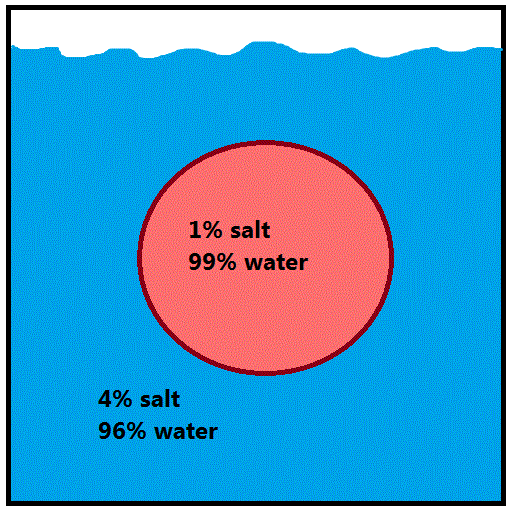
If a cells Ψp = 3 bars and its Ψs = -4.5 bars, what is the resulting Ψ ?
-7.5
7.5
-1.5
1.5
Why do mitochondria and chloroplasts have DNA in them?
They were once prokaryotic cells.
They produce their own DNA through photosynthesis.
They receive the DNA from the nucleus.
They process the DNA of the cell.
Most enzymes are composed of .....
Lipids
Carbohydrates
Proteins
Nucleic Acids
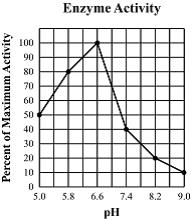
The energy required to start a chemical reaction is ___.
endothermic
exothermic
activation
released
In a _____ reaction, the products have more energy than the reactants.
exergonic
endergonic

The Calvin Cycle occurs in the
Thylakoid
Grana
Inner membrane of chloroplast
Stroma
5 carbon sugar that combines with CO2 in the Calvin Cycle
3-PGA
G3P
RuBP
Glucose
Which of the following is a way to increase the rate of photosynthesis?
Increase oxygen levels
Decrease CO2 levels
Increase light intensity
Decrease water level
Which of the following is NOT component in electron transport chain?
Cytochrome
Flavoprotein
Cytochrome c
ATP synthase
Which of the following gets pumped into the intermembrane space?
FADH2
O2
H+
NAD+
ATP synthesis by ATP synthase is driven by
H+ movement
electron movement
NADH movement
FADH2 movement

