wayground logo

Free Printable Worksheets

Font size

S
M
L
XL
Worksheets

Matter

Total questions: 65

Worksheet time: 1hrs 13mins

Name
Class
Date
1.
Choose the sentence that best describes solids. 
a)
"the stream was frozen solid"
b)
"do me a solid"
c)
"pusheen was frozen solid"
d)
"wot is a solid"
2.
What is the difference between mass and weight?
a)
Mass is the total matter in an object, and weight is the downward pull of an object.
b)
Mass is the downward pull of gravity on an object, and weight is the total matter making up an object.
c)
Mass is Batnan, Weight is Spider-Cam
d)
I don't know 😭
3.
What are the states of matter?
a)
solid, liquid, and juice
b)
solid and liquid
c)
solid and gas
d)
solid, liquid, and gas
4.
a type of matter that can be found on earth as a solid, liquid, and gas
a)
gold
b)
water
c)
oxygen
d)
rock
5.
If you saw a glass of water and later the water was gone what happened to the water? Remember that your in the science lab.
a)
Ms. Klenk was very thirsty and drank the water.
b)
evaporation
c)
precipitation
d)
solubility
6.
What causes a change in the state of matter?
a)
physical properties
b)
chemical energy
c)
temperature
7.
Which change can occur when  you add heat energy to water?
a)
The water can change from a liquid to a solid
b)
The water can change from a gas to a liquid
c)
The water can change from a liquid to a gas
d)
The water can change from a solid to a liquid
8.
Gasoline is a ________________.
a)
liquid
b)
solid
c)
gas
9.
Sand is a ___________________.
a)
liquid
b)
solid
c)
gas
10.
I am the smallest whole particle of matter. 
a)
atom
b)
compound
c)
molecule
d)
mixture
11.
What is an example of gas?
a)
crayons
b)
paper
c)
soda
d)
air
12.
What form of matter has a definite shape?
a)
Solid
b)
Liquid
c)
Gas
d)
Square
13.
Particles in this state of matter are moving the fastest.
a)
solid
b)
liquid
c)
gas
14.
Particles in this state of matter are moving the slowest.
a)
solid
b)
gas
c)
liquid
15.

This state of matter takes ONLY the shape of its container.

a)

liquid

b)

gas

c)

solid

16.
This state of matter keeps its shape and volume.
a)
gas
b)
solid
c)
liquid
17.
This state of matter takes both the shape and volume of it container.
a)
gas
b)
solid
c)
liquid
18.
In this state of matter, there is a strong attraction between molecules and they cannot break away from each other. 
a)
solid
b)
liquid
c)
gas
19.
In this state of matter, the molecules can move around each other, but cannot break the force of attraction between them.
a)
liquid
b)
gas
c)
solid
20.

In this state of matter, the molecules have enough energy to completely separate from each other.

a)

gas

b)

solid

c)

liquid

21.
When water beads on the outside of a cold glass of water.
a)
vaperization
b)
condensation
c)
melting
d)
freezing 
22.
When boiling water creates steam.
a)
condensation
b)
melting 
c)
freezing
d)
vaporization
23.
When dripping water turns into icicles. 
a)
melting
b)
freezing
c)
vaporization
d)
condensation 
24.
The state of matter in which the atoms are locked and vibrate in place. 
a)
solid
b)
liquid
c)
gas
25.
Changes in a materials state of matter 
a)
physical property
b)
chemical property
26.

When a solid changes straight to a gas.

a)

condensation

b)

sublimation

c)

deposition

d)

freezing

27.

When a gas turns straight to solid.

a)

sublimation

b)

melting

c)

deposition

d)

evaporation

28.

The picture is an example of _____________.

a)

freezing

b)

evaporation

c)

condensation

d)

melting

29.
What is matter?
a)
Anything that has mass and volume
b)
The shape of an object
c)
How much an object weighs
d)
The pull of objects on one another
30.
Evaporation is
a)
Gas changing to a liquid
b)
Solid changing to a liquid
c)
Liquid changing to a solid
d)
Liquid changing to a gas
31.
A solid changing to a liquid is...
a)
melting
b)
freezing
c)
condensing
d)
evaporating
32.
An ice cube is placed in a pan. The pan is placed over an open flame. Which change will MOST likely happen over time?
a)
The ice changes to a gas then a liquid
b)
The ice changes to a gas and then back to a solid
c)
The ice changes to a liquid then to a gas.
d)
The ice changes to a liquid and back to a solid. 
33.
How can you make liquid water become a solid?
a)
Add a lot of salt to the water.
b)
Put the water in a very cold place
c)
Shake the water container very fast.
d)
Heat the water on the stove.
34.
Bob filled a tray with juice and put it in the freezer. The next day Bob opened the freezer. How did the juice MOST likely change?
a)
It became a solid.
b)
It became a gas
c)
It condensed
d)
It evaporated.
35.

When thermal energy is increased in a solid, what change in state is happening?

a)

Melting

b)

Evaporation

c)

Freezing

d)

Condensation

36.

When thermal energy is decreased in a liquid, what change in state is happening?

a)

Melting

b)

Freezing

c)

Condensation

d)

Evaporation

37.

When thermal energy is increased in a liquid, what change in state is happening?

a)

Melting

b)

Evaporation

c)

Condensation

d)

Freezing

38.

When kinetic energy is decreased in a gas, what change in state is happening?

a)

Melting

b)

Freezing

c)

Evaporation

d)

Condensation

39.

When kinetic energy is increased in a liquid and evaporation occurs, what state of matter does the liquid change into?

a)

Solid

b)

Gas

40.

What happens to the movement of the particles in a substance when the thermal energy is decreased?

a)

Speed Up

b)

Slow Down

41.

What happens to the movement of the particles in a substance when the thermal energy is increased?

a)

Speed Up

b)

Slow Down

42.

A substance that has a temperature below its melting point would be in . . .

a)

a gaseous state of matter

b)

a liquid state of matter

c)

a solid state of matter

d)

a plasma state of matter

43.

What two changes of state occur when kinetic energy is added to/increased in a substance?

a)

Melting

b)

Freezing

c)

Condensation

d)

Evaporation

44.

When a substance changes from a liquid to a solid, this is called...

a)

Melting

b)

Evaporation

c)

Condensation

d)

Freezing

45.

What happens to the arrangement of particles as thermal energy is removed from a substance?

a)

The particles get farther apart.

b)

The particles get closer together.

46.
As temperature decreases, the molecules collide more, move faster, and spread out. 
a)
true
b)
false
47.
 The process where water vapor changes from a gas to a liquid is called:
a)
sublimation
b)
precipitation
c)
evaporation
d)
condensation
48.
Which of the following statements correctly identifies the relationship between evaporation rate and temperature?
a)
The evaporation rate is not affected by temperature.
b)
The evaporation rate increases as temperature rises.
c)
The evaporation rate decreases as temperature rises.
d)
Evaporation will stop if the temperature rises.
49.
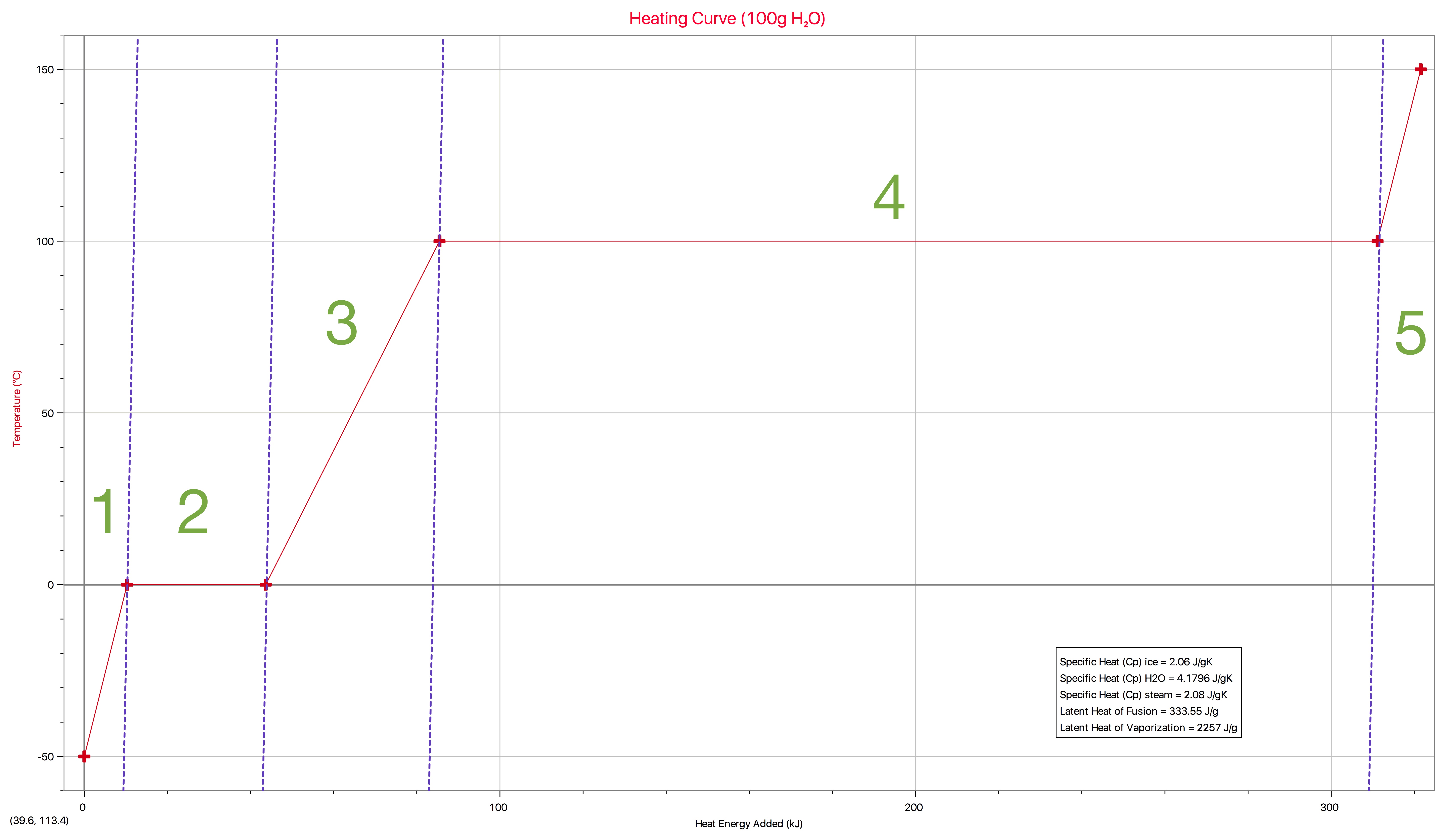
In which region(s) does temperature remain constant?
a)
Region 1, 3, & 5
b)
Region 2 & 4
c)
Region 1 only
d)
Region 1 & 2
50.
In which region(s) does temperature increase?
a)
Region 1, 3, & 5
b)
Region 2 & 4
c)
Region 1 only
d)
Region 1 & 2
51.
In which region(s) of the graph does a phase change occur?
a)
Region 1, 3, & 5
b)
Region 2 & 4
c)
Region 1 only
d)
Region 1 & 2
52.
In which region(s) of the graph would the substance only be in one phase?
a)
Region 1, 3, & 5
b)
Region 2 & 4
c)
Region 1 only
d)
Region 1 & 2
53.
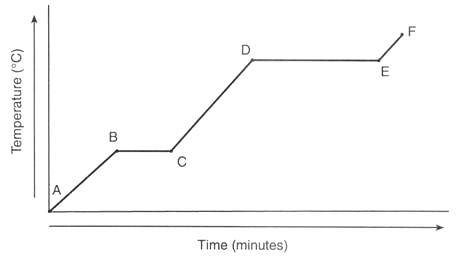
Describe the substance between letters C and D. 
a)
Gas
b)
Liquid
c)
Melting
d)
Evaporating
54.
Between which points is the temperature of the substance remaining constant?
a)
A-B only. 
b)
A-B, C-D, E-F
c)
B-C only. 
d)
B-C, D-E
55.

Given the heating curve of a solid being heated at a constant rate, what is the boiling point of this substance?

a)

20°C

b)

50°C

c)

110°C

d)

170°C

56.

Given the heating curve of a solid being heated at a constant rate, how much total time was required to boil this substance after it reached its melting point?

a)

3 minutes

b)

4 minutes

c)

10 minutes

d)

14 minutes

57.

Given the heating curve for water, during which line segment could I find water in both the solid and liquid phase at the same time?

a)

AB

b)

BC

c)

CD

d)

DE

e)

EF

58.

In which region(s) of the graph would the substance be a liquid and a gas at the same time?

a)

Region 1

b)

Region 2

c)

Region 3

d)

Region 4

e)

Region 5

59.

In which region(s) of the graph would the substance be melting?

a)

No melting occurs on this graph

b)

Region C-E

c)

Region E-G

d)

Region G-I

e)

Region I-K

60.

What is the freezing point of the substance?

a)

0oC

b)

60oC

c)

120oC

d)

180oC

61.

This curve indicates what about the heat energy?

a)

Heat energy is being added or absorbed

b)

Heat energy is being released

62.

This curve indicates what about the heat energy?

a)

Heat energy is being added or absorbed

b)

Heat energy is being released

63.

In which region(s) of the graph does a phase change occur?

a)

Region 1

b)

Region 2

c)

Region 3

d)

Region 4

e)

Region 5

64.

In which region(s) of the graph would the substance be a gas only?

a)

Region 1

b)

Region 2

c)

Region 3

d)

Region 4

e)

Region 5

65.

In which region(s) of the graph does boiling take place?

a)

Region 1

b)

Region 2

c)

Region 3

d)

Region 4

e)

Region 5