wayground logo

Free Printable Worksheets

Font size

S
M
L
XL
Worksheets

Biology-Semester 2 Final Review

Total questions: 103

Worksheet time: 2hrs 53mins

Name
Class
Date
1.
Gel electrophoresis enables scientists to
a)
separate DNA fragments.
b)
combine DNA fragments.
c)
count the genes in DNA.
d)
insert DNA in cells.
2.
Genetic engineering has been used to produce
a)
medicines.
b)
food animals.
c)
improved crops.
d)
all of these.
3.
Polymerase chain reaction is used to
a)
determine the sequence of DNA.
b)
make copies of a DNA sequence.
c)
selectively breed plants and animals.
d)
produce mutations in bacteria.
4.
Which is used to cut DNA molecules at specific points?
a)
gel electrophoresis
b)
PCR analysis
c)
a restriction enzyme
d)
recombinant DNA
5.
Breeders can increase the genetic variation in a population by using
a)
inbreeding.
b)
mutations.
c)
hybridization.
d)
restriction enzymes.
6.
Which produces offspring from a single cell of an adult?
a)
inbreeding.
b)
mutations.
c)
hybridization.
d)
cloning.
7.
During transformation, a cell
a)
is treated with radiation.
b)
has two genetically different parents.
c)
has foreign DNA inserted in its chromosome.
d)
has parents of different species.
8.
Transgenic organisms contain
a)
genes from other species.
b)
cells of another organism.
c)
genes of only one parent.
d)
one or more human genes.
9.
A molecule containing DNA from two different organisms is called
a)
a plasmid.
b)
a polyploid.
c)
a hybrid organism.
d)
recombinant DNA.
10.
Genes found on DNA contain the instructions for making  
a)
pyrimidines 
b)
pyrimidines
c)
proteins
d)
purines
11.
Any change or mistake in DNA replication can cause a ________  
a)
cancer cell 
b)
virus
c)
disease
d)
mutation
12.
molecular scissors that "cut' DNA
a)
plasmid
b)
restriction enzymes
c)
recombinant DNA
d)
gene
13.
In a pedigree chart, how are females illustrated
a)
circles
b)
squares
c)
triangles
d)
lines
14.
In a pedigree chart, how are males illustrated
a)
circles
b)
squares
c)
triangles
d)
lines
15.
In a pedigree chart, how are characterisitcs or traits illustrated
a)
circles
b)
squares
c)
shading
d)
lines
16.
In a pedigree chart, how are relations illustrated
a)
circles
b)
squares
c)
shading
d)
lines
17.
In humans, what would the blood type of a child be if she inherited type A from Dad and type B from Mom?
a)
O
b)
A
c)
B
d)
AB
18.
Mr. Jones was killed in a car accident.  Afterwards, a former girlfriend filed a paternity suit claiming that Mr. Jones was the father of her child, and thus she was entitled to the man’s estate.  Which sample of DNA would have to be from Mr. Jones if he were the child’s father? 
a)
2
b)
3
c)
4
d)
5
19.
Bob was found dead in his home.  Crime scene analysis showed signs of a struggle.  Blood was collected from the crime scene, the victim, and three suspects.  Which suspect likely committed the crime? 
a)
Sue
b)
Lisa
c)
John
d)
None of these
20.
Which male is the father of this child?
a)
Male 1
b)
Male 2
c)
Neither could be the father
d)
Either could be the father
21.
Which man is the father of this baby?
a)
Father 1
b)
Father 2
c)
Father 3
d)
None of them
22.
Which man is the father of the child?
a)
1
b)
2
c)
3
d)
4
23.
Which suspect is likely guilty?
a)
Suspect #1
b)
Suspect #2
c)
Suspect #3
24.

A technique that uses the natural decay rate of unstable

isotopes found in materials in order to calculate the age of that material.

a)

Radiometer

b)

Isopotes

c)

Radriomeric dating

d)

Relative Dating

25.

What provides evidence about the history of life on Earth, and shows how organisms change through time?

a)

fossil record

b)

index fossil

c)

geologic time scale

d)

half-life

26.

When a fossil is compared to the age of other fossils in the same layer, this is use of

a)

fossil record

b)

relative dating

c)

geologic time scale

d)

radioactive dating

27.

The amount of time it takes for half of the radioactive atoms in an isotope to decay is known as

a)

fossil record

b)

index fossil

c)

geologic time scale

d)

half-life

28.

Which is the longest amount of time?

a)

era

b)

period

c)

second

d)

decade

29.

A single species that has evolved into several different forms that live in different ways has undergone

a)

Punctuated equilibrium

b)

Adaptive radiation

c)

co-evolution

d)

Mass extinction

30.

The separation of populations by barriers such as rivers, mountains or bodies of water is

a)

Geographic isolation

b)

genetic equilibrium

c)

Behavioral isolation

d)

Temporal isolation

31.

What is the estimated age of the earth?

a)

10,000 years

b)

6 million years

c)

Greater than 4 billion years

d)

600 million years

32.

What two adaptations had to be solved to colonize land?

a)

How to reproduce

b)

How to prevent dehydration

c)

How to move about

d)

How to avoid predation

33.

How many mass extinctions has the earth been through?

a)

3

b)

1

c)

5

d)

8

34.

How many years is the half life of Carbon 14?

a)

2,430 years

b)

1.5 million years

c)

2.4 billion years

d)

5,730 years.

35.

Early Autotrophs were most likely?

a)

chemosynthetic

b)

photosynthetic

c)

abiotic

d)

Multicellular

36.
Fossil remains of a trilobite are most likely to be found in which type of rock?
a)
igneous
b)
volcanic
c)
sedimentary
d)
metamorphic
37.

How old is the earth?

a)

2.5 million years

b)

4.6 billion years

c)

1.5 billion years

d)

4.6 million years

38.
The Geologic Time Scale is a record of what?
a)
old geologists
b)
sweet geology music
c)
the known history of rocks and fossils
d)
a list of every living thing ever
39.
The first eukaryotic cells are more likely to have evolved from ______________ than eubactria (true bacteria).
a)
exocytosis
b)
endosymbiosis
c)
organelles
d)
Archaebacteria
40.

The idea that life can be produced from nonliving material.

a)

Spontaneous generation

b)

Biogenesis

41.

The idea that living organisms only come from other living organisms.

a)

Spontaneous generation

b)

Biogenesis

42.
Theory that says eukaryotic cells formed from symbiosis among several different prokaryotes.
a)
Natural Selection
b)
Biogenesis Theory
c)
Evolutionary Theory
d)
Endosymbiotic Theory
43.

The Endosymbiotic Theory explains

a)

the origin of prokaryotes

b)

how bacteria lives

c)

the origin of eukaryotes

d)

how species develop

44.
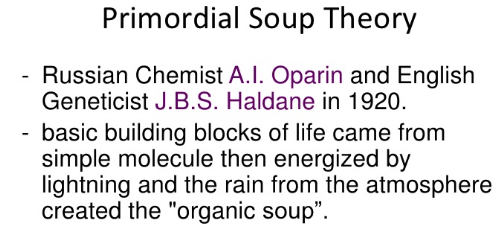
The idea that Earth's early oceans had organic molecules that became the first life is called.
a)
primordial soup
b)
bubble hypothesis
c)
Miller-Urey Experiment
d)
radioactive dating theory
45.

Which is an example of a trace fossil?

a)

a bone

b)

a mosquito encased in amber

c)

a footprint

d)

a tooth

46.

What is one major pattern in the fossil record?

a)

adaptive radiation occurs

b)

mass extincion

c)

explosions

d)

increases in complexity

47.

Archaeopteryx, which lived 150 million years ago, is an intermediate form between

a)

certain dinosaurs and modern birds

b)

certain dinosaurs and modern whales

c)

both

d)

neither

48.

Which types of organisms developed first due to the early environmental conditions on Earth?

a)

prokaryotic and aerobic

b)

prokaryotic and anaerobic

c)

eukaryotic and aerobic

d)

eukaryotic and anaerobic

49.

The Miller-Urey experiment of 1953 was designed to test the hypothesis that lightning supplied the energy needed to turn atmospheric gases into organic molecules such as amino acids. Which of the following describes why the Miller-Urey theory is widely accepted today?

a)

Amino acids spontaneously form from molecules in the atmosphere today.

b)

Organic molecules are present today in extremely high concentrations.

c)

The process of synthesizing organic molecules from a mixture of gases has been successfully modeled in the laboratory.

d)

No other alternative hypotheses have been introduced.

50.

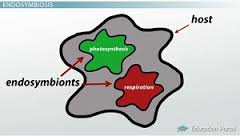
The diagram below shows a proposed theory of the origin of eukaryotic cells, called endosymbiosis.

Which of the following explains why cells that contained mitochondria-like organelles had an evolutionary advantage?

a)

They were able to photosynthesize

b)

They had more DNA

c)

They were able to make more use of available energy

d)

They were immune to bacterial invasion.

51.
The diagram shows fossils in different rock layers. Which of these statements about the age of these fossils is most likely correct?
a)
Fossil A and C are the same age
b)
Fossil B is older than fossil C
c)
Fossils A is older than fossil B
d)
Fossil D is older than fossil C
52.
The idea that Earth's early oceans had organic molecules that became the first life is called the...
a)
Primordial soup hypothesis
b)
Bubble hypothesis
c)
Miller-Urey Experiment
d)
Radioactive dating theory
53.

Which scientist disproved the idea of spontaneous generation once and for all by using a specifically designed swan-necked flask to heat broth?

a)

Spallanzani

b)

Pasteur

c)

Redi

d)

Needham

54.

Which scientist was one of the first to disprove spontaneous generation by showing that flies were not created by meat?

a)

Spallanzani

b)

Pasteur

c)

Redi

d)

Needham

55.
According to fossil records, the horses that lived 50 million years ago were much smaller, weaker and slower than modern horses. Which process is most likely responsible for the changes that have led to the increased size, strength, and speed in horses?
a)
commensalism
b)
inbreeding
c)
migration
d)
evolution by natural selection
56.
Scientists are studying the evolutionary history of a group of plants in the United States, and they developed an evolutionary tree, as shown below.Which statement can be inferred from the evolutionary tree?
a)
Species 1 is most closely related to Species 8.
b)
Species 2 is most closely related to Species 3.
c)
Species 3 is most closely related to Species 7.
d)
Species 5 is most closely related to Species 6.
57.

Brown mice survive and reproduce in their desert environment better than white mice because owls can see and eat the white mice more easily. In this situation, what part of the environment is doing the selecting?

a)

predator

b)

soil composition

c)

mouse fur color

d)

sexual preferences

58.

Over generations of time apart on different islands with different food sources, the separated populations of Galapagos finches accumulated genetic differences until each group had different beaks. This is an example of _____.

a)

natural selection

b)

genetic drift

c)

adaptation

d)

speciation

59.

A phenotype that improves an organism’s chance of survival in their environment is considered a(n) ____________.

a)

natural selection

b)

adaption

c)

speciation

60.

What is speciation?

a)

combining of two species to form one with different traits

b)

Intentional breeding designed to maintain a desired trait

c)

timing of mating that prevents normal sexual selection

d)

A population splits and accumulates different genes in the new groups

61.

Which of the following is NOT an example of natural selection?

a)

People selectively breeding hamsters for size.

b)

Insect populations developing resistance to certain pesticides.

c)

Bacteria becoming resistant to antibiotics.

d)

Male birds of certain species inheriting colorful feathers that are more attractive to females.

62.
Genetic drift is change in the allele frequency of a population due to...
a)
random chance
b)
natural selection
c)
non-random mating (sexual selection)
d)
artificial selection
63.

Eyes that can see in the dark is a(an) _______ inherited by nocturnal animals.

a)

adaptation

b)

acquired trait

c)

learned ability

64.

Many different groups of organisms have wings, even though they do not share a recent common ancestor. This is because they evolved in environments with similar selective pressures. Wings are an example of a(n) ______________ structure.

a)

vestigial

b)

analogous

c)

homologous

65.

The forelimbs of mammals have similar anatomy because these groups descended from a recent common ancestor. Their bone structure is an example of a(n) ______________ structure.

a)

vestigial

b)

analogous

c)

homologous

66.

The pelvic bone of whales is not needed for movement within the water. This is an example of a(n) ______________ structure.

a)

vestigial

b)

analogous

c)

homologous

67.
Starting in 1954, commercial fishers in the northwest Pacific were paid by weight, rather than by the individual fish, for pink salmon. The fishers increased the use of a type of net that selectively catches larger fish.  Which of the following effects did this change in fishing technique most likely have on the salmon population over the next 20 years?
a)
The average body size of the salmon population decreased significantly.
b)
The average body size of the salmon population increased significantly.
c)
The average body size of the males in the salmon population increased, and the females stayed the same.
68.
European rabbits were introduced to Australia in 1859. The rabbits reproduced rapidly in their new habitat, displaced other animals, and overgrazed vegetation. In an attempt to reduce the rabbit population, a virus was introduced in 1951. This virus is usually deadly to European rabbits. When the virus was first introduced, the rabbits died in large numbers, but the death rate decreased over time. Which of the following best explains the decrease in the rabbit death rate? 
a)
Young rabbits learned to avoid being infected with the virus.
b)
The lifespan of the virus was too short to affect rabbits over a long period of time.
c)
Natural selection favored rabbits that were resistant to the virus. 
d)
No correct choices.
69.
Which of the following statements gives the most likely explanation for the presence of two very similar species of squirrels living on opposite sides of the Grand Canyon?
a)
One squirrel traveled across the canyon and started a new population on the other side.
b)
One squirrel traveled across the canyon and interbred with a different population on the other side.
c)
Members of one single squirrel species were geographically separated by the formation of the canyon.
d)
Members of two different squirrel species migrated from two different places to opposite sides of the canyon. 
70.
The process in which organisms with traits well suited to an environment are more likely to survive and to produce offspring is
a)
Natural Selection
b)
Origin of Species
c)
Genetic Principles
d)
Trait Mechanism
71.
What is the term for a feature that allows an organism to survive better in its environment?
a)
variation
b)
adaptation
c)
homologous structure
d)
vestigial structure
72.
A biological ____________ is a group of interbreeding populations that is reproductively isolated from other groups.
a)
species
b)
family
c)
phylogeny
d)
hybrid
73.
This scientist came up with the idea of natural selection.
a)
Jean Baptiste Lamarck
b)
Gregor Mendel
c)
Charles Darwin
d)
Thomas Malthus
74.
The ability of an organism to survive and reproduce in its specific environment 
a)
diversity.
b)
evolution
c)
adaptation
d)
 fitness
75.
Farmers breed cows to produce high amounts of milk. This is an example of...
a)
Natural Selection 
b)
Variations in a species 
c)
Selective Breeding 
d)
inbreeding
76.
what did Charles Darwin observe in finch populations of the Galapagos Islands off the coast of South America?
a)
different species on different islands
b)
all species on one of the islands
c)
identical species on all the islands
d)
the same species as North America
77.
In natural selection, the selective agent is the
a)
humans
b)
mutations
c)
breeders
d)
environment
78.
This mechanism of evolution occurs when populations migrate.
a)
Extinction
b)
Gene flow
c)
Genetic drift
d)
Natural Selection
79.
What is another name for natural selection?
a)
survival of the smartest
b)
survival of the fastest
c)
survival of the biggest
d)
survival of the fittest
80.
What is the study of organisms at the early stages of development?
a)
DNA studies
b)
embryology 
c)
extinction
d)
fossil record
81.
This is a process by which organisms inherited advantageous traits that tend to reproduce more successfully than the other organisms do. 
a)
Artificial selection
b)
Natural selection
c)
Populations
d)
Environment
82.
This is a process in which organisms gradually change over time.
a)
Environment
b)
Competition
c)
Evolution
d)
Fossils
83.
What characteristic did Darwin observe about the finches on the Galapagos Islands?
a)
Their feathers 
b)
Genotypes 
c)
Their beaks
d)
Their body sizes
84.
The natural differences between individuals of a species is called ___________.
a)
adaptations
b)
natural selection
c)
variation
d)
fitness
85.
What is the advantage of having different shaped beaks?
a)
To look different from other species.
b)
To be able to eat the food readily available in the environment.
c)
To protect itself against predators.
d)
To protect itself against prey.
86.
Which two species are most related?
a)
B&C
b)
A&B
c)
A&C
d)
C&B
87.

The earliest organisms were ___________; the more recent organisms are ____________.

a)

simple; more complex

b)

complex; more simple

88.

The fossil record help scientists

a)

better understand the kinds of organisms that lived in the past

b)

better understand how the environment has changed over time

c)

better understand how organisms have evolved over time

d)

all of the above

89.

Evolution is...

a)

changes over time in populations

b)

natural process that passes favorable traits

c)

historical timeline of fossils

d)

the process in which an animal dies out

90.

A mistake or change that occurs in the DNA sequence is called a ______________________.

a)

Extinction

b)

Speciation

c)

Mutation

d)

Genetic Variation

91.

When there is a difference in population based on genes, it is said to be a _______________.

a)

Mutation

b)

Speciation

c)

Extinction

d)

Genetic Variation

92.
Group of organisms capable of interbreeding and producing fertile offspring.
a)
species
b)
gene pool
c)
population
d)
homologous structure
93.
Scientist who proposed the theory of Natural Selection.
a)
Hardy
b)
Weinburg
c)
Darwin
d)
Einstein
94.

Small differences of a particular trait

a)

gene pool

b)

mutation

c)

variation

d)

continental drift

95.
Which of the following is a fossil?
a)
a plant that has recently died
b)
a group of organisms that can reproduce
c)
a structure or organ that no longer functions
d)
a trace of an organisms that existed in the past
96.
There are three species of birds on an island.  Bird A has a heavy bill for eating seeds.  Bird B has a pointed bill for eating insects.  Bird C has a sharp bill for eating both insects and seeds.  If all insects on the island suddenly disappeared, which bird or birds would be the LEAST affected? 
a)
Bird A
b)
Bird B
c)
Bird C
d)
Bird A and Bird B
97.
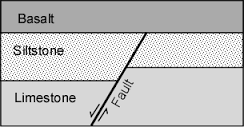
What are the relative ages of the features in order from oldest to youngest?
a)
Limestone, Basalt, Fault, Siltstone
b)
Siltstone, Fault, Basalt, Limestone
c)
Limestone, Fault, Basalt, Siltstone
d)
Limestone, Siltstone, Fault, Basalt
98.
States that younger rocks lie above older rocks if the layers have not been disturbed
a)
Law of crosscutting
b)
Law of superposition
c)
Relative Dating
d)
Unconformity
99.
Which of the following correctly lists the layers in order from oldest to youngest?
a)
A, B, C, D, E
b)
E, B, C, D, A
c)
E, D, C, B, A
d)
C, B, A, D, E
100.

Which layer is OLDER? Layer M or Intrusion P?

a)

Layer M

b)

Intrusion P

101.

Which layer is OLDER? Fault E or Intrusion D?

a)

Fault E

b)

Intrusion D

102.

Which layer is OLDER? Intrusion M or Layer D?

a)

Intrusion M

b)

Layer D

103.

What is the most recent event to happen?

a)

A

b)

B

c)

C

d)

D