wayground logo

Free Printable Worksheets

Font size

S
M
L
XL
Worksheets

LVHS Geoscience Sem 2 Review

Total questions: 99

Worksheet time: 2hrs 4mins

Name
Class
Date
1.
Failure to maintain homeostasis could result in:
a)
lack of internal balance
b)
eventual death
c)
difficulty carrying on metabolism 
d)
all three
2.
The two types of feedback systems that help organisms maintain homeostasis are:
a)
positive and negative 
b)
receptor and effector
c)
static and dynamic
d)
minor and major
3.
Maintaining body temperature is an example of a:
a)
negative feedback loop
b)
positive feedback loop
4.
The "cause" for something to happen is the
a)
response
b)
effect
c)
stimulus
d)
homeostasis
5.
The "effect" of a given stimulus is the...
a)
response
b)
stimulus
c)
cause
d)
result
6.
When you get cut, your skin cells release hormones that signal platelets to come and stop the bleeding. Platelets then release more hormones that signal even more platelets to help stop bleeding. The hormone signals continue until the cut is closed.
a)
Positive Feedback Response
b)
Negative Feedback Loop 
7.
Negative Feedback Loops:
a)
amplify processes
b)
prevent small changes from getting larger
c)
are initiated during childbirth
d)
are found only in plants
8.
What type of feedback loop is represented in the graph above?
a)
Positive
b)
negative
c)
intermittent
d)
full loop
9.

All living things on earth are part of the....

a)

Biosphere

b)

Geosphere

c)

Hydrosphere

d)

Cryosphere

10.

The Geosphere is...

a)

All liquid water on Earth

b)

A 100km thick layer of gases

c)

frozen water on earth

d)

Earths entire solid body

11.

What is the hydrosphere's function?

a)

a recycling planet powered by the flow of solar energy to support a network of life.

b)

sustains various life forms and plays an important role in ecosystems and regulating heat on earth.

c)

sustains life forms on the surface of the earth, absorbs and interacts with harmful solar rays.It protects the earth from natural and human-caused space debris.

d)

controls the distribution of minerals, rocks and soils and generates natural hazards that shape the land and impact humans

12.

How do the geosphere and the biosphere interact?

a)

Fossil fuels in the geosphere used to be living.

b)

Bacteria is in the air.

c)

Water rains onto the geosphere.

13.

A group of components (parts) that work together is a...

a)

Sphere

b)

System

c)

Habitat

d)

Cycle

14.

Contains solid inner metal core, liquid outer core, and rocky mantle and crust.

a)

Hydrosphere

b)

Geosphere

c)

Biosphere

d)

Atmosphere

15.

All of Earth’s water.

a)

Cryosphere

b)

Geosphere

c)

Hydrosphere

d)

Biosphere

16.

Thin envelope of gases surrounding the Earth and contains the weather.

a)

Atmosphere

b)

Hydrosphere

c)

Biosphere

d)

Geosphere

17.

All ice and snow on Earth.

a)

Hydrosphere

b)

Cryosphere

c)

Atmosphere

d)

Geosphere

18.

A tree is blown down by wind.

a)

Atmosphere and Geosphere

b)

Hydrosphere and Atmosphere

c)

Biosphere and Atmosphere

d)

Biosphere and Cryosphere

19.

Water vapor condenses to form clouds in the sky,

a)

Cryosphere and Atmosphere

b)

Hydrosphere and Geosphere

c)

Hydrosphere and Biosphere

d)

Atmosphere and Hydrosphere

20.

Plants use ____________________ to make their own food.

a)

Carbon Dioxide

b)

Oxygen

c)

Materials

d)

Gravity

21.

How do animals get carbon?

a)

By eating plants and or other animals.

b)

They absorb it from the atmosphere.

c)

From the ground

d)

They do not get carbon from anywhere.

22.

What are fossil fuels made from?

a)

Plants and animals that are buried underground for millions of years.

b)

They absorb it from the atmosphere.

c)

Water

d)

Wind

23.

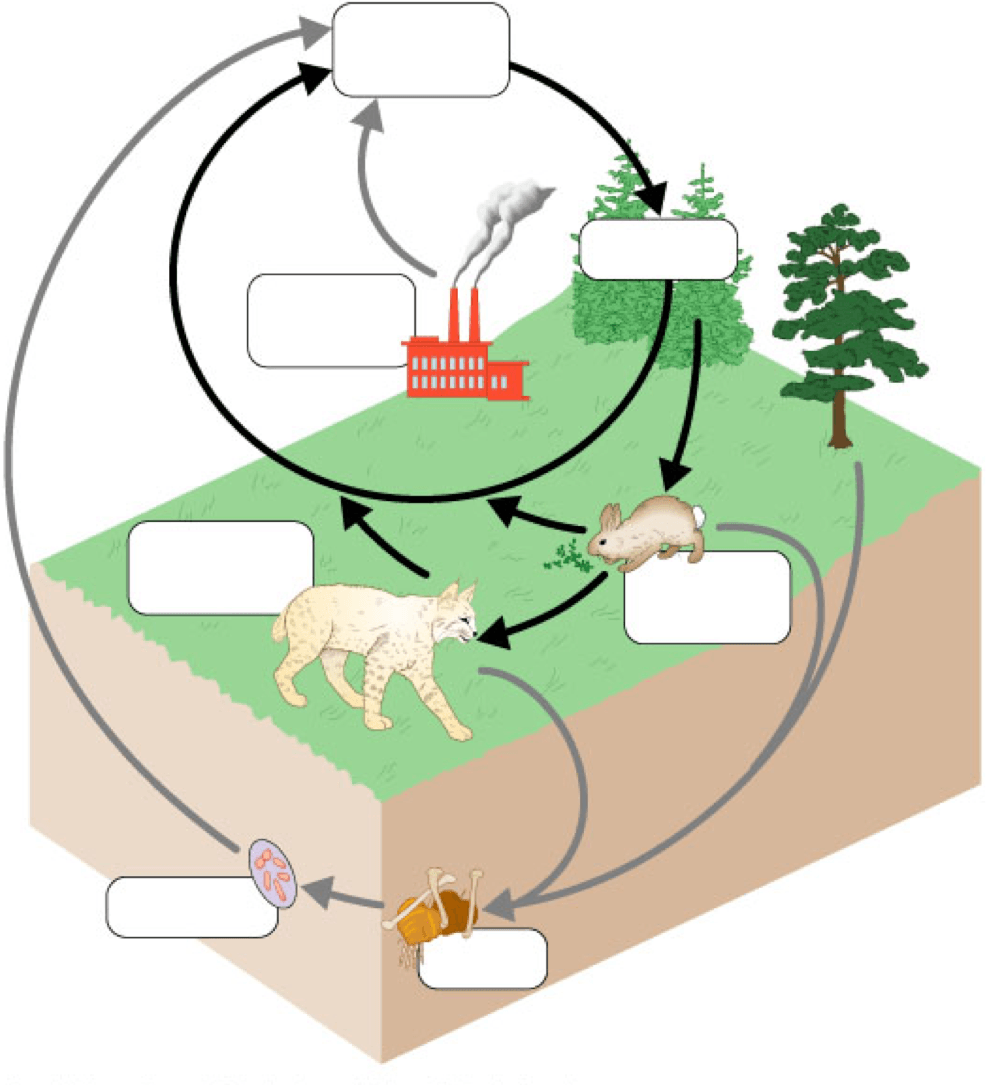
How does carbon become locked inside the earth?

a.

b.

c.

d.

a)

Tree roots expel carbon into the soil as they grow

b)

Humans use machines to pump carbon dioxide into

large underground tanks

c)

Rocks become richer in carbon as time goes on

d)

The carbon-rich bodies of plants and animals decay

into the earth after they die
24.
What does not produce carbon dioxide?
a)
Photosynthesis
b)
Burning Fossil Fuels
c)
Animal respiration
d)
Plants decaying
25.
In what process is Carbon transformed into chemical energy?
a)
Photosynthesis
b)
Respiration
c)
Primary Production
d)
Secondary Production
26.
Which process converts carbon in the form of sugar into carbon dioxide gas?
a)
Bioremediation
b)
Photosynthesis
c)
Respiration
d)
Transpiration
27.
If the plant population decreased, the amount of carbon would _________.
a)
Stay the same
b)
Increase
c)
Decrease
28.
What process takes carbon from the Earth and into the atmosphere(geosphere to atmosphere)?
a)
erosion
b)
photosynthesis
c)
combustion
d)
rock cycle
29.
Which of the following stocks is the largest reservoir of carbon dioxide on the Earth
a)
landfills
b)
forests
c)
soil
d)
oceans
30.

Ocean coral and oysters use carbon to create _________.

a)

oxygen

b)

shells

c)

leaves

d)

food

31.

What has the highest albedo?

a)

the oceans

b)

Ice in the Arctic or Antarctic

c)

the ground

d)

roads

32.
Albedo can best be described as...
a)
the temperature at the equator
b)
the amount of solar radiation absorbed
c)
the amount of solar radiation reflected
d)
the air pressure during El Nino
33.
Which type of surface would have the highest albedo effect?
a)
Forest
b)
Snow
c)
Water
d)
Rock
34.

Which would you expect to have the lowest albedo?

a)

dark soil

b)

white sand

c)

ice and snow

d)

deep sea water

35.

_______is a measure of the reflective characteristics of the Earth's surface.

a)

Albedo Effect

b)

Greenhouse Effect

c)

Climate Effect

36.

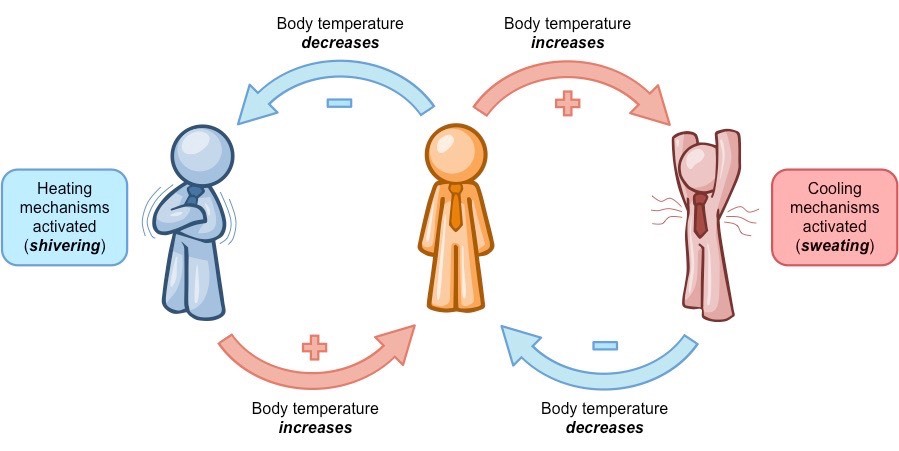
In this body temperature feedback loop, predict what would happen if cooling mechanisms were NOT activated?

a)

The body would not warm up.

b)

The body would not cool down.

c)

Your body would get colder and colder.

d)

Your body would release lots of heat.

37.
The two types of feedback systems that help organisms maintain homeostasis are:
a)
positive and negative 
b)
receptor and effector
c)
static and dynamic
d)
minor and major
38.
The process of childbirth is an example of:
a)
negative feedback loop
b)
positive feedback loop
39.
The "cause" for something to happen is the
a)
response
b)
effect
c)
stimulus
d)
homeostasis
40.
The "effect" of a given stimulus is the...
a)
response
b)
stimulus
c)
cause
d)
result
41.
When you get cut, your skin cells release hormones that signal platelets to come and stop the bleeding. Platelets then release more hormones that signal even more platelets to help stop bleeding. The hormone signals continue until the cut is closed.
a)
Positive Feedback Response
b)
Negative Feedback Loop 
42.
When glucose levels in the blood rise, your brain sends a signal to your pancreas. The pancreas releases insulin, which opens channels in cell membranes to allow glucose to enter the cell, lowering blood sugar levels. 
a)
Positive Feedback Response
b)
Negative Feedback Loop 
43.
As you get dehydrated, your blood becomes thicker and harder to pump. Your kidneys will respond by stopping urine production, sending the water from urine into your bloodstream to thin your blood back to normal level.
a)
Positive Feedback Response
b)
Negative Feedback Loop 
44.
Negative Feedback Loops:
a)
amplify processes
b)
prevent small changes from getting larger
c)
are initiated during childbirth
d)
are found only in plants
45.

Higher temperatures cause more evaporation which leads to more water vapor in the atmosphere. Water vapor is a greenhouse gas so will trap more heat so the atmosphere will warm more.

a)

Positive Feedback

b)

Negative Feedback

46.

As the Earth warms, evaporation increases. Snowfall at high latitudes increases, icecaps enlarge. More energy is reflected by increased albedo of ice cover. The Earth cools. Rates of evaporation fall.

a)

Positive Feedback

b)

Negative Feedback

47.

As the Earth warms, organic matter in soil is decomposed faster, more carbon dioxide is released. The enhanced greenhouse effect occurs, the Earth warms further and rates of decomposition increase

a)

Positive Feedback

b)

Negative Feedback

48.

As the Earth warms, ice cover melts, exposing soil or water. Albedo decreases (albedo is the fraction of light that is reflected by a body or surface). More energy is absorbed by the Earth’s surface. Global temperature rises. More ice melts.

a)

Positive Feedback

b)

Negative Feedback

49.
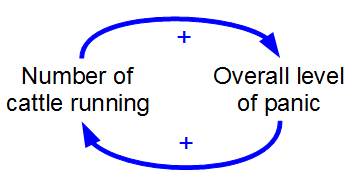
The following is an example of what type of feedback loop?
a)
Negative Feedback Loop
b)
Neutral Feedback Loop
c)
Positive Feedback Loop
d)
Global Warming Feedback Loop
50.
The following is an example of what type of feedback loop?
a)
Negative Feedback Loop
b)
Neutral Feedback Loop
c)
Positive Feedback Loop
d)
Cowboy Feedback Loop
51.
The following is an example of what type of feedback loop?
a)
Negative Feedback Loop
b)
Neutral Feedback Loop
c)
Positive Feedback Loop
d)
Cowboy Feedback Loop
52.
This is an image demonstrating...
a)
Tornado Formation
b)
The Greenhouse Effect
c)
Hurricane Formation
53.
What gas from the list below is a cause for global warming?
a)
Urethane
b)
Oxygen
c)
Carbon Dioxide
54.
What is the greenhouse effect?
a)
The warming of a planet due to trapped radiation.
b)
The cooling of Earth due to air pollution.
c)
The heating of a solid, such as a rock.
55.
Humans have the ability to cause temperature change.
a)
True
b)
False
56.
What do greenhouse gases do?
a)
absorb Earth's outgoing infrared radiation
b)
reflect Earth's incoming infrared radiation
c)
magnify ultraviolet radiation in the atmosphere
d)
block the Sun's infrared radiation
57.
Why is the increase of Greenhouse gasses a big issue?
a)
It causes climate change and increase in the global temerature 
b)
It can lead to a major increase in Greenhouses 
c)
It leads to more factories
d)
It causes a major decrease in people
58.
Global warming is due to 
a)
Greenhouse gases
b)
Nitric and sulfuric acids
c)
CFCs
d)
Ozone depletion
59.
Greenhouse gases, in moderate amounts, keep the Earth's temperature stable
a)
True
b)
False
60.
This graph represent the interactions in the predator prey ecosystem. Based on this image, what type of feedback loops is this one?
a)
Positive
b)
Negative
c)
Intermittent
d)
full loop
61.
What interactions do you see occurring in this graph?
a)
Both animals maintain each other in balance
b)
The hares are going extinct
c)
The lynxes are going extinct
d)
There is no correlation.
62.

All living things on earth are part of the....

a)

Biosphere

b)

Geosphere

c)

Hydrosphere

d)

Cryosphere

63.

What is the hydrosphere's function?

a)

a recycling planet powered by the flow of solar energy to support a network of life.

b)

sustains various life forms and plays an important role in ecosystems and regulating heat on earth.

c)

sustains life forms on the surface of the earth, absorbs and interacts with harmful solar rays.It protects the earth from natural and human-caused space debris.

d)

controls the distribution of minerals, rocks and soils and generates natural hazards that shape the land and impact humans

64.

Contains solid inner metal core, liquid outer core, and rocky mantle and crust.

a)

Hydrosphere

b)

Geosphere

c)

Biosphere

d)

Atmosphere

65.

A group of components (parts) that work together is a...

a)

Sphere

b)

System

c)

Habitat

d)

Cycle

66.
How old is our solar system?
a)
4.6 billion years
b)
13.8 billion years
c)
6,000 years
d)
15,000 years
67.
Smaller particles collecting together into larger and larger objects is called . . .
a)
accretion
b)
contraction
c)
explosion
d)
rotation
68.
When you spin any mass, what shape will it likely take?
a)
Sphere
b)
Disc
c)
Cylinder
d)
Cloud
69.
The moon probably formed when...
a)
A piece of the Earth broke off due to it's fast rotation
b)
A Mars-sized object rammed into the Earth
c)
Earth captured the moon gravitationally as it attempted to pass by.
d)
the molten bubble of the Earth budded.
70.
The Nebular Theory is:
a)
A theory on how the Milky Way galaxy was formed
b)
A theory on how the universe was formed
c)
A theory on how the solar system will be destroyed
d)
A theory on how the solar system was formed
71.
The thinnest layer of the Earth is the ___________.
a)
mantle
b)
crust
c)
core
72.
The part of the earth that includes the crust and the upper mantle and is split into tectonic plates is the
a)
lithosphere
b)
 crust
c)
asthenosphere
d)
mantle
73.
The hottest layer
a)
crust
b)
inner core
c)
mantle
d)
outer core
74.
This layer is completely liquid
a)
crust
b)
inner core
c)
mantle
d)
outer core
75.
This layer is a mix between solid and liquid
a)
crust
b)
inner core
c)
mantle
d)
outer core
76.
What happens to pressure as we move from the crust down into the inner core?
a)
Pressure Decreases
b)
Pressure Increases
c)
Nothing
77.
The Earth's magnetic field is caused by
a)
magnets put at the north and south poles
b)
convection currents in the mantle
c)
the lithosphere floating on the asthenosphere
d)
the solid inner core spinning inside the liquid outer core
78.
Which box has a higher density?  
a)
Box A
b)
Box B
c)
cannot be determined
d)
they are the same
79.
What is the volume of the fish?
a)
18.0 cm3
b)
6.0 cm
c)
38.0 cm3
80.
If an object has a density of 3.6 g/mL and you put it into water, will it sink or float? (density of water is 1 g/ml) 
a)
sink
b)
float
c)
none
81.
What is the measuring unit for mass?
a)
centimeter 
b)
millimeter 
c)
grams 
d)
pounds
82.
Why do the liquids form different layers?
a)
They have different densities.  
b)
They have different masses.  
c)
They have different volumes.  
d)
They are different temperatures.  
83.
I have two objects with the same volume but different masses.  Which object will be more dense?
a)
The object with less weight.
b)
The object with more weight.
c)
The object with more mass.
d)
The object with less mass.
84.
Tectonic plates are made up of continental crust and ________ crust.
a)
continental
b)
oceanic
c)
plates
d)
mantle
85.
What is the core made of?
a)
steel
b)
iron 
c)
aluminum
d)
iron and nickel
86.
What layer is a semisolid and acts like a plastic?
a)
Lithosphere
b)
Mantle
c)
Asthenosphere
d)
crust
87.
What forms in the very center of the accretion disk?
a)
A protosun
b)
A planet
c)
A protoplanet
d)
A planetesimal
88.
The group of inner planets are known as:
a)
The Terrestrial Planets
b)
The Gas Giants
c)
The Outer Planets
d)
The Hallow Planets
89.
The group of outer planets are known as:
a)
The Terrestrial Planets
b)
The Gas Giants
c)
The Inner Planets
d)
The Rocky Planets
90.
What caused the lighter elements to leave the terrestrial planets?
a)
Gravity from the Gas Giants
b)
Nothing, the lighter elements stayed
c)
Gravity from the Sun
d)
Heat from the Sun
91.
What percentage of the nebula will the Sun accumulate?
a)
99%
b)
1%
c)
50%
d)
75%
92.
Evidence that the universe has cooled over time includes ____.
a)
doppler effect
b)
point of reference
c)
cosmic background radiation
d)
big bang
93.
Based on the observed red shifts in the spectral lines of distant galaxies, astronomers conclude that ____.
a)
Earth is in the center of the universe   
b)
the universe is contracting   
c)
the universe is expanding   
d)
the universe is smaller than once believed
94.
What is the CMB radiation?
a)
Cosmic magellanic background radiation
b)
Cosmic microwave background radiation
c)
Constant multiple background radiation
95.
What does the Big Bang theory suggest?
a)
The universe was just there
b)
The Milky Way is the only solar system
c)
The universe is still expanding
d)
The universe started as a point and is moving towards each other
96.
The color of the light that galaxies give off as they move apart.
a)
Yellow
b)
Red
c)
Blue
d)
Green
97.
Which galaxy is moving faster?
a)
Galaxy B is moving faster because it had a bigger shift
b)
Galaxy B is moving slower because it had a bigger shift
c)
Galaxy A is moving faster because it had a smaller shift.
d)
Bunnies are scary
98.
In its first moments, the Universe was
a)
Hot and large.
b)
Cold and large.
c)
Hot and small.
d)
Cold and small.
99.
CMB, or Cosmic Microwave Background radiation, is evidence that the Universe
a)
Has expanded over time.
b)
Has shrunk over time.
c)
Has heated over time.
d)
Has cooled over time.