
 Worksheets
Natural Selection & Evolution
Total questions: 66
Worksheet time: 52mins
On the African Veldt, there lives the Zebra, the Lion, and the Warthog. The Zebra lives for 10 years, has 4 foals per year, eats grass, and is natural prey for pretty much all other animals. The Lion is an awesome predator, loaded with muscle and a fabulous bushy mane. They are able to run down the Zebras for food. Each year, they have two cuddly cubs that spend their time playing and eating the bloody intestines of the dead Zebras. Then, there is the lowly Warthog. The Warthog sleeps 23 hours a day. For the measly hour they are awake, they roll in the mud, and eat nasty half-rotten grubs under logs. Every 6 months, they have 24 piglets that are also incredibly lazy.
Based on this information, who is the most "fit" for the environment and why?
zebra - it has effective camouflage pattern
lion - it is a fantastic apex predator
warthog - it reproduces a lot
Farmer Joe only breeds the fattest hogs, the fastest horse of the cows that give the most milk. This is an example of:
natural selection
artificial selection
evolutionary fitness
survival of the fittest
Which of the following is MOST important to the survival of a species?
ability to reproduce
development of mutations
having lots of variations
ability to avoid predators
What causes variations within a species?
artificial selection by nature
artificial selection by humans
species desiring certain traits
genetic mutations
What will happen to a species that does not produce offspring?
it will evolve
it will become extinct
it will migrate elsewhere
it will acquire the trait of asexual reproduction
A tree frog population lives in the canopy of a tropical rain forest. In this population, a mutation occurs that results in a new trait of skin coloration causing stripes on their legs. Which of the following factors has the greatest effect on whether leg stripes will become more common in the tree frog population?
if the reproduction rate of the tree frogs remains constant over time
if the trait increases the survival of tree frogs in their environment
if enough food or water is available in the rain forest
if the trait is dominant or recessive
An example of a physical adaptation is...
a turtle hiding inside its shell
the spikes on a porcupine fish
a rabbit burrowing underground
a viper biting when threatened
Which of the following is an example of behavioral adaptation?
A monkey has a long tail to help it swing from branch to branch.
A black bear hibernating during the winter months.
Parrots have special feet, with two toes on the front and back to help them cling to branches.
A lion has pointed teeth to help it tear meat off of the bone.
Which of the following is an example of a structural adaptation?
An arctic tern migrates for food and warmth.
A squid will squirt black ink at predators when frightened.
A cat has a long tail to help it balance.
When threatened, some animals make warning sounds to help other animals escape a predator.
Anything that helps an animal survive in its environment.
counter-shading
migration
adaptation
camouflage
A walking stick looking like a twig is an example of _____________.
warning coloration
mimicry
protective resemblance
counter shading

"Survival of the Fittest" describes which theory
natural selection
artificial selection
heredity
acquired traits
What do we call traits that increase an individual's chance to survive and reproduce?
Maladaptations
Mutations
Variations
Adaptations
What does a cladogram show?
Evolutionary relationships
Differences in traits among organisms
How ancestors are related to descendants
How much an organism has changed

Of the organisms in the cladogram, who are the most closely related?
Crocodiles and Birds
Sharks and Crocodiles
Amphibians and Birds
Ray-finned fish and Primates
Which of the following traits do amphibians and primates share? (choose ALL that apply)
bony skeleton
amniotic eggs
hair
vertebrae
four limbs
Which trait is unique to crocodiles and birds?
bony skeleton
amniotic eggs
eggs with shells
four limbs
Which trait do all the organisms have?
bony skeleton
amniotic eggs
vertebrae
four limbs
Some female peacocks prefer males with large, colorful tales while other female peacocks prefer males with no tail at all. Females are now mating only with the tail they prefer. What type of reproductive barrier is this?
behavioral isolation
hybrid sterility
temporal isolation
mechanical isolation
The flashing pattern of the firefly (Lampyridae) is used to attract the opposite sex. Female fireflies only flash back and attract male fireflies who first signal them with a species-specific pattern of light.
Geographic isolation
Behavioral isolation
Temporal isolation
In the Great Lakes region of North America, gray wolves and coyotes are similar species but do not mate because their breeding periods occur at different times of the year.
Geographic isolation
Behavioral isolation
Temporal isolation
Which of the following examples of Reproductive Isolation depends on the timing of breeding to be compatible between mates?
Mechanical
Temporal
Behavioral
Gametic
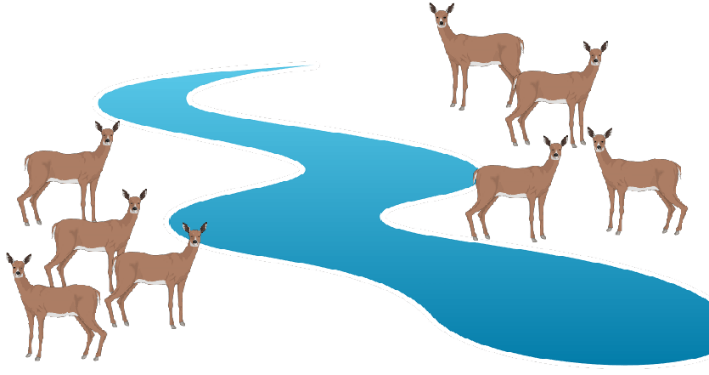
Two populations of the same species are separated by land barriers like rivers or mountains.
geographical isolation
temporal isolation
adaptive ratiation
behavioral isolaton

Two populations of the same species do not have the same mating rituals or signals.
geographical isolation
temporal isolation
adaptive ratiation
behavioral isolaton

According to the theory of natural selection, why are some individuals more likely than others to survive and reproduce?
Some individuals pass on to their offspring new characteristics they have acquired during their lifetimes.
Some individuals are better adapted to exist in their environment than others are.
Some individuals do not pass on to their offspring new characteristics they have acquired during their lifetimes.
Some individuals tend to produce fewer offspring than others in the same environment.
A bird's wing and a butterfly's wing have the same function, but they have very different structures. These structures are classified as follows:
homologous structures
analogous structures
vestigial structures
embryological homologues
Structures that appear to have lost size and function over the proposed evolutionary history of an organism are called ______.
homologous structures
analogous strucutres
vestigial structures
embryology
Evolutionary biologists say that similarities between different species are evidence of which of the following?
Organs shrinking and losing their function
Formation of the first cell in an organic soup
The presence of a common ancestor in a species
The concept that life comes only from life
The arm of a human, the flipper of a whale, and the wing of a bat all have similar bone structures. Therefore, these parts of the body would all be considered...
homologous structures
vestigial structures
transitional fossils
common ancestors
Archaeopteryx is a fossil that displays a mix of characteristics belonging to both birds and dinosaurs. This makes Archaeopteryx an example of a...
homologous structure
modern-day bird
transitional fossil
modern-day dinosaur
The two most important things that the fossil record tell us about the history of life on Earth are...
some species go extinct, and it is impossible for new species to take their place
some species go extinct, and new species appear over time
species usually never go extinct, but somehow dinosaurs did go extinct
Earth never changes, and changes to life on Earth happen very quickly
Darwin's study of biogeography led him to 2 very important observations. They were...
species vary globally, and species never adapt
species vary locally, and global species show no similarities
species vary globally, and species vary locally
species never evolve, and species vary locally
The study of embryological development (evo-devo) provides anatomical evidence for evolution because...
all vertebrate embryos pass through the same stages of development in the same sequence.
all vertebrates are born with gills and a tail.
all vertebrate embryos have completely different stages of development that look nothing alike.
all plants and animals have wings, even if you can't see them when they are born.
According to evolutionists, which is the best test to show the relatedness of two organisms?
Similarity in embryological development
Similarity in feeding behavior
Similarity in structure
Similarity of amino acid sequence in DNA

The fossil record helps to build a timeline of life on Earth because...
the older a fossil is, the deeper it will be found within layers of sedimentary rock.
the older a fossil is, the closer it will be to the surface layers of sedimentary rock.
gaps in the fossil record tell us all of the detailed changes to life on Earth during that gap.
fossilized clocks from millions of years ago tell us exactly what time it was when specific events happened.
Due to the over and improper use of antibiotics, some bacteria have...
gone extinct
become mutants
evolved to become resistant to certain antibiotics
remained the same over generations
The fossil record shows
How dinsaurs went extinct
How ancient species are related to more recent ones
How evolution occurs by natural selection
Molecular evidence of evolution
Structures change over time because
they adapt to changing environments
evolution is a random process
species are continually becoming more perfected
Artificial selection is when
nature selects which individuals survive/die
humans select which individuals survive/die
technology is used to change genes
chemicals are used to cause mutations
Which of the following statements best explains why genetic variation is important to the survival of a population?
Genetic variation decreases gene flow in the population.
Genetic variation decrease the likelihood of genetic mutation.
Genetic variation increases the size of animals so that more offspring will be produced.
Genetic variation increases the likelihood of an allele being present that is best suited for
the environment.
Which is the most accurate method of dating fossils?
radioactive dating
relative dating
studying layers in the earth
Which method determines a fossil's approximate age by examining which layer of earth is is found in?
radioactive dating
relative dating
chemical
Survival of the Fittest and Evolution were proposed by what scientist?
Charles Darwin
James Hutton
Jean-Baptiste Lamarck
Peter Grant
For natural selection to occur in a population, individuals must have a variety of traits.
true
false
For natural selection to occur in a population, more individuals must be produced than can survive.
true
false
Natural selection is dependent upon time and place: it favors the characteristics in a varying population that fit the organism’s current, local environment.
true
false
For natural selection to occur in a population, there must not be any competition among the individuals.
true
false

