
NEW
Font size
 Worksheets
DHS STEAM Elective- Unit 2- Waves, Light- Q4- 2024
Total questions: 40
Worksheet time: 36mins

The transfer of energy from a wave to the medium through which it travels
transmission
reflection
diffraction
absorption
Electromagnetic radiation that you can see
radiant energy
light
lens
wavelength

A material that allows almost all of the light striking it to pass through
transparent
translucent
opaque
reflection

A material through which light does not pass
transparent
translucent
opaque
reflection

Which type of interaction is this?
reflection
refraction
absorption
transmission

A student placed a pencil in a cup of water. The pencil appears broken because light...
always travels in a straight line
bends when it passes through water
makes the water in the glass evaporate
reflects the pencil on the water's surface
A rarefaction of a wave can be described as...
the part of a sound wave where the particles are close together
the part of a sound wave where the particles are far apart
the part of a wave where the particles are warm
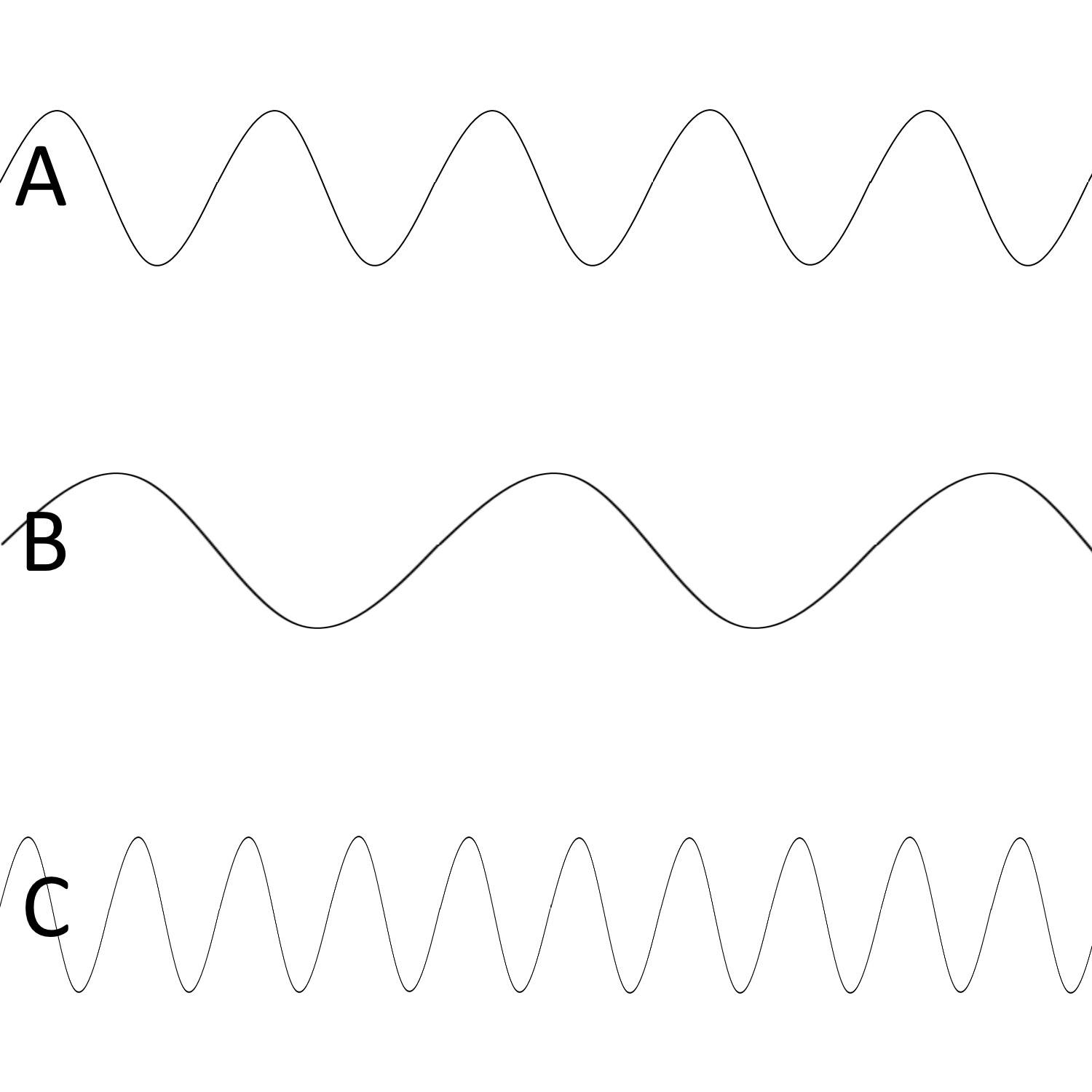
Which wave has the longest wavelength?
A
B
C
None (same wavelength)

Which wave has the highest frequency?
A
B
C
None (same frequency)

What is the relationship between frequency and wavelength?
high frequency --> short wavelength
high frequency --> long wavelength
low frequency --> short wavelength
there is no relationship
The highest part of a transverse wave is
the crest
the trough
the wave point
the hotel transylvania
The lowest part of a transverse wave are the
crests
troughs
wave points
low nodules
The distance between two corresponding parts of a wave is its
amplitude
frequency
wavelength
velocity
The height of the wave from its resting point is called its
wavelength
amplitude
velocity
frequency
A wave that needs a medium to travel is called a(n)
electromagnetic wave
mechanical wave
ocean wave
any way can do this
Longitudinal waves have:
crests and troughs
crests and compressions
compressions and rarefactions
troughs and rarefactions
Transverse waves have:
crests and troughs
troughs and rarefactions
compressions and contractions
rarefactions and crests
How often a wave occurs is the wave's
frequency
amplitude
wavelength
velocity
Longitudinal waves move:
at a right angle compared to the direction the wave is traveling
in a circle compared to the direction the wave is traveling
matter
in the same direction as the wave is traveling
What does a wave carry from place to place?
energy
matter
people

What kind of wave is this?
electromagnetic
longitudinal
transverse

#1 refers to the
wavelength
amplitude
crest
trough
#2 refers to the
wavelength
amplitude
crest
trough
#3 refers to the
wavelength
amplitude
crest
trough
#4 refers to the
wavelength
amplitude
crest
trough
What is it called when light waves enter a substance?
refraction
reflection
energy
absorption
When you change the pitch of the wave, the __________ of the wave is changing.
wavelength
amplitude
crest
trough
Tsunamis are caused by
underwater disturbances such as earthquakes, landslides, and volcanoes.
wind and the gravitational pull of the moon.
Tsunamis can move at
over 500 miles per hour
over 1,000 miles per hour
over 5,000 miles per hour
under 5 miles per hour



What is the Doppler effect?
The observed change in frequency of sound or light because of the relative motion of a wave source and the observer.
The observed change in amplitude of sound or light because of the relative motion of a wave source and the observer.
The observed change in wave speed of sound or light because of the relative motion of a wave source and the observer.
The observed change in equilibrium position of sound or light because of the relative motion of a wave source and the observer.
A wave has frequency of 5 Hz and a speed of 25 m/s. What is the wavelength of the wave?
25 m
125 m
5 m
25 m/s
A wave has a wavelength of 24 meters and a frequency of 14 Hz. What is its velocity?
226 m/s
336 m/s
446 m/s
1.71 m/s
A wave has a wavelength of 7 meters and a frequency of 43 Hz. What is its velocity?
301 m/s
310 m/s
321 m/s
331 m/s

