wayground logo

Free Printable Worksheets

Font size

S
M
L
XL
Worksheets

Final Exam Review

Total questions: 110

Worksheet time: 2hrs 22mins

Name
Class
Date
1.
AB + CD →AD + CB
a)
Double Replacement
b)
Single Replacement
c)
Synthesis
d)
Decomposition
2.
Identify this type of reaction,
Cl2 + 2KI -->  I2 + 2KCl
a)
Synthesis
b)
Single displacement
c)
Double displacement
d)
Decomposition
3.
Identify this type of reaction,
Cl2 + 2KI -->  I2 + 2KCl
a)
Synthesis
b)
Single displacement
c)
Double displacement
d)
Decomposition
4.
2 C5H5 + Fe --> Fe(C5H5)2 
a)
single displacement
b)
double displacement
c)
decomposition
d)
synthesis
5.
2 RbNO3 + BeF2 --> Be(NO3)2 + 2 RbF
a)
single displacement
b)
double displacment
c)
decomposition
d)
synthesis
6.
Which chemical reaction breaks down into 2 substances?
a)
Double displacement
b)
Single displacement
c)
Synthesis
d)
Decomposition
7.
Which of the following is an example of synthesis?
a)
Na + Br--> NaBr
b)
KClO--> KCl + O2
c)
HgO + Cl2-->HgCl + O2
d)
Cl2 + NaBr --> NaCl + Br2
8.
2 AgNO3 + Cu --> Cu(NO3)2 + 2 Ag 
a)
single displacement
b)
double displacement
c)
decomposition
d)
synthesis
9.
The following is what type of reaction:
NH3 + HCl  → NH4Cl
a)
Synthesis
b)
Decomposition
c)
Single Replacement Replacement
d)
Double Replacement Replacement
10.
_P4+_O  _P2O3
a)
3 P4+1 O→ 2 P2O3
b)
1 P4+1 O→ 2 P2O3
c)
1 P4+ 3 O→ 2 P2O3
d)
1 P4+ 2 O→ 3 P2O3
11.
_AgNO3 + _Cu _Cu(NO3)2 + _Ag
a)
2 AgNO3 + 2 Cu → 3 Cu(NO3)2 + 1 Ag
b)
2 AgNO3 + 1 Cu → 1 Cu(NO3)2 + 2 Ag
c)
1 AgNO3 + 2 Cu → 2 Cu(NO3)2 + 1 Ag
d)
3 AgNO3 + 2 Cu → 3 Cu(NO3)2 + 2 Ag
12.
_BaS + _PtF2  _BaF2 + _PtS
a)
1 BaS + 1 PtF2 → 1 BaF2 + 1 PtS
b)
4 BaS + 2 PtF2 → 1 BaF2 +  1 PtS
c)
1 BaS + 2 PtF2→ 2 BaF2 +  2 PtS
d)
1 BaS + 3 PtF2 →1 BaF2 +  2 PtS
13.
_Al + _HCl →_H2 + _AlCl3
a)
2 Al + 2 HCl → 2 H2 + 6 AlCl3
b)
3 Al + 3 HCl → 6 H2 + 2 AlCl3
c)
1 Al + 1 HCl → 3 H2 + 1 AlCl3
d)
2 Al + 6 HCl → 3 H2 + 2 AlCl3
14.
_K + _Cl2 _KCl
a)
2 K + 16 Cl2 → 8 KCl
b)
2 K + 1 Cl2 → 2 KCl
c)
3 K + 4 Cl2 → 3 KCl
d)
1 K + 1 Cl2 →1 KCl
15.
Mg2+ and Cl- create...
a)
Mg2Cl
b)
MgCl2
c)
Mg2Cl2
d)
MgCl
16.
Li+ and P3- create...
a)
Li3P
b)
LiP3
c)
LiP
d)
Li2P
17.
What is the NAME of....
Na2S
a)
sodium (II) sulfide
b)
sodium sulfide
c)
disodium sulfide
d)
sodium sulfur
18.
Which of these combinations is an ionic compound made of?
a)
Metal and Metal
b)
Nonmetal and Nonmetal
c)
Metal and Nonmetal
d)
Cation and Cation
19.

Name this compound: KF

a)

Potassium fluoride

b)

Potassium fluorite

c)

Fluorine potasside

d)

Potassium fluorate

20.

Write the formula for barium + nitrogen

a)

Ba2N3

b)

Ba3N2

c)

BaN

d)

BaN3

21.

Which of the following is an ionic compound:

a)

CH4

b)

I2

c)

LiBr2

d)

CO

22.
How do the following two elements bond together?
Al3+  O2-         
a)
AlO
b)
Al2O3
c)
Al3O6
d)
Al3O2
23.
Name the following ionic compound: BeCl2
a)
beryllium chlorine
b)
beryllium II chloride
c)
beryllium chloride
d)
beryllium dichloride
24.
What is the formula for manganese(III) oxide?
a)
MgO
b)
Mg2O3
c)
MnO
d)
Mn2O3
25.

Name the following ionic compound: MgSO4

a)

magnesium sulfoxide

b)

magnesium sulfide

c)

magnesium sulfate

d)

magnesium oxide

26.

Which of the following combinations would need roman numerals in the name?

a)

silver + fluorine

b)

zinc + oxygen

c)

boron + iodine

d)

lead + oxygen

27.

Name the following compound: FeCl3

a)

iron (II) chloride

b)

iron (III) chloride

c)

iron chlorate

d)

iron (III) chlorate

28.

The name of Cu₃N₂ is

a)

copper (III) nitride

b)

copper (II) nitride

c)

copper nitride

d)

tricopper dinitride

29.

what is the chemical formulas for copper (II) chloride?

a)

CuCl2

b)

CuCl

c)

Cu2Cl

d)

Cu2Cl2

30.

Write the formula for copper (I) phosphide

a)

Cu3P

b)

CuP

c)

Cu1P

d)

CuP3

31.

What is the name of K3PO4?

a)

Tripotassium Phosphate

b)

Tripotassium Phosphite

c)

Potassium phosphide

d)

Potassium phosphate

32.

Name this compound:

Ca2CO3

a)

Calcium carbon oxide

b)

Calcium (II) carbonate

c)

Calcium carbonate

d)

Carbonate (I) calcide

33.

What is the formula for Calcium Chlorate?

a)

CaClO3

b)

Ca(ClO3)2

c)

Ca(ClO3)3

d)

Ca(ClO3)4

34.

What is the formula for sodium nitrate?

a)

Na3NO

b)

NaNO

c)

Na3NO3

d)

NaNO3

35.

What is the correct name of the compound NO2?

a)

Nitrogen oxide

b)

Mononitrogen dioxide

c)

Nitrogen dioxide

d)

Dinitrogen monoxide

36.

Which type of elements will a covalent compound form between?

a)

Metals and nonmetals

b)

Nonmetals only

c)

Metals only

d)

Metalloids & metals

37.

When an atom ___________ electrons, it becomes a _______________.

a)

loses; anion

b)

gains; cation

c)

loses; cation

d)

shares; polyatomic

38.

Which of the following compounds is covalent?

a)

Na2O

b)

CaCl2

c)

S2Br

d)

Mg(OH)2

39.

__________ become __________ when they gain electrons.

a)

Nonmetals; anions

b)

Metals; anions

c)

Nonmetals; cations

d)

Metals; cations

40.

Which of the following formulas is correct for the compound "dinitrogen pentoxide"?

a)

N5O2

b)

N2O3

c)

N2O5

d)

N2O7

41.
According to the octet rule most elements need _______ valence electrons.
a)
2
b)
8
c)
6
d)
18
42.
An element with five valence electrons is
a)
phosphorus
b)
oxygen
c)
beryllium
d)
rubidium
43.
How many Valance electrons does Iodine Have?
a)
6
b)
16
c)
7
d)
17
44.
How many electrons should Carbon have around its Lewis dot model?
a)
1
b)
3
c)
4
d)
5
45.
What atom matches this electron configuration?
1s22s22p63s23p64s23d10
a)
Zinc
b)
Copper
c)
Nickel
d)
Germanium
46.
The electron configuration of an atom is 1s22s22p6.  The number of electrons in the atom is 
a)
3
b)
6
c)
8
d)
10
47.
Which electron configuration belongs to Chlorine (Cl)?
a)
1s2s2p3s3p5
b)
1s2s2p3s3p6
c)
1s2s2p3s3p7
48.
How many electrons can the d sublevel hold?
a)
14
b)
10
c)
2
d)
6
49.
How many electrons can the s sublevel hold?
a)
14
b)
10
c)
2
d)
6
50.
What atom matches this electron configuration?
1s22s22p63s2
a)
Neon
b)
Magnesium
c)
Aluminum
d)
Potassium
51.

Choose the correct shortcut configuration for iodine.

a)

[Ar]4s24d104p5

b)

[Kr]5s24d105p5

c)

[Xe]5s25d105p5

d)

none of the above

52.

Each row on the periodic table represents:

a)

an energy level

b)

a sublevel

c)

an electron

d)

an orbital

53.

Which area on the periodic table represents the electrons in the "d" sublevel?

a)

representative elements

b)

columns 3-8

c)

rare earth elements

d)

transition elements

54.

Which of the following is not a correct designation for a sublevel?

a)

zz

b)

p

c)

d

d)

f

55.
How many electrons can the s sublevel hold?
a)
14
b)
10
c)
2
d)
6
56.
What is the noble gas shorthand electron for Sulfur atom?
a)
[Ar] 3p4
b)
[He] 3s23p4
c)
[Ne] 3s23p4
d)
[Na] 3s23p4
57.
What is the electron configuration for this atom?
a)
1s22s22p6
b)
1s22s22p5
c)
1s22s22p3
d)
2s22p3
58.
Which element is depicted from this orbital diagram
a)
Fluorine
b)
Neon
c)
Chlorine
d)
Argon
59.
What is the charge of an atom that has lost one electron?
a)
-1
b)
-2
c)
+1
d)
+2
60.
What is the charge of an atom that has gained one electron?
a)
-1
b)
-2
c)
+1
d)
+2
61.
Anions are _______ that form ____________ ions and __________ electrons.
a)
nonmetals, positive, lose
b)
nonmetals, negative, gain
c)
metals, positive, gain
d)
metals, positive, lose
62.
Which element is pictured?
a)
neon
b)
fluorine
c)
magnesium
d)
argon
63.
How many electron can be found in a p orbital?
a)
2
b)
3
c)
4
d)
6
64.
What is the electronic configuration of iron?
a)
1s22s22p63s23p64s23d6
b)
1s22s22p63s23p63d8
c)
1s22p63s23p64s23d6
d)
1s22s22p63s23p64s13d6
65.
What does Boyle's law relate to?
a)
Temperature and Volume
b)
Volume and Pressure
c)
Temperature and Pressure
66.
When the temperature of matter increases the particles...
a)
speed up and move closer
b)
speed up and move farther apart
c)
slow down and move closer together
d)
slow down and move farther apart
67.
What type of relationship is Charles' Law?
a)
Inverse
b)
Direct
c)
Not enough information
d)
#goals
68.
What is the formula for Boyle's Law?
a)
P1V1=P2V2
b)
P1V1/P2V2
c)
P1V2=P2V1
d)
P1/V1=P2/V2
69.
When Pressure increases then the Volume must...
a)
Increase
b)
decrease
70.
When Volume increases then Pressure must...
a)
Increase
b)
Decrease
71.
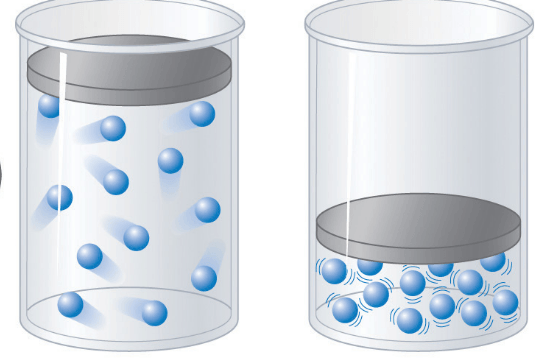
What type of relationship to pressure and volume have?
a)
direct
b)
inverse
c)
no relationship
d)
I don't know
72.
Which container will have a lower pressure?
a)
left
b)
right
c)
they both have the same pressure
d)
I don't know
73.
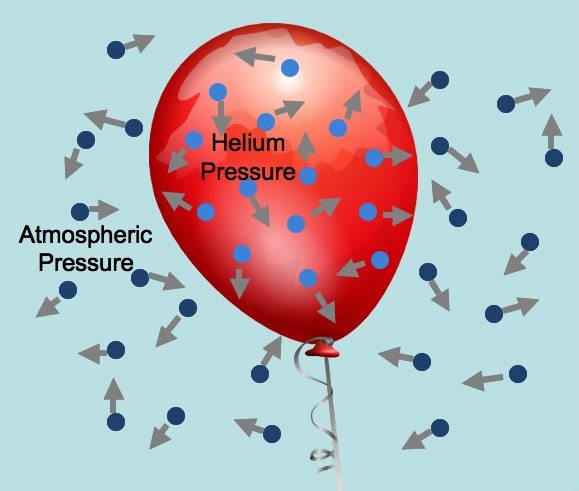
What causes pressure?
a)
The walls of the container
b)
The vacuum in the container
c)
The collisions of the particles
d)
Atmospheric pressure acting on the outside walls
74.
What is the formula Charles' Law?
a)
V = T
b)
VT = VT
c)
T1 / V1 = T2 / V2
d)
V1 / T1 = V2 / T2
75.

A student measures the pressure and volume of an empty water bottle to be 1.4 atm and 2.3 L. She then decreases the pressure to 0.65 atm. What is the new volume?

a)

2.1 L

b)

5.0 L

c)

8.2 L

d)

3.9 L

76.

What is the pressure of a car tire that had an initial pressure of 1.8 atm but was heated from 38°C to 123°C?

a)

0.9 atm

b)

2.1 atm

c)

1.6 atm

d)

3.4 atm

77.

Three gases are mixed together in a container with a total pressure of 4.8 atm. If two of the gases have pressures of 1.2 atm and 1.5 atm, what is the pressure of the third gas?

a)

2.5 atm

b)

1.8 atm

c)

2.1 atm

d)

1.3 atm

78.
In order to convert to Kelvin, you add ______ to the Celsius measurement.
a)
372
b)
273
c)
237
d)
732
79.
What is 50 °C in Kelvin?
a)
223
b)
323
c)
100
d)
50
80.
Charles' Law States...
a)
As Pressure goes up volume goes down
b)
As Pressure goes up temperature goes up
c)
As Volume goes up temperature goes up 
d)
As Pressure goes down volume goes down 
81.
Calculate the volume that a 0.323-mol sample of a gas will occupy at 265 K and a pressure of 0.900 atm.
a)
7.18 L 
b)
7.81 L
c)
4.63 L
d)
4.36 L
82.

Determine the temperature required for 0.0470 mol of gas to fill a balloon to 1.20 L under .998 atm pressure.

a)

0 K

b)

107 K

c)

207 K

d)

307 K

83.

A sample of gas with a volume of 30.0 mL at 25.0oC is heated to 50.0oC. What is the new volume of the gas?

a)

60.0 mL

b)

15.0 mL

c)

27.5 mL

d)

32.5 mL

84.
A high specific heat means...
a)
It heats up quickly with energy added
b)
It requires more energy to change temperature
85.
What  is the formula to calculate heat energy required to raise the temperature of any substance?
a)
Q=mc∆t
b)
Q=mc
c)
Q= ½mv
d)
m=QC
86.

A 15.75-g piece of iron absorbs 1086.75 joules of heat energy, and its temperature changes from 25°C to 175°C. Calculate the specific heat capacity of iron.

a)

0.46 J/goC

b)

1.654 J/goC

c)

2,567,446.875 J/goC

87.

How many joules of heat are needed to raise the temperature of 10.0 g of aluminum from 22.0°C to 55.0°C, if the specific heat of aluminum is 0.903 J/g°C?

a)

298 Joules

b)

0.003 Joules

c)

297 J/g°C

d)

0.003 J/g°C

88.

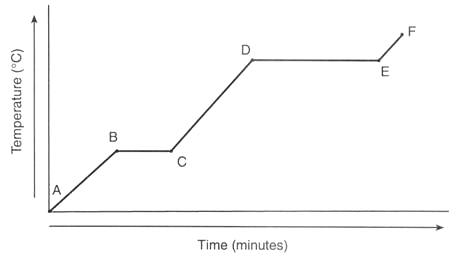
What state of matter would this substance be between points A & B?

a)

Solid

b)

Liquid

c)

Gas

89.

What state of matter would this substance be between points C & D?

a)

Solid

b)

Liquid

c)

Gas

90.

What state of matter would this substance be between points E & beyond?

a)

Solid

b)

Liquid

c)

Gas

91.
Phase change from a solid to a gas.
a)
sublimation
b)
deposition
c)
condensation
d)
evaporation
92.
Phase change from a solid to a liquid.
a)
melting
b)
sublimation
c)
boiling
d)
condensation
93.
Phase change from a gas to a liquid.
a)
condensation
b)
evaporation
c)
melting
d)
deposition
94.
Change from Gas to Solid is called........
a)
Sublimation
b)
Deposition
c)
Fusion
d)
condensation
95.
What state of matter is Y?
a)
solid 
b)
liquid
c)
gas
d)
supercritical fluid
96.
What state of matter is Z?
a)
solid 
b)
liquid
c)
gas
d)
supercritical fluid
97.
What change occurs from F to E?
a)
sublimation
b)
deposition
c)
melting
d)
condensation
98.
What change occurs from E to C?
a)
sublimation
b)
freezing
c)
melting
d)
boiling
99.
What change occurs from C to D?
a)
condensation
b)
vaporization
c)
melting
d)
sublimation
100.

How long does it take this substance to change from a liquid to a gas?

a)

1 minute

b)

2 minutes

c)

10 minutes

d)

15 minutes

101.

What phase change occurs at letter F?

a)

Melting

b)

Freezing

c)

Vaporization

d)

Sublimation

102.

Are the particles moving faster or slower as time goes on?

a)

Faster

b)

Slower

103.

What phase change occurs at letter C?

a)

Vaporization

b)

Sublimation

c)

Melting

d)

Condensation

104.
At 0.10 atm, what phase(s) can exist?
a)
solid, liquid or gas
b)
liquid or gas
c)
solid only
d)
gas only
105.
A substance's heating curve is shown in the graph.  What is its boiling point?
a)
100 C
b)
60 C
c)

-60 C

d)
20 C
106.

A substance's heating curve is shown in the graph.  What is its freezing point?

a)

-60 C

b)
60 C
c)
80 C
d)

-100 C

107.
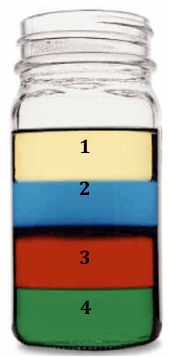
Put the liquids in order from most dense to least dense?
a)
4, 3, 2, 1
b)
1, 2, 3, 4
c)
3, 4, 2, 1, 
d)
4, 3, 1, 2
108.
If an object has a density of .6 g/mL and you put it into water, will it sink or float?  
a)
sink
b)
float
109.
If an object has a density of 3.6 g/mL and you put it into water, will it sink or float?  
a)
sink
b)
float
110.
Frank has a paper clip. It has a mass of 9g and a volume of 3cm3. What is its density?
a)
3 g/cm3
b)
1/3 g/cm3
c)
27 g/cm3
d)
39 g/cm3