
 Worksheets
circulatory/respiratory system test
Total questions: 170
Worksheet time: 2hrs 15mins
After cellular respiration, what happens to the carbon dioxide?
It leaves the alveoli and is exhaled from the lungs
It leaves the bloodstream and enters the alveoli
It leaves the cells and enters the bloodstream
It leaves the alveoli and enters the bloodstream
Which of the following describes the path of carbon dioxide as it leaves your capillaries and exits through the respiratory system?
bronchioles, bronchi, alveoli, trachea, larynx, pharynx, mouth/nose
alveoli, bronchioles, bronchi, trachea, larynx, pharynx, mouth/nose
mouth/nose, pharynx, larynx, trachea, bronchi, bronchioles, alveoli
mouth/nose, pharynx, larynx, bronchioles, trachea, bronchi, alveoli
The structure that contracts, allowing you to inhale is/are the
lungs
diaphragm
trachea
larnyx
You are sitting calmly while you work on this test. The amount of air that is regularly being exchanges through your lungs during this time is called the
residual volume.
total lung capacity.
tidal volume.
vital capacity.
Your friend had her larynx removed. What will she be unable to do?
cough
swallow
breath
speak
When your diaphragm and intercostal muscles are relaxing, what are you doing?
exhaling
a strenuous activity
resting
inhaling

tiny sacs of lung tissue specialized for the movement of gases between air and blood.
lungs
bronchi
alveoli
diaphragm

What is the function of these tiny hairs in the bronchial tubes?
moistens the air as it enters the lungs
helps the lungs get carbon dioxide
removes unwanted mater from the lungs
helps the lungs get oxygen
Which answer is describes Boyle's Law?
Increase in volume= increase in pressure
Increase in volume+ no effect on pressure
decrease in volume= decrease in pressure
Increase in volume= decrease in pressure
How many lobes does the left lung have? Right lobe?
R:3, L:4
L:3, R:2
R:3, L:2
R:2, L:2

Diagram shows a model of human respiratory system. K represents....
lung
rib cage
diaphragm
thoracic cavity
Which is the correct order of air passage in the breathing mechanism?
Nostril, nasal cavity, pharynx, larynx, trachea, bronchus, bronchiole, alveolus
Nostril, nasal cavity, larynx, pharynx, trachea, bronchus, bronchiole, alveolus
Nostril, nasal cavity, pharynx, larynx, trachea, bronchiole, bronchus, alveolus
Nostril, nasal cavity, trachea, larynx, pharynx, bronchus, bronchiole, alveolus
"Movements of the rib cage and diaphragm make the thoracic cavity smaller and cause the air pressure in the thoracic cavity to increase"
The situation happens during....
inhalation
exhalation
excretion
blood circulation
Red Blood Cells that carry oxygen are produced in:
The lungs
Bone marrow
The heart
The kidneys
During breathing, gases between the lungs and capillaries are exchanged by
Osmosis
Active Transport
Diffusion
Brownian Motion
Why do you need mucous membranes in the bronchioles?
to help the food go down smoothly
to stop the air irritating them
to help air pass through
to trap and remove foreign particles

Which part of the pharynx is most superior?
laryngopharynx
nasopharynx
oropharynx
alveolarpharynx
A chronic respiratory disorder where bronchial tubes contract quickly causing shortness of breath, coughing, and wheezing
Bronchitis
Emphysema
Lung cancer
Asthma
Membrane layer which covers the outside of lungs.
Pleura
Alveolar Ducts
Alveoli
Bronchi
The central control of breathing
Epiglottis
Medulla
Cerebellum
Frontal lobe
A contraction of the diaphragm during inhalation causes it to flatten. What else does the contraction result in?
An increase in the volume of the thoracic cavity
Increase in alveolar pressure
A decrease in lung volume
A decrease in the volume of the thoracic cavity
Inspiration is produced by a _____________ in the pressure in the thoracic cavity and in the air passages of the lungs.
decrease
increase
consistency
As volume increases the amount of molecules running into each other will _____
increase
decrease
stay the same
During expiration your diaphragm moves ....
up
down
both
The more collisions between molecules the ...
lower the presssure
greater the pressure
the smaller the drop in pressure
the larger the drop in pressure
According to Boyle’s law, the pressure exerted by a gas ___________ as the volume of space it occupies __________ ,provided its temperature remains constant.
decreases, decreases
decreases, increases
increases, increases
What are the main muscles of inhalation?
The diaphragm and intercostal muscles
The scalenes and the abdominal muscles
The diaphram and abdominal muscles
The diaphragm and latissimus muscles


What pressure gradient is exhalation triggered by?
The pressure in the lungs is less than the pressure of the atmosphere
The pressure in the lungs is greater than the pressure of the atmosphere
The pressure in the lungs is equal to the pressure of the atmosphere

Which letter corresponds to the volume of air breathed in or out of the lungs per breath
A
B
C
D

Which letter corresponds to the maximum volume of air that can be forcibly expired after a maximal intake of air
H
F
G
A

Which letter corresponds to the volume of air remaining in the lungs at the end of a maximal expiration
C
D
F
H
What type of tissue lines the nasal cavity and the superior pharynx?
Simple squamous epithelium
Pseudostratified epithelium
Stratified squamous epithelium
Simple cuboidal epithelium
What type of tissue lines the inferior pharynx?
Simple squamous epithelium
Pseudostratified epithelium
Stratified squamous epithelium
Simple cuboidal epithelium
What type of tissue lines the trachea and bronchi?
Simple squamous epithelium
Pseudostratified epithelium
Stratified squamous epithelium
Simple cuboidal epithelium
What type of tissue lines the alveoli?
Simple squamous epithelium
Pseudostratified epithelium
Stratified squamous epithelium
Simple cuboidal epithelium
Steps to inhalation then exhalation NOT in the correct order.
1. Diaphragm relaxes
2. Diaphragm contracts
3. Volume in chest cavity increases
4. Volume in chest cavity decreases
5. Pressure is greater in the chest than in the air outside
6. Pressure is lower in the chest than in the air outside
7. Air rushes in
8. Air ruses out.
Which step would happen first starting with inhalation: (a) example answer 8. 0r 8 (only one # for answer!!!)
Steps to inhalation then exhalation NOT in the correct order.
1. Diaphragm relaxes
2. Diaphragm contracts
3. Volume in chest cavity increases
4. Volume in chest cavity decreases
5. Pressure is greater in the chest than in the air outside
6. Pressure is lower in the chest than in the air outside
7. Air rushes in
8. Air ruses out.
Which step would happen 2nd starting with inhalation: (a) example answer 8. 0r 8 (only one # for answer!!!)
Steps to inhalation then exhalation NOT in the correct order.
1. Diaphragm relaxes
2. Diaphragm contracts
3. Volume in chest cavity increases
4. Volume in chest cavity decreases
5. Pressure is greater in the chest than in the air outside
6. Pressure is lower in the chest than in the air outside
7. Air rushes in
8. Air ruses out.
Which step would happen 3rd starting with inhalation: (a) example answer 8. 0r 8 (only one # for answer!!!)
Steps to inhalation then exhalation NOT in the correct order.
1. Diaphragm relaxes
2. Diaphragm contracts
3. Volume in chest cavity increases
4. Volume in chest cavity decreases
5. Pressure is greater in the chest than in the air outside
6. Pressure is lower in the chest than in the air outside
7. Air rushes in
8. Air ruses out.
Which step would happen 4th starting with inhalation: (a) example answer 8. 0r 8 (only one # for answer!!!)
Steps to inhalation then exhalation NOT in the correct order.
1. Diaphragm relaxes
2. Diaphragm contracts
3. Volume in chest cavity increases
4. Volume in chest cavity decreases
5. Pressure is greater in the chest than in the air outside
6. Pressure is lower in the chest than in the air outside
7. Air rushes in
8. Air ruses out.
Which step would happen 5th starting with inhalation: (a) example answer 8. 0r 8 (only one # for answer!!!)
Steps to inhalation then exhalation NOT in the correct order.
1. Diaphragm relaxes
2. Diaphragm contracts
3. Volume in chest cavity increases
4. Volume in chest cavity decreases
5. Pressure is greater in the chest than in the air outside
6. Pressure is lower in the chest than in the air outside
7. Air rushes in
8. Air ruses out.
Which step would happen 6th starting with inhalation: (a) example answer 8. 0r 8 (only one # for answer!!!)
Steps to inhalation then exhalation NOT in the correct order.
1. Diaphragm relaxes
2. Diaphragm contracts
3. Volume in chest cavity increases
4. Volume in chest cavity decreases
5. Pressure is greater in the chest than in the air outside
6. Pressure is lower in the chest than in the air outside
7. Air rushes in
8. Air ruses out.
Which step would happen 7th starting with inhalation: (a) example answer 8. 0r 8 (only one # for answer!!!)
Steps to inhalation then exhalation NOT in the correct order.
1. Diaphragm relaxes
2. Diaphragm contracts
3. Volume in chest cavity increases
4. Volume in chest cavity decreases
5. Pressure is greater in the chest than in the air outside
6. Pressure is lower in the chest than in the air outside
7. Air rushes in
8. Air ruses out.
Which step would happen last starting with inhalation: (a) example answer 8. 0r 8 (only one # for answer!!!)
What makes up around 55% of the blood?
Plasma
Red Blood Cells
White Blood Cells
Platelets
What carries oxygen around the body?
Plasma
Red Blood Cells
Platelets
White Blood Cells
What causes the blood to be the distinct red color?
Hemoglobin
Glucose
Hormones
Oxygen
What is the function (job) of the platelets?
To form clots (i.e. scabs) when you have cuts and grazes.
To transport oxygen to the muscles
To carry dissolved sugars.
To produce antibodies
What is the function (job) of the white blood cells?
To transport oxygen around the body.
To carry dissolved sugars.
To clot and cover wounds like cuts and grazes.
To destroy pathogens.
Which blood vessels take blood TO the heart?
Veins
Arteries
Capillaries
Which blood vessels take blood AWAY from the heart?
Veins
Arteries
Capillaries
Which is the smallest of the 3 blood vessels?
Veins
Arteries
Capillaries

What is blood made of?
oxygen and plasma
red blood cells and white blood cells
plasma, red blood cells, white blood cells, and platelets.
plasma and platelets
Which cell engulfs and digests bacteria/pathogens? Most common leukocyte.
lymphocytes
neutrophil
platelets
eosinophil
Which white blood cells make antibodies and killer cells?
phagocytes
lymphocytes
platelets
A system of the body which pumps blood too and from the lungs to become oxygenated.
Systemic
Pulmonary
Parasympathetic
Sympathetic
A system of the body which pumps blood from the left ventricle of the heart to the Aorta and the rest of the body.
Systemic
Pulmonary
Parasympathetic
Sympathetic
What is Hemoglobin?
Iron rich protein that transports oxygen in the blood cells.
Blood Cells
Blood Vessels
A type of Capillary
I have a large lumen, I have thin muscular walls, and low pressure
Artery
Vein
Capillary
Arteriole
I have muscular walls, and a small lumen. Blood under higher pressure
Artery
Vein
Capillary
Arteriole
Which of the following shows a correct route for the exchange of substances in blood leaving the heart?
arteriole --> artery --> capillary --> vein --> venule
artery --> vein --> capillary --> venule --> arteriole
venule --> vein --> capillary --> artery --> arteriole
artery --> arteriole --> capillary --> venule --> vein
____ bridged between the arteries and vein
Lungs
Heart
Spine
Capillaries
What is the part of the blood vessel through which blood flows called?
Artery
Lumen
Gap
Tube
Oxygen and carbon dioxide are transported between the blood and alveoli by way of
exocytosis and endocytosis by endothelial cells
diffusion from areas of higher concentration to lower concentration
pinocytosis using fluid-filled vesicles
active transport (using ATP) by protein carriers of endothelial cells
What is the name of the process where white blood cells surround, engulf and digest pathogens?
protein synthesis
exocytosis
passive transport
phagocytosis

What process is being shown shown in the diagram?
production of antibodies
exocytosis
phagocytosis
Passive transport
Which of the following is not a plasma protein?
albumin
globulin
fibrogen
hemoglobin
Which of the following white blood cells are able to leave the bloodstream and enter surrounding tissues becoming macrophages?
neutrophil
monocytes
electrocytes
lymphocytes
What type of tissue is blood?
Epithelial
Connective
Muscle
Nerve
Plasma is made of ____% water.
45%
55%
90%
110%
Which of the following is not a whole cell?
monocytes
thrombocytes
leukocytes
lymphocytes
name of the valve that separates right atrium from right ventricle.
tricuspid
aortic semilunar
mitral
bicuspid
Valve that blood is forced through from right ventricle into pulmonary arteries.
pulmonary semi lunar valve
aortic semi lunar valve
mitral valve
tricuspid valve
In the walls of the heart, there are two thin layers around a thick layer of muscle called the
epithelial tissue.
pericardium.
connective tissue.
myocardium.
................................... of the heart has the thick muscular wall because it pumps the blood to the systemic circuit
left ventricle
Right ventricle
right atrium
left atrium


Which layer covers the heart and major vessels that contains a lubricating fluid that reduces friction as the heart beats?
Pericardium
Endocardium
Myocardium

Deoxygenated blood enters the right atrium from the upper part of the body through the.
inferior vena cava
superior vena cava
aorta
pulmonary vein
Where would you find the semilunar valves?
between the atria and ventricles to prevent backflow of blood from ventricles to atria.
at the base of the arteries to prevent blood returning to the ventricle
between left atrium and left ventricle
between right atrium and right ventricle

Which number is the superior vena cava?
1
2
4
8
Where is the blood in 1 and 4 coming from?
All over the body
The upper half of the body, head and arms
The lower half of the body, legs and abdomen
The lungs


Vein that empties blood from the lower body into the upper right heart chamber
Inferior Vena Cava
Superior Vena Cava
Pulmonary Veins
Aortic veins
Veins that empty blood from the lungs into the upper left heart chamber
Inferior Vena Cava
Superior Vena Cava
Pulmonary Veins
Aortic veins
Which number is the pulmonary vein?
4
5
6
8
Which number is the left ventricle?
3
9
2
8
Which number is the right ventricle?
3
9
2
8
Which number is the right atrium?
3
9
2
8
The right and left chambers are separated by
Sternum
Septum
Sernom
Strenoum

From the lungs blood enters the heart through this blood vessel.
Pulmonary artery
Pulmonary vein
Aorta
Vena cava

From the pulmonary vein blood enters this chamber of the heart.
Left atrium
Right atrium
Left ventricle
Right ventricle

From the left atrium blood travels through this valve
tricuspid valve
mitral valve (bicuspid)
aortic valve
pulmonary valve


The larynx is inferior to the tracheae
true
false

The main bronchi are medial to the secondary bronchi
true
false

Identify structure A
Nasal cavity
Larynx
Bronchiole
Trachea
Bronchi
Identify structure B
Nasal cavity
Larynx
Bronchiole
Trachea
Bronchi
Identify structure C
Alveoli
Larynx
Bronchiole
Trachea
Bronchi
Identify structure E
Nasal cavity
Larynx
Pharynx
Trachea
Bronchi
Identify structure F
Nasal cavity
Larynx
Pharynx
Trachea
Bronchi
Identify structure G
Nasal cavity
Larynx
Pharynx
Trachea
Bronchi

Identify structure A
Alveoli
Larynx
Vocal folds
Trachea
Epiglottis
When you breathe, your lungs take in ___ and remove ___.
air/oxygen
oxygen/carbon dioxide
carbon dioxide/waste
waste/air
The air sacs that are covered with capillaries where gas exchange takes place
bronchi
lungs
oxygen
alveoli
What adaptations does the alveoli have for efficient gas exchange?
thick walls
thin walls
small surface area
what is found around alveoli?
capillaries
pleura
lymphatic nodes
saliva

Gas exchange is needed to supply _____________ to cells and remove __________________
carbon dioxide; oxygen
oxygen; food
oxygen; carbon dioxide
carbon dioxide; water
Supply the tissues of the heart walls with Oxygen.
Phrenic arteries
Thoracic aorta
Aortic arch
Coronary arteries
How many bones are in an adult human body?
365
206
270
302
Cardiac muscles


Natural pacemaker
Purkinje fibers
Sinoatrial node
Atrioventricular node
Bundle of His
Which part of the heart exerts the highest pressure during heart beat?
Right atrium
Right ventricle
Left atrium
Left ventricle

SA node → Purkinje fibers → AV node → Bundle of His
Bundle of His → Purkinje fibers → AV node → SA node
SA node → AV node → Bundle of His → Purkinje fibers
"lub" "dub"
lub - AV valves closed
dub - AV valves closed
lub - semilunar valves closed
dub - semilunar valves closed

Electrolysis
Electromagnet
Electrocardiogram
What is the function of valves present in the veins?
Ensure blood flow back to the heart
Prevent blood clotting
Ensure blood flow in one direction
The first 'lub' sound is produced when ________ close.
tricuspid valve
tricuspid vale and bicuspid valve
semilunar valve
bicuspid valve
The contraction of the atria is controlled by the:
SA node
AV node
Purkinje fibres
Bundle of His
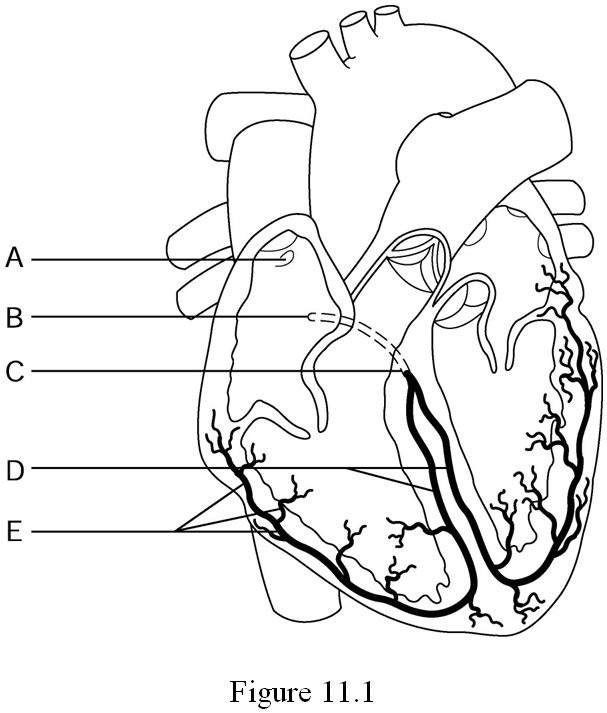
What area of the heart is responsible for the delay of conduction between the atrium and ventricles?
Right bundle branch
AV node
Bundle of his
Bachmann bundle
Which label is representing the SA node?
A
C
D
E
Planet Pneumo-Lumo (found way out beyond Pluto) has an atmospheric pressure of 1000mmHg. Oxygen makes up 25% its atmosphere. What is the Partial Pressure of Oxygen (PO2) on Pneumo?
25mmHg
250mmHg
500mmHg
750mmHg
Which gas plays the more important role in determining respiratory rates?
o2 levels
co2 levels
N2 levels
Which of the following is the process by which oxygen and carbon dioxide diffuse between the bloodstream and the body tissues?
External Respiration
Internal Respiration
Pulmonary Ventilation
Cellular Respiration
Why is it difficult to breathe at high altitude?
The percentage of o2 is lower
The percentage of co2 is higher
The partial pressure of co2 is lower
The partial pressure of o2 is lower

In the diagram below, which part of the tracing represents the contraction of the atria?
P
T
R
S
This wave indicates repolarisation of ventricles
T waves
U waves
P waves
Q waves

This element of the EKG represents ventricular depolarization and contraction, and the blood moving to the lungs and body
P Wave
QRS Complex
T Wave
PR Interval

