
 Worksheets
FINAL EXAM REVIEW
Total questions: 146
Worksheet time: 4hrs 26mins
Al + H2SO4 ->
How many grams of aluminum sulfate would be formed if 250g H2SO4 completely reacted with aluminum?
0.85 g
290 g
450 g
870 g
Cl2 + KBr →
how many grams of potassium chloride can be produced from 356 grams potassium bromide?
749 g
223 g
479 g
814 g

Percent yield=(________)÷(________)×100%
LiOH + KCl →
I actually produced 6 grams of lithium chloride and I began this reaction with 20 grams of lithium hydroxide. What is my percent yield?
16.9%
5.91%
1.88%
12.3%
CH4 + 2O2 → CO2 + 2H2O
24 grams of CH4 was added to the above reaction. Calculate the theoretical yield of CO2.
66 grams
132 grams
33 grams
8.72
2Fe2O3 + C → Fe + 3CO2
You add 28 grams of carbon. You find the actual yield to be 181.2 grams of CO2. What is the percent yield of CO2? (Hint: calculate theoretical yield of CO2 first)
58.8%
308%
6435%
15.5
P4 + 6Cl2 --> 4PCl3
The reaction of 75.0g P4 with excess chlorine gas produces 110g PCl3 in lab. Find the theoretical yield and calculate percent yield for the reaction.
78%
64%
27%
33%
2Pb(NO3)2 (s)→2PbO(s)+4NO2(g)+O2(g)
Lead nitrate can be decomposed by heating. What is the % yield of the decomposition reaction if 7.4g Pb(NO3)2 are heated to give 4.1 g PbO?
82%
44%
56%
67%
Zn + HCl →
15 grams of HCl should theoretically produce 0.41 grams of H2. The reaction actually produced 0.15 grams of H2. What is the percent yield of H2?
2.8%
280%
1%
37%
An ionic compound forms between a _______ and _______.
metal and non-metal
two metals
two non-metals
Name the ionic compound, LiCl
lithium chlorine
lithium chloride
lithium chlorate
lithium monochloride
Name the ionic compound, FeBr3
Iron (II) bromide
Iron (III) bromide
What is the formula for diphosphorus pentoxide?
P2O5
PO5
P5O2
Po2O5
What is the name for SiCl4?
silicon tetrachloride
silicon quadchloride
monosilicon tetrachloride
silicon chloride
Which of the following combinations would need roman numerals in the name?
potassium + fluorine
beryllium + oxygen
boron + iodine
lead + oxygen
What is the name of the compound Na2(SO4)?
Sodium sulfate
Sodium sulfide
Sodium sulfite
Sodium sulfuroxide
When naming ionic compounds with transition metals you need to include roman numerals to show the _____ of the metal..
atomic number
mass number
charge
ionization energy

The following properties are all characteristics of ionic compounds EXCEPT
solid at room temperature
soft
crystal lattice structure
conduct electricity when dissolved in water
Ionic bonds could be best described as:
A bond formed when 2 atoms share electrons
A firm handshake
An electrostatic attraction between oppositely charged ions
An electrostatic attraction between anions
Which type of bond is formed from the sharing of electrons?
ionic bond
covalent bond
What set of elements is most likely to form a covalent compound?
Na and O
Na and K
O and C
Which set of elements is most likely to form an ionic compound?
Na and O
C and O
Na and K
The bond between C and Cl is polar covalent. That means
there is a pair of electrons shared equally between them
there is a pair of electrons shared unequally between them
an electron will be stolen from one and given to the other
The bond between C and H is non-polar covalent. That means
there is a pair of electrons shared equally between them
there is a pair of electrons shared unequally between them
an electron will be stolen from one and given to the other
In a polar covalent bond, the electrons gather around...
The atom with the Greatest Electronegativity
The atom with the Lowest Electronegativity
Each atom Equally
None of the Above
In a nonpolar covalent bond, the electrons gather around...
The atom with the Greatest Electronegativity
The atom with the Lowest Electronegativity
Each atom Equally
None of the Above
The polarity of a bond is determined by...
The sum of the electronegativities of the two atoms
The difference in the electronegativities of the two atoms
The charges of the atoms
None of the Above
What must the difference in electronegativity between two atoms be in order for the bond between them to be nonpolar covalent?
less than 0.4
greater than 1.7
between 0.4 and 1.7
exactly 0
What is the empirical formula for C4H6?
CH
CH3
C2H3
C4H6
You are given 40.05g S and 59.95g O. Find the empirical formula for these elements.
SO
SO2
SO3
SO4
A compound consists of 72.2% magnesium(Mg) and 27.8% nitrogen(N) by mass. What is the empirical formula?
Mg4N3
MgN2
Mg3N2
MgN
What is the molecular formula for a compound with the empirical formula: K2SO4 and a molecular mass of 696g.
K2SO4
K8SO16
K8S4O8
K8S4O16
What is the molecular formula if the empirical formula is CH2O and the molecular molar mass is 180.18?
CH2O
C2H4O2
C4H8O4
C6H12O6

Na2CO3 · 10H2O is known as sodium carbonate ______

A 4.175 gram sample of a certain hydrate of copper (II) sulfate, CuSO4•xH2O, is heated until all the water is driven off. The resulting anhydrous compound weighs 3.120 grams. What is the formula of the hydrate?
CuSO4•H2O
CuSO4•3H2O
CuSO4•6H2O
CuSO4•4H2O
__Li + __Cl2 -> __LiCl
If an element is diatomic it should have a subscript of___
1, always
2, only when it is an element
it shouldn't have a subscript, it should have a coefficent
2, when bonded in a compound
What is the charge of Iron in this compound. (Hint: think swap drop method):
Fe3(PO4)2
3+
2+
1+
6+
The symbol for a substance dissolved in solution is ______
(s)
(l)
(aq)
(g)
Predict the products of this synthesis reaction: H2 + Cl2 →
HCl
H2Cl2
H2Cl
HCl2
Predict the products for the this Single Replacement reaction:
K + HCl →
KCl + H2
KHCl
KH + Cl2
HCl + K2
Predict the products for the this Double Replacement reaction:
AgNO3 + KCl →
AgCl + KNO3
AgK + ClNO3
KAg + NO3Cl
AgCl + 3 KNO
Complete the balanced equation for this Double Replacement reaction.
3 NaOH + Fe(NO3)3 →
NaFe + OH(NO3)3
NaNO3 + Fe(OH)3
3 NaNO3 + Fe(OH)3
3 NaFe + 3 (OH)NO3
Predict the products for the decomposition of aluminum oxide, Al2O3 →
Al + O2
O + Al2
Al2 + O3
Al + O
What are the products of this reaction:
C2H4 + O2 →
C2O2 + H4
CO2 + H2 + O2
CO + H
CO2 + H2O
Predict the products of this single replacement reaction: Na + H2O →
NaO + H2
NaOH + H2
NaH + O2
ONaH
Ni (s) + H2O (l) →
Br2 (l) + KI (aq) →
Au (s) + HCl (l) →
Predict the product(s) of this reaction (don't worry about balancing):
Li + H2O →
Li2O + H2
LiO + H2
LiOH + H2
Li(OH)2
Based on the activity series, which metal could X represent in the reaction below?
X + Ca (NO3)2 --> Ca + X (NO3)2
Ba
Fe
Mg
Zn
Soluble or insoluble? Mg(NO3)2
soluble
insoluble
Soluble or insoluble? BaSO4
soluble
insoluble
2Ag+(aq) + 2Cl- (aq) → 2AgCl(s)
CuCl2(aq) + NaOH(aq) → Cu(OH)2(s) + NaCl(aq)
3NH4NO3 + Na3PO4 --> (NH4)3PO4 + 3 NaNO3
Assuming we start with 30 g of NH4NO3 and 50 g of Na3PO4, identify the limiting reactant.
ammonium phosphate
sodium phosphate
ammonium nitrate
sodium nitrate
3NH4NO3 + Na3PO4 --> (NH4)3PO4 + 3 NaNO3
Assuming we start with 30 g of NH4NO3 and 50 g of Na3PO4, What is the maximum amount of each product that can be formed?
18.6 g of ammonium phosphate, 31.9 of sodium nitrate
54 g of ammonium phosphate, 31.9 of sodium nitrate
32.4 g of ammonium nitrate, 76 g of sodium phosphate
21 g of ammonium nitrate, 34 g of sodium phosphate

Which of the following is an empirical formula?
CH2O
C2H4O2
C4H8O4
C6H12O6
A 3.11 g sample of ZnSO4 ⋅ 7H2O is heated to dryness. Determine the mass of anhydrous salt remaining after all the water has been driven off.
3.11 g
1.75 g
1.36 g
0.562 g
What is the empirical formula for C4H6?
CH
CH3
C2H3
C4H6


What is the correct shape of CHCl3?
Bent
Trigonal pyramidal
Tetrahedral
Trigonal planar


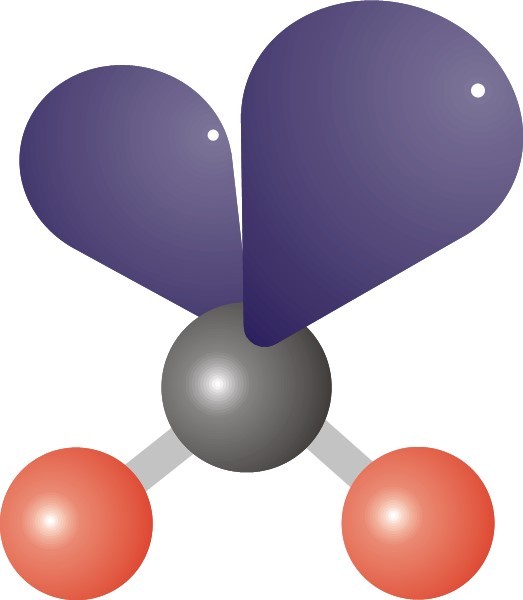
What molecule could this be? (Each purple cloud represents a lone pair of electrons.)
CO2
NH3
H2S
CH4
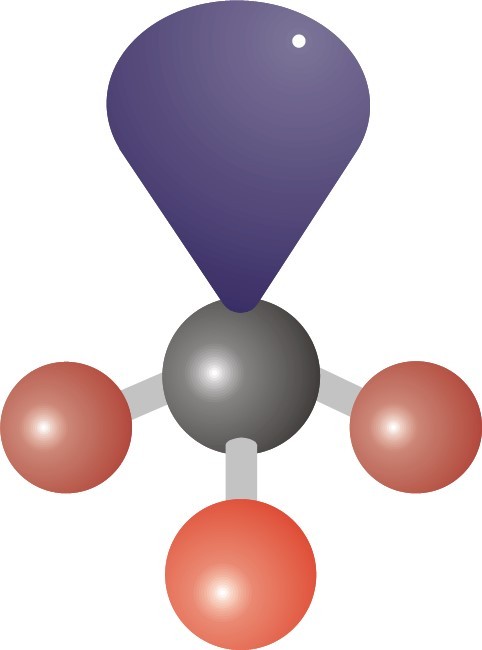
What molecule could this be? (The purple cloud represents a lone pair of electrons.)
H2O
NH3
CO2
CH4
This is what you call a reactant that you have enough of. The one that DOES NOT run out.
Limiting Reactant
Excess Reactant
Highly Reactant
Super Reactant
4NH3+6NO --> 5N2 + 6H2O
P4 + 3O2 --> P4O6
How many moles of P4O6 can be made if 3 moles of P4 react with 6 moles of O2?
1 mole
2 moles
4 moles
0 moles
Cu+ AgNO3-->
K + HCl -->
4Fe + 3O2 → 2Fe2O3
2H2O2 →2 H2O + O2
Ni (s) + H2O (l) →
Br2 (l) + KI (aq) →
Au (s) + HCl (l) →
Predict the product(s) of this reaction (don't worry about balancing):
Li + H2O →
Li2O + H2
LiO + H2
LiOH + H2
Li(OH)2
Br2 + NaF ->
Li + NaF ->
LiBr + Na ->
What of these is always soluble?
Nitrates
Phosphates
Carbonates
Hydroxides
What is the state of matter symbol for a soluble compound?
(s)
(aq)
(g)
(l)
(s)
(aq)
(g)
(l)
Predict the products of this reaction: Al2(SO4)3 + Ca3(PO4)2 --->
This reaction will not occur
Al(PO4) + Ca(SO4)
Al2Ca3 + (PO4)2(SO4)3
Al2(SO4)3 + Ca3(SO4)3
Predict the products of this reaction: AgF + KCl --->
This reaction will not occur.
AgCl + KF
AgCl3 + KF2
AgK + ClF
CuCl2 + NaOH → Cu(OH)2 + NaCl
Which product is insoluble?
The products for FeCl3 + AgNO3 ----> are...
Fe(NO3)3 (aq) + AgCl (s)
FeNO3 (aq) + AgCl3 (s)
Fe(NO3)3 (s) + AgCl (aq)
The name for the chemical formula AlCl3
aluminum chlorine
aluminide chloride
aluminum trichloride
aluminum chloride
When balancing an equation you can only add or adjust:
coefficients
subscripts
parentheses
exponents
What is the noble gas configuration for oxygen?
[Ar] 3p⁴
[He] 3s² 3p⁴
[He] 2s² 2p⁴
[Li] 2s² 2p⁴

What happens to the energy of an electron as it moves from n=4 to n=2?
energy is absorbed
energy is released
energy remains the same
unable to determine
What is the percent composition of oxygen in BaCrO₄?
20.5%
25.3%
54.2%
9.5%
How many moles of silver atoms are in 1.8 x 10²⁴ atoms of silver?
3.0 x 10¹ mol
3.0 x 10⁻¹ mol
3.0 mol
1.1 x 10⁴⁴ mol
1 mole of helium gas occupies what volume at STP?
22.4 L
0 °C
1 atm
4.00 L/mol
How many molecules are in 2.5 mol of NaCl?
1.51x10²³
146
4.15
1.51x1024

When Ryan poured vinegar on baking soda, which of the following was a sign that a chemical change occurred?
nothing happened
it fizzed and produced gas
it glowed
its color became darker
Protons have a ____________ charge.
Positive
Negative
Neutral
Neutrons are found ____________ the nucleus.
Inside
Outside
The number of protons in an atom. It is the same as the number of electrons.
Atomic Mass
Atomic Number
Element
Compound
The columns in the periodic table.
All members of groups/families behave the same way; they have the same chemical properties.
Groups/Families
Periods
Shiny, good conductors of heat, usually solid at room temperature, able to be molded into shapes.
Example: Lithium, Sodium, Magnesium, Calcium
Metals
Nonmetals
The most reactive metals in the table.
React best with Group 17 of the nonmetals.
Example: Hydrogen, lithium, sodium, potassium, rubidium, cesium, francium.
Alkali Metals
Alkaline Earth Metals
Halogens
Noble Gases
Matter that is different throughout, the parts of the mixture are distinguishable.
Example: Chex mix, chocolate chip cookie, sandwich, salad, pizza
Element
Compound
Homogeneous Mixture
Heterogeneous Mixture

