wayground logo

Free Printable Worksheets

Font size

S
M
L
XL
Worksheets

A&P Semester Exam Review

Total questions: 150

Worksheet time: 2hrs 34mins

Name
Class
Date
1.
a)
Quadriceps
b)
Satorius
c)
Hamstring
d)
Gastronecmius
2.
a)
Latissmius Dorise
b)
Erectors
c)
Deltoids
d)
Abdominal
3.
a)
Buccinator
b)
Occuli
c)
Satorius
d)
Gastronecmius
4.
a)
Abdominal
b)
External Oblique
c)
Erectors
d)
Satorius
5.
a)
Tricep
b)
Deltoid
c)
Hamstring
d)
Bicep
6.
a)
Buccinator
b)
Occuli
c)
Pectorals
d)
Soulius
7.
a)
Trapezius
b)
Gluteals
c)
Deltoid
d)
Hamstring
8.
a)
Hamstrin
b)
Quadricep
c)
Tibialis Anterior
d)
Gastrocenmius
9.
a)
Glutueal
b)
Hamstring
c)
Quadricep
d)
External Oblique
10.
a)
Pectoral
b)
Tricep
c)
Bicep
d)
Deltoid
11.
a)
Hamstring
b)
Quadriceps
c)
Gastronecmius
d)
Satorius
12.
a)
Abdominal
b)
External Oblique
c)
Pectorals
d)
Trapezius
13.
a)
Hamstring
b)
Quadriceps
c)
Bicep
d)
Satorius
14.
a)
Latissimius Dorsi
b)
Trapezius
c)
Triceps
d)
Erectors
15.
a)
Biceps
b)
Triceps
c)
Occuli
d)
Trapezius
16.
What is your cardiac muscle?
a)
heart
b)
brain
c)
lungs
d)
gluteus maximus
17.
What kind of muscle do you move on purpose?
a)
voluntary
b)
involuntary
c)
cardiac
d)
heart
18.
About how many muscles are in your body?
a)
206
b)
300
c)
over 600
d)
1,000
19.
What muscle is on your femur?
a)
Abs
b)
Bicep
c)
Gluteus Maximus
d)
Quads
20.
Skeletal muscles are attached to _________.
a)
organs
b)
heart
c)
bones
d)
lungs
21.
What is another name for your voluntary muscles?
a)
skeletal
b)
involuntary
c)
smooth
d)
cardiac
22.
What ties muscles to bones?
a)
cartilage
b)
tendons
c)
ligaments
d)
flexors
23.
tissue that connects bone to bone
a)
ligament
b)
tendon
c)
tissue
d)
muscle
24.
Name the chest muscle  highlighted in yellow.
a)
Biceps
b)
Pecs
c)
Triceps
d)
Hamstrings
25.
This man is flexing his......
a)
Triceps
b)
Biceps
c)
Fliceps
d)
Glutes
26.
a is pointing to
a)
deltoid
b)
trapezius
c)
biceps brachii
d)
triceps brachii
27.
c is pointing to
a)
external oblique
b)
rectus abdominus
c)
transverse abdominus
d)
internal oblique
28.
d is pointing to
a)
quadriceps
b)
hamstrings
c)
gastrocnemius
d)
gluteus maximus
29.
Where would you find the deltoid? 
a)
Forearm
b)
Shoulder
c)
Back
d)
Chest
30.
The gastrocnemius muscle is likely to be contracted when you:
a)
Play computer games.
b)
Bench press.
c)
Stand on your tip toes.
d)
Chew your food.  
31.
What major muscle do you sit on?
a)
latissimus dorsi
b)
quadricep
c)
bicep
d)
gluteous maximus
32.
Shrugging your shoulders uses your:
a)
trapezius
b)
hamstring
c)
tricep
d)
oblique
33.
What term means "In front of"?
a)
anterior
b)
inferior
c)
posterior
d)
superior
34.
Letter H is the ___
a)
Orbicularis Oris
b)
Masseter
c)
Frotalis
d)
Orbicularis Oculi
35.
Muscle responsible for raising the eye brows
a)
Temporalis
b)
Frotalis
c)
Zygomaticus
d)
Masseter
36.
Hamstrings are found on the _____ side of the body
a)
Anterior
b)
Posterior
37.
Action flexes the arm at the shoulder.
a)
Biceps brachii
b)
Pectoralis major
c)
Trapezius
d)
Triceps brachii
38.
Action is to extend forearm at the elbow.
a)
Pectoralis major
b)
Deltoid
c)
Biceps brachii
d)
Triceps brachii
39.
What part of the body does the gastrocnemius move?
a)
hand
b)
wrist 
c)
hip
d)
foot
40.
Which muscle rotates and flexes your head?
a)
masseter
b)
temporalis
c)
platysma
d)
sternocleidomastoid
41.
What is the name of muscle number 6?
a)
orbicularis oculi
b)
temporalis
c)
platysma
d)
epicranial aponeurosis
42.
Action of the quadriceps?
a)
extends leg at knee
b)
extends thigh at hip 
c)
flexes leg at knee
d)
flexes thigh at hip
43.

What muscle type is this?

a)

cardiac

b)

skeletal

c)

smooth

44.

Which muscle type is striated?

a)

cardiac

b)

skeletal

c)

smooth

d)

cardiac and skeletal

45.

What type of muscle lines the inside of the stomach?

a)

cardiac

b)

skeletal

c)

smooth

46.

What type of muscle is/are voluntary?

a)

smooth and cardiac

b)

smooth

c)

skeletal and smooth

d)

skeletal

47.

What type of muscle(s) is involuntary?

a)

skeletal and smooth

b)

cardiac and skeletal

c)

smooth and cardiac

d)

skeletal

48.

What type of muscle is not banded or striated?

a)

cardiac

b)

skeletal

c)

smooth

49.

What type of muscle tissue is this?

a)

cardiac

b)

skeletal

c)

smooth

50.
What is the name of the Thick filaments?
a)
Actin
b)
Myosin
c)
Myoglobin
d)
Titan
51.
What is the name of the thin filaments in the muscle cell?
a)
Actin
b)
Myosin
c)
Myoglobin
d)
Titan
52.
The neurotransmitter that signals muscle contraction is called...
a)
Ach
b)
Myosin
c)
Actin
d)
Calcium
53.
The plasma membrane of a skeletal muscle cell is called the:
a)
sarcomere
b)
myofilament
c)
sarcolemma
d)
sarcoplasm
54.
What is the name of the contractile unit in a muscle cell?
a)
fascicle
b)
sarcomere
c)
tendon
d)
endomysium
55.
Region where a motor neuron comes in close contact with a muscle cell.
a)
neurotransmitter
b)
muscular dystrophy
c)
muscle tension
d)
neuromuscular junction
56.
What two chemicals are necessary for muscle contraction to occur?
a)
Niacin and Potassium
b)
Calcium and ATP
c)
Sodium and Potassium
d)
Ach and Potassium
57.
___ and ___ are regulatory proteins bound to actin. 
a)
Troponin and tropomyosin
b)
Myosin and actin
c)
Calcium and Oxygen
d)
Glycogen and hemoglobin
58.
What is the structure that stores the Calcium in the muscle cell.  
a)
Sarcoplasm
b)
Sarcolemma
c)
Sarcoplasmic Reticulum
d)
Myoglobin
59.
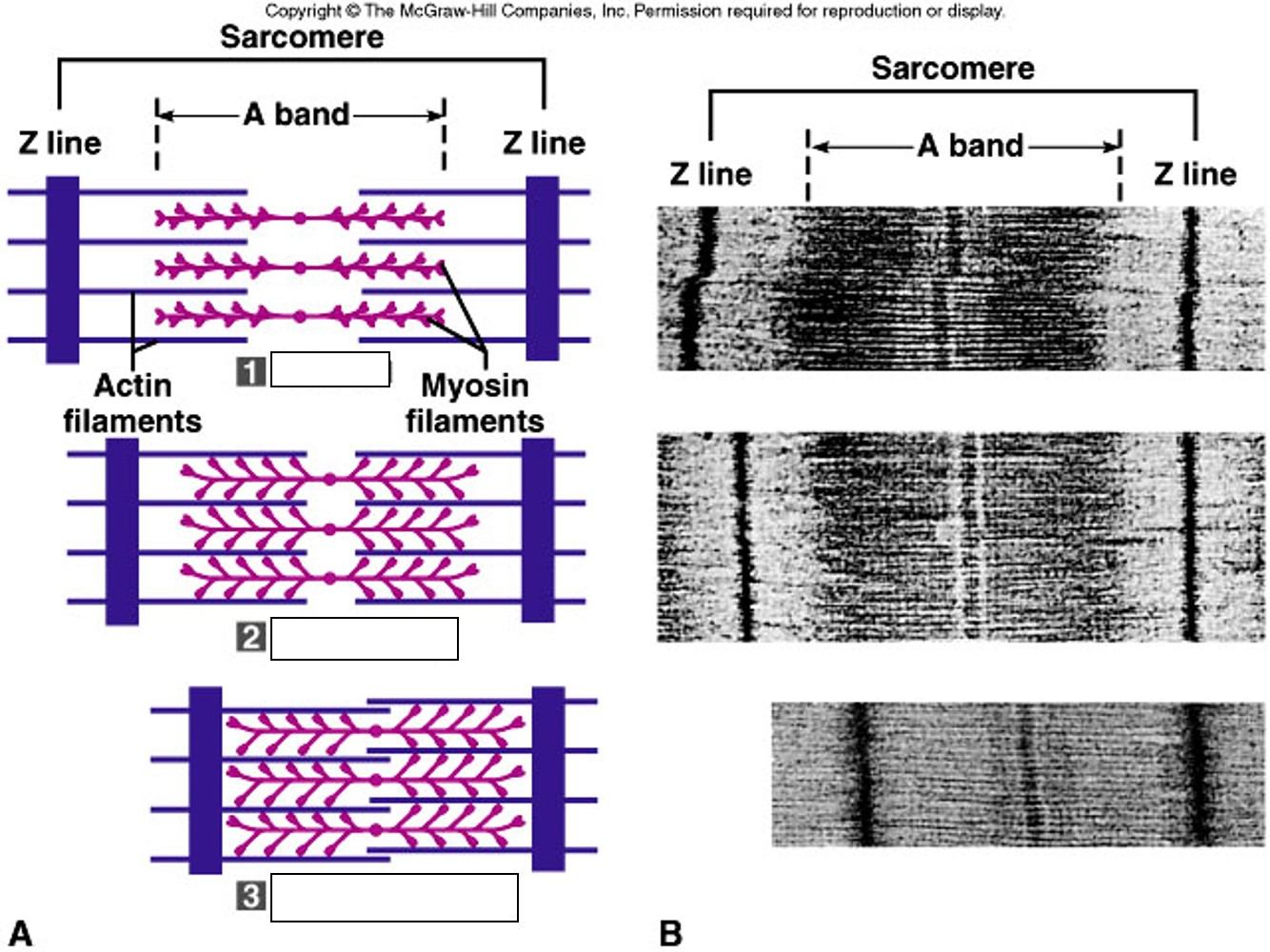
What state is the sarcomere in #1
a)
Relaxed
b)
Contracting
c)
Fully Contracted
d)
None of the above
60.
What state is the sarcomere in #2
a)
Relaxed
b)
Contracting
c)
Fully Contracted
d)
None of the above
61.
What is a crossbridge?
a)
Where myosin binds to actin
b)
Where the calcium crosses into the cytoplasm
c)
Where calcium binds with troponin
d)
None of the answers are correct.
62.
Another name for a muscle cell.
a)
Fiber
b)
Sacrolemma
c)
Sacromere
d)
Fascicle
63.
Muscles are attached to bones by _____.
a)
Ligaments
b)
Tendons
c)
Cartilage
d)
Axons
64.
Ribbon like organelle found in muscle cells that have a banded appearance
a)
sarcomere
b)
myofibril
c)
fascicle
d)
actin
65.
a)
Orbicularis Oris
b)
Orbicularis Oculi
c)
Corrugator
d)
Occipitals
66.
a)
Buccinator
b)
Zygomaticus Major
c)
Zygomaticus Minor
d)
Masseter
67.
a)
Masseter
b)
Buccinator
c)
Platysma
d)
Sternoclidomastoid
68.
a)
Mentalis
b)
Platysma
c)
Sternoclidomastoid
d)
Risorius
69.
Name the muscle
a)
Levator Scapula
b)
Trapezius
c)
Rhomboids major
d)
Latissimus Dorsi
70.
a)
rhomboids
b)
infraspinatus
c)
erector spinae
d)
middle trapezius
71.

The disorder the causes widespread pain in the muscles and skeletal system and causes fatigue, not thought to be caused by inflammation.

a)

fibromylagia

b)

dystonia

c)

myositis

d)

myasthenia gravis

72.
stretch or tear in the ligament
a)
sprain
b)
straom
c)
tetanus
d)
cramp
73.
What is Muscular Dystrophy?
a)
Weaker muscles
b)
Stronger muscles
c)
collapsing  muscles
d)
bigger than normal muscles
74.

Can muscular dystrophy be cured?

a)

No

b)

Yes

75.

The branch like structures on the neuron are called?

a)

Dents

b)

Branches

c)

Dentines

d)

Dendrites

76.
The part of the neuron that receives signals is the:
a)
Axon
b)
Dendrite
c)
Axon Terminal
d)
Cell Body
77.
Which part of the neuron is a long fiber that send information to other cells?
a)
dendrite
b)
terminal
c)
cell body
d)
axon
78.
What are the main parts of the Central Nervous System?
a)
Brain & Chest
b)
Spinal Cord & Spinal Nerves
c)
Brain & Spinal Cord
d)
Heart & Brain
79.
a signal molecule that transmits nerve impulses across synapses
a)
neuron
b)
neurotransmitter
c)
nerve
d)
action potential
80.
What is the insulating membrane that surrounds parts of the axon that helps to protect & propagate action potential?
a)
Axon
b)
Dendrites
c)
Node of Ranvier
d)
Myelin Sheath
81.

What contains the nucleus of the neuron?

a)

Terminal Bouton

b)

Cell Body

c)

Axon Hillock

d)

Myelin Sheath

82.
What is the difference between white and grey matter?
a)
White matter is myelinated axons, gray matter is unmyelinated axons.
b)
White matter is unmyelinated axons, and grey matter is myelinated axons.
c)
White matter is sensory axons, and grey matter is motor axons.
d)
White matter is motor axons, and grey matter is sensory axons.
83.

The part of the neuron that is protected by the myelin sheath is the

a)

cell body

b)

dendrites

c)

axon

d)

axon terminals

84.
X
a)
Axon Terminal Button
b)
Neurotransmitters
c)
Dendrite
d)
Synapse
85.
Z
a)
Dendrite
b)
Axon Terminal
c)
Neurotransmitters
d)
Synapse
86.

If I step on a nail...what type of neuron take that signal TO the CENTRAL NERVOUS SYSTEM?

a)

interneurons

b)

motor

c)

sensory

d)

receptors

87.

If I step on a nail...what type of neurons send the response from the brain to my muscles?

a)

motor

b)

interneurons

c)

sensory

d)

not neurons, muscle tissue sends the response

88.

The reaction to a stimulus by a muscle or gland

a)

response

b)

reaction

c)

effect

89.

A rapid, automatic response to a stimulus

a)

Reaction

b)

Reflex

c)

Response

90.
When a neuron is resting, the inside of the axon has a ____________ charge.
a)
positive
b)
negative
91.
The nob on the bottom part of the brain where balance and coordination are controlled is called the _____
a)
cerebellum
b)
cerebrum
c)
brain stem
92.

The cortical regions at the back of the brain, housing the visual cortex

a)

Temporal Lobe

b)

Occipital Lobe

c)

Frontal Lobe

d)

Parietal Lobe

93.

Cortical lobes that process sounds, including speech

a)

Temporal Lobe

b)

Occipital Lobe

c)

Parietal Lobe

d)

Frontal Lobe

94.

How do the parts of the brain communicate?

a)

snapchat

b)

molecular transference

c)

cells

d)

neurons

95.

Lying towards the back and top of the brain; involved in touch sensation and in perceiving spatial relationships

a)

Parietal Lobe

b)

Frontal Lobe

c)

Occipital Lobe

d)

Temporal Lobe

96.
Controls vital functions such as breathing and heart rate
a)
Diencephalon
b)
Frontal Lobe
c)
Brain Stem
d)
Cerebellum
97.
Nerves are
a)
wires in your body.
b)
bundles of neurons.
c)
quick impulses your body sends.
98.
Spinal nerves connect to
a)
the brain.
b)
the spinal cord.
c)
your entire body.
99.
The brain stem controls
a)
digestion, breathing, heart rate.
b)
feelings and emotions.
c)
memory.
100.
A patient has a possible concussion and the doctor is looking at him.  He has a difficult time paying attention. What part of the brain was hurt?
a)
parietal lobe
b)
occipital lobe
c)
frontal lobe
d)
brain stem
101.
Trochlear Nerve
a)
II
b)
IV
c)
V
d)
VIII
102.
Allows you to swallow your food
a)
Trigeminal
b)
Facial
c)
Glossopharyngeal
d)
Hypoglossal
103.
Sense of smell
a)
I
b)
II
c)
III
d)
VII
104.
Slows the heart rate 
a)
Glossopharyngeal
b)
Vagus
c)
Accessory
d)
Hypoglossal
105.
Balance
a)
Optic
b)
Trigeminal
c)
Vestibulocochlear
d)
Vagus
106.

What is the largest part of the brain?

a)

medulla

b)

cerebrum

c)

cerebellum

107.
Part of the peripheral that controls conscious activities
a)
autonomic
b)
somatic
c)
sympathetic
d)
parasympathetic
108.
Part of the autonomic that activates in high stress emergencies
a)
sympathetic
b)
reflexal
c)
parasympathetic
d)
somatic
109.
The part of the nervous system that consists of nerves that branch out from the CNS and connect to other body parts
a)
Sympathetic
b)
Parasympathetic
c)
Autonomic
d)
Peripheral
110.
The _____part of the autonomic nervous system is active during resting.
a)
sympathetic
b)
parasympathetic
c)
somatic
d)
peripheral
111.
The _____part of the autonomic nervous system is active during resting.
a)
sympathetic
b)
parasympathetic
c)
somatic
d)
peripheral
112.
The ____ nervous system controls unconscious activities.
a)
somatic
b)
sympathetic
c)
parasympathetic
d)
autonomic
113.
An example of voluntary movement would be:
a)
smiling
b)
heart beat
c)
digestion
d)
breathing 
114.
You're giving a speech in front of the class (most of you would feel this)
a)
sympathetic
b)
parasympathetic
115.
Amy has an itch on her nose and would like to scratch it.  What part of her nervous system will control the movement of her arm to scratch her nose?
a)
Somatic
b)
Sympathetic
c)
Parasympathetic
d)
Autonomic
116.
You have two types of nerves in your peripheral nervous system
a)
somatic and autonomic
b)
sensory and motor
c)
parasympathetic and sympathetic
d)
neurons and anti-neurons
117.
_____ neurons carry  messages away from the central nervous system.
a)
Motor
b)
Inter
c)
Sensory
d)
Flower
118.
_____ neurons carry messages to the central nervous system
a)
Motor
b)
Inter
c)
Sensory
d)
Fun
119.

How many subsections does the autonomic nervous system have?

a)

2

b)

3

c)

4

d)

1

120.
When you look in the mirror, what part of the eye can you NOT see?
a)
Iris
b)
Pupil
c)
Sclera
d)
Retina
121.

What part of the human eye opens and closes to adjust the total amount of light entering the eye.

a)

Human lens

b)

Cornea

c)

Scelera

d)

Iris

122.

Which part of the eye contracts and dilates based on the environment its exposed to?

a)

Cornea

b)

Sclera

c)

Iris

d)

Pupil

123.

Photoreceptors that detect colour are called..

a)

Cones

b)

Rods

124.

What is the white portion of the human eye called?

a)

Retina

b)

Sclera

c)

Dyslexia

d)

Pupil

125.

What is the clear tissue that covers the front of the eye called?

a)

Pupil

b)

Cornea

c)

Iris

d)

Lens

126.

This type of light sensitive (photosensitive) cell detects movement and black & white...

a)

Sclera

b)

Cornea

c)

Cones

d)

Rods

127.

Conjunctivitis is also known also:

a)

Lazy Eye

b)

Pink Eye

c)

Green Eye

d)

Iritis

128.

What part is #2?

a)

Pinna

b)

Ear Canal

c)

Ear Drum

d)

Oval Window

129.

What part is #3?

a)

Pinna

b)

Ear Canal

c)

Ear Drum

d)

Oval Window

130.

What part is #6?

a)

Semicircular Canals

b)

Eustachian Tube

c)

Cochlea

d)

Oval Window

131.

What part is #7?

a)

Semicircular Canals

b)

Eustachian Tube

c)

Cochlea

d)

Oval Window

132.

What part is #10?

a)

Incus/Anvil

b)

Malleus/Hammer

c)

Cochlea/Snail Shell

d)

Stapes/Stirrup

133.

What part is #12?

a)

Incus/Anvil

b)

Malleus/Hammer

c)

Cochlea/Snail Shell

d)

Stapes/Stirrup

134.

Your tongue and your ______ help you taste food.

a)

Teeth

b)

Lips

c)

Frenulum

d)

Nose

135.
What disorder causes the impairment of motor function due to the  disruption in brain development?
a)
Dystonia
b)
Tetanus
c)
DMD
d)
Cerebral palsy
136.
Destroyed by Alzheimer's disease
a)
Neurons
b)
Glial Cells
137.
Provides insulation to prevent interference from other electrical signals.
a)
Glial Cells
b)
Neurons
138.
Receives sensory information
a)
Neurons
b)
Glial Cells
139.
Releases chemicals to influence the growth of the other type of brain cell.
a)
Neurons
b)
Glial Cells
140.
For the other type of brain cell, guides growth and supports mature cells
a)
Neurons
b)
Glial Cells
141.
Star shaped
a)
Neurons
b)
Glial Cells
142.

Which of the following is NOT a function of the somatic nervous system?

a)

Stimulates skeletal muscle

b)

Is under voluntary control

c)

Consists of single neurons or nerve cells, which have their body located in the central nervous system

d)

Stimulates cardiac muscle

143.

Which of the following is NOT a cerebral lobe?

a)

parietal lobes

b)

occipital lobe

c)

temporal lobes

d)

parasympathetic lobes

144.

Which of the following taste buds is located on the back of the tongue?

a)

sweet taste

b)

salty taste

c)

sour taste

d)

bitter taste

145.

Which of the following is a common neurological disorder which is characterized by recurrent unprovoked seizures?

a)

epilepsy

b)

cerebral palsy

c)

bacterial meningitis

d)

Parkinson's disease

146.

Hyperopia is NOT which of the following?

a)

Commonly called farsightedness

b)

Causes individuals to be able to see objects far away better than those nearby

c)

Clouding of the natural lens

d)

Treated with glasses, contacts or surgery

147.

Which of the following regions of the brain consists of the thalamus, subthalamus, epithalamus and hypothalamus?

a)

cerebrum

b)

cerebellum

c)

brain stem

d)

diencephalon

148.

If you damage a spinal nerve, paralyzation will occur from which of the following locations?

a)

 Above the damaged nerve

b)

At the damaged nerve and below

c)

Below the damaged nerve

d)

In all extremities regardless of location

149.

Which of the following is a neurodegenerative disease which is found mostly in individuals over age 65?

a)

ALS

b)

Alzheimer's

c)

Cerebral Palsy

d)

Episepsy

150.

Which of the following is the minimum level of a stimulus required to activate a neuron? A. Resting potential B. Action potential C. Threshold D. Moving potential

a)

Resting Potential

b)

Action potential

c)

threshold

d)

moving potential