wayground logo

Free Printable Worksheets

Font size

S
M
L
XL
Worksheets

June Final 2023

Total questions: 146

Worksheet time: 4hrs 45mins

Name
Class
Date
1.

What type of reaction involves the breaking down of a substance into simpler substances?

a)

Single Replacement Reaction

b)

Double Replacement Reaction

c)

Synthesis Reaction

d)

Decomposition Reaction

2.

What type of reaction involves 2 substances combining to form 1 new compound?

a)

Decomposition Reaction

b)

Single Replacement Reaction

c)

Double Replacement Reaction

d)

Synthesis Reaction

3.

What type of reaction involves one element replacing another element in a compound?

a)

Single Replacement Reaction

b)

Double Replacement Reaction

c)

Synthesis Reaction

d)

Decomposition Reaction

4.

What type of reaction involves ions from 2 compounds exchanging places to form 2 completely new compounds?

a)

Single Replacement Reaction

b)

Double Replacement Reaction

c)

Synthesis Reaction

d)

Decomposition Reaction

5.

What are the reactants in the chemical equation pictured?

a)

CH4 and CO2

b)

CH4 and O2

c)

CO2 and H2O

d)

O2 and H2O

6.

What are the products of the chemical reaction pictured?

a)

CH4 and CO2

b)

CH4 and O2

c)

CO2 and H2O

d)

O2 and H2O

7.

What type of chemical reaction is this one?

Al(OH)3 --> Al2O3 + H2O

a)

Decomposition

b)

Combustion

c)

Synthesis

d)

Single Replacement

8.

What type of chemical reaction is this one?

CUO + CO2 --> CuCO3

a)

Decomposition

b)

Combustion

c)

Synthesis

d)

Single Replacement

9.

What type of chemical reaction is this one?

Ca + MgCl2 --> CaCl2 + Mg

a)

Decomposition

b)

Combustion

c)

Synthesis

d)

Single Replacement

10.

3KOH + H3PO4 --> K3PO4 + 3H2O

a)

Combination

b)

Decomposition

c)

Single replacement

d)

Double replacement

11.
CxHy +O--> H2O + CO2
a)
Decomposition
b)
Double replacement
c)
Combustion
d)
Single Replacement
12.

Balancing this reaction:

____ CH4 + ____ O2 ---> ___ CO2 + ____ H2O

a)

2,1,3,1

b)

1,2,1,2

c)

1,2,2,1

d)

2,1,1,2

13.

Balance this reaction:

____ Na3PO4 + ____ KOH ---> ____ NaOH + ____ K3PO4

a)

1,3,3,1

b)

1,3,2,1

c)

2,3,3,1

d)

1,1,3,1

14.

Balance this reaction:

____ NaF + ____ Br2 ---> ___ NaBr + ____ F2

a)

3,1,2,1

b)

1,2,3,4

c)

2,1,2,1

d)

1,2,1,2

15.
The red numbers in the image below represent ________
a)
subscripts
b)
coefficients
c)
I don't know, and don't want to try
d)
None of the answers are correct
16.
The blue numbers in the image below represent ________
a)
I don't know, and don't want to try
b)
coefficients
c)
subscripts
d)
none of the answers are correct
17.

Predict the products for this substance: Al2O3 → ? + ?

a)

Al + O2

b)

O2 + Al3

c)

Al2 + O3

d)

Al + O

e)

Al3 + O

18.

Predict the products if Calcium Carbonate reacts with Silver Sulfate.

CaCO3 + Ag2SO4 → ?

a)

Ag2CO3 + Ca2SO4

b)

AgCO3 + CaSO4

c)

CaSO4 + Ag2CO3

d)

Ag(CO3)2 + CaSO4

19.

If Ethylene (C2H4) reacts with Oxygen gas in a chemical reaction, what are the products?

a)

C2O2 + H4

b)

CO2 + H2 + O2

c)

CO + H2

d)

CO2 + H2O

20.

Barium Bromide reacts with Lithium Phosphate to yield Lithium Bromide and Barium Phosphate. What substance forms the precipitate in this reaction?

a)

Lithium Phosphate

b)

Lithium Bromide

c)

Barium Bromide

d)

Barium Phosphate

21.
What are the products of this reaction?
Cu+ AgNO3--> 
a)
Cu(NO3)2+Ag
b)
CuNO3 + Ag
c)
CuAg+NO3
d)
Cu+ AgNO3
22.

Write a Balanced Equation for this reaction: C2H4 + 3 O2 -->

a)
C2O2 + H4
b)
CO2 + HOH
c)
CO + H
d)
2 CO2 + 2H2O
23.
What are the correct formulas and coefficients for the products of the following single-replacement reaction?
Mg + Al(OH)3 →
a)
No Reaction
b)
Al + Mg(OH)3
c)
2 Al + 3 Mg(OH)2
d)
3 Al + MgOH3
24.
If an element is diatomic it should have a subscript of___
a)
2, always
b)
2, only when it is by itself
c)
it shouldn't have a subscript, it should have a coefficent
25.
What kind of reaction is this:
4Fe  +  3O2 →   2Fe2O3 
a)
Synthesis
b)
Decomposition
c)
Single Replacement 
d)
Double Replacement
26.
What kind of reaction is this:
2H2O2 →2 H2+ O2
a)
Synthesis
b)
Decomposition
c)
Single Replacement 
d)
Combustion
27.
What kind of reaction is this:
Fe + CuSO4 -> Cu + FeSO4
a)
Double Replacement
b)
Decompostion
c)
Single Replacement
d)
Combustion
28.
in a reaction, aqueous barium chloride reacts with aqueous potassium carbonate to produce solid barium carbonate and aqueous potassium chloride. what is the correct balanced equation.
a)
Ba2Cl(aq) + KCO3(aq) --> BaCO3(s) + KCl(aq)
b)
BaCl2(aq) + K2CO3(aq) --> BaCO3(s) + 2KCl(aq)
c)
BaCl(aq) + K2CO3(aq) --> BaCO3(s) + K2Cl(aq)
d)
Ba2Cl2(aq) + KCO3(aq) --> Ba2CO3(s) + KCl2(aq)
29.

What are the products of this reaction?

Cu2+ + AgNO3

a)

Cu(NO3)2 + Ag

b)

CuNO3 + Ag

c)

CuAg + NO3

d)

Cu + AgNO3

30.

What are the correct formulas and coefficients for the products of the following single-replacement reaction?

Ag + K2SO4

a)

No Reaction

b)

K2 + AgSO4

c)

2K + Ag(SO)4

d)

2K + AgSO4

31.

What is the total number of atoms present in 5Na3PO4?

a)

5

b)

55

c)

40

d)

8

32.

How many Mn atoms are found in the following compound?

2MnO4

a)

1

b)

2

c)

4

d)

8

33.

What is the little number after an element in a chemical equation called?

Example: H2

a)

Coefficient

b)

Atom

c)

Subscript

d)

Equation

34.
What is a coefficient?
a)
The small number on the right of the chemical symbol.
b)
The large number in front of a chemical formula.
c)
The number in between the chemical symbols.
d)
The number behind a chemical formula.
35.

What is the Law of Conservation of Mass?

a)

It states that matter cannot be created or destroyed.

b)

It states that energy cannot be created or destroyed.

c)

It states that matter can be created or destroyed.

d)

It states that sound can be created or destroyed.

36.
What are the smaller numbers that you CANNOT change in a chemical equation? 
a)
Coefficient
b)
Products
c)
Reactants
d)
Subscript
37.

What is the mass of 1.2 x 1024 atoms of C?

a)

2.0 grams

b)

24 grams

c)

0.17 grams

d)

1.4 x 1025 grams

38.

Calculate the number of atoms in 0.0340 g Zn.

a)

5.20 x 10⁻⁴ atoms Zn

b)

3.13 x 10²³ atoms Zn

c)

3.13 x 10²⁰ atoms Zn

d)

2.05 x 10²² atoms Zn

39.

How many grams are in 1.2 moles of neon?

a)

0.059 grams

b)

7.2 x 10²³ grams

c)

2.0 x 10⁻²⁴ grams

d)

24 grams

40.

How many moles are in 98.3 grams of aluminum hydroxide, Al(OH)3?

a)

1.26 moles

b)

0.8 moles

c)

7,670 moles

d)

1.63 x 10⁻²² moles

41.

Which of the following dimensional analysis setups will correctly convert 4.00x10²³atoms of cobalt to moles of cobalt? How many moles of colbalt are there?

a)

setup B : 0.664 mol Co

b)

setup A: 2.41x1047mol Co

c)

setup A : 0.664 mol Co

d)

setup B: 2.41x1047mol Co

42.
How many formula units are there in 2.45 moles potassium chloride?
a)
4.07 x 10⁻²⁴ 
b)
1.47 x 1024 
c)
1.47
d)
4.07
43.

What is the molar mass of table salt (NaCl)? Read all options! Be careful!

a)

58.44 amu

b)

35.45 g/mol

c)

22.99 g/mol

d)

58.44 g/mol

44.

To melt the ice, Juan throws 455 g of calcium chloride, CaCl2 on his sidewalk. How many moles of CaCl2 did he throw?

a)

50,500 moles

b)

4.10 moles

c)

7.56 x 10⁻²² moles

d)

111 moles

45.
What is the molar mass of NaOH?
a)
40 g/mol
b)
38.989 g/mol
c)
23.998 g/mol
d)
57.004 g/mol
46.
What is the molar mass of AuCl3?
a)
96 g
b)
130 g
c)
232.5 g
d)
303.3 g
47.
How many molecules of sugar (C6H12O6) are in a mole?
a)
24 molecules
b)
180 molecules
c)
180 g
d)
6.02 x 10²³ molecules
48.
The total number of sodium atoms in 46.0 grams is
a)
3.01 x 10²³
b)
6.02 x 10²³
c)
12 x 1023
d)
24 x 1023
49.

What is a mole ratio?

a)

An animal that burrows underground.

b)

How many moles of reactant are used up in a chemical reaction.

c)

The ratio of a reactant / product to a different one - compared by the number of particles.

d)

The process by which we multiply fractions by using numbers from a chemistry problem.

50.
2H2  +   O2  →  2H2O
How many moles of oxygen are consumed if 8 moles H2 are used?
a)
2
b)
4
c)
6
d)
8
51.
For the Balanced Reaction: 3 Mg + 1 Fe2O3 → 3 MgO + 2 Fe; What is the Ratio of moles of MgO to moles Fe?
a)
3mol Mg / 2 mol Fe
b)
2 mol Mg/ 3 mol Fe
c)
1 mol Fe/ 2 mol Fe
d)
3 mol MgO / 2 mol Fe
52.
Which of the following would increase the (gas) pressure of a system?
a)
Increase the Temperature
b)
Pump in more gas
c)
Decrease the volume
d)
All of these
53.
A neutral substance would have pH of...
a)
8
b)
7
c)
6
d)
14
54.
An extremely strong base would have a pH of...
a)
1
b)
7
c)
9
d)
14
55.
A weak base would have a pH of...
a)
8
b)
7
c)
6
d)
14
56.
An extremely strong acid would have a pH of...
a)
1
b)
7
c)
9
d)
14
57.
A weak acid would have a pH of...
a)
1
b)
7
c)
6
d)
14
58.
Which of the following is true about acids and bases?
a)
The lower the pH, the stronger the acid
b)
the higher the pH, the stronger the acid
c)
The lower the pH, the more neutral the acid
d)
The higher the pH, the weaker the base
59.
Which one of the following statements about strong acids is TRUE?
a)
Strong acids are 100% ionized in water.
b)
The conjugate base of a strong acid is a strong base.
c)
Strong acids are very concentrated acids.
d)
Strong acids produce solutions with a higher pH than weak acids. 
60.

In the equation 2 Al2O3 --> 4 Al + 3 O2, what is the mole ratio of aluminum to oxygen?

a)

10:6

b)

3:4

c)

4:3

d)

2:3

61.

Given the reaction: 4Al + 3O2 --> 2Al2O3

How many moles of Aluminum oxide do you have if you have 2 moles of Al?

a)

3 mole

b)

2 mole

c)

1 mole

d)

0.5 mole

62.

All alkali metals react with water to produce hydrogen gas and the corresponding alkaline metal hydroxide. A typical reaction is that between lithium and water :

2Li(s) + 2H2O(l) →2LiOH(aq) + H2(g)

Calculate the mass of H2 gas formed when 40.0 g of Li react with water

a)

4.21 g

b)

7.31 g

c)

5.80 g

d)

4.42 g

63.
The impact on the planet due to global warming is called...
a)
climate change
b)
the seasons
c)
the weather
d)
natural change
64.
Any amount of CO2 (Carbon Dioxide) in the atmosphere is bad for our planet.
a)
True
b)
False
65.
The conditions in an area over a long period of time?
a)
Climate
b)
Weather
66.
Changes from minute-to-minute, hour-to-hour, day-to-day
a)
Climate
b)
Weather
67.
Winters in Minnesota frequently experience temperatures below zero.
a)
Climate
b)
Weather
68.
Texas has long, hot summers.
a)
Climate
b)
Weather
69.
Increasing quantities of CO2 (Carbon Dioxide) in the atmosphere will cause air temperatures to be _____. 
a)
warmer
b)
cooler
70.
Which of the following is NOT evidence of global warming?
a)
Sea level rising
b)
Loss of Arctic Sea Ice
c)
Less Water Vapor in the Air
d)
More extreme weather events
71.
Climate change causes extreme weather conditions such as:
a)
Flooding
b)
Heat Waves
c)
Hurricanes
d)
All of the above
72.
Which of the following is NOT a greenhouse gas?
a)
Carbon dioxide CO2
b)
Methane CH4
c)
Water vapor
d)
Nitrogen N2
73.
Which human activity contributes the MOST carbon dioxide to the atmosphere?
a)
Fishing
b)
Breathing
c)
Burning Fossil Fuels
d)
Farming
74.
The amount of carbon dioxide CO2 in the atmosphere is decreasing. 
a)
True
b)
False
75.
Increased carbon dioxide may cause global warming by trapping more ____________ in the atmosphere.
a)
water
b)
gases
c)
heat
d)
water vapor
76.

Clues to ancient climates were like come from...

a)

ice cores

b)

fossil tree rings

c)

plant pollens

d)

all of the above

77.

Possible human solutions for limiting global warming and climate change are...

a)

being more energy-efficient

b)

using renewable sources of energy

c)

removing carbon from fossil fuel emissions

d)

all of the above

78.

What is the direct cause of rising sea levels?

a)

Melting Sea Ice

b)

Melting Land Ice

c)

Climate Change

79.

Floating sea ice melts...

a)

and causes sea levels to rise because it adds water to the ocean.

b)

but does not cause sea levels to rise because the ice displaces the same amount of ocean water as the melted ice would displace.

80.

Melting land ice...

a)

causes sea levels to rise because it adds water to the ocean.

b)

does not cause sea levels to rise because the water fills the space left by the melted sea ice.

81.
Which of the following is the best conclusion that can be made from this graph?
a)
atmospheric carbon dioxide levels have been decreasing since 1960
b)
Hawaii has a lot of carbon dioxide
c)
humans have been working hard to decrease carbon dioxide levels
d)
atmospheric carbon dioxide levels have increased steadily since 1960
82.
 What is the greenhouse effect?
a)
The warming of a planet due to trapped radiation.
b)
The cooling of Earth due to air pollution.
c)
The heating of a solid, such as a rock.
83.
What do scientists think the effect will be of having more greenhouse gases in our atmosphere?
a)
More warming of the atmosphere
b)
More cooling of the atmosphere
c)
More air in the atmosphere
d)
Less air in the atmosphere
84.
How do scientists collect evidence about climate?  
a)
using remote sensing from space with satellites
b)
by ground-based measurements of surface temperatures, carbon dioxide concentration and sea level
c)
by collecting “proxy data” from tree rings, ice cores, and historical records
d)
all of the above
85.
Changes in temperature are expected to be greatest
a)
near the equator
b)
near the poles
c)
between the equator and the North Pole
d)
between the equator and the South Pole
86.

Without the greenhouse effect, Earth's atmosphere would be __________ to support life.

a)

too hot

b)

too wet

c)

too dry

d)

too cold

87.

Living vegetation and the ocean are known as "carbon sinks" because

a)

they are made of carbon.

b)

they create carbon.

c)

they destroy carbon.

d)

they store carbon.

88.
Man made carbon dioxide comes from the burning of fossil fuels.  An example of a fossil fuel is
a)
wood
b)
oil
c)
shale
89.
Ocean acidification begins with 
a)
pollution from ships
b)
carbon dioxide released from combustion
c)
dumping of waste from cities into the ocean
90.
Carbon dioxide and seawater combine to form
a)
calcium carbonate
b)
carbon monoxide
c)
carbonic acid 
91.
Marine organisms make their shells from calcium and
a)
chloride
b)
carbonate
c)
seawater
92.
An example of a marine organism that needs calcium carbonate 
a)
a crab
b)
a shark
c)
an octopus
93.
Very slight increases in the acidity of seawater __________  marine organisms that make shells.
a)
doesn't bother
b)
has no effect on 
c)
is unhealthy and stresses
94.
Carbon dioxide levels in the air have changed throughout earth's history.  The difference today is how ______ the change is happening.
a)
rapidly 
b)
slowly 
c)
wide spread
95.
The process of burning fuel to drive a car or operate a factory is called 
a)
photosynthesis
b)
combustion
c)
respiration
96.

Which molecule makes water acidic?

a)

Carbonate Ions

b)

Carbon Dioxide

97.

When carbon dioxide ions react with water, what molecules do they release?

a)

Hydrogen Ions

b)

Carbonate Ions

98.

According to this slide

a)

CO2 is causing marine life to die by "poisoning' the water

b)

CO2 is destroying sea shells

c)

CO2 is formed from the combustion of Octane

99.

This image demonstrates that

a)

There is a direct correlation with the atmospheric CO2 and the CO2 in seawater

b)

That pH of the ocean increases as the atmospheric CO2 increases

c)

That there is no correlation between pH of the ocean and atmospheric CO2

100.
As the ocean becomes more acidic, the pH of the water
a)
increases
b)
decreases
101.

A pH of 3 is how much more acidic than a pH of 6?

a)

10

b)

30

c)

300

d)

1000

102.

What do some marine creatures do with the carbonate ion?

a)

use it as a food source

b)

use it as a defense mechanism

c)

use it to build shells and exoskeletons

d)

use it to cool body temperatures

103.

What is the typical pH of a base?

a)

higher pH, >7

b)

25 km

c)

lower pH, < 7

d)

110 ppm

104.

Consequence of acid on marine organisms?

a)

risk of extinction

b)

death

c)

their shells get stronger

105.

In chemistry,what is the scale used to specify the acidity or basicity in a water-based solution?

a)

pH

b)

acid level

c)

TA

d)

Kg

106.

What is the typical pH of an acid?

a)

higher pH, >7

b)

25 km

c)

lower pH, < 7

d)

110 ppm

107.

What happens to water when it is dissolved with carbon dioxide?

a)

it becomes more acidic

b)

it becomes more basic

c)

it becomes healthier to drink

d)

it turns into coal

108.

Why is carbonate important?

a)

Used as a buffer to keep ocean pH stable

b)

Used by animals to make shells and exoskeletons

c)

Used as an acid to keep ocean more acidic

d)

Used as a food source for animals

109.

Why is it important to know that shells decrease in mass in more acidic water?

a)

Shows us how organisms need acidic water to open their shells so they can eat

b)

Shows us how organisms' shells may become weak and the organisms could die

c)

Shows us how organisms could die as their predators eat them.

d)

Shows us that shells will decrease in mass but doesn't really relate to the real world

110.

If a liquid is basic, its pH is...

a)

From 0-7

b)

7

c)

From 7-14

d)

From 0-100

111.

If a liquid is acidic, its pH is...

a)

From 0-7

b)

7

c)

From 7-14

d)

From 0-100

112.

If a liquid is neutral, its pH is...

a)

From 0-7

b)

7

c)

From 7-14

d)

From 0-100

113.

Which would be the strongest acid?

a)

Lemon (pH 2.0)

b)

Orange (pH 3.3)

c)

Soda (2.5)

d)

Coffee (4.5)

114.

Which would be the strongest acid?

a)

Lemon (pH 2.0)

b)

Orange (pH 3.3)

c)

Soda (2.5)

d)

Coffee (4.5)

115.

Which would be the strongest base?

a)

Ammonia (pH 11)

b)

Milk of Magnesia (pH 10)

c)

Soapy Water (pH 12)

d)

Tooth Paste (pH 9)

116.

What are marine calcifiers?

a)

Ocean animals that can walk or swim

b)

Large ocean fish like sharks and barracudas

c)

Fish with hard scales

d)

Ocean animals that use calcium to make their shells and bodies

117.

How is ocean water becoming more acidic?

a)

Marine calcifiers are dying, making more acid

b)

The ocean is mixing with CO2 in the air to produce acid

c)

The ocean is getting too hot, which makes it acidic

d)

Humans are dumping large amount of acid in the ocean

118.

Which is an example of a marine calcifier?

a)

Crab

b)

Mussel

c)

Coral

d)

All of the above

119.

When water mixes with CO2 in the air, this creates...

a)

Carbonic acid

b)

Citric acid

c)

Lactic acid

d)

Acetic acid

120.

How does ocean acidification impact marine calcifiers?

a)

It weakens their shells and bodies

b)

It makes their food die

c)

It makes the water too warm for them

d)

It adds too much weight to their shells

121.
B2H6 + 3O2 -->2 HBO2 + 2 H2O
 What mass of O2 will be needed to burn 36.1 g of B2H6?
a)
13.8 g O2
b)
3.86 mol of O2
c)
124 g O2
122.
4 Al + 3 O2 –> 2 Al2O How much aluminum would be needed to completely react with 45 grams of O2?
a)
1.05 moles
b)
3.75 moles
c)
1.875 grams
d)
1.875 moles
123.
What is a substance that is dissolved in another substance? 
a)
solution
b)
solute
c)
solvent
d)
compound
124.
What is a solvent?
a)
The substance that does the dissolving in a solution.
b)
The substance that is being dissolved in a solution.
c)
The mixing of different substances.
d)
The process in which neutral molecules lose or gain electrons
125.
In the above picture, a powder is about to be poured into the liquid. Which of the following should be done to make this powder dissolve faster?

a)
stir the powder in the liquid
b)
freeze the mixture
c)
add more powder to the liquid
d)
store the mixture in a dark place
126.
When Koolaid mix is light colored and tastes watery it is a _______ solution.
a)
saturated 
b)
diluted
127.
When a Koolaid mix in water is dark in color and very sweet it is a __________ solution.
a)
concentrated 
b)
Diluted
128.
To make a solute dissolve more quickly i n a solvent which would you do?
a)
Put it in cold water and stir it
b)
Put it in warm water and stir it
129.
The concentration of a mixture can be increased in which of the following ways?
a)
Heating the mixture
b)
Adding more water “solvent”
c)
Adding more powder “solute”
d)
Stirring the mixture
130.
When a certain amount of solvent cannot hold any more solute it is called a ________ solution.
a)
Diluted
b)
Saturated
131.
How does a solution become supersaturated?
a)
dissolve lots of solvent in it.
b)
dissolve a little solute in it. 
c)
dissolve more solute than you should be able to. 
d)
dissolve a super amount of solvent in it. 
132.

Which of the following actions will NOT

increase the rate of dissolution

(dissolving)?

a)

Stirring the solution

b)

Decreasing the temperature

c)

Increasing the surface area of the

solute

d)

Increasing the temperature

133.

You are given a small beaker of solution at room temp. You add a bit of solute to the solution and it dissolves. The solution was:

a)

saturated

b)

unsaturated

c)

concentrated

d)

warm

134.
The chemical property of water that allows it to dissolve substances with positive and negative charges.
a)
Solubility
b)
Polarity
c)
Surface Tension
d)
Evaporation
135.
As temperature increases, the particle movement......
a)
speeds up or increases
b)
slows down or decreases 
c)
is equal to the temperature
d)
does not change 
136.
When a cold tire is inflated to a certain pressure and then is warmed up due to friction with the road, the pressure increases. This happens because the
a)
air molecules hit the walls of the tire less frequently
b)
rubber in the tires reacts with oxygen in the atmosphere
c)
air molecules speed up and collide with the tire walls more often
d)
air molecules diffuse rapidly through the walls of the tire.
137.

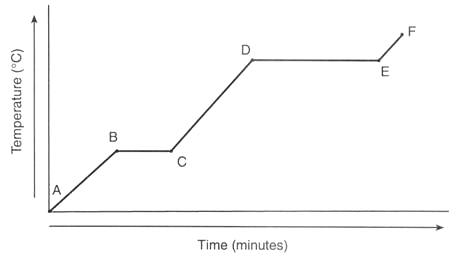
Is the substance gaining or losing energy?

a)

Gaining

b)

Losing

138.

What state/phase is the object likely from points A to B?

a)

Solid

b)

Liquid

c)

Gas

d)

Plasma

139.

What is happening to the particles in the substance between points A and B?

a)

Melting

b)

Freezing

c)

Speeding Up

d)

Slowing Down

140.

Is the substance gaining or losing energy?

a)

Gaining

b)

Losing

141.

Is the substance gaining or losing energy?

a)

Gaining

b)

Losing

142.
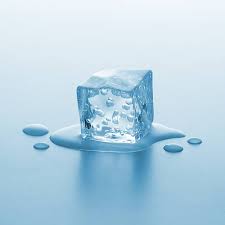
When a substance melts, the kinetic energy _____________.
a)

decreases

b)

stays the same

c)

increases

d)

decreases then increases

143.
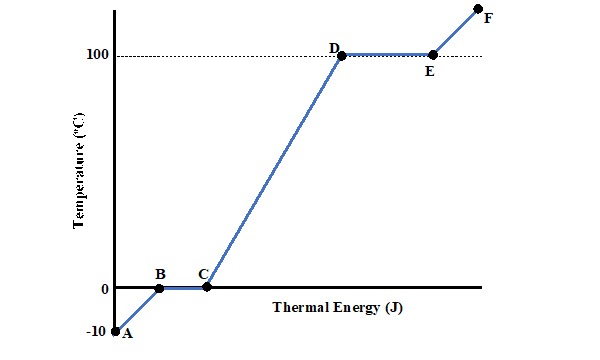
A substance's heating curve is shown in the graph.  What is its boiling point?
a)
100 C
b)
60 C
c)
80 C
d)
20 C
144.

Between which two points is the gas heating up?

a)

A ----> B

b)

B <---- C

c)

C ----> D

d)

D ----> E

e)

E ----> F

145.

Which of the following is a TRUE statement about the freezing process?

a)

At the freezing point, energy is added, particles move more slowly

b)

At the freezing point, energy is removed and the particles move more slowly

c)

At the freezing point, energy is removed and the particles move less freely

d)

At the freezing point, energy is added and the particles move more freely

146.

At the boiling point, with energy being added, which of the following choices are false?

a)

Particles move more quickly

b)

Particles begin to gain more freedom of motion

c)

Particles begin to lose freedom of motion

d)

Particles move more slowly