wayground logo

Free Printable Worksheets

Font size

S
M
L
XL
Worksheets

Bio 30 Final Review

Total questions: 159

Worksheet time: 3hrs 23mins

Name
Class
Date
1.
Which of the following is NOT a limiting factor for a population's size?
a)
Available food and nutrients
b)
Space
c)
predators
d)
small population size
2.
A patient visits the doctor for a checkup and is diagnosed with skin cancer. Which of the following is the MOST likely cause of this disease?
a)
poor eating and sleeping habits
b)
exposure to ultraviolet rays
c)
a defect in the person's immune system
d)
working with plants and animals
3.
Which of the following would be the RNA strand transcribed from the following DNA strand: ATTGGCTAG?
a)
UAAGGTTCA
b)
TTAGCCTTT
c)
UAACCGAUC
d)
TAACCGATC
4.
Which of the following is NOT found in the DNA of all organisms?
a)
Phosphate
b)
Guanine
c)
Deoxyribose
d)
Uracil
5.
In animals, sexual reproduction depends on the production of gametes. Which of the following processes produces gametes in animals? 
a)
Meiosis
b)
Binary fission
c)
Mitosis
d)
Fragmentation 
6.
Which of the following biomolecules carries genetic information?
a)
Lipids
b)
Carbohydrates
c)
Nucleic Acids
d)
Proteins
7.
What happens in G1 of the cell cycle?
a)
cell divides
b)
DNA replicates
c)
cell multiplies
d)
cell grows
8.
What happens in S-phase of the cell cycle?
a)
cell divides
b)
DNA replicates
c)
cell multiplies
d)
cell grows
9.
What happens in mitosis?
a)
cell divides
b)
DNA replicates
c)
cell multiplies
d)
cell grows
10.
What happens in cytokinesis?
a)
cytoplasm divides
b)
DNA replicates
c)
mitosis
d)
cell grows
11.
Which correctly places the stages of mitosis in order?
a)
metaphase, prophase, interphase, telophase
b)
metaphase, prophase, interphase, telophase
c)
prophase, metaphase, anaphase, telophase
d)
prophase, metaphase, anaphase, cytokinesis
12.
What part of DNA holds the genetic information?
a)
the nitrogenous base
b)
the ribose sugar
c)
the phosphodiester bond
d)
the phosphate
13.
If a homozygous dominant (AA) individual is crossed to a homozygous recessive (aa) individual, what will the genotypes be of the offspring?
a)
50% AA, 50% aa
b)
25% AA, 50% Aa, 25% aa
c)
100% Aa
d)
50% AA, 50% Aa
14.
What is meant by the term "genetic variation?"
a)
Some individuals have the same genes as others
b)
Some genes are multiplied in tetraploid organisms
c)
Some chromosomes are longer than others
d)
Some individuals have different genes than others
15.
 Why do structural, physiological, and behavioral adaptations of individuals become more common each generation?  
a)
Individuals with those adaptations do not breed frequently
b)
More offspring with those adaptations survive and reproduce 
c)
Well-adapted individuals rarely survive
d)
The alleles responsible for those adaptations increase or decrease randomly 
16.
Each body cell of a goat contains 60 chromosomes.  The number of chromosomes in a goat egg cell, produced by meiosis, will be
a)
15
b)
30
c)
60
d)
120
17.
The alleles Bb are:
a)
homozygous
b)
heterozygous
c)
homozygous recessive
d)
heterozygous dominant
18.
Which of the following alleles is homozygous recessive?
a)
Tt
b)
tt
c)
TT
d)
T
19.
A man treated his home with a pesticide that kills scorpions. The first application of the pesticide
killed 92% of the scorpions. Two months later he applied the pesticide to his home again, but the
second application killed only 65% of the scorpions. What would be the best explanation for the
decrease in the effectiveness of the pesticide?
a)
The pesticide is effective only against mature scorpions.
b)
Once scorpions learned how to fight the pesticide, they taught
others.
c)
The surviving scorpions were naturally resistant to the pesticide,
and that resistance was passed onto their offspring.
d)
The pesticide caused some of the scorpions’ digestives systems to mutate and metabolize the
pesticide.
20.
If the amount of food or resources available increases, the carrying capacity for an animal:
a)
Stays the same
b)
Increases
c)
Decreases
d)
Fluctuates
21.

Which cell structure makes proteins using coded instructions that come from the nucleus?

a)

Ribosomes

b)

Golgi Apparatus

c)

Mitochondrion

d)

Vacuole

22.

The CENTRAL nervous system consists of

a)

the brain only

b)

the brain and spinal cord

c)

neurons only

d)

the brain, the spinal cord and neurons

23.

The nervous system that is your body's control center, responsible for interpreting signals and making decisions is the

a)

central nervous system

b)

peripheral nervous system

24.

Which human body system is responsible for detecting, processing, and responding to stimuli?

a)

Circulatory

b)

Nervous

c)

Immune

d)

Skeletal

25.

Which part of a neuron sends the message out from the cell body?

a)

axon

b)

dendrite

c)

cell body

d)

neuron

26.

If I step on a nail...what type of neuron take that signal TO the CENTRAL NERVOUS SYSTEM?

a)

cerebrum

b)

motor

c)

sensory

d)

cerebellum

27.
The association area of the ___________ lobe processes visual information.
a)
Occipital lobe
b)
Temporal lobe
c)
Frontal lobe
d)
Parietal lobe
28.
The part of the brain that controls higher mental activities such as learning, perception, memory  and making decisions.
a)
cerebellum
b)
cerebrum
c)
thalamus
d)
midbrain
29.
Lobe involved with making decisions, planning, reasoning, and carring out voluntary body movements.
a)
Frontal Lobe
b)
Parietal Lobe
c)
Occipital Lobe
d)
Temporal Lobe
30.
Receives and processes  auditory information and involved in language comprehension?
a)
Frontal Lobe
b)
Temporal Lobe
c)
Occipital Lobe
d)
Parietal Lobe
31.
Which lobe of the brain is this?
a)
Frontal
b)
Parietal
c)
Occipital
d)
Temporal
32.
The Medulla Obolongata controls our ___.
a)
Blood Pressure 
b)
Muscle Memory 
c)
Pain reaction
d)
Memory 
33.

Which portion of the brain is responsible for balance and coordinating movements of the body?

a)

Cerebellum

b)

Cerebrum

c)

Brain stem

d)

Pons

34.

Which part is #2?

a)

iris

b)

cornea

c)

retina

d)

lens

35.
What part of the eye has the highest concentration of rods and cones?
a)
optic nerve
b)
fovea centralis
c)
optic disk
d)
iris
36.
What part of the eye is the colored, muscular portion of the eye which controls pupil size?
a)
iris
b)
lens
c)
choroid
d)
ciliary body
37.
What part of the eye focuses light on the retina?
a)
lens
b)
retina
c)
pupil
d)
ciliary body
38.
Type of photoreceptor that is active in bright light and perceives color?
a)
fovea centralis
b)
cones
c)
rods
d)
optic disk
39.
Type of photoreceptor that functions in low light and creates shades of gray
a)
retina
b)
rod
c)
cone
d)
choroid
40.

What does the Auditory canal do?

a)

Makes ear wax

b)

Pulls sound waves into the ear

c)

End the journey of the sound waves

41.

What happens in the eardrum?

a)

Sound waves vibrate the skin and delivers vibrations

b)

Sound waves make the tiny hairs in your ear move

c)

Carries the message to the brain

42.

What does the fluid inside your ears doing?

a)

Vibrates the skin in your ear

b)

Sends sound waves to the brain

c)

Vibrates the cilia (tiny hairs).

43.

What does the Auditory nerve do?

a)

Carries the message to the brain

b)

Carries the message to the Semi-Circular canal

c)

Send the message to the Eustachian tube

44.

What happens to the eardrum when sound hits, causing transmission of sound to the inner ear?

a)

it opens

b)

it grows hair

c)

it refracts the sound

d)

it vibrates

45.

The ear functions for ___________.

a)

balance

b)

hearing

c)

both balance and hearing

46.

What else does our ears do besides help us to hear?

a)

Smell

b)

Balance

c)

Sight

d)

Fight off sickness

47.
A goiter is an enlargement of what gland?
a)
Pituitary
b)
Adrenal
c)
Mammary
d)
Thyroid
48.
Which of the following anterior pituitary hormones stimulates growth of long bones?
a)
Prolactin
b)
Thyrotropin
c)
Adrenocorticotropic hormone
d)
Human growth hormone
49.
Which of the following hormones opposes the action of parathyroid hormone?
a)
Thyroid stimulating hormone
b)
Testosterone
c)
Insulin
d)
Calcitonin
50.
Glands located on the kidneys that regulate the use of carbohydrates and salt, and prepare the body for emergencies.
a)
Thyroid gland
b)
Pancreas
c)
Adrenal glands
d)
Ovaries/testes
51.
What is an Hormone?
a)
Substance produced in one part of an organism that affects another part of the organism
b)
Cells that has an receptor for a particular hormone
c)
Cells that pick up on a particular hormones through receptor
d)
Steroids that cause the abnormal actions in hormones
52.
What are the functions of the Pancreatic hormones?
a)
Reduce or increase blood sugar levels
b)
Increase blood calcium levels
c)
Increase blood pressure
d)
Decrease rate of metabolism
53.
Progesterone is responsible for?
a)
Regulation of menstrual cycle
b)
Release of glucocorticoids
c)
Increase blood sugar level
d)
Decrease stress level
54.
Insulin and glucagon;
a)
Are secreted by the beta cells of the islets of Langerhans
b)
Elevate blood glucose
c)
Are secreted in response to declining plasma levels of glucose
d)
Are secreted by the pancreas and are concerned with the regulation of blood glucose
55.
Function of parathyroid gland?
a)
produces hormones that influence metabolic rate
b)
decrease blood calcium
c)
increase bone calcium levels
d)
decreases bone calcium levels
56.
Function of adrenal glands:
a)
produces hormones that control BSL (blood sugar level)
b)
control female characteristics and menstrual cycle
c)
control male characteristics and sperm production
d)
help prepare the body for stress
57.

Which structure is the vas deferens?

a)

A

b)

B

c)

C

d)

D

58.

Which part is where fertilisation takes place?

a)

a

b)

b

c)

c

d)

d

e)

g

59.

Where are mature sperm stored, before they are ejaculated?

a)

epididymis

b)

seminiferous tubules

c)

vas deferens

d)

seminal vesicles

e)

prostate gland

60.

Which label indicates the ovary?

a)

d

b)

i

c)

c

d)

h

e)

g

61.

Which structure is a corpus luteum?

a)

A

b)

B

c)

C

d)

E

e)

F

62.

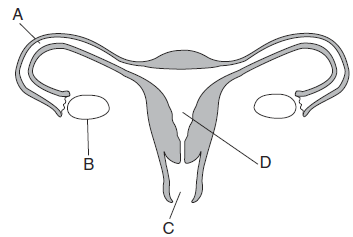
The human female reproductive system is represented below. Where will the embryo attach itself after fertilization?

a)

A

b)

B

c)

C

d)

D

63.

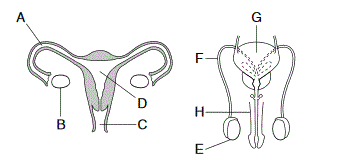
The diagram represents the reproductive systems of the human female and male. In which two structure are the gametes made

a)

B and E

b)

B and H

c)

H and E

d)

D and G

64.
Chimpanzees have 48 chromosomes in each normal body cell. How many chromosomes does a chimpanzee gamete contain?
a)
23
b)
24
c)
46
d)
48
65.
The ___________ is the fetus' link to life.
a)
umbilical cord
b)
fallopian tubes
c)
placenta
66.
the process when a sperm cell joins an egg
a)
penis
b)
ovaries
c)
menstrual cycle
d)
fertilization
67.
What do you call the process in which the ovary releases a mature egg cell?
a)
penile erection
b)
ejaculation
c)
ovulation
d)
nocturnal emission
68.
What do you call the union of egg and sperm cell?
a)
penile erection
b)
ejaculation
c)
fertilization
d)
ovulation
69.
What is the main role of Progesterone?
a)
Completes development of uterus wall, promotes glycogen storage
b)
Stimulates follicle to burst and release the ovum
c)
Stimulates rebuilding of the uterus wall
d)
Stimulates one egg cell to develop (become follicle)
70.
What is the main role of FSH?
a)
Stimulates follicle to burst and release the ovum
b)
Stimulates rebuilding of the uterus wall
c)
Stimulates one egg cell to develop (become follicle)
d)
Completes development of uterus wall, promotes glycogen storage
71.
On what day of the cycle is ovulation?
a)
Day 4
b)
Day 8
c)
Day 14
d)
Day 28
72.
The two hormones that maintain the lining of the uterus are:
a)
FSH and Oestrogen
b)
LH and Oestrogen
c)
Oestrogen
d)
Progesterone and Oestrogen
73.
In correct chronological order, the three phases of the human ovarian cycle are:
a)
menstrual → ovulation → luteal. 
b)
follicular → luteal → secretory. 
c)
menstrual → proliferative → secretory. 
d)
follicular → ovulation → luteal. 
74.
This occurs on days 1 to 5 of the menstrual cycle.
a)
The lining of the uterus remains in place in preparation for the possible arrival of an early embryo.
b)
Shedding of the lining of the uterus
c)
An egg is released from the ovaries
d)
The lining of the uterus builds up
75.
The ovarian follicle is stimulated through development by:
a)
FSH
b)
LH
c)
Estrogen
d)
Progesterone
76.
Ovulation is trigger by a surge in:
a)
FSH
b)
LH
c)
Estrogen
d)
Progesterone
77.

A temporary suspension of the menstrual cycle normally occurs during

a)

menstruation

b)

pregnancy

c)

ovulation

d)

menopause

78.

The animal's digestive tract forms from the _______.

a)

endoderm

b)

mesoderm

c)

ecotoderm

d)

protostome

79.

The embryo layer that forms the skin and nervous tissue is the _____.

a)

endoderm

b)

mesoderm

c)

ectoderm

d)

deuterostome

80.

Embryonic structure of an animal that consists of TWO cell layers

a)

blastula

b)

gastrula

c)

morula

d)

blastocyst

81.

______ implants itself into the lining of the uterus.

a)

blastual

b)

gastrula

c)

blastocyst

d)

morula

82.
Name the process in the diagram. 
a)
Meiosis 
b)
Mitosis 
c)
Endocytosis 
d)
Phagocytosis 
83.
Which of the following best describes meiosis?
a)
It is carried out in all tissues that require cell replacement. 
b)
It occurs only in cells in the reproductive structures of organisms. 
c)
It happens in all tissues except the brain and spinal cord
d)
It is the first stage of mitosis 
84.
The diagram shows two strawberry plants. Plant 2 is produced asexually from plant 1. If the leaf cells of plant 1 have 47 chromosomes, how many chromosomes will be found in the leaf cells of plant 2? 
a)
14
b)
28
c)
47
d)
112
85.
Mitosis and meiosis are processes involved in cellular reproduction. Which of the following describes an even that results from mitosis but not meiosis? 
a)
Two stages of cell division 
b)
Replication of cellular genetic material 
c)
Daughter cells that are identical to the parent cell
d)
Four daughter cells that are produced from each parent cell. 
86.
Which of the following best describes cancer?
a)
absence of cyclins in the DNA
b)
Multiple gene mutations on a chromosome of DNA
c)
Uncontrolled cell growth caused by mutations in genes that control the cell cycle.
d)
Presence of genetic defects caused by hereditary disorders. 
87.
Which of the following phases of mitosis is represented by the diagram below? 
a)
Prophase
b)
Metaphase 
c)
Anaphase 
d)
Telophase 
88.
What letter correctly represents structure X in the diagram? 
a)
Spindle fibers
b)
Cleavage Furrow 
c)
Chromosomes
d)
Centrioles
89.
In both mitosis and meiosis, sister chromatids separate during anaphase, but there are _____ haploid nuclei produced by meiosis compared to _______ diploid nuclei by mitosis. 
a)
6,3
b)
4,2
c)
2,4
d)
3,6
90.
a)
Anaphase
b)
Cytokinesis
c)
Telophase
d)
Metaphase
91.
a)
Cytokinesis
b)
Anaphase
c)
Telophase
d)
Prophase
92.
a)
Prophase
b)
Interphase
c)
Anaphase
d)
Telophase
93.
Place these cells in order of mitosis.
a)
A, B, C, D, E
b)
B, E, D, A, C
c)
C, E, A, D, B
d)
B, D, A, E, C
94.
Human eggs and sperm are _____, and each has ____ chromosomes.
a)
diploid, 23
b)
diploid, 46
c)
haploid, 23
d)
haploid, 46
95.
The process on the left is:
The process on the right is:
a)
Left: meiosis
Right: meiosis
b)
Left: meiosis
Right: cloning
c)
Left: mitosis
Right: meiosis
d)
Left: mitosis
Right: mitosis
96.
The cells produced in meiosis are...
a)
Identical
b)
Unique
97.
The daughter cells in mitosis are...
a)
Identical
b)
Unique
98.

If the daughter cells each have 16 chromosomes after cell division, what was the number of chromosomes in the parent cell? See Figure M-2.

a)

16

b)

6

c)

32

d)

4

99.

A tomato plant cell has 24 chromosomes. How many chromosomes will each daughter cell have after the cell undergoes a mitotic division?

a)

6 chromosomes each

b)

12 chromosomes each

c)

24 chromosomes each

d)

48 chromosomes each

100.
What is the result of mitosis?
a)
1 cell
b)
2 genetically identical cells
c)
2 genetically different cells
d)
4 genetically identical cells
101.
What is the relationship between DNA and chromosomes?
a)
Chromosomes are made of DNA
b)
DNA is made of chromosomes
c)
DNA and chromosomes are the same thing.
d)
All of the above are correct
102.

Cystic fibrosis is an inherited disease that occurs when an individual is homozygous for a recessive allele.

If parents are both heterozygous for this characteristic, what is the probability that their first child will have cystic fibrosis?

(a)  

103.

What determines the sex of a baby?

a)

the father’s blood group

b)

the father’s chromosomes

c)

the mother’s blood group

d)

the mother’s chromosomes

104.

In cats, the allele for short hair is dominant to the allele for long hair. A short-haired cat gives birth to five kittens. Two of them have long hair.

Which statement must be correct?

a)

Neither of the parents is heterozygous

b)

One parent is homozygous

c)

The female cat is heterozygous

d)

The male cat is heterozygous

105.

Albinism in humans is caused by a recessive allele.

Parents who do not suffer from the condition produce an albino child.

What is the probability that their second child will be born albino?

(a)  

106.

An individual has the genotype Bb.

What is the correct description of this genotype?

a)

heterozygous, with two different alleles of the same gene

b)

heterozygous, with two different genes of the same allele

c)

homozygous, with two different alleles of the same gene

d)

homozygous, with two different genes of the same allele

107.
Which of the following is a phenotype?
a)
BB
b)
Bb
c)
bb
d)
Blue eyes
108.
An allele whose trait only shows up when no dominant allele is present.
a)
hidden allele
b)
dominant allele
c)
recessive allele
d)
present allele
109.
What gamete possibilities could come from this parent's genotype?
a)
AB, AB, aB, aB
b)
Ab, AB, Ab, ab
c)
Ab, Ab, Ab, Ab
d)
AB, aB, ab, aB
110.

What goes in box 3

a)

Aabb

b)

AABB

c)

AAbb

d)

aaBb

111.
What genotype is missing from this Punnett Square?
a)
RrYy
b)
RRYY
c)
rryy
d)
RrYY
112.
Based off this punnett square, what fraction of the offspring will have wrinkled, yellow seeds?
a)
9/16
b)
3/16
c)
1/16
d)
16/16
113.
A male beetle has the genotype Ttbb. If this beetle mates with a female with genotype TTBb, what is the chance their offspring will have the genotype TtBb?
a)
3/16
b)
4/16
c)
8/16
d)
12/16
114.

A white mouse with red eyes is crossed with a black mouse with brown eyes. The white mouse is recessive for both of its traits. The black mouse is dominant for both of its traits.

This cross would be

a)

BBEE x bbee

b)

BBEe x BbEe

c)

BbEE x BbEe

d)

BBee x BBEE

115.

"T" is dominant, "t" is recessive. If an organism has the genes "Tt."

Which will trait will result?

a)

"T" dominant

b)

"t" recessive

116.

"G" is dominant, "g" is recessive. If an organism has the genes "gg."

Which will trait will result?

a)

"G" dominant

b)

"g" recessive

117.
T - tall and t = short
In the punnett square below, what belongs in the missing square
a)
tt
b)
Tt
c)
Bb
d)
TT
118.
B=brown eyes
b= blue eyes
What is true about these two brothers that have brown eyes:
One has genotype BB the other Bb.
a)
they have same phenotype and genotype
b)
they have different genotypes and phenotypes
c)
they have same phenotype but different genotypes
d)
they have same genotype but different phenotypes
119.
B=brown eyes
b= blue eyes
What is true about these two brothers that have brown eyes:
One has genotype BB the other Bb.
a)
they have same phenotype and genotype
b)
they have different genotypes and phenotypes
c)
they have same phenotype but different genotypes
d)
they have same genotype but different phenotypes
120.

When one allele is not dominant over another, resulting in a blended phenotype for heterozygous offspring is considered....

a)

Incomplete Dominance

b)

Codominance

121.

Some flowers are controlled by codominance. Red flowers (RR), blue flowers (BB) and Speckled flowers (RB).


Cross a red flower with a speckled flower. What is the phenotypic ratio?

a)

2 red, 2 speckled

b)

2 red, 2 blue

c)

2 blue, 2 speckled

122.

Some flowers are controlled by codominance. Red flowers (RR), blue flowers (BB) and Speckled flowers (RB).


Cross two speckled flowers.

a)

1 red, 2 speckled, 1 blue

b)

2 red, 2 blue

c)

2 blue, 2 speckled

d)

1 red, 1 speckled, 2 blue

123.

Some flowers are controlled by codominance. Red flowers (RR), blue flowers (BB) and Speckled flowers (RB).


Cross a red flower with a blue flower.

a)

1 red, 2 speckled, 1 blue

b)

2 red, 2 blue

c)

4 speckled

d)

1 red, 1 speckled, 2 blue

124.

Radish color is completely dominant, red and white are pure breeding colors. While heterozygous are purple.


Cros a red radish with a white.

a)

4 purple

b)

1 red, 2 purple, 1 white

c)

2 red, 2 white

d)

1 red, 1 purple, 2 white

125.
What are the nucleotides made of?
a)
Sugar, Phosphate, nitrogen base
b)
Phosphate, Adenine, nitrogen base
c)
Thymine, Adenine, Cytomine
d)
Phosphate, Nitrogen, Adenine
126.
Adenine bonds with ______________.
a)
Guanine
b)
Thymine
c)
Cytosine
d)
Adenine
127.
Guanine bonds with ______________.
a)
Adenine
b)
Guanine
c)
Cytosine
d)
Thymine
128.
What are the 4 nitrogen bases?
a)
adenine, thymine, cytoplasm, and guanine
b)
adenine, thymine cytosine, and guanine
c)
adenine, thymine, cytosine, and gylcerol
d)
adenine, thymine, cytosine, and glucose
129.
Which sequence of DNA bases would pair with this partial strand
ATG TGA CAG
a)
ATG TGA CAG
b)
TAC ACT GTC
c)
GTA AGT GAC
d)
CAT TCA CTG
130.
Which shows the correct complementary base pairing for DNA?
a)
C-A, T-G
b)
A-G, C-T
c)
C-G, U-A
d)
T-A, G-C
131.
What determines the code, or information, of a DNA molecule?
a)
the shape (structure) of the nitrogen bases
b)
the order (sequence) of the nitrogen bases
c)
the color of the nitrogen bases
d)
the frequency (number) of nitrogen bases
132.
Which 2 molecules form the sides (backbone) of the DNA ladder?
a)
deoxyribose sugar and adenine
b)
deoxyribose sugar and a hydrogen bond
c)
deoxyribose sugar and the nucleus
d)
deoxyribose sugar and phosphate
133.
The two strands of nitrogenous bases in DNA are joined by which type of bond?
a)
polar bonds
b)
ionic bonds
c)
covalent bonds
d)
hydrogen bonds
134.
A long chain of amino acids is a/an
a)
protein
b)
nucleic acid
c)
tRNA
d)
mRNA
135.
If a DNA molecule consists of 29% Guanine, how much cytosine will it contain?
a)
29%
b)
58%
c)
21%
d)
I have no idea.
136.
DNA replication results in two DNA molecules,
a)
each one with two original strands
b)
each one with two new strands
c)
each one with one new strand and one original strand
d)
one with two new strands and the other with two original strands
137.
order of replication
a)
3, 4, 2, 1
b)
3, 1, 4, 2
c)
2, 1, 4, 3
d)
3, 4, 1, 2
138.
In what phase of the cell cycle does DNA replication take place?
a)
G1
b)
S
c)
G2
d)
M
139.
Which enzyme is responsible for adding nucleotides?
a)
Topoisomerase
b)
DNA Polymerase
c)
Ligase
d)
Primase
140.
The process of DNA replication is called semi conservative because it results in
a)
none of these
b)
Two DNA molecules.  One original molecule and one with two new strands
c)
two exact copies with new strands
d)
two identical molecules, each with 1 original strand and one new.
141.
How does RNA differ from DNA?
a)
RNA contains uracil and deoxyribose
b)
RNA contains ribose and thymine
c)
RNA contains uracil and ribose
d)
RNA contains adenine and ribose
142.
How would the DNA sequence GCTATA be transcribed to mRNA?
a)
GCUAUA
b)
CGATAT
c)
CGAUAU
d)
GCUTUT
143.
The process by which the genetic code of DNA is copied into a strand of RNA is called
a)
translation
b)
transcription
c)
transformation
d)
replication
144.

What is the correct order to make a protein?

a)

Protein, DNA, RNA

b)

RNA, DNA, Protein

c)

DNA, RNA, Protein

d)

Protein, RNA, DNA

145.

RNA has what base that is instead of thymine?

a)

guanine

b)

adenine

c)

thymine

d)

uracil

146.
Where does transcription take place?
a)
nucleus
b)
cytoplasm
c)
ribosome
147.

Where are proteins made?

a)

ER

b)

nucleus

c)

cytoplasm

d)

mitochondria

148.
Translation takes place in the 
a)
ribosome
b)
chloroplast
c)
nucleus
d)
mitochondria
149.
Brings the amino acids to the ribosome
a)
mRNA
b)
tRNA
c)
rRNA
d)
DNA
150.
What would be the tRNA anticodon for the mRNA codon CAG?
a)
GTC
b)
GUC
c)
CUG
d)
CAG
151.
How many amino acids are coded for by this sequence of nucleotides:
ATG GGA ACT CCA
a)
4
b)
2
c)
6
d)
12
152.
The job of tRNA is to
a)
carry amino acids to the ribisomes
b)
carry ribisomes to the ER
c)
carry glucose to mitochondria
d)
carry mRNA out of the nucleus
153.

Which Hardy-Weinberg factor represents the frequency of heterozygous individuals in a population?

a)

p2

b)

2pq

c)

q2

d)

p2 + 2pq

154.
A few deer wander out of their native woods into a completely new park where no deer had ever been before. They go on to create an entirely new population.
a)
Genetic Drift
b)
Natural Selection
c)
Non-random mating
d)
Mutation
155.
A population of 150 individuals has an allele frequency of 0.3 for the dominant allele (B) and a frequency of 0.7 for the recessive allele (b). Use the Hardy-Weinberg equation to determine the frequency of the genotype (bb).
a)
0.09
b)
0.42
c)
0.49
d)
0.21
156.

The allele frequency of p=.20 What is the percentage of recessive genotype?

a)

.80

b)

.04

c)

.32

d)

.64

157.
Gene flow involves
a)
Natural disasters killing most of the members of a population
b)
Individuals moving into and out of the population
c)
Selective mating
d)
Small changes because of the environment
158.

If a population experiences no migration, is very large, has no mutations, has random mating, and there is no selection, which of the following would you predict?

a)

The population will evolve, but much more slowly than normal

b)

The makeup of the population's gene pool will remain virtually the same as long as these conditions hold.

c)

The composition of the population's gene pool will change slowly in a predictable manner.

d)

Dominant alleles in the population's gene pool will slowly increase in frequency while recessive alleles will decrease.

e)

The population probably has an equal frequency of A and a alleles.

159.
When a population is in Hardy-Weinberg equilibrium,  what is NOT happening to the species?
a)
Survival
b)
Reproduction
c)
Death
d)
Evolution