
 Worksheets
Basic Physics Final Examination
Total questions: 77
Worksheet time: 58mins

Heat is defined as
the transfer of thermal energy from one object to another due to temperature difference
the temperature of a solid, liquid, or gas
The kinetic energy of a solid, liquid, or gas.
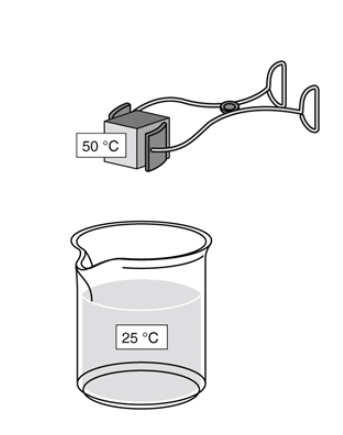
As part of a lab experiment, Tasha drops a metal cube into a beaker of water, as shown in the figure below.
After energy in the form of heat transfers between the substances, what is the final temperature of the water?
The final temperature is 25 °C because there is more water than metal.
The final temperature is 50 °C because the metal warms the water to the temperature of the metal.
The final temperature is between 25 °C and 50 °C because energy is transferred from the metal to the water.
The final temperature is between 25 °C and 50 °C because most of the thermal energy is lost to the air around the substances.

The water in Mario’s swimming pool absorbs energy as heat during the day. Which of the following would the water in the pool be most likely to do?
condense
evaporate
freeze
melt
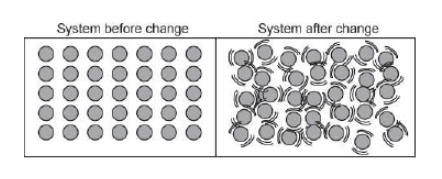
The picture below shows a closed system before and after undergoing a change.
What was changed in the system?
Particles were added to the system.
Water was added to the system.
Heat was added to the system.
Air was added to the system.
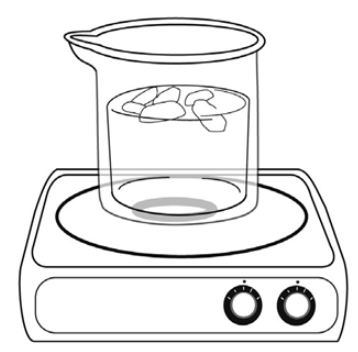
Emerson places a beaker of water on a hotplate and turns the hotplate on. The temperature in the room is 25 ºC. After the water heats to 75 ºC, she adds pieces of ice to the beaker.
Which of the following describes a transfer of heat energy that occurs during this experiment?
from the air to the water
from the ice to the beaker
from the water to the ice
from the water to the hotplate

Joe places two solid objects in contact with each other. Which property determines the direction of the flow of heat between the two objects?
material of the objects
volume of objects
density of objects
temperature of objects
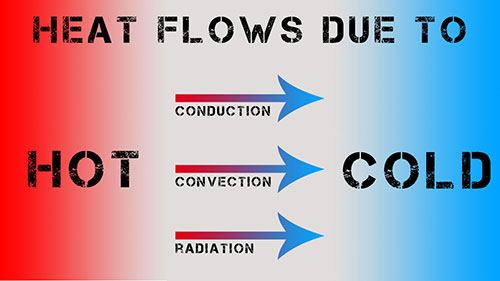
Jeriah places two metal cubes in contact with each other. Energy transfers as heat flows from Cube A to Cube B. What conclusion can you draw regarding Cube A?
It is larger than Cube B.
It is cooler than Cube B.
It is smaller than Cube B.
It is warmer than Cube B.
How does heat transfer when you hold an ice cube in your hand?
from the cold ice cube to your warm hand
the cold ice cube makes your hand cold
from your warm hand to the cold ice cube
very carefully

How does the thermal energy of the liquid in the larger beaker compare to the thermal energy of the liquid in the smaller beaker?
The liquid in the larger beaker has less thermal energy than the liquid in the smaller beaker.
The liquid in the larger beaker has more thermal energy than the liquid in the smaller beaker.
The liquid in the larger beaker has the same amount of thermal energy as the liquid in the smaller beaker.
The exact volume of the liquid in each beaker must be known to compare the thermal energy of the liquids.
Which description defines heat?
total thermal energy of an object or substance
change in the temperature of a substance in degrees Celsius
energy transferred between objects at different temperatures
average kinetic energy of the particles that make up a substance

Which state of matter does this image represent?
liquid
solid
gas
A concept that addresses the conservation of energy
2nd law of thermodynamics
1st law of thermodynamics
3rd law of thermodynamics
A concept stating that systems can´t reach absolute zero
3rd law of thermodynamics
2nd law of thermodynamics
1st law of thermodynamics
To keep milk cold, you need to place it in a device that uses electric energy to pump thermal energy from a cooler location to a warmer location
heat engine
Heating appliance
refrigerator
thermostat
a device that uses electric energy to pump thermal energy from a cooler location to a warmer location.
heating appliance
thermostat
refrigerator
heat engine
4. What is the correct sequence of a four-cycle stroke gasoline engine?
Intake, Power, Exhaust, Compression
Power, Exhaust, Compression, Intake
Intake, Compression, Power, Exhaust
Intake, Exhaust, Compression, Power
5. What is the function of a heat engine?
It converts chemical energy to mechanical energy
It converts thermal energy to mechanical energy
c. It converts mechanical energy to chemical energy
It converts thermal energy to chemical energy.
What cannot happen according to the Law of Conservation of Energy?
Energy cannot be transformed into another state of matter.
Energy cannot be converted from one form to another.
Energy cannot be created or destroyed.
Energy cannot be changed.
If thermodynamic system A and thermodynamic system B are in equilibrium with each other, which of the following will occur?
Heat will transfer back and forth between the two systems indefinitely.
System A will be in equilibrium with system C, but system B will not.
One of the systems will become very hot, and the other will become very cold.
Both A and B will be in equilibrium with thermodynamic system C.
Efficiency is calculated by useful energy output divided by total energy input, expressed as a percentage
False
True

Total energy = 200J
Useful energy = 20J
Workout the efficiency of this lightbulb.
efficiency = total energy inuseful enegy ×100
100%
80%
40%
10%

This car needs 8600J of energy to power it. If 5000J is changed into useful energy, how much energy is wasted?
13600J
3600J
5000J
8600J
A car transfers 100 J of chemical energy in order to gain 50 J of kinetic energy. The efficiency of the car is
20%
0.5%
50%
200%

Which of the following has the MOST momentum? (they are all rolling at the same velocity)
rolling ping-pong ball
rolling bowling ball
rolling soccer ball
rolling basketball
In an adiabatic process there is no _________ transfer between the gas and the surroundings.
Kinetic Energy
Work
Thermal Energy
4. A process where volume of a system remain same is
Isobaric Process
Isochoric Process
Adiabatic Process
Isothermal Process
Boiling an open pot of water is an example of an
Adiabatic
Isovolumetric
Isothermal
Isochoric
What name is given to the boundary that does not allow heat to flow through it?
Isobaric
Isochoric
Isothermal
Adiabatic
1.Thermal Equilibrium is related to
Pressure
Temperature
Volume
All of the above
What is the Doppler Effect?
A change in frequency due to the relative motion of a wave source and an observer
When a wave overlaps with another wave
When a wave bounces off of another object
When a wave bends due to traveling through a different medium
An ambulance is driving towards you as you stand on the sidewalk. What happens to the pitch of the siren as it comes towards you?
It increases
It decreases
You are driving in a car and honk the horn at a person standing in the street. As you approach the person, what happens to the pitch of the horn according to you in the car?
It increases
It decreases
It stays the same because you are in the car moving with the sound.
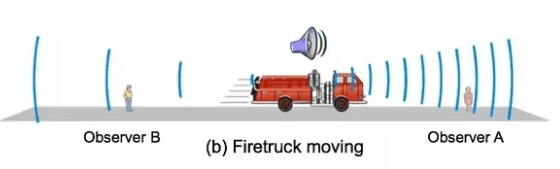
Look at the picture. Who is experiencing a higher pitched sound?
Observer A
Observer B
There's no difference
The pitch of a sound wave relates to the wave's _________________.
Amplitude
Frequency
Wavelength
Period
The mathematical equation of the first law of thermodynamics is __________________.
ΔU=W
ΔU=Q
ΔU=Q - W
The study of how thermal energy is transformed into another types of energy is _________________________.
Thermodynamics
Power
Temperature
The thermal energy entering the system from outside is called ________________.
Work
Heat
Power
What is thermal expansion?
The transfer of thermal energy between materials by the collisions of particles
Is a decrease in a materials volume when temperature decreases
An increase in a materials volume when temperature increases
When temperature increases, distance between molecules ______________.
decreases
increases
stays the same

Convert a 136 Degrees Fahrenheit to Degrees Celsius:
57.777 oC
330 K
57.5 oF
220 C
Convert 253 Degrees Celsius to Kelvin:
526.15 K
625 K
0 K
186 K
Convert 25.0 Degrees Celsius to Degrees Fahrenheit:
77 oF
77 oC
100 oF
100 oC
What is a heat engine?
device that make heat flow from low temperature to high temperature
device that use heat to produce work
device that make heat flow from cold to hot
device that use work to produce heat
Choose application of reversed heat engine
refrigerator
air conditioning
heat pump
all above
Compression is a key element of an internal combustion engine. Which engine component supplies the compression needed to power an engine?
Crankshaft
Ignition Armature
Connecting Rod
Piston
Which of the following is not an internal combustion engine
2-stroke petrol engine
steam turbine
4-stroke petrol engine
diesel engine
Why does the piston move up in the second stroke?
Because the crankshaft pushes it
Because the combustion chamber gets narrower
To compress particles and make explosion more powerful
Air-fuel mixture pushes it
What is a set of particles or interacting components that is considered a distinct physical entity called?
a. an engine
b. a system
c. an environment
d. an ideal gas
Which of the following are ways in which energy can be transferred to or from a substance?
a. heat and internal energy
b. work and internal energy
c. heat and work
d. heat and kinetic energy
The amount of matter in an object
Mass
Weight
Newton
Joules
As temperature reaches absolute zero, the entropy of a system approaches a constant minimum.
0th law
1st law
2nd law
3rd law
Specific Heat is..
the temperature initial minus temperature final
the amount of heat/energy required to raise 1 gram of a substance by 1°C (or K) aka "C"
the temperature final minus temperature initial
the item in a system with given weight in grams
When two bodies are in thermal equilibrium with a third body they are also in thermal equilibrium with
each other. This statement is called
(a) Zeroth law of thermodyamics
(b) First law of thermodynamics
(c) Second law of thermodynamics
(d) Kelvin Planck’s law.
A system is in thermodynamic equilibrium
if temperature and pressure at all points are same
if temperature and pressure at all points are not same
if temperature at all points are same
if pressure at all points are same
Energy cannot be created or destroyed.
0th law
1st law
2nd law
3rd law
The 2nd Law of Thermodynamics tells us...
Heat flows from cold to hot.
Heat flows randomly, it's a 50/50 coin flip
Heat doesn't flow, temperature flows.
Heat flows from hot to cold.

What is the definition of thermodynamics?
The energy available to do work.
The study of the relationship between heat, work, and energy.
The amount of heat it takes to move an engine.
The movement of heat.

