wayground logo

Free Printable Worksheets

Font size

S
M
L
XL
Worksheets

Unit 1 Matter Test

Total questions: 50

Worksheet time: 29mins

Name
Class
Date
1.
Fireworks having the ability to combust is a ______
a)
physical change
b)
Chemical change
c)
physical property
d)
chemical property
2.
______ have no definite shape, but has definite volume
a)
solid
b)
liquid
c)
gas
d)
plasma
3.
Tearing a sheet of paper is a ______.
a)
physical change
b)
chemical change
c)
physical property
d)
chemical property
4.

Matter is anything that has:

a)

mass

b)

volume

c)

mass and volume

d)

substance

5.

Mass is a measurement of:

a)

the amount of particles a substance has.

b)

the space an object occupies

6.

Volume is a measurement of:

a)

the amount of particles a substance has.

b)

the space an object occupies

7.

How would you find the mass of an object?

a)

Measure its dimensions with a ruler, and then multiply length x width x height

b)

Water displacement

c)

use a balance/scale

d)

use a timer

8.

How would you find the volume of an irregular shaped object?

a)

use a ruler to measure its dimensions

b)

water displacement

c)

use a balance/scale

d)

use a timer

9.

How could you determine if a golden penny is made of gold?

a)

You wouldn't be able to figure it out.

b)

If it looks like gold, it's gold.

c)

You would test the properties of the gold penny and compare those to the properties of gold.

d)

You would guess.

10.

What is the density of a liquid if its volume is 125 mL and its mass is 50 g?

a)

2.5 g/mL

b)

175 g/mL

c)

0.4 g/mL

d)

6250 g/mL

11.
True or False:  The density of a specific type of material never changes.  
a)
True
b)
False
12.
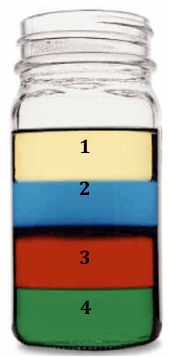
Put the liquids in order from most dense to least dense?
a)
4, 3, 2, 1
b)
1, 2, 3, 4
c)
3, 4, 2, 1, 
d)
4, 3, 1, 2
13.
Why does ice float?
a)
Liquid water is less dense than solid water.
b)
Solid water is less dense than liquid water.
c)
Gaseous water is less dense than solid water.
d)
Liquid water is less dense than gaseous water.
14.
What is the formula for density?
a)
density = mass x volume
b)
density = mass / volume
c)
density = mass + volume
d)
density = mass - volume
15.
Jack has a rock. The rock has a mass of 14 g and a volume of 2 cm3. What is the density of the rock?
a)
7 mL
b)
7 g/cm3
c)
28 g/cm3
d)
1/7 g/cm3
16.
_________________ is the study of the structure and properties of matter
a)
chemistry
b)
Christmas Tree
c)
biology
d)
physics
17.
What are the two types of mixtures? 
a)
element and sub-atomic
b)
atoms and compounds
c)
homogeneous and heterogeneous
d)
element
18.
How many classification of mixtures there are? 
a)
one
b)
two
c)
three
d)
four
19.
Is coffee a Homogeneous Mixture? 
a)
YES
b)
NO
20.
Type of mixture that has the SAME COMPOSITION in every part.
a)
Homogenous
b)
Heterogeneous
21.
Type of mixture that DOESN'T HAVE the same composition in every part.
a)
Homogeneous
b)
Heterogeneous
22.
Chocolate milk is an example of a
a)
homogeneous mixture
b)
heterogeneous mixture
23.
The _____is the part that gets dissolved. 
a)
solute 
b)
solvent 
c)
solution 
d)
Sacajawea 
24.
A solution is a kind of ________. 
a)
mixture 
b)
compound 
c)
element 
d)
stuff 
25.
A solution is a ________ mixture. 
a)
heterogeneous 
b)
homogeneous 
c)
dumb 
d)
mixed 
26.

Is this a physical or chemical change?

a)

Physical

b)

Chemical

27.

Which of the following observations would indicate a chemical change has happened? Select ALL correct answers.

a)

a solid precipitate forms

b)

heat energy is released

c)

breaks into smaller pieces

d)

folded in half

e)

a gas is produced

28.

Bubbles form when water boils. Is this evidence of chemical change?

a)

Yes, because water is changing.

b)

Yes, because the water is reacting.

c)

No, because the vapor is still water.

d)

No, because water doesn't react with anything.

29.

Every chemical change involves a transfer of ______.

a)

mass

b)

volume

c)

density

d)

energy

30.

This is an example of _____ change.

a)

Physical

b)

Chemical

31.

Wood is chopped into small pieces. Then, it is burned to cook food. This is an example of a ____ change followed by a ____ change.

a)

chemical, physical

b)

physical, chemical

c)

physical, physical

d)

chemical, chemical

32.

Which type of change is occurring in the picture?

a)

Chemical

b)

Physical

33.

True/False --- As this water freezes, the change in color means a chemical change has occurred.

a)

True

b)

False

34.

Safety goggles should only be used when working with

a)

an open flame

b)

chemicals

c)

using a mechanical device

d)

all the answers are correct

35.

Sandals are permitted during laboratory experiments.

a)

True

b)

False

36.

Three main rules when working with open flames

a)

tie back long hair

b)

wear gloves

c)

wear goggles

d)

secure loose clothing

37.

Using chipped glassware is permitted during the labs.

a)

True

b)

False

38.

Unused chemical should be returned to original containers.

a)

True

b)

False

39.

When is it appropriate to use the safety shower?

a)

Upon exposure to small amounts of chemicals

b)

If you are on fire

c)

large chemical spills

d)

only when directed by the teacher

40.

Always pour acid into water

a)

True

b)

False

41.

Wash your hands after handling all living organisms.

a)

True

b)

False

42.

If burned during the lab,

a)

Use the safety shower for 15 minutes

b)

rinse the area with cold water

c)

ignore it

d)

tell the teacher

43.

End of class procedures

a)

Turn off appliances, water and gas

b)

Return all materials to the appropriate place.

c)

Disposal of chemicals as directed by the teacher.

d)

Clean your area

e)

Wash your hands

44.
air is a 
a)
compound
b)
element
c)
heterogeneous mixture
d)
solution
45.
Blue Color: Chemical or Physical Property
a)
Chemical Property
b)
Physical Property
46.
Density: Chemical or Physical Property
a)
Chemical Property
b)
Physical Property
47.
Flammability (burns): Chemical or Physical Property
a)
Chemical Property
b)
Physical Property
48.
Solubility (dissolves): Chemical or Physical Property
a)
Chemical Property
b)
Physical Property
49.
Reacts with Acid: Chemical or Physical Property
a)
Chemical Property
b)
Physical Property
50.
Boiling Point: Chemical or Physical Property
a)
Chemical Property
b)
Physical Property