
Font size
 Worksheets
Revision for year 12 (module 7+8)
Total questions: 63
Worksheet time: 2hrs 6mins

What is the RMM of this compound?
56
31
29
55
The tall peak at 31 is representing which fragment?
CH2OH+
CH2CH3+
CH2CH2CH3+
What compound is present?
Ethanol
Propane
1-propanol
Ethane

What does the peak at 43 represent?
A methly fragment - CH3+
An ethyl fragment - C2H5+
A propyl fragment - C3H7+

The IR spectra of an unknown substance was taken and is shown above. The substance is most likely a(n)...
Ketone
Alcohol
Aldehyde
Ether

The above IR spectra could possibly contain which of the following functional groups?
An ester
A carboxylic acid
An alcohol
A nitrile
I. aldehydes
II. esters
III. ethers

How many HNMR signals in propane is
4
3
2
1

How many carbon environments?
1
2
3
4

How many carbon environments?2
1
2
4
6

How many carbon environments?
1
2
3
4

How many carbon environments?
2
3
4
5
A light blue precipitate formed when sodium hydroxide is added to an unknown solution indicates the presence of.....
barium
calcium
copper
iron(II)
A green precipitate formed when sodium hydroxide is added to an unknown solution indicates the presence of.....
iron(III)
calcium
copper
iron(II)
An orange-brown precipitate formed when sodium hydroxide is added to an unknown solution indicates the presence of.....
iron(III)
calcium
copper
iron(II)
Which metal produces a brick red flame?
barium
calcium
silver
lead
A yellow precipitate formed when an unknown solution is added to silver nitrate and nitric acid indicates the presence of which ion?
iodide
chloride
bromide
fluoride
Which ion turns red litmus paper blue?
chloride
sulfate
hydroxide
phosphate
A gas produced when nitric acid is added to an unknown solution indicates the presence of....
sulfate
carbonate
phosphate
nitrate
Silver nitrate and nitric acid are used to test for....
metal ions
noble gases
halide ions
metal oxides
What happens when you add ammonia solution to a substance that contains copper ions?
A light blue precipitate insoluble in excess
A dark blue precipitate forms which is soluble in excess
Ms Norman's head explodes
A light blue precipitate forms which dissolves in excess forming a dark blue solution
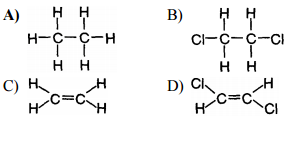


What functional group is found in the following molecule:
halide
hydroxide
carboxyl
amide
Which compound belongs to the alkene family?
C2H2
C2H4
C6H6
C6H14

A molecule of 2,3 dimethyl hexane would have how many TOTAL carbons?
6
7
8
9
Name this: (CH3)2CClCCl(CH3)2
2,3-dichloro-2,3-dimethybut-2-ene
3,4-dichlorohex-3-ene
3,4-dichlorohexane
2,3-dichloro-2,3-dimethylbutane
If an alkene reacts with a halogen (such as bromine), it is known as what type of reaction?
Addition
Condensation
Polymerisation
Hydrogenation
What is the term given to the process by which longer chain hydrocarbons are broken down into shorter length alkanes, alkenes, and possibly hydrogen?
fractional distillation
evaporation
cracking
polymerisation

What is the by product of this reaction?
HBr
H2
H2O
Light or heat is required for which step in the halogenation of alkane?
initiation
propagation
termination

What are the reagents required for the following reaction?
H2O, NaOH
H2O, H2SO4

What is the major product for the following reaction?


Which reactants you need to obtain the compound in the image?
butanoic acid and methanamine
butanoic acid and ammonia
butanal and methanamine
butanoic acid and methanol
Oxidate heptanal to obtain:
heptanone
heptanoic acid
heptanol
heptene

Oxidate the compund in the image
pentanal
pentanoic acid
Not possible
3-pentanol

What is the product of the reduction of the compund in the image
3-methyl butanol
3-methyl-3-butanol
3-methyl butanoic acid
3-methyl butanone
Halogenate 2-pentene with bromine, what is the product?
pentane
2,3-dibromopentane
3,3-dibromopentane
2,2-dibromopentane
What kind of alcohol is obtained from the reduction of a ketone?
primary
tertiary
secondary
not possible

Give name of the reaction based on this equation?
Dehydration
Hydration
Reaction with Na
Esterification
Esters are formed through what type of reaction?
hydrolysis
condensation
hydration
dehydration
A use for ester is...
fuel
additives in petrol
flavourings
hair dye

What is this compound called?
propyl ethanoate
ethyl ethanoate
ethyl propanoate
methyl ethanoate
A chain of repeating units (called monomers)
monomer
dimer
replicate
polymer
Once formed, it can be heated and reformed over and over again
thermoset
thermoplastic
elastomer
kevlar
Which of the following determine the properties of a polymer?
chemical nature of the monomer
length of the polymer chain
how the monomers are joined together
All of the above

What is the name of the addition polymer?
poly(bromoethane)
poly(bromoethene)
poly(bromoethanol)

What is the name of the addition polymer?
poly(ethene)
poly(propene)
poly(butene)

What is the name of the addition polymer?
poly(fluoroethene)
poly(difluoroethene)
poly(tetrafluoroethene)

Identify the type of polymer involved
addition polymer
polyester
polyamide

Identify the type of polymer involved
addition polymer
polyester
polyamide

Identify the polymer made from these monomer(s)


Identify the polymer made from these monomer(s)


The alkali sodium hydroxide is used in the following reaction
NaOH + palm oil → Soap + glycerol
alkylation
neutralisation
sulphonation
saponification
Which of the following materials is used to make detergents?
petroleum
natural gas
animal fats
vegetable oils

The structure of the detergent ion has a part similar to the soap ion. Which is the part?
A
B
C
D
Which of the following are soaps?


Diagram shows the structural formula of detergent molecule. Which of the following is correct about part Y?
hydrophylic
hydrophobic
very soluble in water
dissolves in organic materials

