
Font size
 Worksheets
Matter quiz
Total questions: 40
Worksheet time: 27mins

Is condensation endothermic or exothermic?

Is vaporization endothermic or exothermic?

Is freezing endothermic or exothermic?


Which two listed are examples of a physical change of matter?
Melting butter and a rotting banana.
Cutting paper and freezing water.
A rusting car and freezing water.
Burning paper and melting butter.
Which is an example of a chemical change?
Folding paper into a paper airplane.
Boiling water until it turns into vapor.
Baking a cake in the oven.
Blowing up a balloon with air.
Which describes the particles of matter in a solid?
The particles are moving quickly and are spread far apart.
The particles are sliding past one another inside their container.
The particles are vibrating in place and are tightly packed together.
The particles are bouncing off of one another and are spread far apart.
The particles of matter in a gas do not have a definite shape or ____?
volume.
mass.
density.
shape.
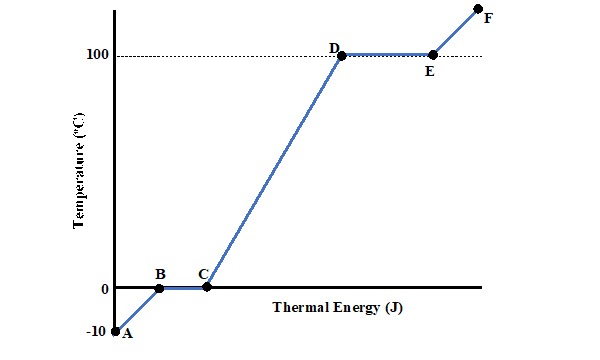
Between which two points is the gas condensing?
A <---- B
B <---- C
C <---- D
D <---- E
E <---- F


From point A to point E, the sample is going through an
exothermic process by releasing heat to the surroundings
exothermic process by absorbing heat from the surroundings
endothermic process by releasing heat to the surroundings
endothermic process by absorbing heat from the surroundings
What type of mixture would coffee be?
homogeneous
heterogeneous
What type of mixture would fruit salad be?
homogeneous
heterogeneous

Which contains a solid? (Choose all)
A
B
C
D

What type of change is this?
Chemical
Melting
Evaporation
Condensation
Sublimation

What type of change?
Chemical
Evaporation
Condensation
Sublimation
Melting
A type of mixture where the particles are larger than those in a solution but not heavy enough to settle out.
Homogeneous mixture
Colloid
Suspension
Compound

brass
solution
suspension
colloid
alloy
What is it called when light passes through a colloid and scatters/spreads out
tyndall effect
fog effect
spreading out effect
substance effect
________ are the starting substances in a chemical equation.
Reactants
Producer
Reaction
Products
The law of conservation of mass states that ________
the total mass of reactants is more than the total mass of products
the mass of a chemical reaction is not constant
the mass of a chemical reaction remains constant
the total mass of reactants is less than the total mass of products
Solve for the unknown mass: 6.1 g + ? g = 9.1 g
15.2
3 g
15.2 g
3

Put the types of mixtures in order based off of size particles (smallest to largest)
solution, colloid, suspension
suspension, colloid, solution
colloid, suspension, solution
solution, suspension, colloid
The tyndall effect can be seen in...
Suspension
Solution
Colloids
All of the above

