

wayground logo

Free Printable Worksheets

NEW

Font size

S
M
L
XL
Worksheets

Eco Unit II: Review Quiz

Total questions: 60

Worksheet time: 3hrs 23mins

Name
Class
Date
1.
The top layer of soil is called ________.
a)
bedrock
b)
topsoil
c)
subsoil
d)
grass
2.
This type of soil is best for plant growth. 
a)
rock
b)
sand
c)
loam
d)
clay
3.
The four types of soil are _____. 
a)
humus, gravel, pebbles, sand
b)
sand, silt, clay, loam
c)
sand, rock, pebbles, granite
d)
sand, clay, bedrock, topsoil
4.

Convection can take place in _________________.

a)

solids only

b)

liquids only

c)

liquids and gases only

d)

solids, liquids and gases

5.

Liquids and gases are together called ___________.

a)

Fluids

b)

Matter

c)

Solvent

d)

None of the above

6.
Heat transfers from an area of ____temperature to an area of ___ temperature.
a)
high to low
b)
low to high
c)
high to high
d)
It can travel high to low and low to high. 
7.
What is the definition of CONDUCTION?
a)
When heat is transferred from objects like rays of light or electromagnetically.
b)
a  hot liquid or air that  expands, becomes less dense, and rises or becomes more dense, and sinks.
c)
When heat transfers from objects that are touching.
d)
When heat transfers through the heater or AC in your house.
8.
Heat transfer by conduction occurs when...
a)
particles bump into each other
b)
large numbers of atoms move from place to place
c)
atoms give off heat in the form of electromagnetic waves
d)
electromagnetic waves travel from place to place through a vacuum
9.
What does a barometer do?
a)
measures air pressure
b)
measures temperature
c)
measures humidity
d)
measures length
10.
The weight of the atmosphere is ...
a)
temperature
b)
humidity
c)
air pressure
d)
weather
11.

How does air pressure change as you climb a mountain?

a)

it decreases (less air pressure)

b)

it increases (more air pressure)

c)

stays the same

d)

the temperature gets warmer

12.

What protects Earth from ultraviolet rays from the sun?

a)

ozone layer

b)

mesosphere

c)

air pressure

d)

troposphere

13.
In what layer would you find the ozone layer?
a)
troposphere
b)
stratosphere
c)
mesosphere
d)
thermosphere
14.
The Northern Lights occur in which layer?
a)
mesosphere
b)
exosphere
c)
thermosphere
d)
stratosphere
15.
What layer comes next:
Troposphere - 
stratosphere -
?????
a)
mesosphere
b)
exosphere
c)
thermosphere
d)
ionosphere
16.

What gas makes up the majority of the atmosphere?

a)

oxygen

b)

nitrogen

c)

water vapor

d)

carbon dioxide

17.
In what layer of the atmosphere would you find clouds and weather?
a)
troposphere
b)
stratosphere
c)
mesosphere
d)
thermosphere
18.

What is transpiration?

a)

Excess water being released from the aerial parts of plants in the form of water vapor

b)

Excess sugar being released from the leave

c)

The way a plant makes its food

d)

When the plant uses sugar for energy

19.

Evaporation is the change of state from ___________ to __________

a)

liquid to gas

b)

solid to liquid

c)

gas to liquid

20.

What is infiltration?

a)

The process by which water sinks into the ground

b)

The zone where there are still air spaces left between the particles.

c)

The process by which water vapor turns into liquid water and forms fog or clouds.

d)

The process by which water does not sink into the ground, but rather travels along the surface.
21.

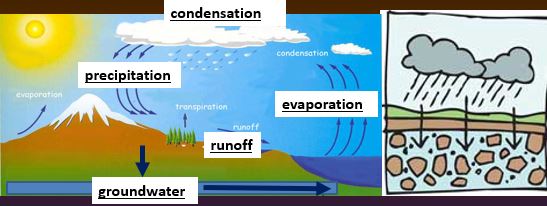
Water that is found underground in the cracks and spaces in soil, sand and rock is called:

a)

Groundwater

b)

River

c)

Surface water

d)

Snow

22.
An area of permeable layer of rock or soil that holds a large amount of water in the saturated zone is called what?
a)
Aquifer
b)
Spring
c)
Well
d)
Reservoir
23.

40 % Sand

50% Silt

10% Clay

a)

Clay

b)

Clay Loam

c)

Silt Loam

d)

Sandy Loam

24.

70 % Sand

15% Silt

15% Clay

a)

Sandy Loam

b)

Clay

c)

Silt Loam

d)

Clay Loam

25.

35 % Sand

15% Silt

50% Clay

a)

Clay Loam

b)

Sandy Loam

c)

Silt Loam

d)

Clay

26.

20 % Sand

60% Silt

20% Clay

a)

Sandy Loam

b)

Silt Loam

c)

Clay Loam

d)

Clay

27.

30 % Sand

40% Silt

30% Clay

a)

Clay

b)

Sandy Loam

c)

Clay Loam

d)

Silt Loam

28.

What is the Texture for Silt Based on the Texture: SILTY CLAY:


5% SAND

50% CLAY

a)

45%

b)

38%

c)

36%

d)

55%

29.

What is the Texture for CLAY Based on the Texture: Clay Loam


27% SAND

35% SILT

a)

33%

b)

45%

c)

38%

d)

55%

30.

What is the Texture for CLAY Based on the Texture: Clay


22% SAND

23% SILT

a)

7%

b)

38%

c)

83%

d)

55%

31.

What is the Texture for Silt Based on the Texture: SILT


10% SAND

7% CLAY

a)

45%

b)

83%

c)

55%

d)

5%

32.

What is the Texture for SAND Based on the Texture: Sandy Clay Loam:


21% SILT

27% CLAY

a)

7%

b)

40%

c)

21%

d)

52%

33.
This is determined by the relative proportions of particle sizes that make up the soil. Names for this include, loam, sandy clay, or other descriptive terms.
a)
Soil Permeability
b)
Soil pH
c)
Soil Profile
d)
Soil Texture
34.
The ___________________ the grain size, the faster the water will move through the soil.
a)
more mixed
b)
smaller
c)
larger
35.
Sand sediments are usually more permeable than silt sediments because sand grains are...
a)
larger
b)
smoother
c)
rounder
d)
more soluble
36.
Which diagram represents the soil with the greatest permeability?
a)
Choice 1
b)
Choice 2
c)
Choice 3
d)
Choice 4
37.

The amount of space between sediment is called ...

a)

permeability

b)

porosity

c)

evaporation

d)

condensation

38.

If water can easily move between cracks of a rock, we can say that...

a)

water is permeable

b)

rock is permeable

c)

rock is impermeable

d)

water is impermeable

39.
A sponge has high porosity.  A rock can have it too.  Porosity is...
a)
the inability to hold water
b)
the ability to hold water
c)
allowing water to pass through
40.
An area of permeable layer of rock or soil that holds a large amount of water in the saturated zone is called what?
a)
Aquifer
b)
Spring
c)
Well
d)
Reservoir
41.
A hole dug or drilled into the ground to provide a supply of water.
a)
watershed
b)
desalination
c)
groundwater
d)
well
42.

How many states in the USA share the Ogallala?

a)

5

b)

6

c)

7

d)

8

43.

Is water renewable or non-renewable?

a)

Renewable

b)

Non-renewable

44.

Is water in the Ogallala renewable or non-renewable?

a)

Renewable

b)

Non- renewable

45.

Soil formation begins with the weathering of_______.

a)

Humas

b)

Subsoil

c)

Litter

d)

Bedock

46.
Which of the following shows where soil formation happens at a faster rate?
a)
Cold, dry climate
b)
Steep Slopes
c)
Valleys and Flat Areas
d)
Few animals and plants are present
47.
What is the movement of soil from one place to another?
a)
weathering
b)
deposition
c)
discharge
d)
erosion
48.
Humus is.....
a)
the dead parts of plants and animals in soil.
b)
A food we eat with pretzels.
c)
The tiny particles inside of soil
d)
The roots that come off of a plant and live in soil.
49.
Decayed organic material turns into dark colored material called __.
a)
litter
b)
clay
c)
humus
d)
soil
50.
Weathering occurs fastest in
a)
cold, dry climates
b)
cold, wet climates
c)
hot, dry climates
d)
hot, wet climates
51.
Earthworms, moles and other animals help soil formation by:
a)
Breaking rock down
b)
Mixing and loosening soil by burrowing 
c)
Draining the water from soil
d)
Eating soil
52.

You have just analyzed a 100 g soil sample. You have organized your findings in the data table. Which two materials make up at least 50 percent of the composition of your soil sample?

a)

air and silt

b)

silt and sand

c)

air and water

d)

clay and organic matter

53.
Hurricane season goes from ______ 1st to _______ 30th
a)
June, October
b)
April, September
c)
June, November
d)
May, October
54.
A tropical storm becomes a hurricane when its winds exceed 
a)
100
b)
156
c)
73
d)
131
55.
A _____________ is moving in, so this must be a ____________ front.
a)
thunderstorm, warm
b)
bank of high wispy clouds, warm
c)
tornado, occluded
d)
thunderstorm, cold
56.
Which front is this?
a)
Warm front
b)
Cold front
c)
Occluded front
d)
Stationary front
57.
Which front is this?
a)
Warm front
b)
Cold front
c)
Occluded front
d)
Stationary Front
58.
What does the Enhanced Fujita (EF) scale measure?
a)
Tornado wind speed
b)
Width of tornado vortex
c)
Height of vortex
d)
Damage caused
59.

Which is/are true about a storm surge?

a)

It is the rising of seawater level during a storm.

b)

It produces waves of up to a maximum of 1 meter.

c)

It develops from undersea disturbances.

60.

The name of the scale used to describe hurricanes.

a)

saffir-simpson

b)

seismograph

c)

telegraph

d)

richter scale
